Alpheratz, Alpha Andromedae (α And), is a spectroscopic binary star located at a distance of 97 light years in the constellation of Andromeda. The bright double star marks Andromeda’s head. With a combined apparent magnitude of 2.06, it shares the title of Andromeda’s brightest star with the variable red giant Mirach (Beta Andromedae).
Alpheratz is one of the four bright stars that form the Great Square of Pegasus, a conspicuous asterism that dominates the night sky throughout the northern hemisphere autumn. The asterism outlines the body of the mythical flying horse represented by the neighbouring constellation Pegasus.
Star system
Alpha Andromedae appears as a single star to the unaided eye and in telescopes. However, it is in fact a spectroscopic binary system composed of two stars in close orbit. The system was long listed as a single-lined spectroscopic binary star (SB1), one in which the spectrum of only one component is visible. Now that it has been resolved, Alpha Andromedae is classified as a double-lined spectroscopic binary star (SB2), one showing alternately double and single spectral lines.
The Alpheratz system consists of an evolved blue star of the spectral type B8IV-VHgMn and a white main sequence star with the stellar classification A7V. The two stars complete an orbit every 96.69 days. They are separated by 23.917 ± 0.127 milliarcseconds on the sky, corresponding to a physical distance of 0.7146 ± 0.0327 astronomical units (Earth – Sun distances).
Alpha Andromedae A, the primary component, is formally named Alpheratz. With an apparent magnitude of 2.22, it is slightly fainter than Mirach (Beta Andromedae) and just outshines Almach (Gamma Andromedae), Andromeda’s third brightest star.
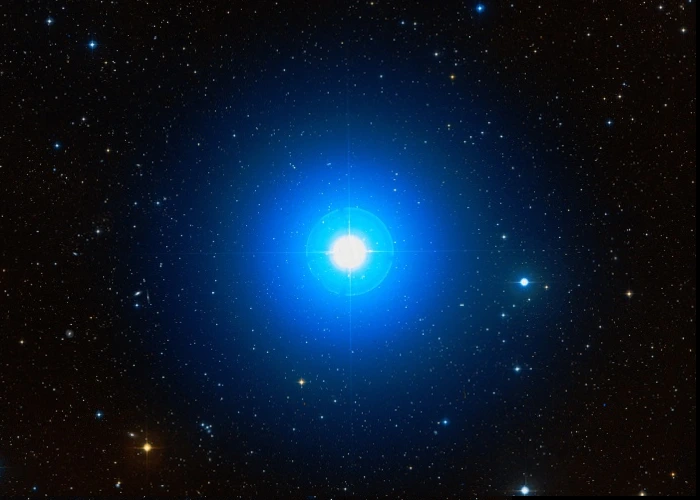
Alpheratz (Alpha Andromedae), image credit: ESO/Digitized Sky Survey 2 (CC BY 4.0)
Alpheratz is an evolved star with the spectral class B8IV-VHgMn, indicating a luminous blue star that is coming to the end of its main sequence lifetime and evolving into a subgiant. The suffix “HgMn” indicates an overabundance of mercury (Hg) and manganese (Mn) in the star’s spectrum.
Alpheratz has 3.63 times the Sun’s mass and a radius around 2.94 times that of the Sun. With an effective temperature of 11,950 K, it is around 158 times more luminous than the Sun. The star has an estimated age of around 200 million years. It was previously believed to be only 60 million years old.
The star spins with a projected rotational velocity of 53 km/s, taking 2.38 days to complete a rotation. It is moving towards the Sun with a radial velocity of −10.6 ± 0.3 km/s.
Alpheratz is the brightest mercury-manganese star in the sky. The star’s atmosphere has an excess of mercury, manganese, gallium, xenon, and other elements.
Mercury-manganese stars are typically slow rotators and have the stellar classification B8, B9 or A0. The elemental abundances are believed to be a result of radiative diffusion, as suggested by Georges Michaud in 1970. The theory proposed that, because the stars have very calm atmospheres, some elements sink due to gravitational settling, resulting in underabundances, while others are pushed to the surface by radiation pressure, which leads to overabundances.
Other bright mercury-manganese stars include Maia (20 Tauri), one of the brightest stars in the Pleiades cluster in Taurus, Gienah (Gamma Corvi), the brightest star in the constellation Corvus, Dabih (Beta Capricorni), the second brightest star in Capricornus, and Muliphein (Gamma Canis Majoris) in Canis Major.
The Simbad database lists Alpha Andromedae A as an Alpha2 Canum Venaticorum variable, a magnetic, chemically peculiar star whose brightness varies because of an uneven distribution of chemical elements in its atmosphere. The variations are caused by spots that come in and out of view as the star rotates.
The companion, Alpha Andromedae B, has an apparent visual magnitude of 4.21. If it were a single star, it would be visible to the unaided eye but considerably fainter than Alpheratz.
Alpha Andromedae B has the stellar classification A7V, indicating a white main sequence star. The spectral type is estimated based on the star’s brightness relative to the primary component.
The star has a mass of 1.875 solar masses and a radius 2.03 times that of the Sun. With a surface temperature of 7,935 K, it shines with 14.79 solar luminosities. The star is a fast spinner, with a projected rotational velocity of about 110 km/s. Estimates of its age range from 70 million years to a more recent value of 447 million years.
The binary system has a visual companion, a class G5 star designated as ADS 94 B in the Aitken Double Star Catalogue and as WDS 00084+2905B in the Washington Double Star Catalog. The optical companion was discovered by William Herschel on July 21, 1781. It has a visual magnitude of 10.8. However, it is not physically related to the Alpha Andromedae system. It lies at a much greater distance (1,360 light years).
Facts
With an apparent magnitude of 2.06, Alpheratz is, on average, the 54th brightest star in the night sky. It is only slightly fainter than Hamal in the constellation Aries, Diphda in Cetus, and Nunki in Sagittarius. It is about as bright as its Andromeda neighbour Mirach and Menkent in Centaurus, and it just outshines Saiph in Orion, Kochab in Ursa Minor, Rasalhague in Ophiuchus, and Tiaki in Grus.
Before the modern constellation boundaries were defined in 1930, Alpheratz was considered to be part of both Andromeda and Pegasus. Around 270 BCE, the Greek poet Aratus designated the star as xunos aster, “joint star,” i.e. shared by Andromeda and Pegasus. The 2nd century CE Greek astronomer Ptolemy also considered Alpheratz to be shared by the two constellations. The German astronomer Johann Bayer (1572 – 1625) assigned it two Greek letter designations: Alpha Andromedae and Delta Pegasi.
Alpheratz kept its Pegasus membership into the 20th century, when the designation Delta Pegasi finally fell into disuse. Once the constellation boundaries were set, the star was assigned only to Andromeda. A similar thing happened to Elnath, which once belonged both to Taurus and Auriga and had the Bayer designations Beta Tauri and Gamma Aurigae. Even though it now belongs only to Taurus, the star is easily recognizable mainly because it is part of Auriga’s conspicuous hexagon asterism. In Taurus, it marks the Bull’s northern horn.
Alpheratz forms the Great Square of Pegasus with three bright Pegasus stars: Algenib (Gamma Pegasi), Scheat (Beta Pegasi), and Markab (Alpha Pegasi). The asterism dominates the eastern part of the constellation Pegasus and makes it easy to find a number of notable stars and deep sky objects. These include the bright spiral galaxy NGC 7331 with the Deer Lick Group and the famous Stephan’s Quintet, a striking visual grouping of five galaxies.
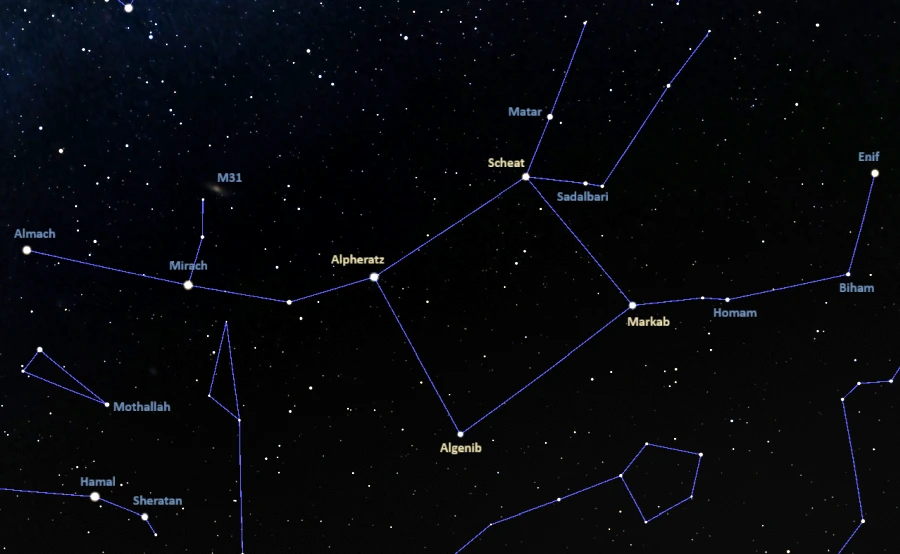
Great Square of Pegasus, image: Stellarium
Alpheratz is the brightest of the four stars of the Great Square, mainly because the other three stars lie at greater distances. It has a similar intrinsic luminosity to the fellow subgiant Markab (165 L☉), which lies approximately 133 ly away, but does not compare to the red giant Scheat (1,644 L☉), located 196 ly away, and the hot blue supernova candidate Algenib (6,000 L☉), located at a distance of 470 ly.
Alpheratz and Mirach (Beta Andromedae) have almost the same apparent magnitude. Since different sources provide slightly different values, both stars have been called Andromeda’s brightest star. Mirach is a red giant whose brightness varies from magnitude 2.01 to 2.10, so on average it is slightly brighter, but not constantly so. It lies at a much greater distance of 197 light years (100 light years farther away than Alpheratz) and is much more intrinsically luminous. It has a luminosity 1,675 times that of the Sun, while Alpheratz shines with 158 solar luminosities.
Alpheratz is one of the 58 stars that have a special status in the field of celestial navigation. Navigational stars are some of the brightest and best-known stars in the sky. They span 38 constellations and have been selected both because they are exceptionally bright and because they are easy to identify. Alpheratz is recognizable because it is part of the Great Square of Pegasus. It is the only navigational star in Andromeda. Markab, Alpha Pegasi, which lies on the opposite side of the Great Square, is also included on the list.
Alpheratz, Algenib (Gamma Pegasi) and Caph (Beta Cassiopeiae), the rightmost star of Cassiopeia’s W, are known as the Three Guides. The three stars mark the equinoctial colure, the prime meridian of the celestial sphere that passes through the north and south celestial poles and the two equinoxes (vernal and autumnal).
Variations in the radial velocity of Alpha Andromedae were discovered by the American astronomer Vesto Slipher at the turn of the 20th century. Slipher measured the star’s radial velocity with the Lowell spectrograph from 1902 to 1904. He concluded that Alpheratz was a spectroscopic binary system with a highly eccentric orbit and that the components completed an orbit every 100 days or so. The German astronomer Hans Ludendorff gave a preliminary orbit in 1907, and the American astronomer Robert Horace Baker published a more accurate orbit for the system in 1910.
Alpha Andromedae B was first resolved interferometrically by a team led by Xiaopei Pan, an astronomer at the California Institute of Technology (Caltech), in 1988. The team used the Mark III Stellar Interferometer at the Mount Wilson Observatory in California and determined all orbital parameters for the system. They published their work in January 1992.
The spectral lines of the companion were seen in the early 1990s in high-resolution CCD observations made between 1991 and 1994. The results were published in 1995.
Unusual lines in the spectrum of Alpha Andromedae were first reported by British astronomers Norman Lockyer and F. E. Baxandall in 1906. Baxandall identified them as enhanced manganese lines in 1914, noting that Mu Leporis in the constellation Lepus showed similar lines.
In 1931, American astronomer William Wilson Morgan reported 12 other stars with an excess of manganese in their spectra. In 1975, C. R. Cowley and G. C. L. Aikman identified the stars as part of the group of mercury-manganese stars.
In 1973, Alpheratz was reported to show slight variations in brightness with a period of 0.9636 days, but UVBY photometric observations in the early 1990s found that the star was not a photometric variable.
Observations made between 1993 and 1999 revealed that the mercury line in the star’s spectrum at 398.4 nm varies as the star rotates because the distribution of mercury in the star’s atmosphere is not even. The study, published in 2002, found higher concentrations of mercury near the equator. Subsequent observations, published in 2007, confirmed the variability of the mercury line on a time scale of about 2.38 days and revealed that the clouds of mercury slowly drifted over the star’s surface.
Name
The name Alpheratz (pronunciation: /ælˈfɪəræts/) comes from the Arabic surrat al-faras, meaning “the navel of the horse.” The star’s other traditional name, Sirrah (pronunciation: /ˈsɪrə/), is derived from the same phrase. The names refer to the star’s position in Pegasus, where it marked the horse’s navel.
In medieval Arabic astronomy, Alpheratz was also known as Al Ras al Mar’ah al Musalsalah, meaning “the head of the chained woman.” The name is a reference to the star’s placement in Andromeda. The Andromeda constellation represents the princess in Greek mythology who was chained to a rock and left to the sea monster (Cetus) before being rescued by Perseus.
The International Astronomical Union’s (IAU) Working Group on Star Names (WGSN) approved the name Alpheratz on June 30, 2016. The name formally applies only to the brighter component of the Alpha Andromedae system.
In traditional Chinese astronomy, Alpha Andromedae was known as 壁宿二 (Bì Sù èr), the Second Star of Wall. It formed the Wall asterism with Algenib (Gamma Pegasi). The asterism was part of the larger Wall mansion, one of the seven mansions of the Black Tortoise.
In Hindu astrology, Alpheratz and Algenib form the 26th nakshatra (lunar mansion), known as Uttara Bhādrapadā or Uttṛṭṭāti.
Location
Alpheratz is very easy to find because it is part of a prominent northern asterism. The Great Square of Pegasus can be found using the bright stars that form Cassiopeia’s W. A line extended from Segin, Epsilon Cassiopeiae, through Ruchbah, Delta Cassiopeiae, points in the direction of the asterism.
Alpheratz marks the northeastern vertex of the Great Square, appearing in the upper left corner. It is the first in a chain of three stars between Pegasus and Perseus that makes the constellation Andromeda easy to recognize. The middle star in the chain, Mirach (Beta Andromedae) is particularly well-known to stargazers because it is commonly used to find the Milky Way’s largest neighbours: the Andromeda Galaxy (Messier 31) and the Triangulum Galaxy (Messier 33). Almach, the third star in the chain, makes it easy to identify Algol, the famous variable star located in the neighbouring Perseus constellation.
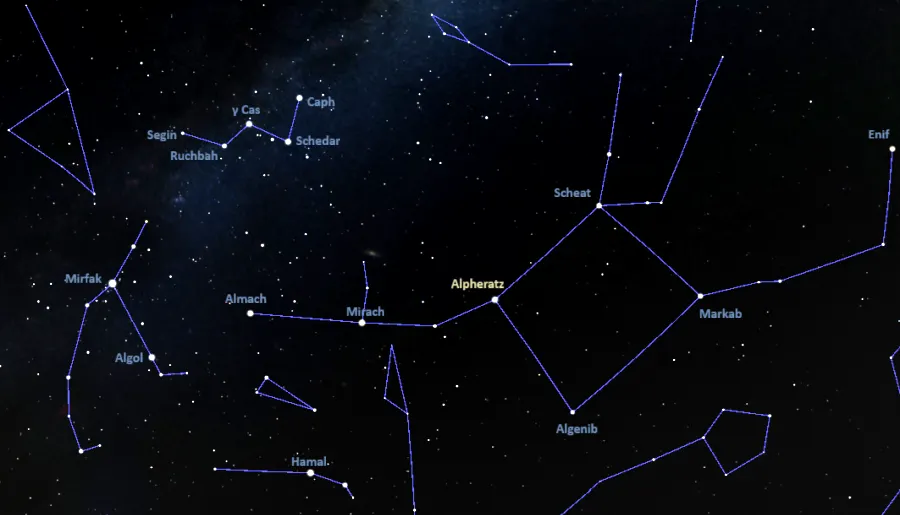
Location of Alpheratz (Alpha Andromedae), image: Stellarium
There are several faint deep sky objects that appear in the vicinity of Alpheratz. The NGC 68 Group of galaxies, also known as Arp 113, is a cluster of at least 40 galaxies about 300 million light years away. The brightest galaxies in the group form a small triangle. The central member, NGC 68, is a lenticular galaxy with an apparent magnitude of 12.9.
The spiral galaxies NGC 1 and NGC 2, the first objects logged in the New General Catalogue, appear close in the sky but are unrelated. The brighter NGC 1 (mag. 13.65) lies at a distance of 185 million light years, while NGC 2 (mag. 15.0) lies 345 million light years away. The lenticular galaxy NGC 16 (mag. 13.0) and spiral galaxy NGC 22 (mag. 14.4) appear in the same field of view.
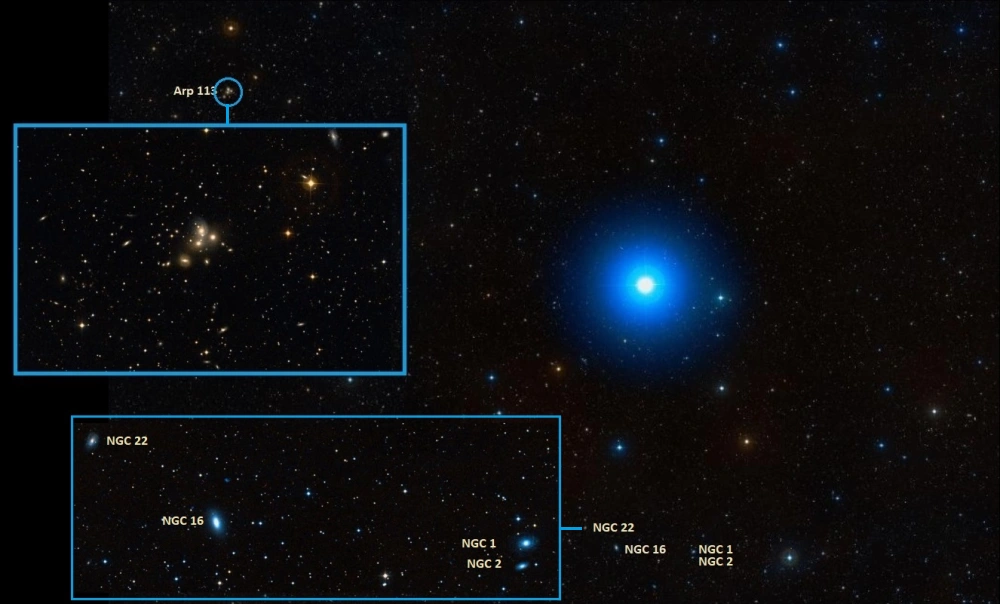
Alpheratz, Arp 113, NGC 1, NGC 2, NGC 16 and NGC 22, image credit: ESO/Digitized Sky Survey 2 (CC BY 4.0)
At declination +29°, Alpheratz can be seen from all locations north of the latitude 60° S. For northern observers, it is particularly prominent in the sky in the evenings from August to October. The star reaches its highest point in the sky at midnight around October 9.
Constellation
Alpheratz is located in the constellation Andromeda. Representing the mythical princess Andromeda, the daughter of Cassiopeia and Cepheus and wife of Perseus, Andromeda is the 19th largest constellation in the sky. It occupies an area of 722 square degrees between the constellations Perseus, Cassiopeia, Lacerta, Pegasus, Triangulum and Pisces. It is one of the Greek constellations, first listed by the Greek astronomer Ptolemy in the 2nd century CE.
Andromeda is best-known for being home to the Andromeda Galaxy (Messier 31), the nearest large galaxy to the Milky Way, with which it will eventually merge. Other notable deep sky objects in the constellation include Andromeda’s smaller satellites Messier 32 and Messier 110, the spiral galaxy NGC 891 (the Silver Sliver Galaxy), the Rose Galaxy (Arp 273), the planetary nebula NGC 7662 (the Blue Snowball Nebula), and the bright open star clusters NGC 752 and NGC 7686.
Bright stars in Andromeda include the red giant Mirach (Beta Andromedae), the orange bright giant Almach (Gamma Andromedae), the multiple star systems Delta Andromedae and Omicron Andromedae (Alfarasalkamil), the orange giant Nembus (51 Andromedae), the G-type subgiant Lambda Andromedae (Udkadua), and the binary stars Shimu (Zeta Andromedae) and Mu Andromedae.
Andromeda is also home to the nearby red dwarfs Ross 248 and Groombridge 34, the yellow-white dwarf Titawin (Upsilon Andromedae A) with three orbiting exoplanets, the S-type star R Andromedae, the yellow giants Eta Andromedae (Kui) and Epsilon Andromedae, and the yellow supergiant Psi Andromedae.
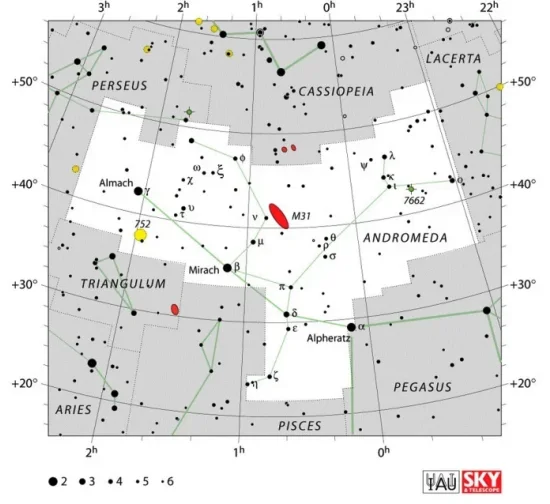
Andromeda constellation map by IAU and Sky&Telescope magazine (Roger Sinnott & Rick Fienberg) (CC BY 3.0)
The best time of the year to observe the stars and deep sky objects of Andromeda is during the month of November, when the constellation appears higher above the horizon in the early evening. The entire constellation can be seen from locations north of the latitude 40° S.
The 10 brightest stars in Andromeda are Mirach (Beta And, mag. 2.05), Alpheratz (Alpha And, mag. 2.06), Almach (Gamma And, mag. 2.10), Delta Andromedae (mag. 3.28), Nembus (51 And, mag. 3.57), Alfarasalkamil (Omicron And, mag. 3.62), Udkadua (Lambda And, mag. 3.8), Mu Andromedae (mag. 3.87), Shimu (Zeta And, mag. 4.08), and Titawin (Upsilon And, mag. 4.10).
Alpheratz – Alpha Andromedae
| Spectral class | B8IV-VHgMn + A7V |
| U-B colour index | −0.46 |
| B-V colour index | −0.11 |
| R-I colour index | −0.10 |
| Apparent magnitude | 2.06 (2.22 + 4.21) |
| Constellation | Andromeda |
| Right ascension | 00h 08m 23.25988s |
| Declination | +29° 05′ 25.5520″ |
| Names and designations | Alpheratz, Sirrah, Alpha Andromedae, Alpha And, α Andromedae, α And, Delta Pegasi, Delta Peg, δ Pegasi, δ Peg, 21 Andromedae, 21 And, HD 358, HR 15, HIP 677, SAO 73765, BD+28°4, AG+28 11, JP11 345, GC 127, GCRV 62, FK5 1, PPM 89441, SKY# 244, ALS 16723, HGAM 2, H 5 32A, LTT 10039, NLTT 346, PLX 12.00, PMC 90-93 1, GEN# +1.00000358, GSC 01735-03180, LSPM J0008+2905, ASCC 647497, CSI+28 4 1, IRC +30004, SRS 30001, AKARI-IRC-V1 J0008233+290524, MKT 11, JNN 1A, EUVE J0008+29.0, N30 16, UBV 52, UBV M 7157, TD1 31, TIC 427733653, UCAC3 239-808, USNO-B1.0 1190-00002295, WEB 113, uvby98 100000358, IRAS 00057+2848, 2MASS J00082326+2905253, TYC 1735-3180-1, YPAC 1, Renson 50, SBC7 4, SBC9 4, ADS 94 A, CCDM J00083+2905A, IDS 00032+2832 A, WDS 00084+2905A, WDS J00084+2905Aa,Ab, 2MASS J00082326+2905253 |
Alpha Andromedae A
| Spectral class | B8IV-VHgMn |
| Apparent magnitude | 2.22 |
| Absolute magnitude | −0.193 |
| Distance | 97 ± 1 light years (29.7 ± 0.3 parsecs) |
| Parallax | 33.62 ± 0.35 mas |
| Radial velocity | −10.6 ± 0.3 km/s |
| Proper motion | RA: 135.68 mas/yr |
| Dec.: −162.95 mas/yr | |
| Mass | 3.63 ± 0.201 M☉ |
| Luminosity | 158 L☉ (125 – 199 L☉) |
| Radius | 2.94 ± 0.34 R☉ |
| Temperature | 11,950 K |
| Metallicity | 0.2 |
| Age | 60 million years; 200 million years (126 – 317 Myr) |
| Rotational velocity | 53 km/s |
| Rotation | 2.38195 days |
| Surface gravity | 3.75 cgs |
Alpha Andromedae B
| Spectral class | A7V |
| Apparent magnitude | 4.21 |
| Absolute magnitude | 1.797 |
| Mass | 1.875 ± 0.096 M☉ |
| Luminosity | 14.79 L☉ (11.75 – 18.62 L☉) |
| Radius | 2.03 ± 0.23 R☉ |
| Temperature | 7,935 K |
| Metallicity | 0.2 |
| Age | 70 million years; 447 million years (317 – 641 Myr) |
| Rotational velocity | 110 ± 5 km/s |
| Surface gravity | 4.0 cgs |