Beta Lupi (β Lup) is a massive blue star located approximately 383 light years away in the southern constellation of Lupus. Shining at magnitude 2.68, it is the second brightest star in the constellation, after Uridim (Alpha Lupi). It may be massive enough to end its life as a luminous supernova.
What type of star is Beta Lupi?
Beta Lupi presents as a blue subgiant of the spectral type B2IV. Earlier studies classified it as a blue giant with the spectral class B2 III. Astronomers believe that, despite appearances, the massive star is still fusing hydrogen into helium in its core. Beta Lupi has an effective temperature of 24,090 K and is 10,000 times more luminous than the Sun. It has an estimated age of only 25 million years.
Even though it is still a very young star, Beta Lupi has almost burned through its supply of hydrogen and is coming to the end of its main sequence lifetime. Like all massive stars, it will have a short life, measured in millions rather than billions of years.
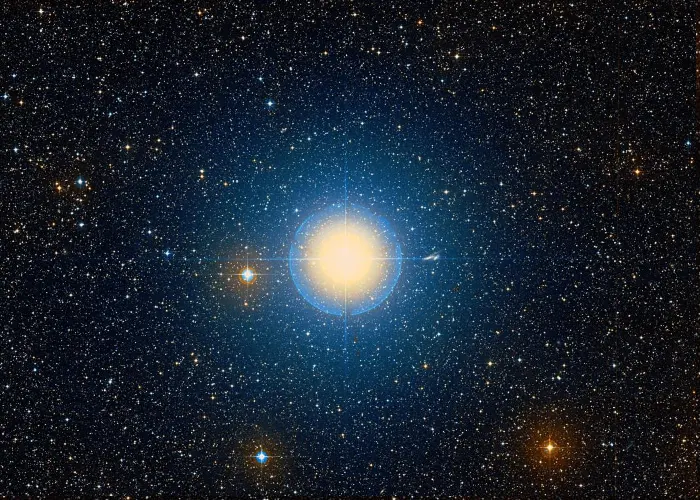
Beta Lupi, image credit: ESO/Digitized Sky Survey 2 (CC BY 4.0)
Mass and radius
Beta Lupi has a mass of 8.8 solar masses and a radius 6.6 times that of the Sun. It is slightly smaller and less massive than its Lupus neighbour Uridim (Alpha Lupi, B1.5 III), and the brighter Hadar (B1 III) in the constellation Centaurus, Adhara (B2 III-II) in Canis Major, and Mimosa (B0.5 III) in Crux.
Beta Lupi has similar properties to Bellatrix (B2 III) in Orion, but it is slightly larger, hotter and more luminous. Bellatrix has a mass of 8.6 solar masses, and radius of 6.4 solar radii, and a surface temperature of 22,017 K. It has an estimated age of 25.2 million years. Shining at magnitude 1.64, it is more than a magnitude brighter than Beta Lupi because it lies much closer to us, at a distance of 250 light years.
The future evolution of Beta Lupi
Beta Lupi will next evolve into a red supergiant. Once it exhausts the helium in its core, it will start to fuse carbon.
With a mass of 8.8 solar masses, the star’s end state is uncertain. Beta Lupi may be massive enough to end its life as a type II supernova, or it may instead expel its outer layers to form a planetary nebula and slowly fade as a dim neon white dwarf.
Related articles:
Life Cycle of Intermediate-Mass Stars
Member of the Scorpius-Centaurus association
Beta Lupi is a member of the Upper Centaurus-Lupus subgroup of the larger Scorpius-Centaurus OB association, the nearest family of massive, luminous O- and B-type stars to the Sun. These stars formed in the same stellar nursery at around the same time and have similar properties. The brightest members of Sco OB2 include the Scorpius luminaries Antares, Dschubba and Acrab, the Crux stars Acrux, Mimosa and Imai, and the Centaurus stars Hadar, Epsilon and Delta Centauri.
The Upper Centaurus-Lupus association contains many bright stars in this region of the sky, including Alpha Lupi, Gamma Lupi, Eta Centauri, Kappa Centauri, Delta Lupi, and Epsilon Lupi. All these are B-type stars much more massive and intrinsically luminous than the Sun.
Beta Cephei variability
Like the brighter Alpha Lupi, Beta Lupi is classified as a Beta Cephei variable. Beta Cephei stars show small, rapid variations in brightness due to pulsations. The pulsations are linked to the properties or iron at temperatures of around 200,000 kelvin in the stellar interiors. Beta Lupi has a dominant oscillation period of 0.232 days.
Also known as Beta Canis Majoris stars, these variables are typically hot blue B-type stars with masses of more than 7 solar masses. The brightest examples include Hadar and Epsilon Centauri in the constellation Centaurus, Spica in Virgo, Mimosa and Imai in Crux, Shaula, Alniyat and Kappa Scorpii in Scorpius, Algenib in Pegasus, Uridim in Lupus, Epsilon Persei (Áldu) in Perseus, Alpha Muscae in Musca, and the class prototypes Mirzam (Beta Canis Majoris) in Canis Major and Alfirk (Beta Cephei) in Cepheus.
Name
Beta Lupi does not have an official proper name formally approved by the International Astronomical Union (IAU).
The star has been called Ke Kwan or Kekouan. The names come from the name of a Chinese asterism known as 騎官 (Qí Guān), meaning Imperial Guards. In traditional Chinese astronomy, Beta Lupi is known as 騎官四 (Qí Guān sì), the Fourth Star of Imperial Guards. It forms the Imperial Guards asterism with Gamma Lupi, Delta Lupi, Kappa Centauri, Lambda Lupi, Epsilon Lupi, Mu Lupi, Pi Lupi, Omicron Lupi, and Uridim (Alpha Lupi). The asterism is part of the larger Root mansion, which corresponds to the chest of the Azure Dragon in Chinese lore.
Where is Beta Lupi in the sky?
Beta Lupi appears in a relatively bright portion of the night sky between the constellations Scorpius and Centaurus. It appears north of Alpha Centauri (Rigil Kentaurus), very close to the fainter Kappa Centauri. The supernova remnant SN 1006 lies 1.3 degrees north-northeast of the star.
At declination -43, Beta Lupi never appears above the horizon for observers north of the latitude 47° N and never rises very high in the sky for locations in the mid-northern latitudes.
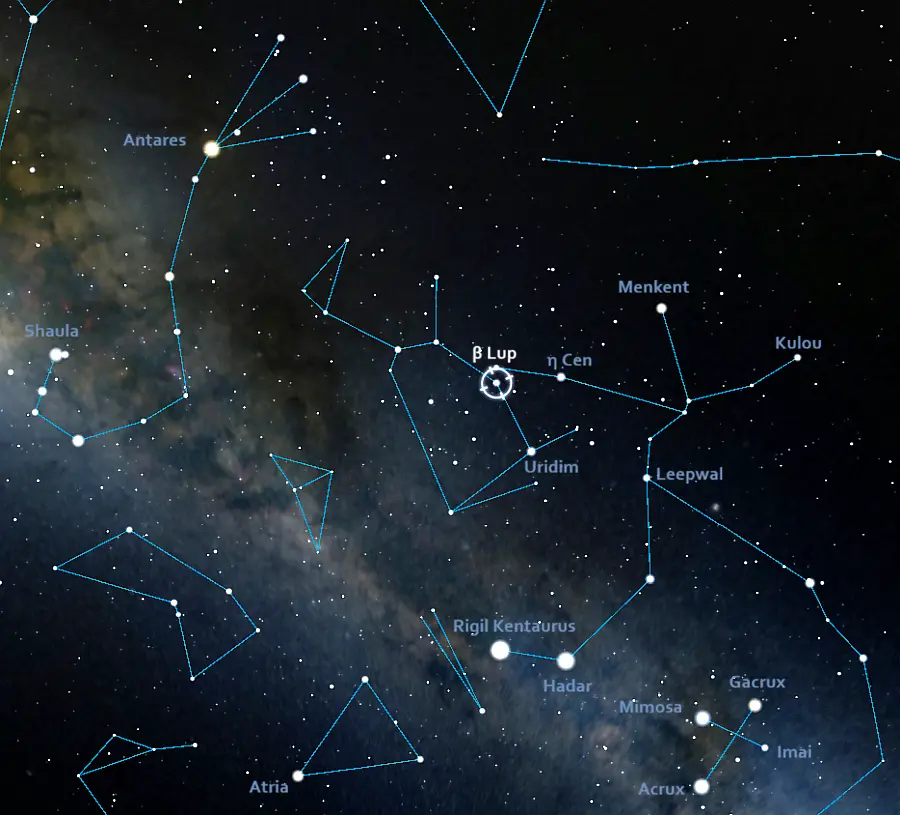
Beta Lupi location, image: Stellarium (annotated for this site)
Constellation
Beta Lupi is located in the constellation Lupus (the Wolf). Lupus lies in the southern sky, south of Scorpius and Libra and north of the bright Southern Pointers Alpha and Beta Centauri. It is never fully visible to observers in the mid-northern latitudes.
Lupus is one of the 48 ancient Greek constellations, catalogued by the Greco-Roman astronomer Claudius Ptolemy of Alexandria in his Almagest in the 2nd century CE. In antiquity, it was seen as animal defeated by the Centaur. Previously seen as an asterism within the larger Centaurus, the constellation was separated from its larger neighbour by Hipparchus of Bithynia in the 2nd century BCE. The Greek astronomer named it Therion, meaning “beast.”
Lupus has its origins in the Babylonian UR.IDIM (Mad Dog), a figure with a human head and torso and a lion’s legs and tail. The name Uridim now formally applies to the constellation’s brightest star, the massive blue giant Alpha Lupi, which shines at magnitude 2.30 from a distance of 460 light years.
Other relatively bright stars in the constellation include the massive B-type stars Gamma Lupi, Delta Lupi, Epsilon Lupi, Eta Lupi, and Iota Lupi, and the yellow giant Zeta Lupi. Like Alpha and Beta Lupi, most of these stars are members of the Scorpius-Centaurus association, and some of them will end their lives as bright supernovae.
Lupus hosts several well-known deep sky objects. These include the planetary nebulae NGC 5882 and the Retina Nebula (IC 4406), the supernova remnant SN 1006, the open clusters NGC 5749 and NGC 5822, and the globular clusters NGC 5824, NGC 5927, and NGC 5986.
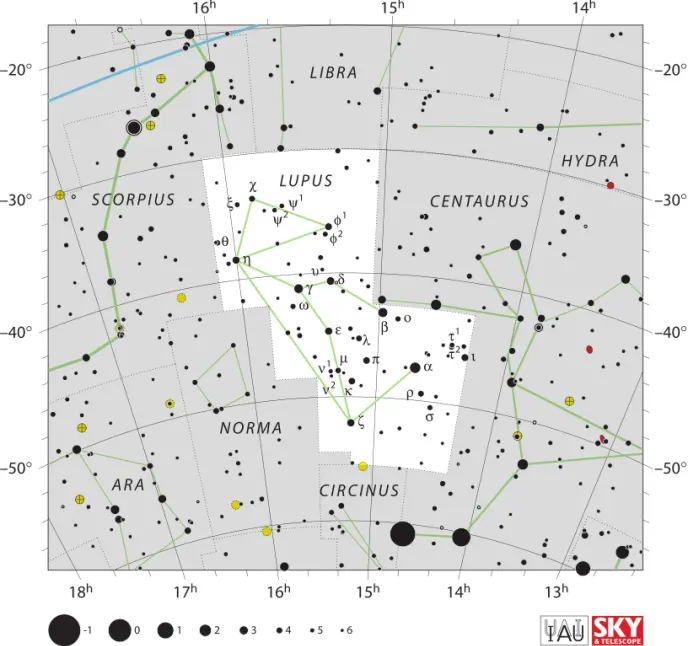
Lupus constellation map by IAU and Sky & Telescope magazine (Roger Sinnott & Rick Fienberg) (CC BY 3.0)
The best time of the year to observe the stars and deep sky objects in Lupus is during the month of June, when the celestial Wolf appears higher in the sky in the early evening. The entire constellation can be seen from locations south of the latitude 35° N.
The 10 brightest stars in Lupus are Uridim (Alpha Lupi, mag. 2.30), Beta Lupi (mag. 2.68), Gamma Lupi (mag. 2.77), Delta Lupi (mag. 3.20 – 3.24), Epsilon Lupi (mag. 3.41), Zeta Lupi (mag. 3.41), Eta Lupi (mag. 3.41), Iota Lupi (mag. 3.54), Phi1 Lupi (mag. 3.58), and Kappa1 Lupi (mag. 3.86).
Beta Lupi
| Spectral class | B2IV or B2 III |
| Variable type | Beta Cephei |
| U-B colour index | -0.902 |
| B-V colour index | -0.226 |
| Apparent magnitude | 2.68 |
| Absolute magnitude | -3.3 |
| Distance | 383 ± 8 light-years (117 ± 2 parsecs) |
| Parallax | 8.52 ± 0.18 mas |
| Radial velocity | +0.1 ± 1.0 km/s |
| Proper motion | RA: -35.78 ± 0.17 mas/yr |
| Dec.: -39.83 ± 0.13 mas/yr | |
| Mass | 8.8 ± 0.2 M☉ |
| Luminosity | 10,000 L☉ |
| Radius | 6.6 R☉ |
| Temperature | 24,090 K |
| Metallicity | -0.35 ± 0.11 dex |
| Age | 24.6 ± 2.7 million years |
| Rotational velocity | 92 km/s |
| Surface gravity | 3.76 cgs |
| Constellation | Lupus |
| Right ascension | 14h 58m 31.92536s |
| Declination | -43° 08′ 02.2699″ |
| Names and designations | Beta Lupi, Beta Lup, β Lupi, β Lup, bet Lup, Ke Kwan, Kekouan, HD 132058, HR 5571, HIP 73273, HIC 73273, SAO 225335, CD -42 9853, CPD -42 6856, CPC 0 12813, SKY# 27188, FK5 552, GC 20128, GCRV 8677, JP11 2556, PPM 320091, GEN# +1.00132058, N30 3380, GSC 07832-02490, WEB 12553, CEL 4329, UBV 12994, UBV M 20464, ALS 15004, uvby98 100132058, TD1 17837, [B10] 3815, [CS62] E6 93, ROT 2130, IRAS 14552-4256, 2MASS J14583192-4308020, TIC 333947284, TYC 7832-2490-1, Gaia DR3 5908509891197204480 |