Elnath, Beta Tauri (β Tau), is a blue-white giant star located 134 light-years away in the constellation Taurus. With an apparent magnitude of 1.65, it is the second brightest star in Taurus, after Aldebaran. It marks the tip of the celestial Bull’s northern horn.
Elnath is one of the bright stars that form the hexagon asterism that dominates the neighbouring constellation Auriga. Because of its location on the border between Taurus and Auriga, Elnath was once also known as Gamma Aurigae.
What type of star is Elnath?
Elnath is a chemically peculiar star of the spectral type B7 III. The stellar classification indicates a giant star appearing bluish or blue-white in colour.
The star has a mass about five times that of the Sun and has expanded to a size of 4.79 solar radii. With an effective temperature of 13,600 K, it shines with 564 solar luminosities. Elnath spins much faster than the Sun. It has a projected rotational velocity of 59 km/s.
The star is about 100 million years old. In another couple of million years, it will evolve into a larger and cooler orange giant star.
Beta Tauri is classified as a mercury-manganese star (HgMn star), a chemically peculiar star with prominent lines of heavy elements in its spectrum. It has a high abundance of manganese compared to the Sun but does not show a high mercury signature. This, combined with the star’s prominent lines of silicon and chromium, has led some researchers to classify it as a SrCrEu star or an Ap star (an A-type star with an overabundance of metals such as strontium or chromium).
Elnath has the designation WDS J05263+2836A in the Washington Visual Double Star Catalog. It has a faint visual companion, catalogued as BD+28°795B, at a separation of 33.4 arcseconds. There are six other fainter stars appearing closer, but they are believed to lie at a greater distance.
A much closer companion, located only 0.1 arcseconds away, was reported based on data collected during a lunar occultation. However, its presence was never confirmed by other observations.
Beta Tauri was reported to be a single-lined spectroscopic binary system by Adelman et al. in 2006. Adelman and his team measured the star’s radial velocity and found its binary nature evident. If this is the case, the candidate companion is much fainter than the primary component. There is no information about its properties or about the system’s orbital elements.
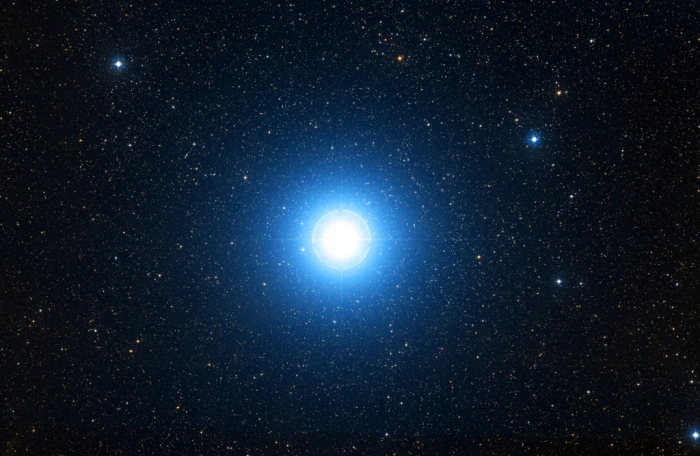
Elnath (Beta Tauri), image credit: ESO/Digitized Sky Survey 2 (CC BY 4.0)
Bull’s Northern Horn
In the constellation figure of Taurus, Elnath represents the Bull’s northern horn. The fainter Tianguan (Zeta Tauri), which represents the southern horn, lies in the region between Elnath and Betelgeuse in Orion. Both stars lie east of the bright Pleiades cluster and northeast of the Hyades.
The two bright star clusters are also part of the figure of the celestial Bull. The Hyades cluster outlines the Bull’s V-shaped head. Aldebaran, the brightest star in Taurus, and the fainter Ain mark the Bull’s eyes. The Pleiades stars sit at the Bull’s shoulder, and Lambda Tauri marks the Bull’s chest.
Auriga’s hexagon
Elnath forms a prominent asterism, Auriga’s hexagon, with the brightest stars of the neighbouring constellation Auriga (the Charioteer): Capella, Menkalinan, Mahasim, Hassaleh, and Almaaz. Most of the asterism lies within the larger Winter Hexagon (or Winter Circle), formed by Capella with Pollux, Procyon, Sirius, Rigel, and Aldebaran.
Elnath was historically seen as part of both Taurus and Auriga. In 1603, the German uranographer Johann Bayer assigned Elnath two designations in his Uranometria: Beta Tauri and Gamma Aurigae. Both Bayer and Ptolemy before him considered the star to be shared by the constellations Taurus and Auriga. In the 18th century, Elnath was assigned dual Flamsteed designations, 112 Tauri and 23 Aurigae.
The designation Gamma Aurigae stopped being used when the International Astronomical Union (IAU) defined the boundaries of the modern 88 constellations in 1930.
Auriga’s hexagon is one of the most recognizable asterisms in the northern sky, along with the Big Dipper and Cassiopeia’s W. It can be used as a guide to find several open clusters and nebulae that appear in the same region of the sky. These include Messier 36, Messier 37, Messier 38, the Flaming Star Nebula (IC 405), and the Tadpole Nebula (IC 410).
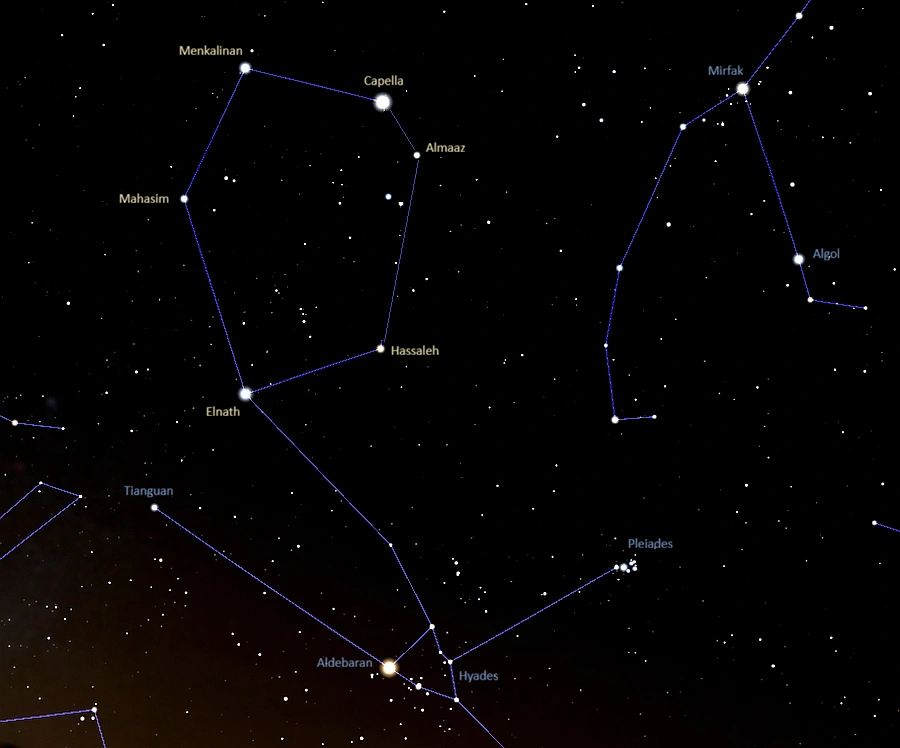
Auriga’s hexagon, image: Stellarium (annotated for this article)
Facts
Elnath is, on average, the 27th brightest star in the sky. It is only slightly fainter than Shaula in the constellation Scorpius, Gacrux in Crux and Bellatrix in Orion. It just outshines Miaplacidus in Carina, Alnilam and Alnitak in Orion, and Alnair in Grus.
Beta Tauri is located right on the border between Taurus and Auriga, only about 3 degrees west of the galactic anticentre, which lies in Auriga. Elnath is the nearest bright star to the galactic anticentre, which lies at the opposite end of the sky to Sagittarius A*, the radio source that marks the location of the supermassive black hole at the centre of the Milky Way.
Beta Tauri is one of the brightest blue giants in the sky, along with Hadar (Beta Centauri) in the constellation Centaurus, Mimosa (Beta Crucis) in Crux, Adhara (Epsilon Canis Majoris) in Canis Major, and Bellatrix (Gamma Orionis) in Orion.
Elnath and its brighter Taurus neighbour Aldebaran are among the 58 stars that have a special status in the field of celestial navigation. Navigational stars are some of the brightest and most identifiable stars in the sky. They were selected by Her Majesty’s Nautical Almanac Office (HMNAO) and the US Naval Observatory. The selection consists of 19 first-magnitude stars, 38 second-magnitude stars, and Polaris, the North Star.
Elnath is located only 5.39 degrees north of the ecliptic, the Sun’s apparent path across the sky, and can be occulted by the Moon. However, most occultations can only be observed from the southern hemisphere due to the star’s location at the northern end of the lunar occultation zone.
Elnath has similar properties to Maia (spectral class B8III), one of the brightest stars in the Pleiades cluster (Messier 45). Even though Maia is a bit larger (6.61 R☉) and slightly less luminous (501 L☉), it is also considerably more distant (444 light-years), and therefore appears much fainter (mag. 3.871) than Elnath.
Elnath was memorably referenced in the episode “The Galileo Seven” (1967) of Star Trek: The Original Series. In the episode, Spock is pulled off course during a mission and must make an emergency landing on Taurus II, a planet orbiting Beta Tauri.
Name
The name Elnath (pronunciation: /ˈɛlnæθ/) is derived from the Arabic an-naţħ, meaning “the butting” (the bull’s horns). The name has also been spelled El Nath and Alnath. It was once also used for Hamal, the brightest star in the constellation Aries.
The International Astronomical Union’s (IAU) Working Group on Star Names (WGSN) formally approved the name Elnath for Beta Tauri on July 20, 2016.
In traditional Chinese astronomy, Elnath is known as 五車五 (Wǔ Chē Wǔ), the Fifth of the Five Chariots. Five Chariots is a Chinese asterism formed by Elnath with Capella (Alpha Aurigae), Hassaleh (Iota Aurigae), Menkalinan (Beta Aurigae), and Mahasim (Theta Aurigae). The asterism is part of the larger Net mansion, one of the western mansions of the White Tiger of the West.
In Arabic astronomy, Elnath was known as Al Ka’b dhi’l Inan, meaning “the heel of the rein-holder.” The name referred to the star’s position in Auriga. In later Arabic astronomy, the star was called Al Karn al Thaur al Shamaliyyah, the Northern Horn of the Bull.
In Babylonian astronomy, Elnath was known as Shur-narkabti-sha-iltanu, roughly translated as the “star in the Bull toward the north” or the “north star toward the chariot.” (The chariot is part of the constellation Auriga, the Charioteer.)
How to find Elnath
Elnath is very easy to find because it forms a prominent hexagon pattern with the brightest stars of the constellation Auriga. It is the southernmost star in Auriga’s hexagon. The bright star pattern rises just before the Pleiades in the eastern sky.
Beta Tauri can be found using the V-shaped Hyades as a pointer. Tracing the lines of the V leads to the Bull’s horns. The Hyades and the bright Aldebaran can be found by following the line of the three stars of Orion’s Belt to the northwest.
Elnath is visible at some point in the night throughout the year except in May and June, when it is too close to the Sun. When the Sun appears to pass through Taurus for about a month each year, the constellation cannot be seen in the night sky.
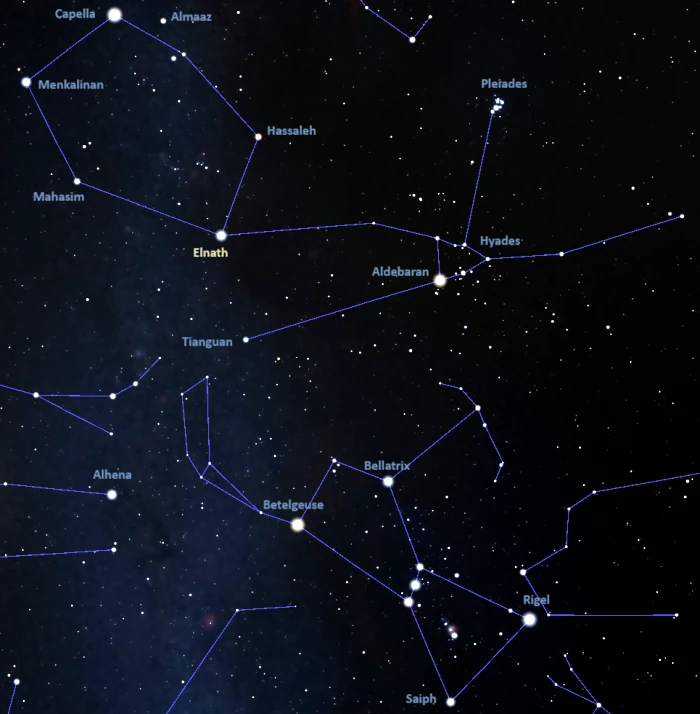
Location of Elnath (Beta Tauri), image: Stellarium (annotated for this article)
Beta Tauri lies near several notable deep sky objects. The supernova remnant Sharpless 2-240 (Simeis 147), nicknamed the Spaghetti Nebula, appears just southeast of the star. It is very large, with an apparent diameter of about 3 degrees, but makes a challenging target for observation due to its low surface brightness. It lies about 3,000 light years from Earth and has an estimated age of 40,000 years.
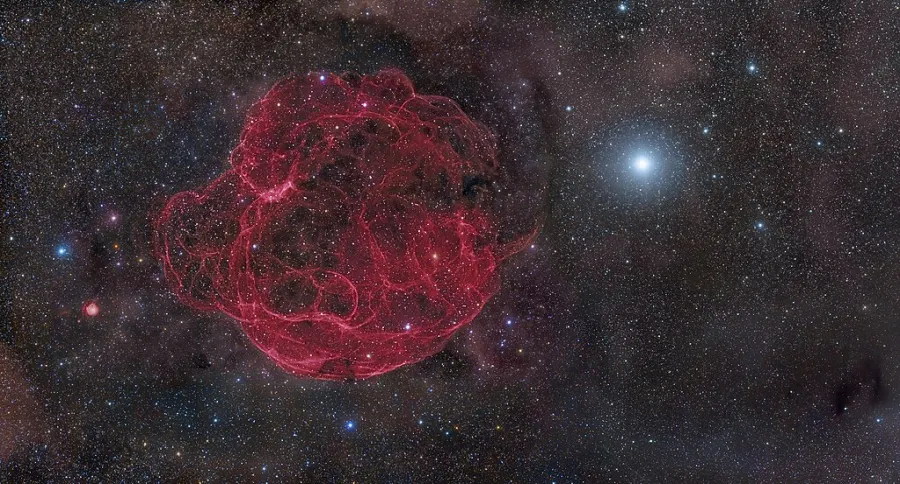
Photograph by Rogelio Bernal Andreo of Simeis 147. Also known as the Spaghetti Nebula and cataloged as Sharpless 2-240, this filamentary structure can be found in the constellation Taurus, close to the border of Auriga, in roughly the same line of sight as the star Elnath. Approximately 3000 light years away, the nebula stretches about 150 light years across. Image credit: Rogelio Bernal Andreo (CC BY-SA 3.0)
Elnath can be used to find the bright open star clusters Messier 36, Messier 37 and Messier 38 in Auriga. Messier 36 lies along the imaginary line extended from Elnath to Menkalinan. Messier 37 is found just east of the line connecting Elnath and Mahasim, about halfway between the stars, and Messier 38 is about a third of the way from Elnath to the bright Capella. The clusters M36 and M37 appear east and west of the midpoint of the imaginary line connecting Elnath and Mahasim.
Several other objects are located in the same region of the sky as M36 and M38. These include the Flaming Star Nebula (IC 405), an emission-reflection nebula surrounding the runaway star AE Aurigae, the emission nebula IC 417 (the Spider Nebula), the open cluster NGC 1893, and IC 410 (the Tadpole Nebula), the HII region that surrounds the cluster.
Elnath and Tianguan, the stars of the Bull’s horns, can be used to find the Crab Nebula (Messier 1). The bright supernova remnant appears only a degree northwest of Tianguan, roughly in the direction of Elnath. It can be spotted in small telescopes.
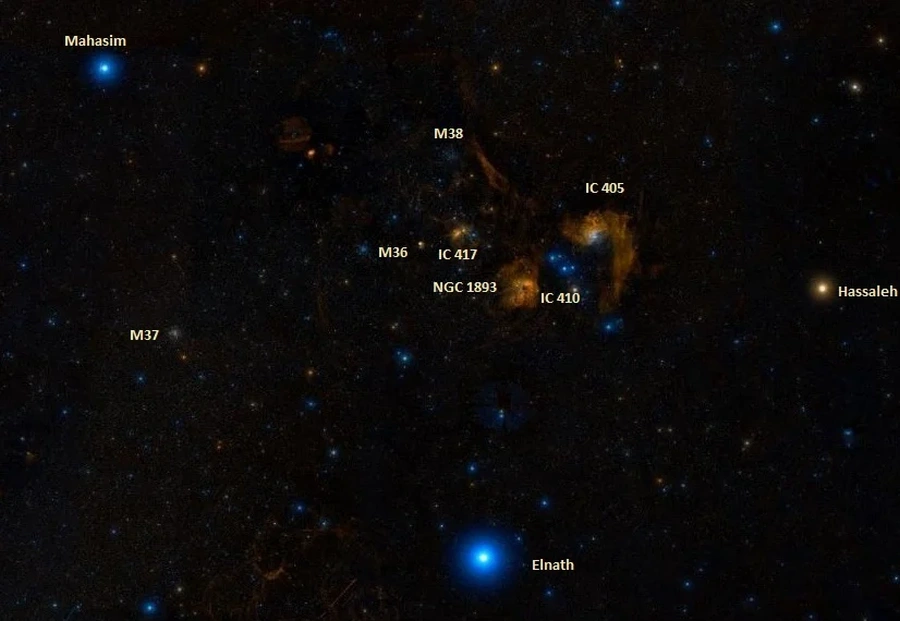
Mahasim, Hassaleh, Elnath, Messier 36, Messier 37, Messier 38 and the Flaming Star Nebula (IC 405), image credit: ESO/Digitized Sky Survey 2 (CC BY 4.0)
Constellation
Elnath is located in the constellation Taurus, the Bull. Known since ancient times, Taurus is one of the ancient constellations listed by the Greco-Roman astronomer Claudius Ptolemy of Alexandria in his Almagest in the 2nd century CE. In Greek lore, it is linked with the story of the god Zeus transforming himself into a white bull while pursuing the princess Europa.
The celestial Bull is the 17th largest constellation in the sky, stretching across 797 square degrees of the predominantly northern sky. It is one of the equatorial constellations, easily visible from both hemispheres for at least part of the year.
Taurus is best known for hosting the bright Aldebaran, the 14th brightest star in the sky, and two bright open star clusters, the Pleiades (Messier 45) and the Hyades. The two nearby clusters form an asterism called the Golden Gate of the Ecliptic. The ecliptic – the Sun’s apparent path across the sky – passes through the region between the clusters.
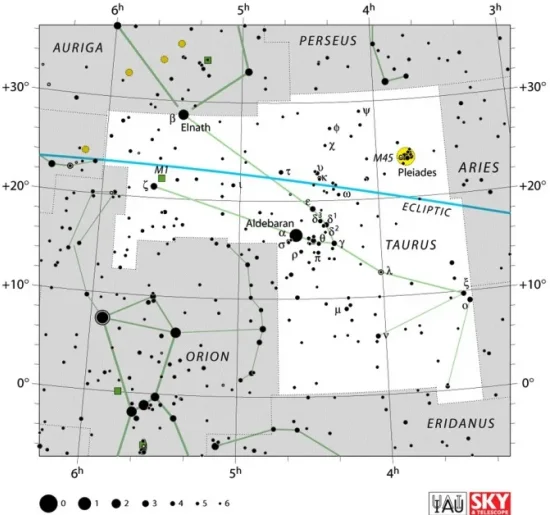
Taurus constellation map by IAU and Sky&Telescope magazine (Roger Sinnott & Rick Fienberg) (CC BY 3.0)
Aldebaran, the constellation’s lucida, is an orange giant located approximately 67 light-years away. Shining at magnitude 0.75 – 0.95, it is slightly brighter than Antares and Spica, the brightest stars in Scorpius and Virgo. The evolved giant star lies in the same line of sight as the Hyades but is not a member of the cluster.
Other than Aldebaran and Elnath, bright stars in Taurus include Alcyone (Eta Tauri) and Atlas (27 Tauri), the brightest members of the Pleiades cluster, the Hyades stars Chamukuy (Theta Tauri), Ain (Epsilon Tauri) and Prima Hyadum (Gamma Tauri), the blue giant Tianguan (Zeta Tauri), the hot blue star Lambda Tauri, and the yellow giant Omicron Tauri.
Taurus also hosts the red supergiant 119 Tauri (Ruby Star), one of the reddest stars in the sky, and the variable class prototypes T Tauri and the yellow supergiant RV Tauri.
In addition to the Pleiades and Hyades, notable deep sky objects in the constellation include the supernova remnants Messier 1 (Crab Nebula, M1) and the Spaghetti Nebula (Sharpless 2-240), the planetary Crystal Ball Nebula (NGC 1514), the reflection nebulae known as Hind’s Variable Nebula (NGC 1555) and the Baby Eagle Nebula (LBN 777), and the interacting galaxies NGC 1409 and NGC 1410.
The best time of year to observe the stars and deep sky objects in Taurus is during the month of January. In the northern hemisphere, the Bull is prominent in the evening sky throughout the winter months.
The 10 brightest stars in the constellation are Aldebaran (Alpha Tau, mag. 0.86), Elnath (Beta Tau, mag. 1.65), Alcyone (Eta Tau, mag. 2.87), Tianguan (Zeta Tau, mag. 2.97), Chamukuy (Theta2 Tauri, mag. 3.40), Lambda Tauri (mag. 3.47), Ain (Epsilon Tau, mag. 3.53), Omicron Tauri (mag. 3.61), Atlas (27 Tau, mag. 3.63), and Prima Hyadum (Gamma Tau, mag. 3.654).
Elnath – Beta Tauri
| Spectral class | B7III |
| U-B colour index | −0.49 |
| B-V colour index | −0.13 |
| Apparent magnitude | 1.65 |
| Absolute magnitude | -1.42 |
| Distance | 134 ± 2 light years (41.1 ± 0.6 parsecs) |
| Parallax | 24.36 ± 0.34 mas |
| Radial velocity | 9.2 ± 2 km/s |
| Proper motion | RA: +22.76 ± 0.42 mas/yr |
| Dec.: -173.58 ± 0.18 mas/yr | |
| Mass | 5.0 ± 0.1 M☉ |
| Luminosity | 564 ± 20 L☉ |
| Radius | 4.79 ± 0.13 R☉ |
| Temperature | 13,600 ± 100 K |
| Metallicity | +0.2 dex |
| Age | 100 ± 10 million years |
| Rotational velocity | 59 km/s |
| Surface gravity | 3.63 cgs |
| Constellation | Taurus |
| Right ascension | 05h 26m 17.51312s |
| Declination | +28° 36′ 26.8262″ |
| Designations | Elnath, El Nath, Alnath, Beta Tauri, Beta Tau, β Tauri, β Tau, Gamma Aurigae, Gamma Aur, 23 Aurigae, 23 Aur, 112 Tauri, 112 Tau, HD 35497, HR 1791, HIP 25428, SAO 77168, FK5 202, BD+28 795, AG+28 516, GC 6681, GCRV 3257, PPM 94361, PLX 1231.00, SKY# 8655, PMC 90-93 145, JP11 1072, IRC +30112, HGAM 398, Renson 9110, ROT 794, GSC 01859-01470, GEN# +1.00035497, LSPM J0526+2836, IRAS 05231+2833, 2MASS J05261751+2836271, CEL 688, CSI+28 795 1, N30 1163, WEB 4928, AKARI-IRC-V1 J0526175+283625, ALS 15829, ASCC 661203, UBV 3965, UBV 5151, UBV M 10935, 1RXS J052619.9+283621, USNO-B1.0 1186-00083031, uvby98 100035497, TYC 1859-1470-1, CCDM 05263+2836A, IDS 05200+2831 A, WDS J05263+2836A |