Capella, Alpha Aurigae (α Aur), is a quadruple star system composed of two pairs of binary stars located 41.929 light-years away in the northern constellation Auriga (the Charioteer). With an apparent magnitude of +0.08, it is the brightest star in Auriga and the sixth brightest star in the sky.
The two brighter components of the Alpha Aurigae system – Capella Aa and Capella Ab – are both individually first-magnitude stars. With magnitudes of 0.76 and 0.91, they are both among the 15 brightest stars in the sky.
Capella ranks as the third brightest star in the northern celestial hemisphere, after Arcturus and Vega. It is part of two prominent asterisms – the Winter Circle and Auriga’s hexagon – that dominate the evening sky during the northern hemisphere winter.
What type of star is Capella?
Capella may appear as a single star to the unaided eye, but it is in fact a multiple star system consisting of two pairs of stars.
The four components of the Alpha Aurigae system are designated Capella Aa, Capella Ab, Capella H, and Capella L. The brighter Capella Aa and Capella Ab form one binary pair and the fainter Capella H and L form the other.
The two pairs – Capella A and Capella HL – are separated by about 723 arcseconds in the sky, corresponding to a physical distance of 9,500 astronomical units (Earth – Sun distances).
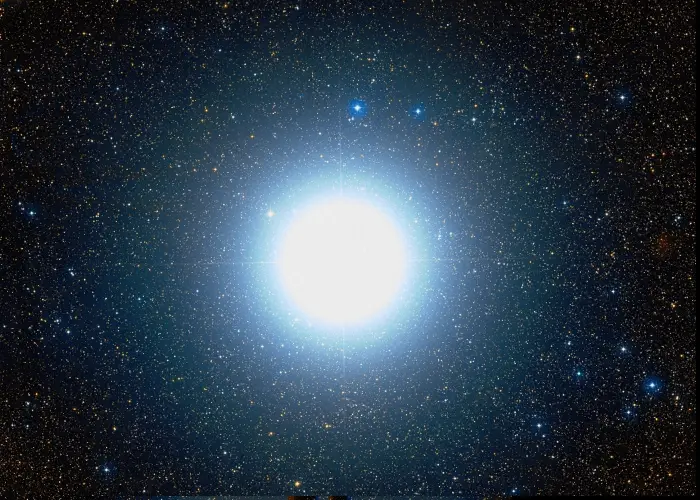
Capella (Alpha Aurigae), image credit: ESO/Digitized Sky Survey 2 (CC BY 4.0)
Capella A: The giant inner pair
The first pair, formed by components Alpha Aurigae Aa and Ab, has the composite spectral class G3III. Both components are evolved giant stars that orbit each other with a period of 104.02128 days at a separation of only 0.74274 astronomical units. The orbital separation between the stars is comparable to the distance from the Sun to Venus.
Capella Aa was long classified as an orange giant of the spectral type K0III, but more recent studies give it the spectral type G8III, indicating a yellow giant. The star has a mass of 2.5687 solar masses and a radius 11.98 times that of the Sun. With an effective temperature of about 4,970 K, it is 78.7 times more luminous than the Sun.
The primary component is a red clump giant, a cool star on the horizontal branch that has undergone a helium flash and is now fusing helium into carbon and oxygen in its core. At its largest, it is believed to have expanded to a size 36 to 38 times that of the Sun. As it approaches the end of the horizontal branch phase, the star is beginning to expand again and will eventually move to the asymptotic giant branch (AGB).
Like most yellow giants, Capella Aa is a relatively slow spinner. With a projected rotational velocity of 4.1 km/s, it takes 104 ± 3 days to complete a rotation.
Its close companion, Capella Ab, is given the luminosity class of a giant (G0III), but is believed to still be a subgiant star currently in the process of evolving into a red giant. The star has a mass of 2.4828 solar masses and a size of 8.83 solar radii. It shines with 72.7 solar luminosities and has a surface temperature of 5,730 K.
The binary companion is a much faster spinner than Capella Aa. It rotates with a velocity of 35 km/s, completing a full rotation in just 8.5 ± 0.2 days.
The stars are believed to be between 590 and 650 million years old. Both were once white, class A main sequence stars and will next become red giants. In 2023, a team of astronomers derived an age of 710 million years, slightly older than previous estimates, based on stellar evolution modelling and the chemical composition of the surface of Capella Aa.
Neither component of Capella A is massive enough to go out as a supernova. Instead, when they reach the end of their life cycles, the stars will expel their outer layers as planetary nebulae, leaving behind planet-sized white dwarfs, similar to the companions of Sirius and Procyon, that will gradually fade over billions of years.
Related: Life Cycle of Intermediate-Mass Stars
The components of Capella A do not constitute an eclipsing binary system. The stars do not eclipse each other as they orbit as seen from Earth. The stars are almost equally bright, with the component Ab generally found to be a little brighter at visual wavelengths, but only by a few tenths of a magnitude. Capella Aa is more luminous overall, when all wavelengths are taken into account.
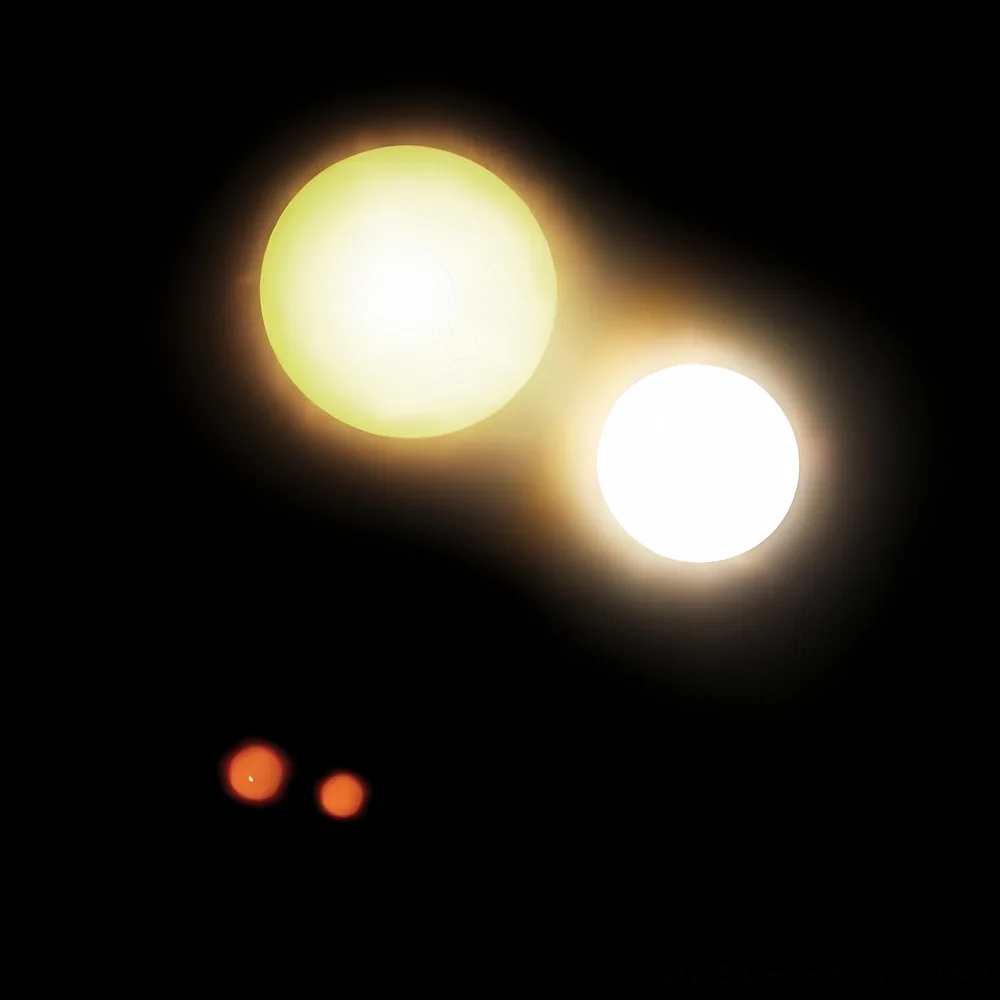
Capella star system, image credit: Pablo Carlos Budassi (CC BY-SA 4.0)
A flickering pair: RS CVn variability
Capella A is slightly variable, showing variations in brightness of about 0.1 magnitudes, from magnitude 0.03 to 0.16. This means that it may occasionally be brighter than Vega (mag. -0.02 – 0.07) or fainter than Rigel (mag. 0.05 – 0.18).
The General Catalogue of Variable Stars lists Alpha Aurigae A as a suspected RS Canum Venaticorum (RS CVn) variable. RS CVn stars are close binary systems with active chromospheres that can cause large stellar spots which, in turn, cause variations in luminosity. These variable stars typically vary in brightness by about 0.2 magnitudes.
Other than the class prototype RS Canum Venaticorum in the constellation Canes Venatici, stars in this class include Achird (Eta Cassiopeiae), Alula Australis (Xi Ursae Majoris), Shimu (Zeta Andromedae), Udkadua (Lambda Andromedae), Epsilon Ursae Minoris, and Omicron Draconis.
Capella HL: The faint outer pair
The secondary pair in the Capella system, Capella HL, consists of two main sequence dwarfs considerably less massive than the Sun. Both stars are cool red dwarfs with the stellar classifications M2.5 V (Capella H) and M4 (Capella L). Shining at magnitudes 10.16 and 13.7, they are invisible to the unaided eye.
Capella H and Capella L orbit each other with a period of 300 years. At the time of discovery (1935), they were separated by 1.8″, but the separation increased to 3.5″ 80 years later. This corresponds to a physical distance of 40 AU between the components.
Capella H has a mass of 0.57 solar masses, while Capella L has 0.53 solar masses. Capella H has a radius only 54% that of the Sun. With a surface temperature of 3,700 K, it shines with only 0.05 solar luminosities.
Capella H and Capella L are sometimes referred to as Capella C and Capella D because the designations B through G refer to stars that were found to be unrelated to the Capella system.
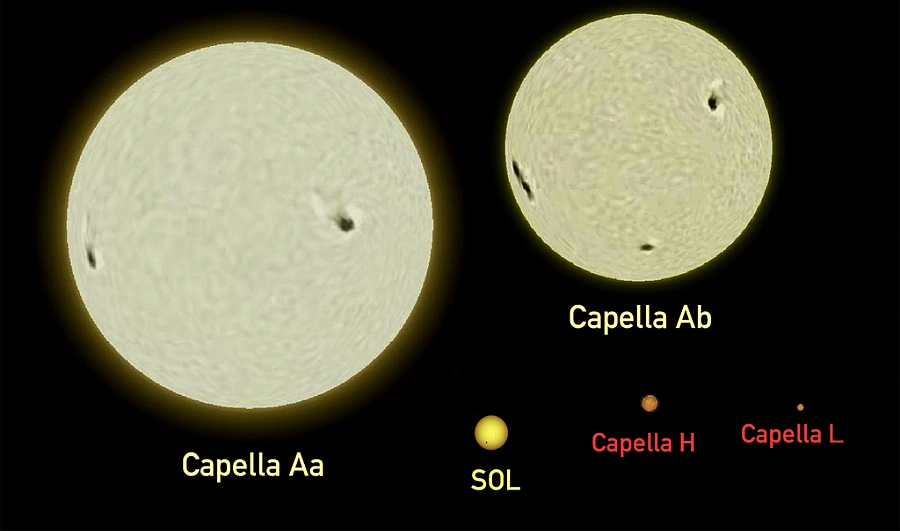
Components of the Capella system compared to the Sun, image credit: Wikimedia Commons/Omnidoom 999 (PD)
Line-of-sight companions
Capella has several visual companions located within a few arcminutes. The Washington Double Star Catalog (WDS) lists stars designated Capella A, B, C, D, E, F, G, H, I, L, M, N, O, P, Q and R. Most of the companions merely lie in the same line of sight as Capella A but are not physically related to the system.
The components H and L are the exception, as they lie at approximately the same distance as Capella and have a similar proper motion. However, the physical companions appear further away from Capella A than the six line-of-sight companions designated Capella B, C, D, E, F and G. These visual companions were discovered before Capella H.
Facts
With a combined apparent magnitude of 0.08, Capella is the sixth brightest star in the night sky. It outshines the bright Rigel in the constellation Orion, Procyon in Canis Minor, and Achernar in Eridanus. It is the brightest yellow giant in the sky and the second brightest G-type star, after Rigil Kentaurus.
Capella was once the brightest star in the sky. It held the title from 210,000 years ago to 160,000 years ago. It reached a peak brightness of -0.82 (slightly brighter than Canopus), when it came within 27.9 light years of the solar system. Even at its peak, the star was considerably fainter than Sirius is today (mag. -1.46).
Capella was succeeded as the brightest star by Canopus in the southern constellation Carina. Canopus held the title of the brightest star three times in the last 5 million years, most recently before Sirius took over about 90,000 years ago.
Capella is the third brightest star in the northern celestial hemisphere. It is only slight fainter than Arcturus (mag. -0.05) in the constellation Boötes and Vega (mag. 0.026) in Lyra. For observers in the mid-northern latitudes (40° N), who cannot see Canopus and Alpha Centauri due to their location in the far southern sky, Capella is the fourth brightest star in the sky, after Sirius, Arcturus, and Vega.
Capella is the closest first-magnitude star to the north celestial pole. It lies on the opposite side of the North Star to Vega at roughly the same distance.
Capella’s nearest neighbours are the red dwarf L 1672-14 (3.9 light years away), the yellow main sequence star Lambda Aurigae (4.5 light years), and the orange main-sequence star G 81-39 (5.4 light years).
A brilliant X-ray source
Capella is one of the brightest stars in X-ray wavelengths, with an X-ray luminosity about 10,000 times that of the Sun. The X-ray emissions are believed to come mainly from the corona of Capella Aa, which is also considerably more variable than the corona of the component Ab.
The X-ray emissions were detected on April 5, 1974, when a rocket flight serendipitously pointed its star sensor at Capella. The event marked the beginning of stellar X-ray astronomy.
Capella remains a key calibration target for X-ray observatories including Chandra and XMM-Newton.
Winter Circle
Capella is one of the six exceptionally bright stars that form the Winter Hexagon (Winter Circle), a prominent asterism that dominates the evening sky during the northern hemisphere winter.
The other stars that form the asterism are Sirius (the brightest star in the sky) in Canis Major, Procyon (the eighth brightest star) in Canis Minor, Pollux (the 17th brightest star) in Gemini, Aldebaran (the 14th brightest star) in Taurus, and Rigel (the seventh brightest star) in Orion.
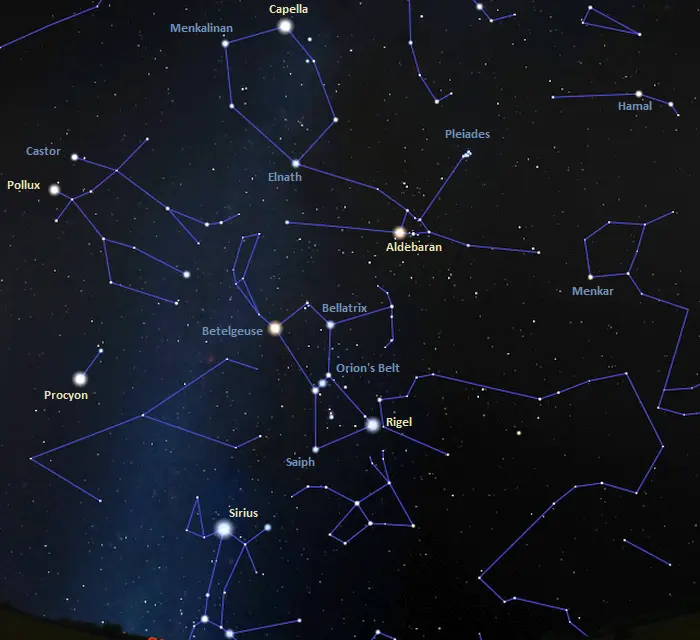
The stars of the Winter Hexagon: Rigel, Sirius, Procyon, Pollux, Capella, and Aldebaran, image: Stellarium (annotated for this article)
Auriga’s hexagon
Capella is the brightest point of light in Auriga’s hexagon, a smaller hexagon pattern formed by the brightest stars of Auriga – Capella, Menkalinan, Mahasim, Hassaleh, and Almaaz – with Elnath in the neighbouring Taurus.
Auriga’s hexagon can be used as a guide to Auriga’s brightest deep sky objects. The open clusters Messier 36 and Messier 37 appear on either side of the midpoint of the imaginary line connecting Mahasim and Elnath.
The bright open cluster Messier 38 can be found roughly a third of the way from Elnath to Capella. Several other deep sky objects appear in the same region of the sky as M38: the open clusters NGC 1907 and Messier 36, the Flaming Star Nebula (IC 405), the Tadpole Nebula (IC 410), the Spider Nebula (IC 417), and the Fly Nebula (NGC 1931).
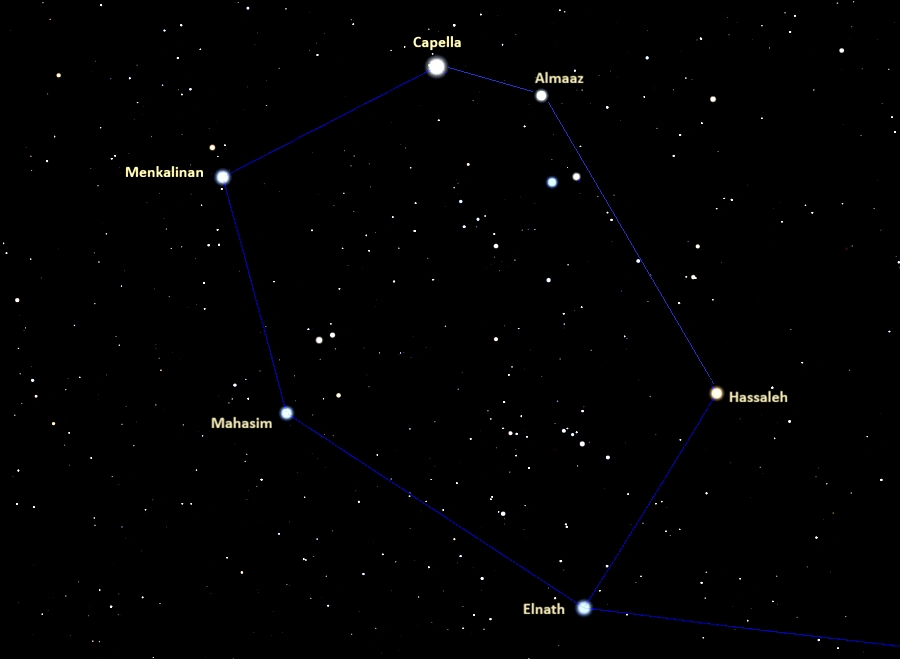
Auriga’s hexagon, image: Stellarium (annotated for this article)
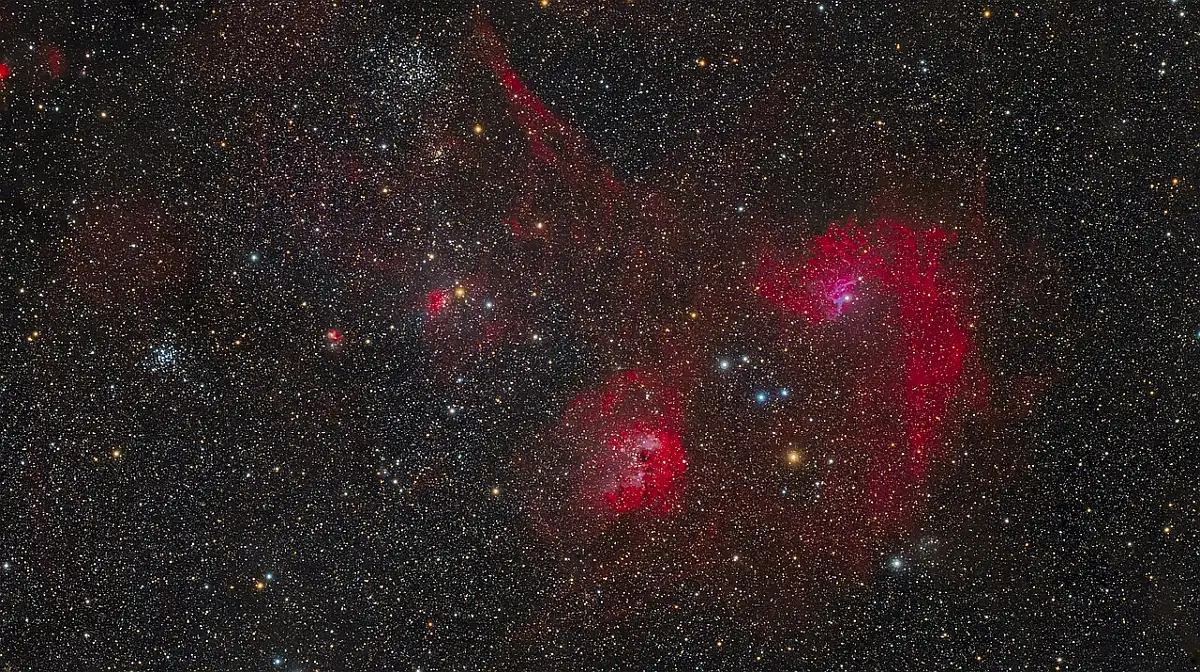
Messier 36 (left), Messier 38 (top left), the Flaming Star Nebula (right), the Tadpole Nebula (below centre) and the Spider and the Fly nebulae (centre left) within Auriga’s hexagon. Image credit: Giuseppe Donatiello (CC0 1.0)
Capra and Haedi
The stars Zeta and Eta Aurigae, formally named Saclateni and Haedus, are known as the Haedi, the kids of the she-goat Capella. Zeta Aurigae was traditionally known as Haedus I and Eta Aurigae as Haedus II.
The star Epsilon Aurigae, which appears between Capella and the kids, is traditionally known as Almaaz, “the billy goat.” Historically, Almaaz was not one of the Haedi but is sometimes included in the asterism because it appears in the same area.
The Haedi were regarded as a separate constellation by the Roman authors Pliny the Elder and Manilius in the 1st century CE. They called the constellation Capra (female goat), Caper or Hircus (male goat). With Capella, the stars were known as Capra and Haedi (the Goat and the Kids).
The Greco-Roman astronomer Ptolemy merged the goat constellation with the Charioteer when he listed the 48 Greek constellations in his Almagest in the 2nd century CE. Some depictions of Auriga still show the Charioteer holding a goat on his left shoulder and the goat’s kids under his arm.
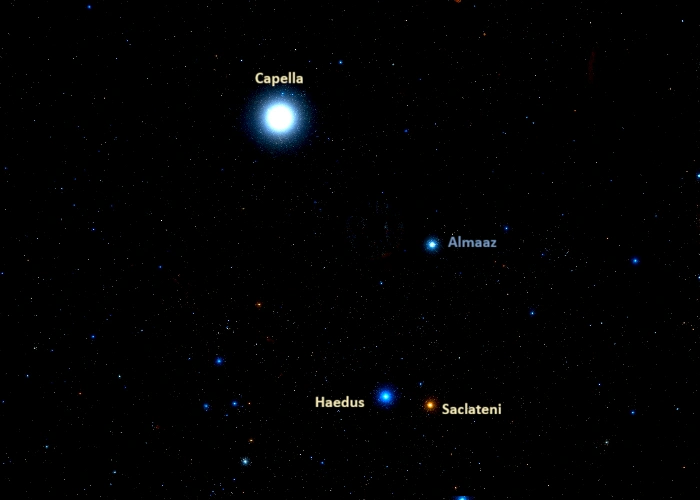
Capella and Haedi (the Goat and the Kids), image credit: ESO/Digitized Sky Survey 2 (CC BY 4.0)
Navigational star
Capella and the other stars of the Winter Hexagon are among the 58 bright stars selected for use in the field of celestial navigation. Navigational stars have a special status in navigation because they are among the brightest and most recognizable stars in the sky.
Selected by Her Majesty’s Nautical Almanac Office and the US Naval Observatory, these stars span the area from the declination -70° to +89° of the celestial sphere. Capella is the only navigational star in the constellation Auriga.
Capella is one of 11 northern stars with a declination north the latitude 30° N included on the list of navigational stars. The other 10 are Polaris and Kochab in Ursa Minor, Dubhe, Alkaid and Alioth in Ursa Major, Schedar in Cassiopeia, Eltanin in Draco, Mirfak in Perseus, Deneb in Cygnus, and Vega in Lyra.
The first spectrum surprise: Discovering the binary nature of Capella
The multiple nature of Capella was discovered by two astronomers independently in 1899. The American astronomer William Wallace Campbell studied photographic plates taken between August 1896 and February 1897. He found that a second spectrum appeared superimposed over the first, also noting doppler shifts to violet and then to red. The Doppler shifts indicated that the component stars were orbiting each other, i.e. moving toward and away from the observer.
In July 1899, British astronomer Hugh Newall observed Capella with a four-prism spectroscope on a 25-inch telescope at Cambridge. After studying its composite spectrum, he also came to the conclusion that the bright star was a binary system.
Discovery of Capella HL
The binary system was discovered to have a dim companion in 1914 by the Finnish astronomer Ragnar Furuhjelm. The companion shared a similar proper motion with the brighter pair, indicating that it was physically associated with Capella Aa and Capella Ab.
American astronomer Carl Leo Stearns noted that the companion was a binary star itself in February 1936. His conclusion was confirmed several months later, in September 1936, by the Dutch astronomer Gerard Kuiper. The components of the second pair are now designated Capella H and Capella L.
First beyond the solar system: Interferometric milestones
Capella was the first object outside our solar system to be measured interferometrically. In 1919, John Anderson and Francis Pease studied the star from Mount Wilson Observatory in California and published an orbit for the system in 1920.
In 1994, a team of astronomers at Mount Wilson Observatory used the Mark III Stellar Interferometer to determine a high precision orbit for the components Aa and Ab.
Then in September 1995, the Cambridge Optical Aperture Synthesis Telescope (COAST) produced the first-ever images of a star outside the solar system using a separate-element optical interferometer. The images captured the actual motions of Capella Aa and Ab. These components cannot be resolved by conventional telescopes.
Located at the Mullard Radio Astronomy Observatory in Cambridgeshire, England, COAST is a multi-element optical interferometer, the first long-baseline interferometer to produce high-resolution images of stellar surfaces outside the solar system by collecting light from three separate telescopes. The images of the Capella system were the first ever obtained from an interferometric array of optical telescopes.
How ancient civilizations saw Capella
Capella’s cultural footprint stretches back for millennia. In Mesopotamian astronomy, the bright star was associated with a constellation known as “GAM,” “Gamlum” or “MUL.GAM.” The constellation was mentioned in the Babylonian compendium MUL.APIN in the 7th century BCE.
GAM was associated with a scimitar or crook and the name may have referred to Capella alone or to the constellation Auriga as a whole. The star itself is believed to have been mentioned in an Akkadian inscription written as early as in the 20th century BCE.
In Akkadian times, Capella may have been Dil-gan I-ku, meaning “the messenger of light,” or Dil-gan Babili, the patron star of Babylon.
In Sumerian, it was called mul.ÁŠ.KAR, meaning “the goat star,” and in Assyria it was known as I-ku, “the leader,” meaning the leader of the year. The start of the year may have been determined by Capella’s position relative to the Moon at the vernal equinox before 1730 BCE, when the Sun entering the constellation Taurus marked the beginning of spring.
Building J of the archaeological site Monte Albán in Oaxaca Valley in southern Mexico, constructed around 175 BCE, is suspected to have been built with respect to Capella’s heliacal rising, at a different orientation to other buildings on the site. A line perpendicular to the base of the steps at the building’s entrance would have pointed directly to the star.
Capella’s heliacal rising – the brief appearance above the eastern horizon at dawn after a period of invisibility – took place on one of the days when the Sun passed directly overhead over the site.
Several ancient temples are believed to be oriented to Capella, including the sanctuary of Ptah in Memphis, Egypt, and the Temple of Diana Propylaea at Eleusis, Greece.
Throughout history, Capella was commonly used in navigation and timekeeping. The Gwichʼin people of Canada and Alaska saw the star and its neighbour Menkalinan as shreets’ą įį vidzee, the right ear of Yahdii. Yahdii was represented by a circumpolar constellation that stretched across much of the sky and helped the Gwichʼin navigate and keep time at night.
The Inuit saw Capella as part of a constellation called Quturjuuk, “collar-bones,” formed by two pairs of stars (Capella and Menkalinan, Pollux and Castor) that each represented a bone.
Medieval astrology
In medieval astrology, Capella was one of the Behenian fixed stars, which were believed to be a source of special astrological power.
Each of the 15 Behenian stars was connected with one or more planets, a plant and a gemstone. The plants and gemstones were used in rituals to bring out the star’s influence.
Capella was associated with the planets Jupiter and Saturn and linked with sapphire and thyme. It was believed to bring wealth as well as civic, political and military honours.
Capella in fiction
Like other bright stars, Capella has been used or referenced in countless works of fiction. Notable mentions include the novels The Exiles of Capella (Os Exilados da Capela, 1949) by Edgard Armond, Lone Star Planet (1958) by H. Beam Piper, Robert A. Heinlein’s Starship Troopers (1959), Jack Vance’s Emphyrio (1969), James Gunn’s The Listeners (1972), Philip José Farmer’s Time’s Last Gift (1972), Christopher Evans’ Capella’s Golden Eyes (1980), Stewart Cowley’s Starliners: Commercial Travel in 2200 AD (1980), and Anne McCaffrey’s The Rowan (1990) novels.
The star was also memorably used in the episode “Friday’s Child” of Star Trek: The Original Series.
Name
The name Capella (pronunciation: /kəˈpɛlə/) means “(small) female goat” in Latin. The star was once also known as Capra (Latin word for “female goat”) and is still sometimes called the Goat Star. In English literature, it is often referenced as the Shepherd’s Star.
Capella has been associated with a goat for millennia. The Greeks associated it with Amalthea, the goat that nursed the infant Zeus. In the myth, Zeus accidentally broke off the goat’s horn, and the horn was transformed into cornucopia, the horn of plenty. The cornucopia had the power to provide unending nourishment and would be filled with whatever the owner desired.
The International Astronomical Union’s (IAU) Working Group on Star Names (WGSN) officially approved the name Capella for Alpha Aurigae Aa on June 30, 2016. The name formally applies only to the primary component but is commonly used for the whole star system and its other individual components (Capella Ab, Capella H, and Capella L).
One star, many names: Capella around the world
Capella has been known by many other names in different cultures throughout history. In the Middle Ages, it was known as Alhajoth, which was possibly a corruption of the star’s Arabic name, al-cayyūq, which may have been derived from the Greek αίξ, meaning “goat.”
In Arabic astronomy, the star was also commonly known as Al-Rākib, meaning “the driver.” This was a translation from the Greek and referred to the star’s prominent position in the sky, becoming visible before other stars in the evening, and appearing to watch over them.
In Bedouin astronomy, Auriga stars represented a herd of goats. The Bedouin in Sinai and Negev called Capella al-‘Ayyūq ath-Thurayyā, “Capella of the Pleiades.”
The Chinese know Capella as the Second Star of the Five Chariots (五車二). Five Chariots is a Chinese constellation also formed by Menkalinan (Beta Aurigae), Hassaleh (Iota Aurigae), Mahasim (Theta Aurigae) and Elnath (Beta Tauri). These stars also form Auriga’s hexagon with Almaaz. In traditional Chinese astronomy, Five Chariots is part of the larger Net mansion, which represents the body of the White Tiger.
In Hindu astronomy, Capella was called Brahma Hṛdaya, “the heart of Brahma.”
Baltic people called Capella Tikutis or Perkūno Ožka, meaning “thunder’s goat.” Slavic Macedonians knew it as Jastreb, “the hawk,” ready to swoop on the Mother Hen, represented by the Pleiades cluster, and the Rooster, represented by the star Elnath.
In ancient Peru, Quechua people knew the star as Colça and associated it with the affairs of shepherds.
In Tahitian mythology, Capella was known as Tahi-ari’I, the mother of prince Ta’urua (represented by the planet Venus), who sails across the sky in his canoe.
In Hawaii, the star was part of an asterism called Ke ka o Makali’I, meaning “the canoe bailer of Makali’I,” which was used in navigation at sea. The asterism was also formed by the bright Sirius, Procyon, Pollux and Castor.
In the Marshall Islands, Capella represented Ligedaner, the mother of stars. In local lore, Ligedaner told her sons that the one who wins the race to an eastern island would become the King of the Stars. She asked her eldest son, Dümur (represented by Antares), to let her come in his canoe. Dümur and all the other sons except the youngest refused and the youngest son, represented by the Pleiades, won the race and became the King of the Stars.
In the Caroline Islands, Capella was known as Jefegen uun, meaning “north of Aldebaran.” In the Society Islands, it was called Tahi-anii, meaning “unique sovereign.”
The Boorong people of northwestern Victoria in Australia called Capella Purra, the kangaroo. The kangaroo met its end at the hands of the twins Yurree and Wanjel, represented by the Gemini stars Castor and Pollux.
The Wardaman people of the Northern Territory of Australia knew Capella as Yagalal, a ceremonial fish scale.
How to find Capella
Capella is quite easy to find because it lies in a region of the sky particularly rich in exceptionally bright stars. Located about halfway between Polaris and Orion’s Belt, it is one of the six bright stars that form the Winter Circle, and the brightest of the stars that form Auriga’s conspicuous hexagon pattern. The small triangle of stars that form the Kids asterism makes Capella very easy to identify.
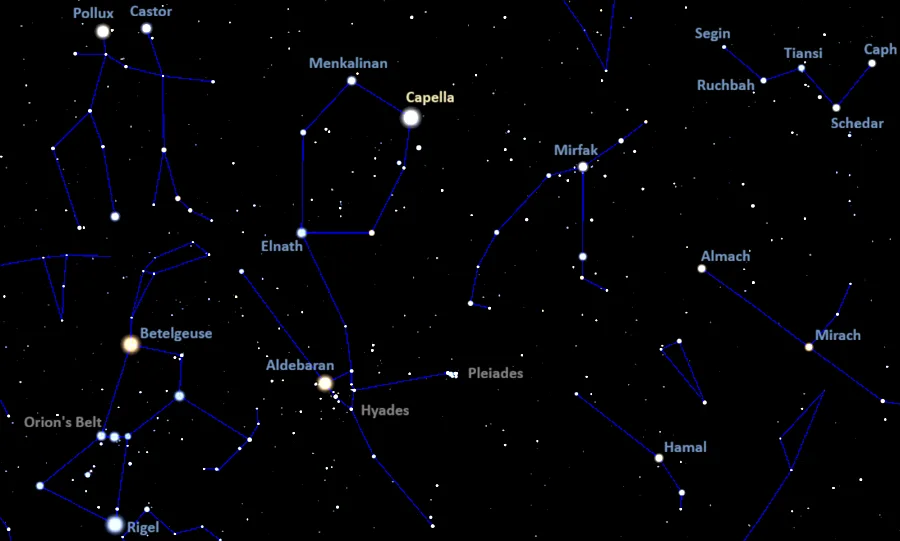
Location of Capella (Alpha Aurigae), image: Stellarium (annotated for this article)
Capella can be found using the stars of the Big Dipper. A line extended from Megrez through Dubhe up the Great Bear’s back and away from the Dipper’s handle points roughly in the star’s direction.
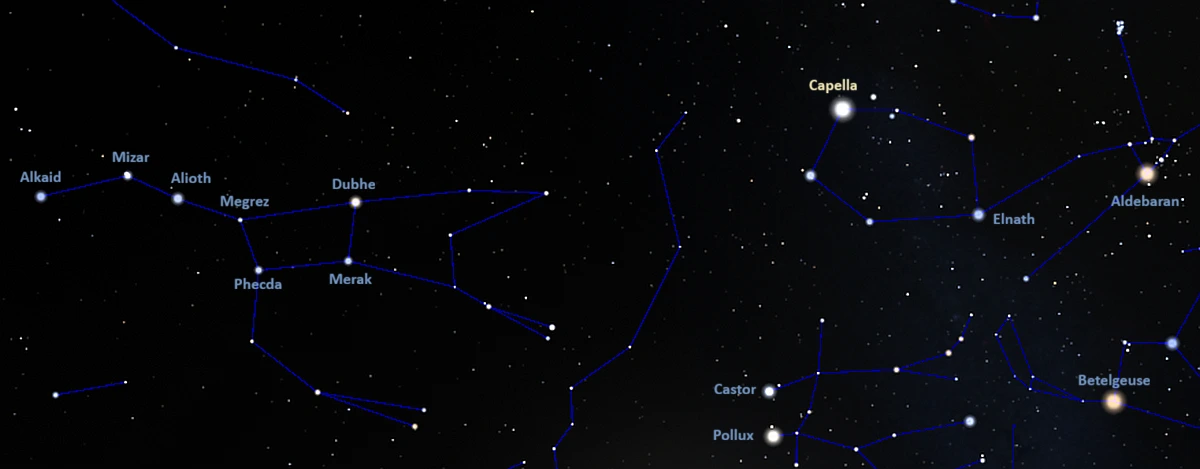
How to find Capella using the Big Dipper, image: Stellarium (annotated for this article)
Capella is the northernmost star in the Winter Circle and in Auriga’s hexagon asterism. It rises just before the bright Hyades and Pleiades and the recognizable constellation figure of Orion. In the northern hemisphere, it appears above Orion and Taurus. Elnath, the southernmost star of Auriga’s hexagon, marks the Bull’s northern horn and can be located by following the line of the Bull’s V-shaped head, represented by Aldebaran and the Hyades, to the northeast.
Capella is circumpolar, i.e. it stays above the horizon year-round, for observers north of the latitude 44° N, while those living south of the latitude 44° S cannot see it all. The star reaches its highest point in the sky at midnight in early December.
Constellation
Capella is located in the northern constellation of Auriga. It marks the left shoulder of the celestial Charioteer or the goat held by the Charioteer over his shoulder.
Auriga is one of the 48 Greek constellations, first listed by the Greco-Roman astronomer Ptolemy of Alexandria in the 2nd century CE. In Greek mythology, it is associated with the mythical goat Amalthea, who nurtured the young Zeus. Alternatively, it is linked with Erichthonius of Athens, the son of Hephaestus credited for inventing the four-horse chariot (the quadriga).
Auriga stretches across 657 square degrees of the northern sky and is the 21st largest of the modern constellations. Its brightest stars form Auriga’s hexagon with Elnath at the northern horn of the Bull.
Auriga is best-known for being home to Capella, one of the brightest stars in the sky. The constellation contains several other notable variable stars, including the Algol-type eclipsing binaries Menkalinan (Beta Aurigae), Almaaz (Epsilon Aurigae), and Saclateni (Zeta Aurigae), the slow irregular variable Pi Aurigae, and Mahasim (Theta Aurigae), an Alpha2 Canum Venaticorum variable.
Other bright stars in the constellation include the orange giants Hassaleh (Iota Aurigae) and Bagu (Delta Aurigae), the slowly pulsating B-type star Haedus (Eta Aurigae), the yellow giant Nu Aurigae, and the variable red bright giant Pi Aurigae.
The Orion variable AE Aurigae, an O-type main sequence star believed to be a runaway star from the Orion Nebula (M42), illuminates the Flaming Star Nebula, a magnitude 6.0 emission-reflection nebula located at a distance of about 1,500 light years from the Sun.
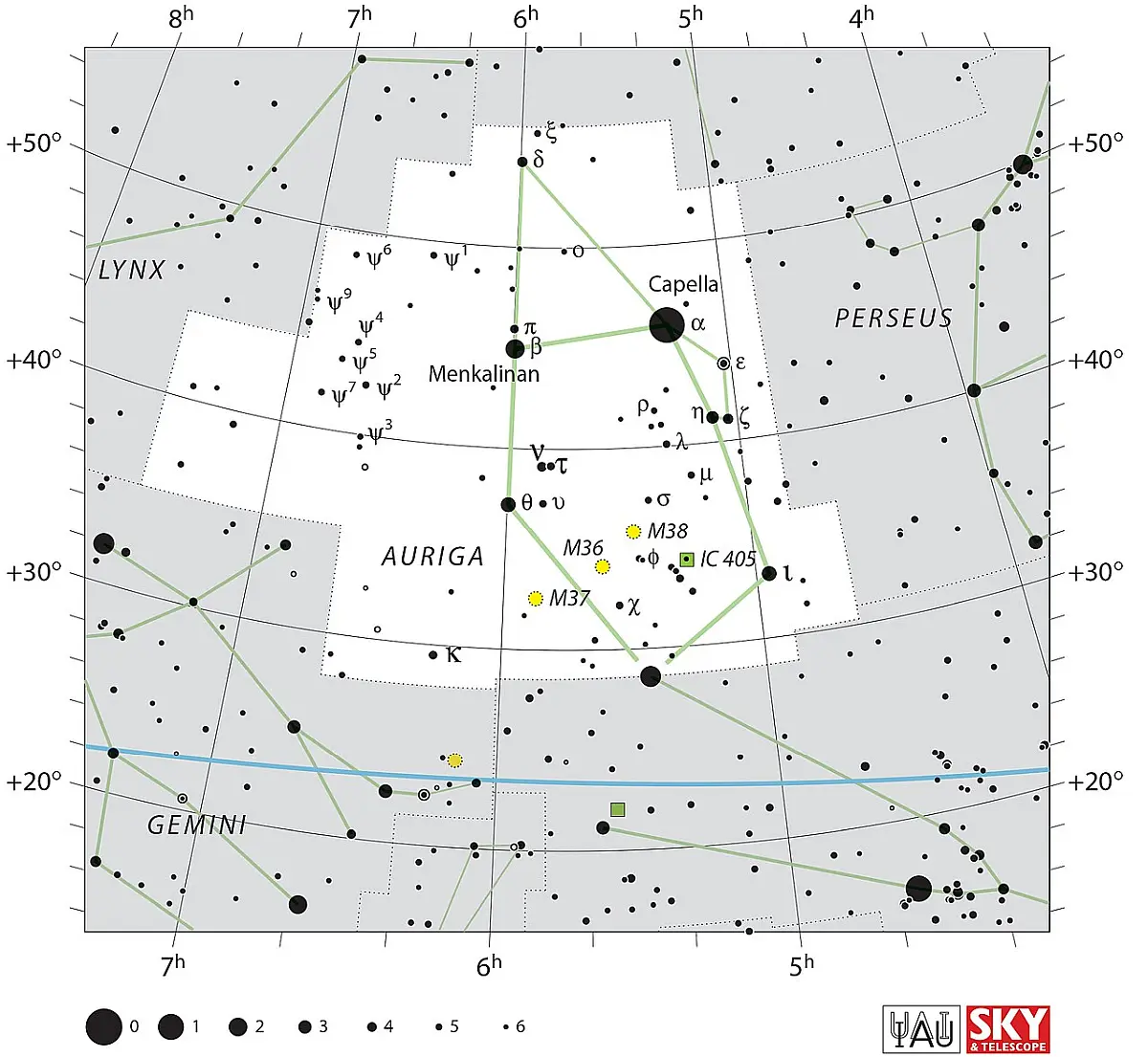
Auriga constellation map by IAU and Sky&Telescope magazine (Roger Sinnott & Rick Fienberg) (CC BY 3.0)
Auriga contains several relatively bright deep sky objects. These include the open clusters Messier 36, Messier 37, Messier 38, NGC 2281, NGC 1664, and NGC 1893, the last of which is embedded in the faint H II region IC 410. Other deep sky objects in the constellation include the emission and reflection nebula NGC 1931 and the protoplanetary Westbrook Nebula.
The best time of the year to observe the stars and deep sky objects of Auriga is during the month of February, when the constellation appears higher above the horizon in the early evening. The entire constellation is visible from locations north of the latitude 40° S.
The 10 brightest stars in the constellation are Capella (Alpha Aur, mag. 0.08), Menkalinan (Beta Aur, mag. 1.90), Mahasim (Theta Aur, mag. 2.62 – 2.70), Hassaleh (Iota Aur, mag. 2.69), Almaaz (Epsilon Aur, mag. 2.92 – 3.83), Haedus (Eta Aur, mag. 3.18), Saclateni (Zeta Aur, mag. 3.70 -3.97), Delta Aurigae (mag. 3.715), Nu Aurigae (mag. 3.957), and Pi Aurigae (mag. 4.25).
Capella – Alpha Aurigae
| Constellation | Auriga |
| Names and designations | Capella, Alpha Aurigae, Alpha Aur, α Aurigae, α Aur, 13 Aurigae, 13 Aur, Alhajoth, Hokulei, HD 34029, HR 1708, HIP 24608, SAO 40186, GJ 194, FK5 193, BD+45 1077, AG+45 512, GC 6427, GCRV 3121, PPM 47925, LTT 11619, NLTT 14766, PLX 1187.00, CSV 100460, NSV 1897, JP11 1010, IRC +50139, CEL 586, CSV 100460, ASCC 317037, EUVE J0516+45.9, N30 1121, CABS 51, CCABS 42, CSI+45-05130, CSI+45 1077 1, Ci 20 321, H 0513+45, RAFGL 713, LSPM J0516+4559, SKY# 8333, UBV 5009, 1E 051259+4556.7, 2E 0513.0+4556, USNO-B1.0 1359-00140245, VVO 236, RE J051640+455929, RE J0516+455, 2RE J051640+455955, 2RE J0516+455, uvby98 100034029, SBC7 214, TD1 4244, SBC9 306, RX J0516.7+4559, 1RXS J051642.2+460001, WEB 4762, IRAS 05130+4556, 2MASS J05164138+4559525, TIC 368326352, TYC 3358-3141-1, AAVSO 0509+45, ADS 3841, IDS 05093+4554, CCDM J05168+4559, WDS 05167+4600 |
| Capella A | Alpha Aurigae A, GJ 194 |
| Capella HL | Capella CD, GJ 195 |
| Capella H | Capella C, GJ 195 A, GCRV 3130, PPM 47938, LTT 11622, NLTT 14788, AG+45 515, GCRV 3130, PPM 47938, PPMX J051723.8+455022, PLX 1193.00A, LSPM J0517+4550, AC +45 217, ST 3H, TIC 368483044, PM J05173+4550, WEB 4770, PMSC 05093+4553H, Ci 20 323, CNS5 1323, 2XMMi J051724.1+455019, CSI+45-05137 2, CSI+45 1077 8, Furuhjelm III-1357, VVO 237, UBV 5010, 2MASS J05172386+4550229, Gaia DR2 211810233512673792, EUVE J0517+45.8, G 96-29A, Gaia DR3 211810233512673792, ADS 3841 H, CCDM J05168+4559H, WDS J05167+4600H |
| Capella L | Capella D, GJ 195 B, VVO 238, CNS5 1324, G 96-29B, ST 3L, PLX 1193.00B, PMSC 05093+4553L, TIC 368483043, 2MASS J05172394+4550198, Gaia DR2 211810233512673920, Gaia DR3 211810233512673920, ADS 3841 L, CCDM J05168+4559L, IDS 05103+4544 L, WDS J05167+4600L |
Capella A
| Spectral class | G3III (Aa: G8III, Ab: G0III) |
| Variable type | RS Canum Venaticorum (suspected) |
| U-B colour index | +0.44 |
| B-V colour index | +0.80 |
| V-R colour index | −0.3 |
| R-I colour index | +0.44 |
| Apparent magnitude | 0.08 (0.03 – 0.16) |
| Absolute magnitude (Capella Aa, Capella Ab) | +0.296, +0.167 |
| Distance | 42.919 ± 0.049 light years (13.159 ± 0.015 parsecs) |
| Parallax | 76.20 ± 0.46 mas |
| Radial velocity | +29.9387 ± 0.0032 km/s |
| Proper motion | RA: 75.25 ± 0.54 mas/yr |
| Dec.: −426.89 ± 0.28 mas/yr | |
| Right ascension | 05h 16m 41.35871s |
| Declination | +45° 59′ 52.7693″ |
Capella Aa
| Mass | 2.5687 ± 0.0074 M☉ |
| Luminosity | 78.7 ± 4.2 L☉ |
| Radius | 11.98 ± 0.57 R☉ |
| Temperature | 4,970 ± 50 K |
| Metallicity | −0.04 ± 0.06 dex |
| Age | 590–650 million years |
| Rotational velocity | 4.1 ± 0.4 km/s |
| Rotation | 104 ± 3 days |
| Surface gravity | 2.691 ± 0.041 cgs |
Capella Ab
| Mass | 2.4828 ± 0.0067 M☉ |
| Luminosity | 72.7 ± 3.6 L☉ |
| Radius | 8.83 ± 0.33 R☉ |
| Temperature | 5,730 ± 60 K |
| Metallicity | −0.04 ± 0.06 dex |
| Age | 590–650 million years |
| Rotational velocity | 35.0 ± 0.5 km/s |
| Rotation | 8.5 ± 0.2 days |
| Surface gravity | 2.941 ± 0.032 cgs |
Capella H
| Spectral class | M2.5 V |
| U-B colour index | 1.24 |
| B-V colour index | 1.50 |
| R-I colour index | 0.91 |
| Apparent magnitude | 10.16 |
| Absolute magnitude | 9.53 |
| Distance | 43.52 ± 0.01 light years (13.342 ± 0.003 parsecs) |
| Parallax | 74.9521 ± 0.0188 mas |
| Radial velocity | 30.15 ± 0.63 km/s |
| Proper motion | RA: 88.425 ± 0.020 mas/yr |
| Dec.: -428.911 ± 0.017 mas/yr | |
| Mass | 0.57 M☉ |
| Luminosity | 0.05 L☉ |
| Radius | 0.54 ± 0.03 R☉ |
| Temperature | 3,700 ± 150 K |
| Metallicity | +0.1 dex |
| Surface gravity | 4.75 ± 0.05 cgs |
| Right ascension | 05h 17m 23.8623810386s |
| Declination | +45° 50′ 22.927685973″ |
Capella L
| Spectral class | M4 |
| Apparent magnitude | 13.7 |
| Absolute magnitude | 13.1 |
| Distance | 43.38 ± 0.03 light years (13.301 ± 0.009 parsecs) |
| Parallax | 75.1838 ± 0.0534 mas |
| Radial velocity (Capella HL) | 31.63 ± 0.14 km/s |
| Proper motion | RA: 53.966 ± 0.059 mas/yr |
| Dec.: -416.903 ± 0.049 mas/yr | |
| Mass | 0.53 M☉ |
| Right ascension | 05h 17m 23.9524233742s |
| Declination | +45° 50′ 19.300250088″ |