Theta Carinae (θ Car) is a massive binary star located in the southern constellation Carina. With an apparent magnitude of 2.76, it is the fifth brightest star in the constellation, after Canopus, Miaplacidus, Avior, and Aspidiske.
Theta Carinae lies approximately 460 light years away. It forms an asterism known as the Diamond Cross with the brighter Miaplacidus and fainter Omega and Upsilon Carinae. The luminous star is the brightest member of the Southern Pleiades (the Theta Carinae Cluster, IC 2602), one of the nearest and brightest open star clusters in the sky.
What type of star is Theta Carinae?
Theta Carinae is a single-lined spectroscopic binary system composed of a massive blue straggler and a much fainter companion. In single-lined binaries, spectral lines of only one component can be observed. The binary nature of the system is inferred from the star’s spectrum periodically shifting towards the blue and then toward the red, which indicates orbital motion. This shift is caused by the Doppler effect, which occurs when a star moves toward or away from the observer.
The primary component, Theta Carinae A, has the spectral class B0.5 Vp or B0Vp, indicating a hot blue main sequence star, and has been identified as a blue straggler. Blue stragglers are unusual stars that appear younger, bluer and more luminous than other members of the same star cluster. These “rejuvenated” stars are believed to form through interactions and mergers of two or more stars.
The “p” in the spectral type indicates peculiarities in the star’s spectrum. Theta Carinae has a variable spectrum in both the optical and ultraviolet band. It shows an overabundance of nitrogen and deficiency of carbon.
The invisible companion, Theta Carinae B, is believed to be an F-type star that contributes less than 0.1 percent to the system’s total flux. F-type stars are yellow-white stars somewhat hotter and larger than the Sun, but much cooler and less luminous than the B-type primary.
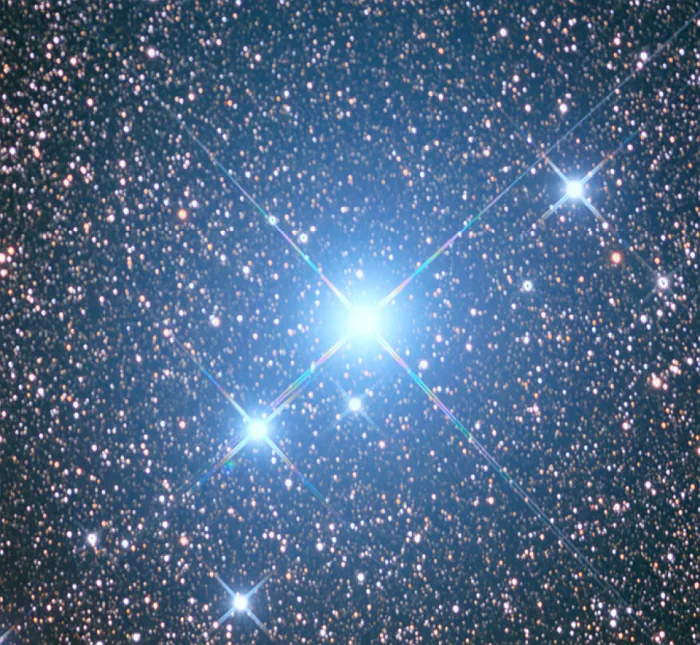
Theta Carinae as viewed from iTelescope’s T75 at Deep Sky Chile. The star is at the center of the open cluster IC 2602. Image credit: Wikimedia Commons/ YayLol123 (CC BY-SA 4.0)
Mass, temperature and luminosity
Theta Carinae A has a mass of 14.9 solar masses and a radius about 5.1 times that of the Sun. With a surface temperature of 31,000 K, it is 14,500 times more luminous than the Sun.
The stellar parameters of Theta Carinae B remain uncertain. In 2021, based on observations with NASA’s Transiting Exoplanet Survey Satellite (TESS), astronomers determined a minimum mass of 0.72 solar masses for the companion.
Why Theta Carinae is considered a blue straggler
Theta Carinae appears much younger than other members of the Theta Carinae Cluster (IC 2602). A 2008 study by Hubrig et al. found that the star lies close to the zero-age main sequence (ZAMS) on the Hertzsprung-Russell diagram, appearing to lag behind in evolution compared to other members of IC 2602. The zero-age main sequence marks the stage when stars begin stable hydrogen fusion in their cores.
Based on the observed effective temperature of 31,000 K, the researchers calculated a mass of 15.25 solar masses and a radius of 5.1 solar radii. They concluded that mass transfer from the initially more massive companion has significantly altered the surface abundances in Theta Carinae A.
A 2010 study of massive young runaway stars by Tetzlaff et al. found a mass of 14.9 solar masses and an age of only 4 ± 0.7 million years for Theta Carinae.
More recent studies (Dobbie, Lodieu & Sharp 2010; Bossini et al. 2019; Jackson et al. 2020) have given age estimates in the range from 35 to 46 million years.
The cluster IC 2602 has an estimated age of 13.7 million years based on the member positions on the Hertzsprung-Russell diagram and a lithium depletion boundary age of 50 million years.
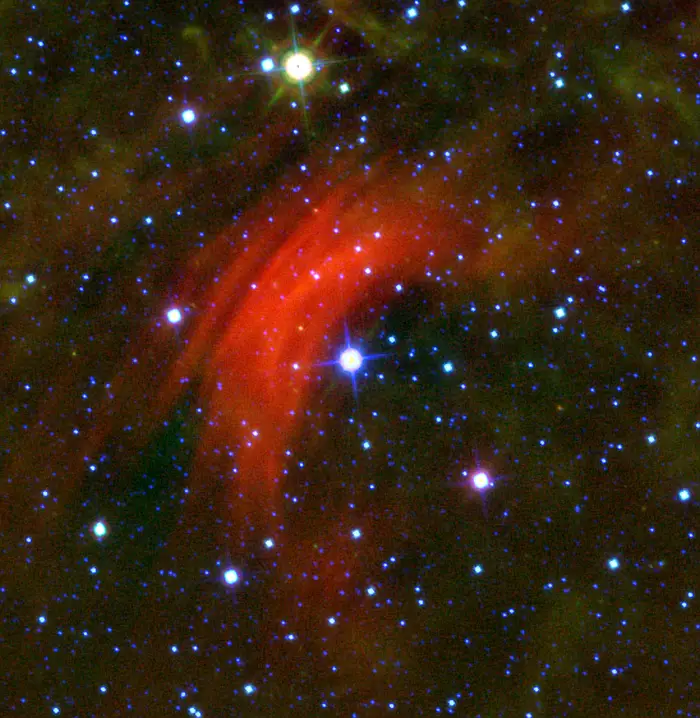
Theta Carinae with unWISE, image credit: unWISE (D. Lang) (CC BY-SA 4.0)
Theta Carinae system
Theta Carinae has been known to be a double star for over a century. The massive star has a variable radial velocity, the speed at which it moves away from the Earth or towards it. These short-period variations were first reported by Wilson and Sanford in 1915. They are caused by orbital motion and indicate that Theta Carinae is a binary star.
Orbital period and evidence of interaction
The Theta Carinae system has an orbital period of only 2.2 days, the shortest one known among massive stars. The close orbit indicates earlier mass transfer between the two components. The transfer of material from one star to the other most likely accounts for the peculiarities in the system’s spectrum. The orbital elements were calculated by Lloyd et al. in 1995, and observations with TESS in 2021 led to a refined rotational period of 2.2034 days.
While the companion, Theta Carinae B, has not been directly detected, the presence of an extended nebulosity around Theta Carinae has been associated with mass loss caused by binary interaction.
Brightest light in the Theta Carinae Cluster (IC 2602)
The Theta Carinae Cluster is a bright open cluster easily visible without binoculars. It has an apparent magnitude of 1.9 and an apparent size of 50 arcminutes. For context, the full Moon spans about 30 arcminutes, which means that the cluster covers almost twice the apparent size of the Moon in the sky.
The young cluster was discovered by the French astronomer Nicolas Louis de Lacaille from South Africa on March 3, 1751.
IC 2602 is popularly known as the Southern Pleiades because it resembles the better-known Pleiades cluster in the northern constellation Taurus. It ranks as the third brightest open star cluster in the sky, after the Hyades and the Pleiades.
The nine brightest members of the Southern Pleiades, including Theta Carinae, PP Carinae, V518 Carinae, HD 93194 and HR 4222, are visible to the unaided eye. Most of them are massive, luminous B-type stars. These stars will burn through their supply of fuel quickly and evolve away from the main sequence within tens of millions of years. In comparison, Sun-like stars have a main sequence lifetime of 10 billion years.
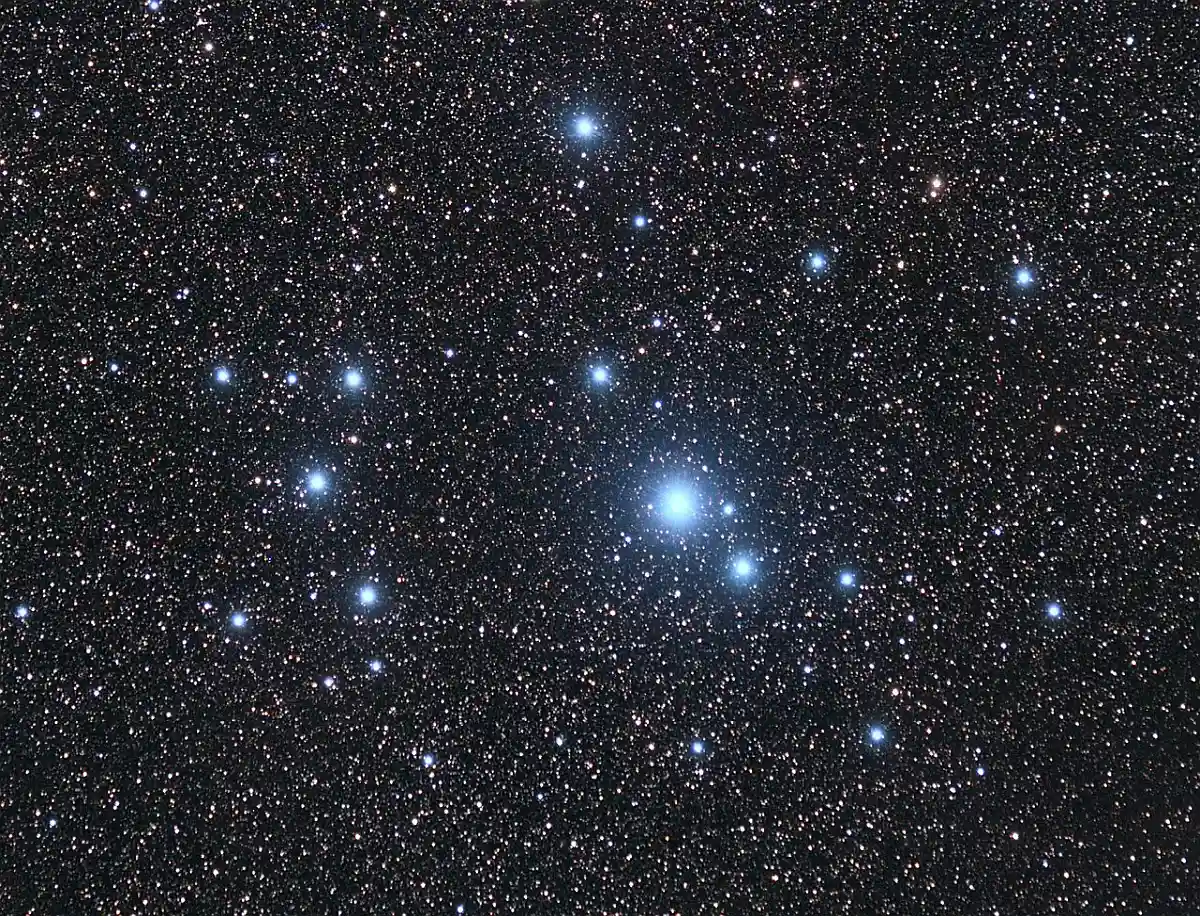
The Southern Pleiades (Theta Carinae Cluster), image credit: Tel Lekatsas (CC BY 2.0)
Diamond Cross
Theta Carinae forms a prominent star pattern known as the Diamond Cross with the brighter Miaplacidus (Beta Carinae) and the fainter Omega and Upsilon Carinae. The asterism lies in the region between the two brighter star patterns, the Southern Cross and the False Cross. It is visible from locations south of the latitude 20° N.
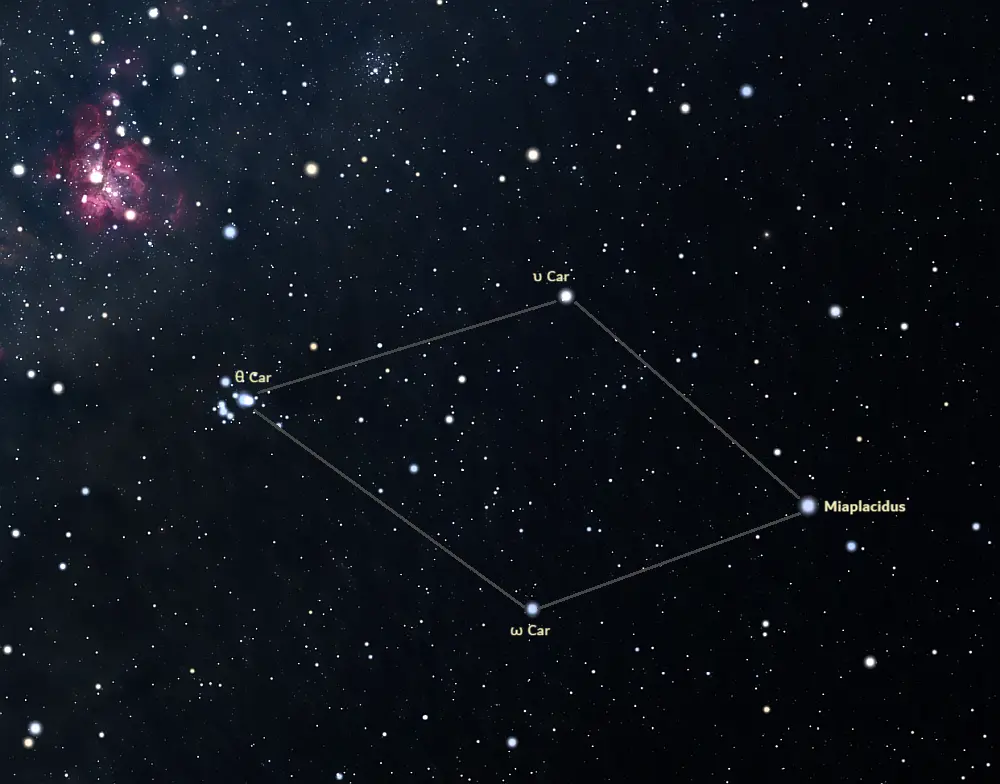
Diamond Cross, image: Stellarium (annotated for this article)
How to identify the Diamond Cross
The Diamond Cross is the faintest of the three diamond-shaped asterisms in the far southern sky. It is flanked by the brighter Southern Cross in the constellation Crux and False Cross in Carina and Vela.
The more prominent Southern Cross appears near the bright Southern Pointers, Alpha and Beta Centauri (Rigil Kentaurus and Hadar), the third and 11th brightest stars in the sky. It is formed by the bright Acrux, Mimosa, Gacrux, Imai, and Ginan, the brightest stars in the constellation Crux.
The vertices of the False Cross are marked by Avior and Aspidiske in Carina and Alsephina and Markeb in Vela. The asterism appears similar in size to the Diamond Cross, but its stars are slightly brighter.
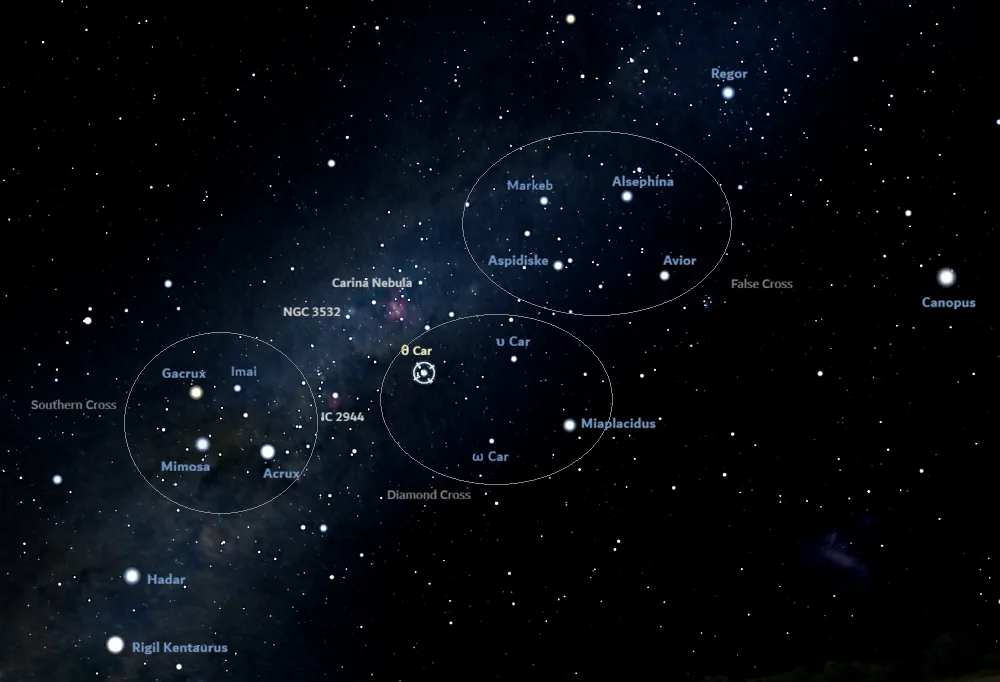
The Southern Cross, Diamond Cross and False Cross, image credit: Stellarium (annotated for this article)
Deep sky objects near the Diamond Cross
The stars of the Diamond Cross asterism can guide observers to several bright deep sky objects in this region of the sky. The best-known of these is the Carina Nebula (NGC 3372), a vast stellar nursery about 300 light years across that hosts Eta Carinae, the most massive star visible to the unaided eye.
The extended emission nebula can be found by drawing a line from Miaplacidus through the midpoint of the imaginary line connecting Theta and Upsilon Carinae.
The bright Wishing Well Cluster (NGC 3532) appears next to the Carina Nebula. The Lambda Centauri Nebula (Running Chicken Nebula, IC 2944) and the Pearl Cluster (NGC 3766) can be seen in the region between Theta Carinae and Mimosa in the Southern Cross.
Other deep sky objects in the vicinity of the Diamond Cross include the bright globular cluster NGC 2808, the Statue of Liberty Nebula (NGC 3576), and the planetary nebula IC 2448.
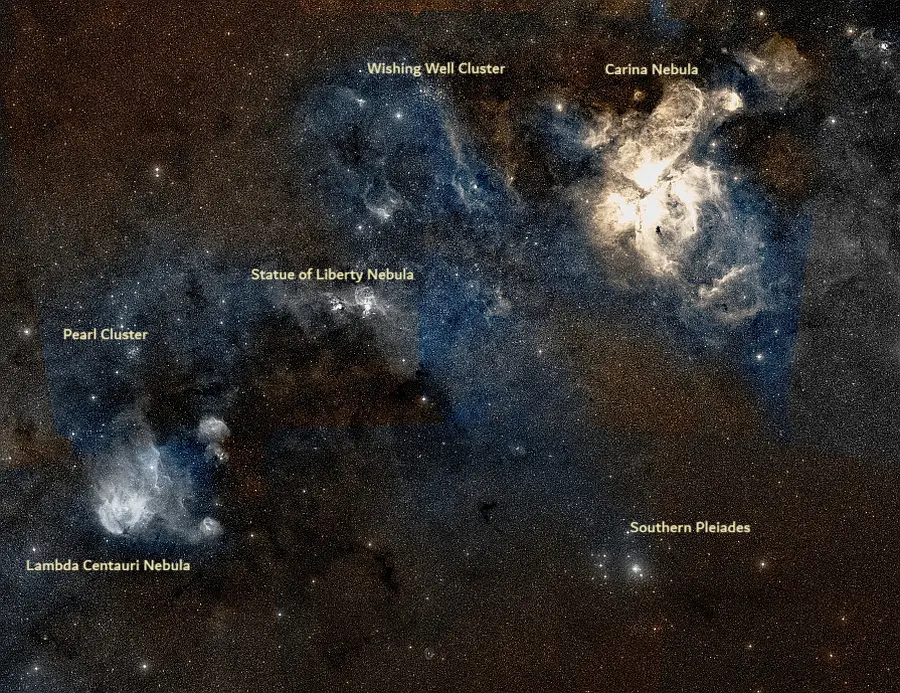
The Theta Carinae Cluster, Carina Nebula, Statue of Liberty Nebula and Running Chicken Nebula, image credit: ESO/Digitized Sky Survey 2 (CC BY 4.0)
Facts
Theta Carinae is, on average, the 121st brightest star in the sky. It is only slightly fainter than Kaus Media in the constellation Sagittarius and Tarazed in Aquila. It appears similarly bright as Yed Prior and Cebalrai in Ophiuchus, Athebyne in Draco, Porrima in Virgo, Hatysa in Orion, and Kulou in Centaurus. It slightly outshines Cursa in Eridanus, Kornephoros in Hercules, and Imai in Crux.
Theta Carinae (mag. 2.76) is one of the brightest cluster stars in the sky, along with Mirfak (mag. 1.82) in the Alpha Persei Cluster in the constellation Perseus. These stars are brighter than Alcyone (Eta Tauri, mag. 2.87) in the Pleiades cluster, Chamukuy (Theta Tauri, mag. 3.4) in the Hyades, Omicron Velorum (mag. 3.60) in the Omicron Velorum Cluster, Meissa (mag. 3.7) in the Lambda Orionis Cluster, and Tau Canis Majoris (mag. 4.40) in the Tau Canis Majoris Cluster.
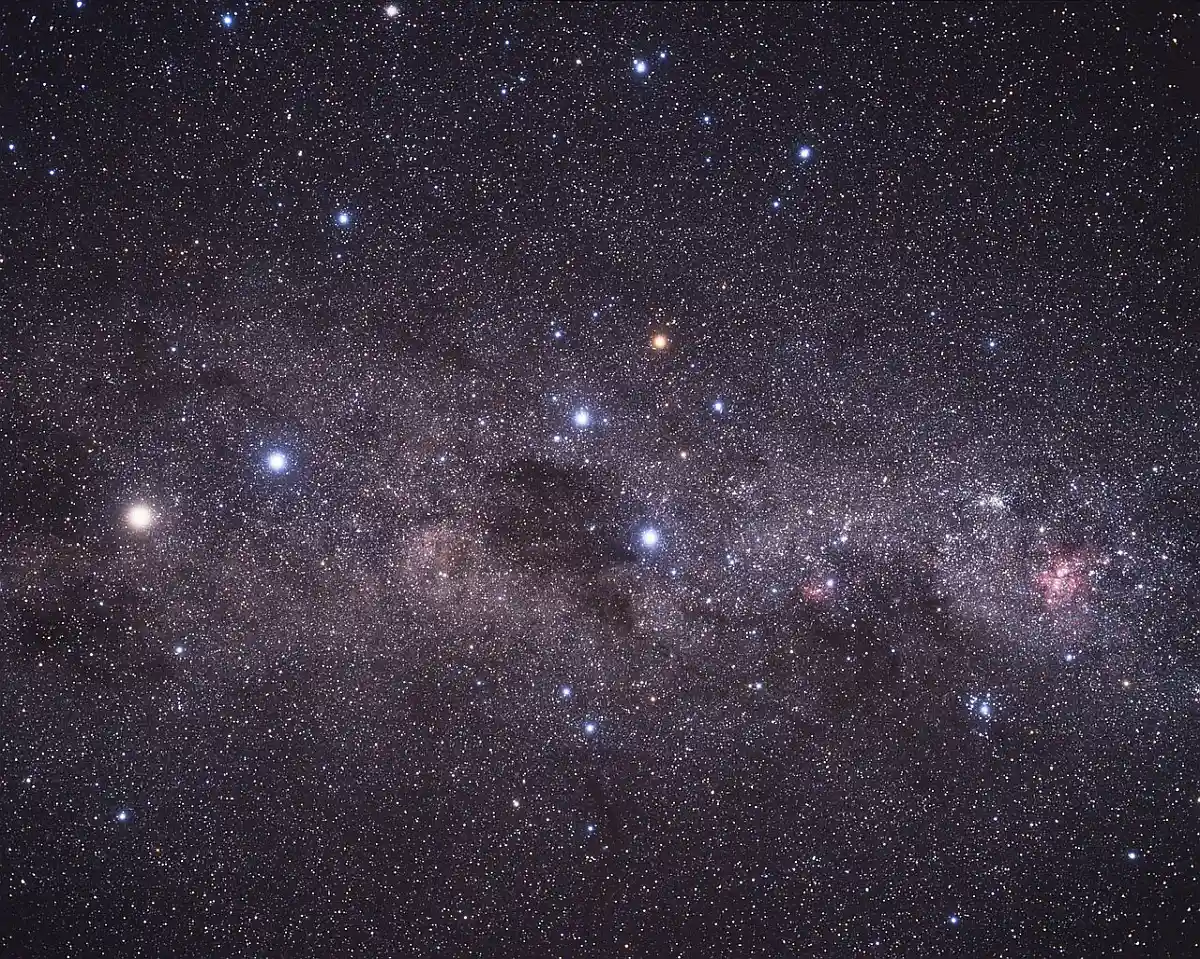
This wide-field image shows the Milky Way stretching across the southern sky. The beautiful Carina Nebula (NGC 3372) and the Theta Carinae Cluster (IC 2602) are seen at the right of the image. The bright stars at the left side are Alpha and Beta Centauri. They point towards Gacrux, the red star that marks the top of the Southern Cross. Credit: ESO/A. Fujii (CC BY 4.0)
Names and designations of Theta Carinae
Theta Carinae does not have a proper name formally approved by the International Astronomical Union (IAU). It is commonly referred to by its Bayer designation, Theta Carinae.
The star is listed as HD 93030 in the Henry Draper Catalogue, HR 4199 in the Bright Star Catalogue, HIP 52419 in the Hipparcos Catalogue, and SAO 251083 in the Smithsonian Astrophysical Observatory Star Catalog.
In traditional Chinese astronomy, Theta Carinae was known as 南船三 (Nán Chuán sān), the Third Star of Southern Boat. It formed the Southern Boat asterism with V337 Carinae, PP Carinae, Miaplacidus (Beta Carinae), and Omega Carinae. The asterism was created in the early 17th century based on European charts of the far southern sky created during the Age of Discovery.
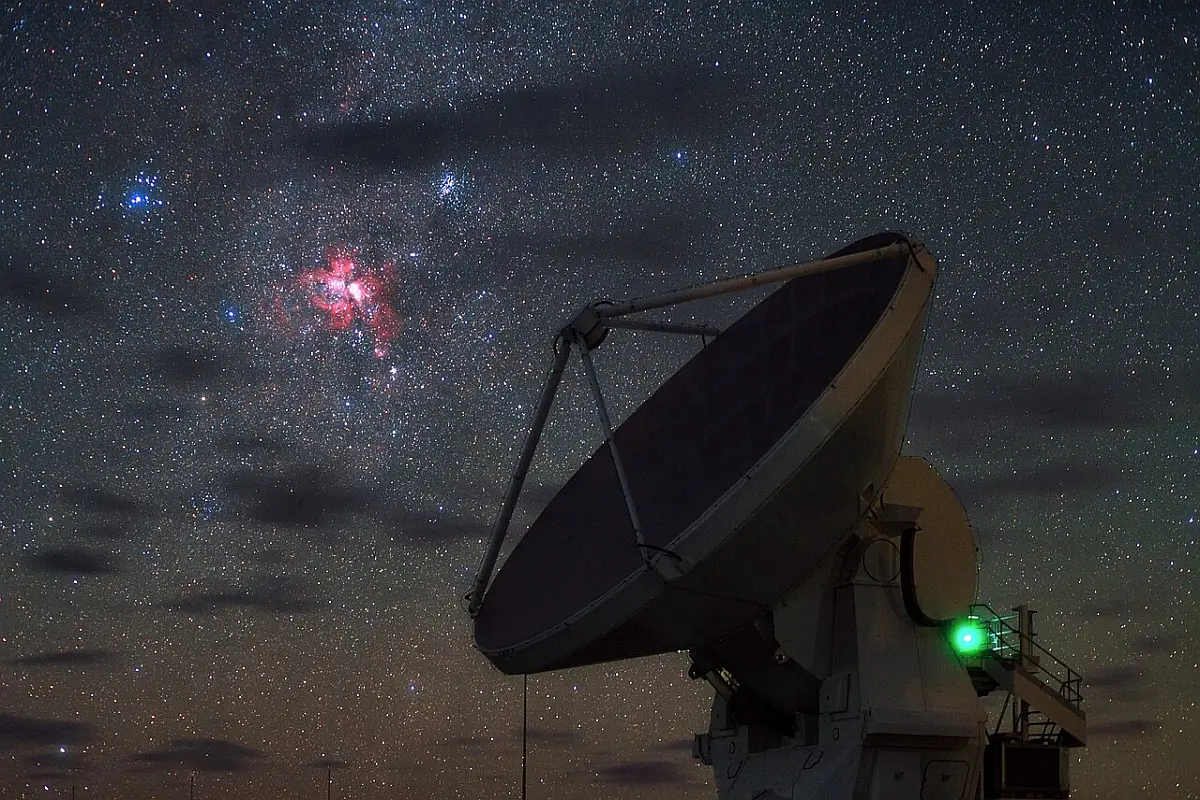
In this wonderful high definition, singe-exposure image taken during the ESO Ultra HD Expedition, three deep sky objects seem to shine in front of the dish of one of the Atacama Large Millimeter/submillimeter Array (ALMA) high-precision antennas. The most striking feature is the reddish Carina Nebula, also known as NGC 3372. It is a large cloud of gas, mostly hydrogen, in which star formation has recently taken place. The short-lived massive blue stars forged within the nebula emit copious amounts of ultraviolet radiation, which then ionises the surrounding gas and causes the hydrogen atoms to glow with a characteristic red colour. Eventually supernovae and strong stellar winds from the most massive stars will disperse the gas of the Carina Nebula, leaving behind one or more clusters of stars. Two such star clusters, known as NGC 3532 and IC 2602, can be seen respectively to the top right and top left of the Carina Nebula in this image. The three celestial objects belong to the constellation of Carina (The Keel) and were first catalogued by the French astronomer Nicolas Louis de Lacaille. They look close to one another in this image, but actually their distances from us are very different. Image credit: ESO/B. Tafreshi (CC BY 4.0)
How to find Theta Carinae
Theta Carinae lies in the far southern sky and is invisible to most observers in the northern hemisphere. At declination -64° 24′, it never rises above the horizon for observers north of the latitude 25° N. In the southern hemisphere, observers can easily locate Theta Carinae because it is the brightest star in the Southern Pleiades, a cluster visible to the unaided eye.
The bright star marks the northeastern vertex of the Diamond Cross. It is the brightest point of light between Acrux in the Southern Cross and Avior in the False Cross. A line from Alsephina through Aspidiske, along the short axis of the False Cross, points in the direction of Theta Carinae and the Southern Pleiades.
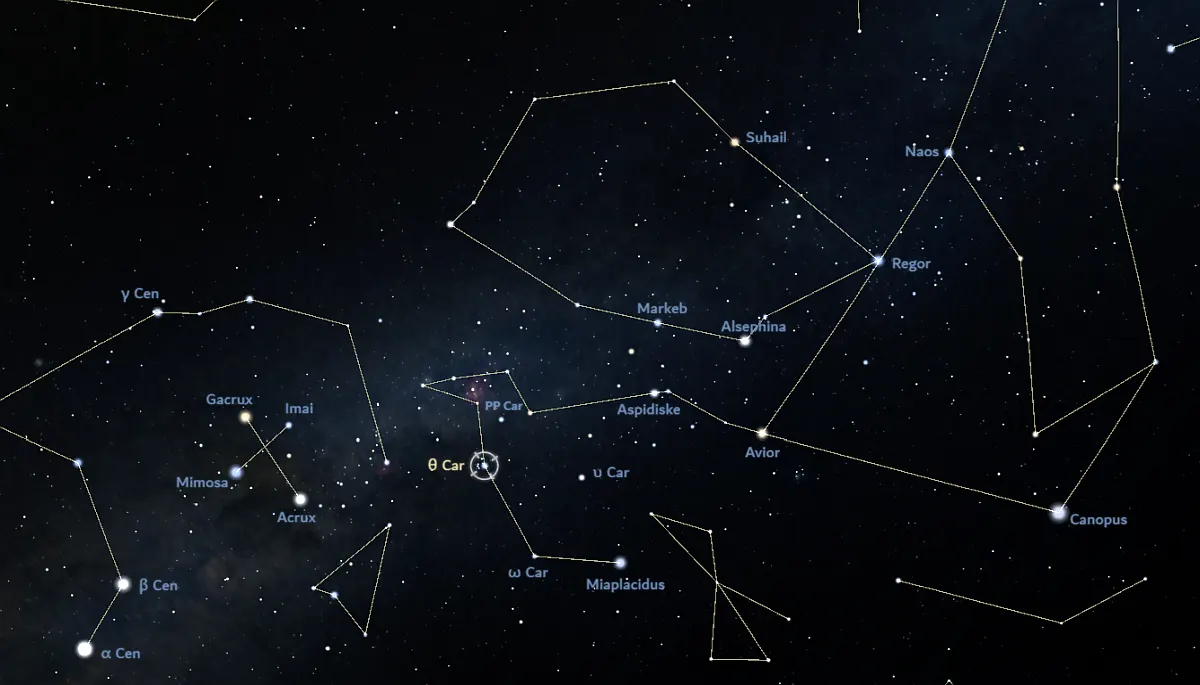
The location of Theta Carinae in the constellation Carina, credit: Stellarium (map annotated for this article)
Constellation
Theta Carinae is located in the southern constellation Carina. The celestial Keel was historically part of Argo Navis (the Ship Argo), the largest constellation in the sky. In Greek mythology, Argo was the ship on which Jason and the Argonauts sailed to Colchis to retrieve the Golden Fleece. The constellation was divided into Carina, Puppis (the Stern) and Vela (the Sails) by the French astronomer Nicolas Louis de Lacaille in the 18th century.
Carina occupies 494 square degrees of the southern sky and is the 34th largest of the 88 constellations. It is one of the most conspicuous southern constellations, containing six stars brighter than magnitude 3.0.
Canopus (Alpha Carinae), the brightest star in Carina, is the second brightest star in the sky, after Sirius. The A-type bright giant shines at magnitude -0.74 from a distance of 310 light-years.
Other bright stars in Carina include the white giant Miaplacidus (Beta Carinae), the massive orange giant Avior (Epsilon Carinae), the A-type supergiants Aspidiske (Iota Carinae) and Upsilon Carinae, and the hot blue giant Omega Carinae.
Carina hosts many other notable stars. These include the massive binary system Eta Carinae, the luminous blue variables HR Carinae and AG Carinae, the yellow hypergiant x Carinae, the massive triple star system HD 93129, the blue-white supergiant V533 Carinae, the red supergiant RT Carinae, the yellow supergiant l Carinae, and the Wolf-Rayet stars WR 22, WR 24 and WR 25. Some of these are among the most luminous and massive stars known.
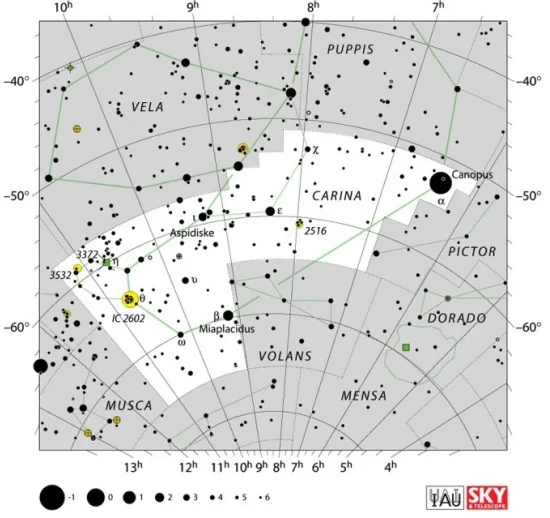
Carina constellation map by IAU and Sky&Telescope magazine (Roger Sinnott & Rick Fienberg) (CC BY 3.0)
Many of these stars reside in the Carina Nebula (NGC 3372), a vast stellar nursery located 8,500 light-years away. The stars that formed in the nebula are members of the Carina OB1 association, a giant stellar family 70 light-years across that is home to some of the Milky Way’s most massive and luminous stars. The Carina Nebula hosts the Homunculus Nebula around Eta Carinae, the Keyhole Nebula, the Defiant Finger globule, the Mystic Mountain pillar, and numerous clusters of exceptionally hot young blue stars.
In addition to the Carina Nebula and the Southern Pleiades cluster, famous deep sky objects in Carina include the bright Wishing Well Cluster (NGC 3532), the Southern Beehive (NGC 2516), the Gem Cluster (NGC 3293), the massive globular cluster NGC 2808, the Statue of Liberty Nebula (NGC 3576), and the large H II region NGC 3603.
The best time of the year to observe the stars and deep sky objects in Carina is in March, when the constellation appears higher in the sky in the early evening. The entire constellation is visible from locations south of the latitude 20° N.
The 10 brightest stars in Carina are Canopus (Alpha Car, mag. -0.74), Miaplacidus (Beta Car, mag. 1.69), Avior (Epsilon Car, mag. 1.86), Aspidiske (Iota Car, mag. 2.21), Theta Carinae (mag. 2.76), Upsilon Carinae (2.97), Omega Carinae (mag. 3.29), PP Carinae (p Car, mag. 3.22 – 3.55), V337 Carinae (q Car, mag. 3.36 – 3.44), and V357 Carinae (a Car, mag. 3.41 – 3.44).
Theta Carinae
| Spectral class | B0.5 Vp or B0Vp |
| U-B colour index | -1.00 |
| B-V colour index | -0.22 |
| Apparent magnitude | 2.76 |
| Absolute magnitude | -3.10 |
| Distance | 460 ± 10 light years (140 ± 4 parsecs) |
| Parallax | 7.16 ± 0.21 mas |
| Radial velocity | + 459.70 ± 0.12 km/s |
| Proper motion | RA: -18.36 ± 0.23 mas/yr |
| Dec.: +12.03 ± 0.18 mas/yr | |
| Mass (θ Car A) | 14.9 ± 0.4 M☉ |
| Luminosity (θ Car A) | 14,500 ± 1,000 L☉ |
| Radius (θ Car A) | 5.1 R☉ |
| Temperature (θ Car A) | 31,000 ± 1,000 K |
| Age (θ Car A) | 35 – 36 million years |
| Rotational velocity (θ Car A) | 108 ± 3 km/s |
| Surface gravity (θ Car A) | 4.20 cgs |
| Constellation | Carina |
| Right ascension | 10h 42m 57.4019674s |
| Declination | −64° 23′ 40.020796″ |
| Names and designations | Theta Carinae, Theta Car, θ Carinae, θ Car, FK5 406, HD 93030, HR 4199, HIP 52419, SAO 251083, IC 2602 37, CPD−63°1599, CPC 21 2210, PPM 358184, GC 14755, GCRV 6678, SKY# 20522, ALS 14951, CEL 3659, JP11 4482, SBC9 631, GEN# +3.26020037, EUVE J1042-64.3, 2E 2309, 2E 1041.1-6407, Renson 26850, IRAS 10411-6407, 2MASS J10425739-6423400, RX J1042.9-6423, 1RXS J104257.1-642339, N30 2542, AKARI-IRC-V1 J1042573-642339, TD1 15097, ROT 3699, UBV 9865, UBV M 38864, WEB 9545, uvby98 326020037, GES J10425736-6423398, Cl* IC 2602 W 18, TIC 390442076, TYC 8965-1765-1, Gaia DR3 5239828735016184448 |