Tianji, Zeta Herculis (ζ Her), is a spectroscopic binary star located 35 light-years away in the constellation Hercules. With an apparent magnitude of 2.81, it is the constellation’s second brightest star, after Kornephoros. The star is part of the Keystone, a relatively bright asterism that outlines Heracles’ torso. It is the brightest member of the Zeta Herculis moving group.
Zeta Herculis star system
The Zeta Herculis system is composed of an evolved yellow-white subgiant star of the spectral type F9 IV and a Sun-like yellow dwarf with the spectral class G7 V. The system appears as a single star to the unaided eye. It was first reported to be a double star by the Baltic German astronomer Friedrich Georg Wilhelm von Struve in 1826.
Zeta Herculis A and Zeta Herculis B have an orbital period of 34.45 years and an eccentricity of 0.46. They are separated by only 1.33 arcseconds in the sky and cannot be resolved in amateur telescopes.
Zeta Herculis A is the brighter of the two stars. It has an apparent magnitude of 2.88, while the companion shines at magnitude 5.52. The system has a combined apparent magnitude of 2.81. It is older than the Sun, with an estimated age of 6.2 billion years.
The physical distance between the two components is around 15 astronomical units (Earth – Sun distances). The two stars are distant enough from each other to not significantly affect each other. There may be a third component in the system, but its presence has not been confirmed.
The nearest neighbours of Zeta Herculis are the red dwarf LP 275-68 (3.4 light-years) and orange dwarf BD+33 2777 (3.5 light-years).
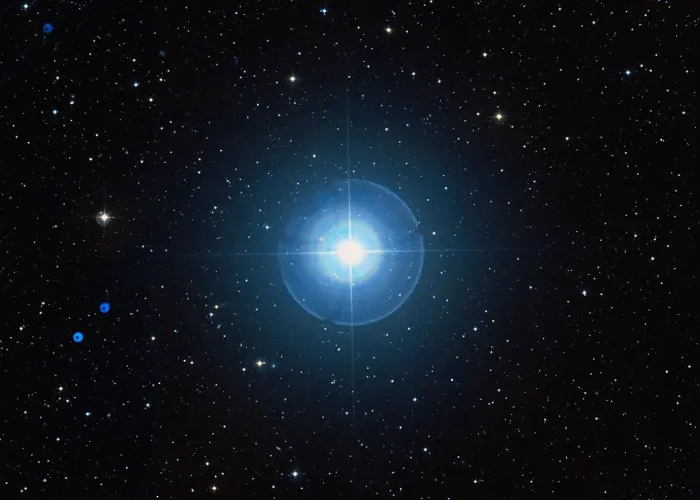
Tianji (Zeta Herculis), image credit: ESO/Digitized Sky Survey 2 (CC BY 4.0)
Zeta Herculis A
Zeta Herculis A is larger, more massive and more evolved than our Sun. It has a mass of 1.45 solar masses and a radius around 2.76 times that of the Sun. With a surface temperature of 5,760 K, it shines with 7.372 solar luminosities. The star is a relatively slow spinner, with a projected rotational velocity of 4.8 km/s.
The yellow-white star has reached the end of its main sequence lifetime as it exhausted the supply of hydrogen fuel in its core. It will next evolve into a giant. Like all Sun-like stars, when it comes to the end of its life, it will expel its outer layers to form a planetary nebula and slowly cool and fade as a dim white dwarf.
Related article:
Life-Cycle of Intermediate-Mass Stars
Zeta Herculis B
Zeta Herculis B is a G-type main sequence star similar to the Sun. It has a mass of 0.98 solar masses and a radius of 0.915-0.920 solar radii. With an effective temperature of around 5,300 K, it shines with 62% of the Sun’s luminosity.
How bright is Zeta Herculis?
Shining at magnitude 2.81, Tianji is a moderately bright star, visible from areas without too much light pollution. It is the second brightest star in Hercules and, on average, the 133rd brightest star in the sky.
Zeta Herculis is only slightly fainter than Kornephoros, the lucida of Hercules, Imai in Crux, Rastaban in Draco, Cor Caroli in Canes Venatici, and Gamma Lupi in Lupus. It is about as bright as Nihal in Lepus and Beta Hydri in Hydrus, and it just outshines Paikauhale in Scorpius, Kaus Borealis in Sagittarius, and Algenib in Pegasus.
Zeta Herculis moving group
Zeta Herculis is the brightest member of the Zeta Herculis moving group, a family of older, high-velocity stars that formed in the same molecular cloud and share a common motion through space. Other members of the group include Beta Hydri in the constellation Hydrus, Zeta Reticuli in Reticulum, Phi2 Pavonis in Pavo, and 1 Hydrae in Hydra. Most of these are low-metallicity yellow or yellow-white main sequence stars and subgiants older than the Sun.
The existence of the Zeta Herculis moving group was originally proposed by the American-Australian astronomer Olin J. Eggen in 1958. Eggen looked for stars that had a similarly high velocity to Zeta Herculis and were moving in the same direction. The list of candidate members was refined to ten stars by the English astronomer Richard Wooley in 1970.
Southwestern vertex of the Keystone
Zeta Herculis forms the Keystone asterism with Pi, Eta, and Epsilon Herculis. The conspicuous star pattern lies in the region between the bright Vega in the constellation Lyra and Arcturus in Boötes, between the head of the Dragon and the head of the Serpent.
The Keystone stars form the torso of Hercules. The celestial hero is typically depicted standing with one foot on the Dragon’s head, formed by Eltanin, Rastaban, Grumium and Kuma. Hercules’ head is marked by the bright Rasalgethi, which appears near Rasalhague, the star that marks the head of Ophiuchus.
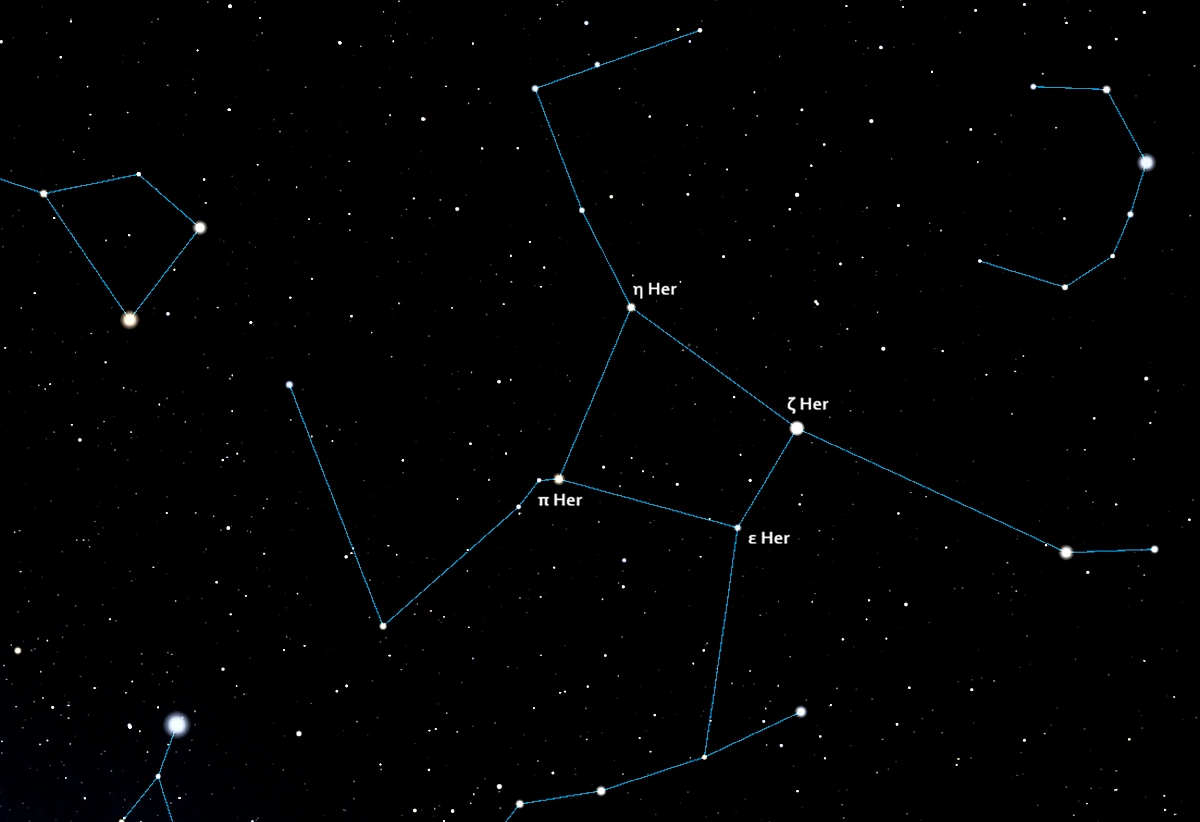
The Keystone in Hercules, image: Stellarium (annotated for this article)
Name
The name Tianji comes from traditional Chinese astronomy. Zeta Herculis is part of an asterism known as 天紀 (Tiān Jì), Celestial Discipline, which represents officials in charge of maintaining discipline or recording livestock. The asterism is also formed by Xi Coronae Borealis, Khepdenreret (Epsilon Herculis), 59 Herculis, 61 Herculis, 68 Herculis, HD 160054, and Theta Herculis. It is part of the Heavenly Market Enclosure, which represents the emperor’s realm.
The name was approved by the International Astronomical Union’s (IAU) Working Group on Star Names (WGSN) on May 14, 2026. It formally applies only to the primary component, Zeta Herculis A.
In Chinese astronomy, the name Tianji is also used for Suhail in the constellation Vela and Phecda in Ursa Major, but with different meanings.
Zeta Herculis was also historically called Rutilicus. The name is a corruption of the Latin titillicus (“armpit”). It was sometimes also used for the brighter Kornephoros.
How to find Zeta Herculis
Zeta Herculis marks the southwestern corner of the Keystone in Hercules. It lies roughly halfway between Eltanin in Draco and Unukalhai in Serpens. It is the nearest of the Keystone stars to Alphecca in the Northern Crown.
At declination +32°, the star is visible from all locations north of the latitude 57° S, which is to say from everywhere except the Antarctic Circle.
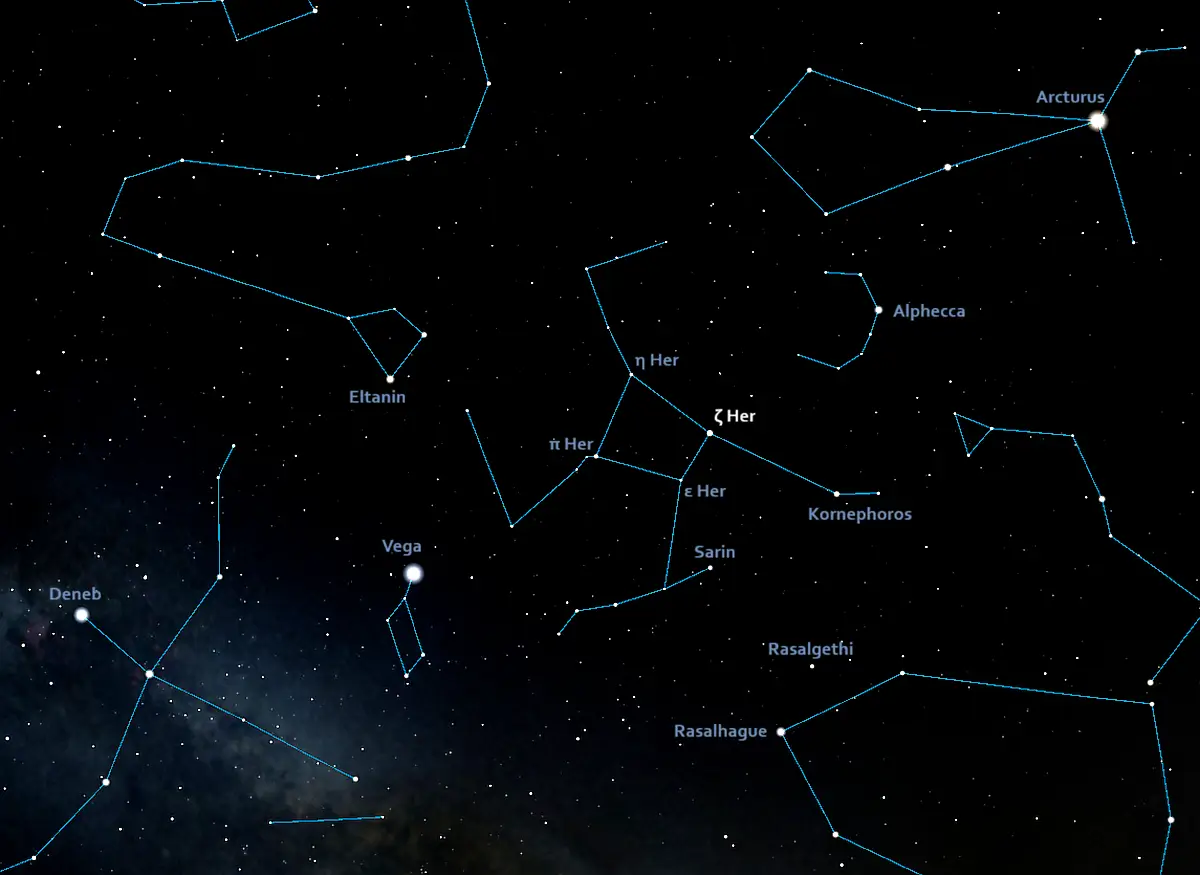
Location of Zeta Herculis, image: Stellarium (annotated for this article)
A nearby bright deep sky object: Hercules Globular Cluster
Zeta and Eta Herculis can be used to find the Hercules Globular Cluster (Messier 13), the brightest globular cluster in the northern celestial hemisphere. The cluster lies about a third of the way from Eta to Zeta. In good conditions, it is visible without binoculars.
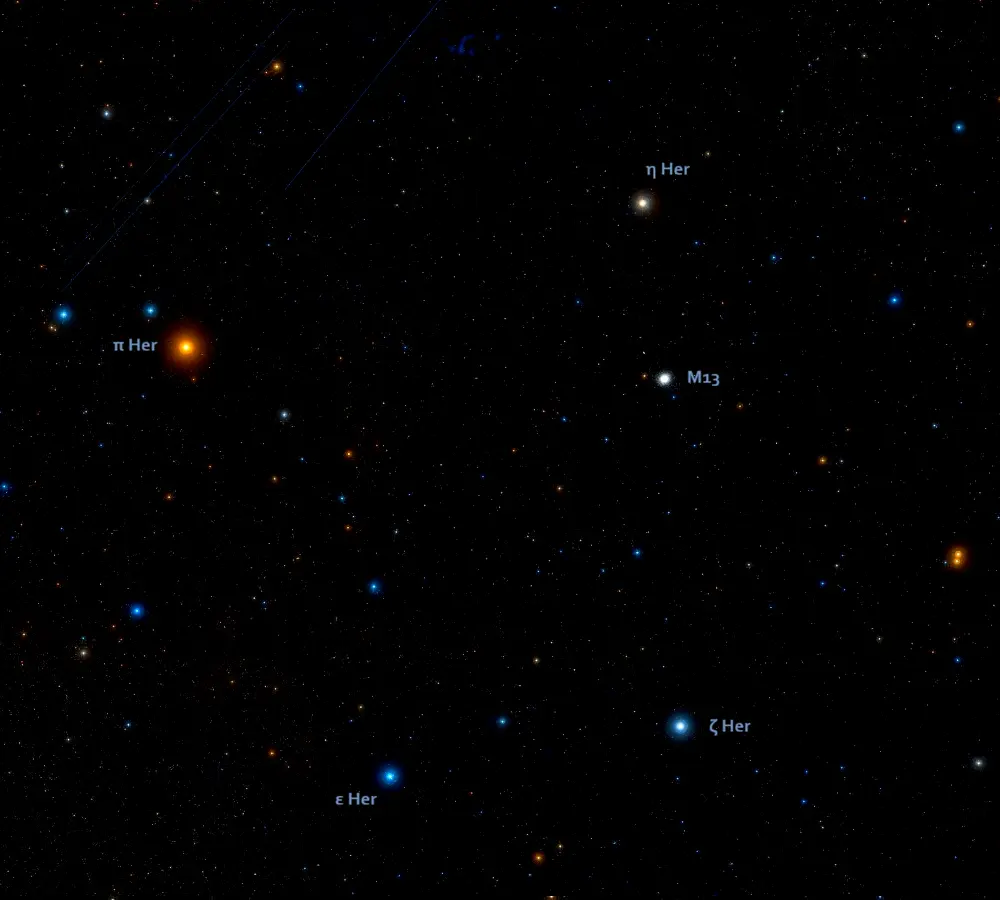
Keystone and Hercules Globular Cluster, image credit: ESO/Digitized Sky Survey 2 (CC BY 4.0)
Constellation
Tianji lies in the northern constellation Hercules. Hercules is one of the Greek constellations, catalogued by the Greco-Roman astronomer Claudius Ptolemy in his Almagest in the 2nd century CE. It represents the Roman mythical hero based on the Greek Heracles.
Hercules stretches across 1,225 square degrees of the northern sky and is the fifth largest of the 88 constellations. It is the second largest constellation in the northern celestial hemisphere, after Ursa Major (the Great Bear).
Kornephoros (Beta Herculis), the brightest star in Hercules, is a G-type giant that shines at magnitude 2.81 from a distance of 140 light-years. Its name means “club bearer” in Greek. Beta and Zeta Herculis are the only stars in the constellation that are brighter than magnitude 3.0.
Other relatively bright stars in Hercules include the spectroscopic binary star Delta Herculis (Sarin), the orange bright giant Pi Herculis (Nüchuang), the multiple star system Alpha Herculis (Rasalgethi), the quadruple star system Mu Herculis, the yellow giants Eta Herculis and Xi Herculis, and the spectroscopic binary stars Gamma Herculis and Iota Herculis (Tianbang).
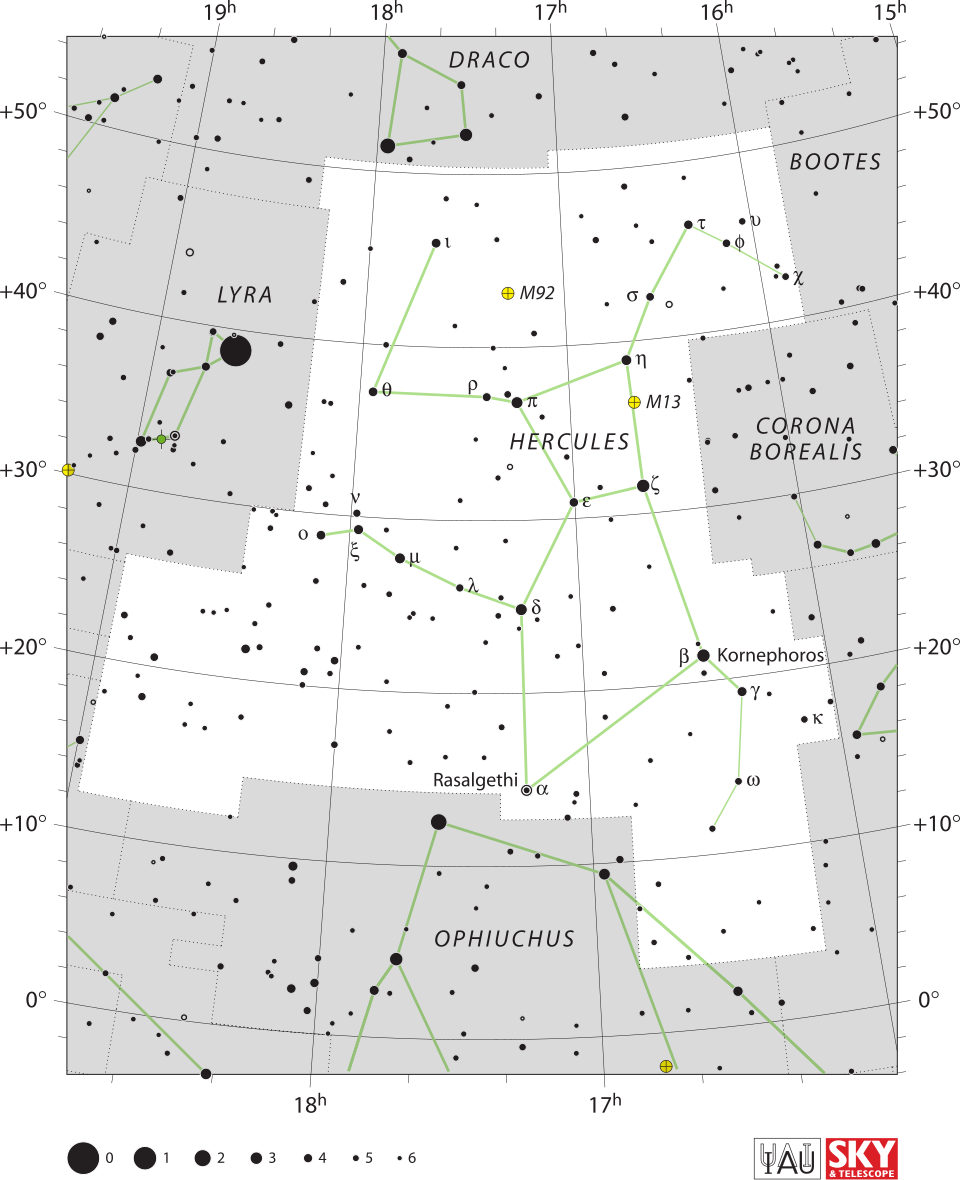
Hercules constellation map by IAU and Sky & Telescope magazine (Roger Sinnott & Rick Fienberg) (CC BY 3.0)
Along with the Hercules Globular Cluster, deep sky objects in the constellation include the globular clusters Messier 92 and NGC 6229, the radio galaxy Hercules A, the interacting pair of galaxies Arp 272, and the planetary nebulae Abell 39, the Turtle Nebula (NGC 6210), and the White-Eyed Pea Nebula (IC 4593).
The best time of the year to observe the stars and deep sky objects in Hercules is during the month of July, when the constellation rises higher above the horizon in the early evening. The entire constellation can be seen from locations north of the latitude 39° S.
The 10 brightest stars in Hercules are Kornephoros (Beta Her, mag. 2.78), Tianji (Zeta Her, mag. 2.81), Sarin (Delta Her, mag. 3.126), Nüchuang (Pi Her, mag. 3.15), Rasalgethi (Alpha Her, mag. 3.350), Mu Herculis (mag. 3.417), Eta Herculis (mag. 3.487), Xi Herculis (mag. 3.70), Gamma Herculis (mag. 3.75), and Tianbang (Iota Her, mag. 3.80).
Tianji – Zeta Herculis
| Spectral class | F9 IV + G7 V |
| Variable type | Suspected |
| U-B colour index | +0.21 |
| B-V colour index | +0.65 |
| Apparent magnitude | 2.81 |
| Absolute magnitude | 2.65 |
| Absolute magnitude (bolometric) | 2.699/5.254 |
| Distance | 35.0 ± 0.2 light-years (10.72 ± 0.05 pc) |
| Parallax | 93.32 ± 0.47 mas |
| Radial velocity | -68.43 km/s |
| Proper motion | RA: -461.52 mas/yr |
| Dec.: +342.28 mas/yr | |
| Constellation | Hercules |
| Right ascension | 16h 41m 17.16104s |
| Declination | +31° 36′ 09.7873″ |
| Names and designations | Tianji, Zeta Herculis, Zeta Her, ζ Herculis, ζ Her, zet Her, 40 Herculis, 40 Her, HD 150680, HR 6212, HIP 81693, HIC 81693, SAO 65485, GC 22464, GCRV 9600, BD +31 2884, AG +31 1438, PLX 3799, PPM 79555, LHS 3234, LSPM J1641+3136, LTT 14952, NLTT 43387, N30 3734, JP11 2785, LFT 1299, SKY# 30048, GEN# +1.00150680, GSC 02582-03158, STF 2084, ASCC 595670, CSI +31 2884 2, CSV 101603, CNS5 4097, Ci 20 1007, NSV 7915, IRC +30294, UCAC4 609-053234, USNO-B1.0 1216-00260952, uvby98 100150680, SBC7 583, SBC9 915, ROT 2374, RX J1641.3+3135, 1RXS J164118.2+313553, WEB 13799, Zkh 230, [ZEH2003] RX J1641.3+3135 1, TIC 43255143, TD1 19451, UBV 14151, UBV 21436, UBV M 21627, IRAS 16393+3141, 2MASS J16411728+3136093, ADS 10157 AB, CCDM J16413+3136AB, WDS J16413+3136AB |
Zeta Herculis A
| Mass | 1.45 ± 0.01 M☉ |
| Luminosity | 7.372 ± 0.080 L☉ |
| Radius | 2.76 ± 0.02 R☉ |
| Temperature | 5,760 ± 96 K |
| Metallicity | +0.04 ± 0.03 dex |
| Age | 6.2 billion years |
| Rotational velocity | 4.8 km/s |
| Surface gravity | 3.72 ± 0.03 cgs |
Zeta Herculis B
| Mass | 0.98 ± 0.02 M☉ |
| Luminosity | 0.62 ± 0.06 L☉ |
| Radius | 0.915 – 0.920 R☉ |
| Temperature | 5,300 ± 150 K |