Alpha Muscae (α Mus) is a massive blue star located approximately 315 light-years away in the southern constellation of Musca (the Fly). With an apparent magnitude of 2.69, it is the constellation’s brightest star. The young star lies in the far southern sky, south of the bright stars of the Southern Cross, and marks the Fly’s left wing.
What type of star is Alpha Muscae?
Alpha Muscae is a massive blue star of the spectral type B2 IV-V. The spectral class indicates a star coming to the end of its main sequence lifetime and evolving into a subgiant. Even though it presents as a more evolved star, Musca’s luminary is still fusing hydrogen in its core. A 2024 study classified it as a main sequence star with the spectral class B2V and placed it at a distance of 116 parsecs (378 light-years) away.
With a mass of 8.8 solar masses, the star is a supernova candidate. It has an estimated age of only 18.3 million years and is about halfway through its existence on the main sequence. It will live for a total of 30-40 million years.
Alpha Muscae has a radius 5.22 times that of the Sun and is 4,270 times more luminous than the Sun. With an effective temperature of 20,400 K, most of its energy output is in the ultraviolet part of the spectrum.
The massive star is a very fast spinner. With a projected rotational velocity of at least 114 km/s, it takes less than two days to complete a rotation.
Alpha Muscae is similar to Zeta Cassiopeiae (Fulu). The two stars have the same spectral type, but Zeta Cassiopeiae is slightly hotter, older, more massive, and more luminous. It has a mass of 8.96 solar masses, a surface temperature of 21,500 K, and a luminosity of 7,200 Suns.
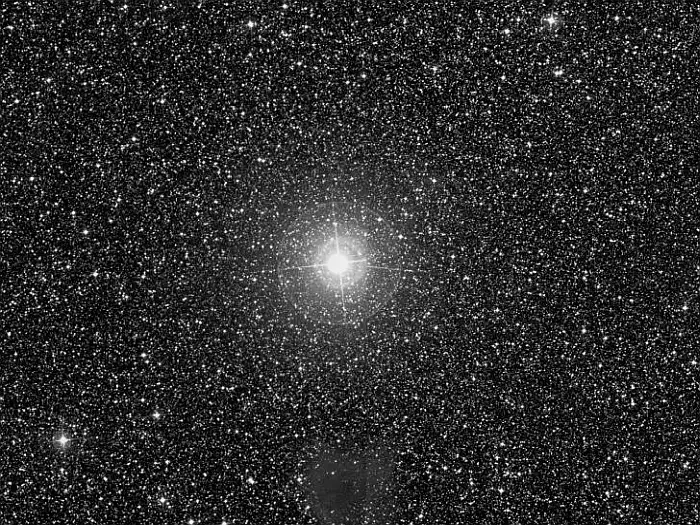
Alpha Muscae, image credit: ESO/Digitized Sky Survey 2 (CC BY 4.0)
Beta Cephei variability
Alpha Muscae is classified as a Beta Cephei variable. Beta Cephei stars show small variations in brightness because of pulsations of their surfaces. The pulsations are thought to be caused by unusual properties of iron at high temperatures (200,000 K) in the stellar interiors.
The brightness of Alpha Muscae has been observed to vary between magnitude 2.68 and 2.73 with a period of only 2.17 hours.
Beta Cephei variables are typically hot, blue B-type stars with masses between 7 and 20 solar masses. Bright examples of this class include the class prototypes Alfirk (Beta Cephei) and Mirzam (Beta Canis Majoris), as well as Hadar, Epsilon and Kappa Centauri in Centaurus, Mimosa and Imai in Crux, Spica in Virgo, Shaula, Kappa Scorpii and Alniyat in Scorpius, Uridim and Delta Lupi in Lupus, Algenib in Pegasus, Áldu (Epsilon Persei) in Perseus, Eta Orionis in Orion, and Theta Ophiuchi in Ophiuchus.
A 2005 study found the variability of Alpha Muscae dubious and proposed that the star may be a long period variable. Based on Hipparcos photometry, the star’s brightness does not show variability of more than 2.5 millimagnitudes.
Member of the Scorpius-Centaurus association
Alpha Muscae is a member of the Lower Centaurus-Crux subgroup of the larger Scorpius-Centaurus OB association, the nearest association of massive O- and B-type stars to the solar system. The members of the stellar family formed in the same molecular cloud and share a common proper motion. The brightest members of the Sco-Cen association, Hadar, Acrux and Antares, are some of the brightest stars in the sky.
Alpha Muscae has variously been assigned to the Lower Centaurus-Crux or the Upper Scorpius-Centaurus subgroup of Sco OB2. Many bright stars in the same region of the sky belong to the Lower Centaurus-Crux association, including Hadar, Epsilon Centauri, Delta Centauri and Lambda Centauri in the constellation Centaurus, Acrux, Mimosa and Imai in Crux, and Beta Muscae in Musca.
How bright is Alpha Muscae compared to other stars?
Shining at magnitude 2.69, Alpha Muscae is the lucida of the constellation Musca and, on average, the 114th brightest star in the sky. It is only slightly fainter than Muphrid in the constellation Boötes and Beta Lupi in Lupus. It as bright as Hassaleh in Auriga and Mu Velorum in Vela, and just outshines Lesath in Scorpius, Pi Puppis in Puppis, Kaus Media in Sagittarius, and Tarazed in Aquila.
Name
Alpha Muscae does not have a proper name formally approved by the International Astronomical Union (IAU). It is listed as HD 109668 in the Henry Draper Catalogue, HR 4798 in the Yale Catalogue of Bright Stars, and HIP 61585 in the Hipparcos Catalogue.
In Wardaman culture, Alpha Muscae is known as Burangalul and represents the “forehead band” of the constellation Buran (“boomerang”), which corresponds to the modern Musca.
How to find Alpha Muscae
Alpha Muscae is very easy to find because it lies in the same region as the bright Southern Pointers (Alpha and Beta Centauri) and the Southern Cross. It can be found by extending a line from Ginan, the faintest star of the Southern Cross, through Acrux.
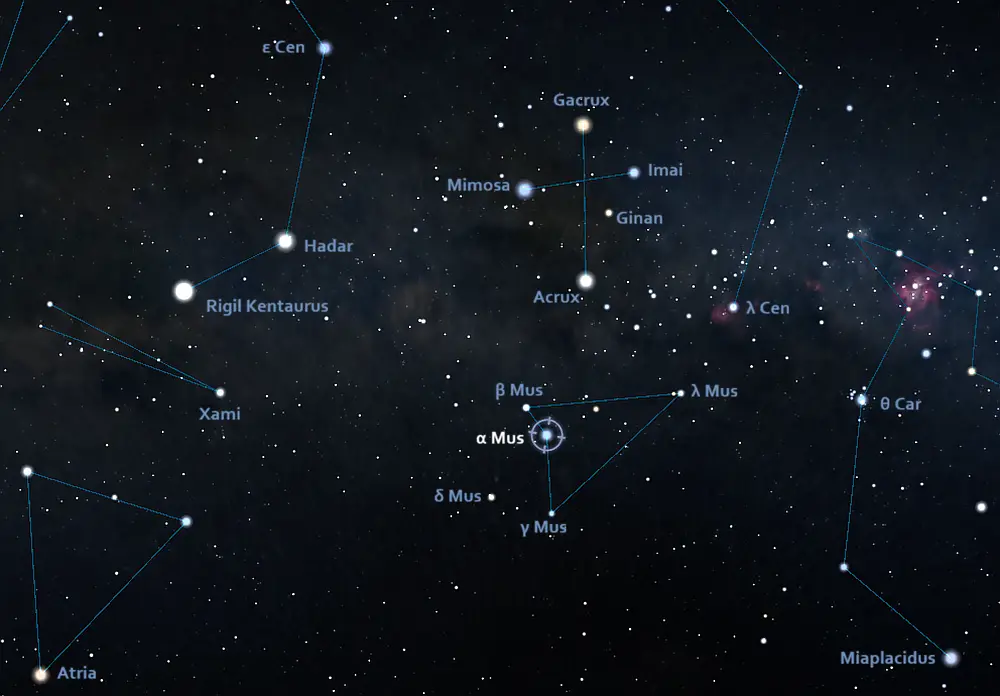
Alpha Muscae location, image: Stellarium (annotated for this article)
Constellation
Alpha Muscae is located in the constellation Musca. The celestial Fly is one of the smallest constellations, stretching across only 138 square degrees of the far southern sky. It was introduced by the Dutch-Flemish astronomer Petrus Plancius in 1598 based on observations of the Dutch navigators Pieter Dirkszoon Keyser and Frederick de Houtman. The constellation first appeared in a celestial atlas in German astronomer Johann Bayer’s Uranometria (1603). It was also known as Apis (the Bee).
In the 18th century, the French astronomer Nicolas Louis de Lacaille assigned Bayer designations to 10 stars in Musca and renamed the constellation into Musca Australis, the Southern Fly. The name was later shortened to simply Musca.
Other than Alpha Muscae, relatively bright stars in the constellation include the massive blue binary star Beta Muscae, the orange giants Delta Musca and Mu Muscae, the A-type main sequence star Lambda Muscae, the B-type main sequence star Gamma Muscae, the red giant Epsilon Muscae, and the multiple star system Eta Muscae.
Musca also hosts the massive multiple star system Theta Muscae, containing the second brightest Wolf-Rayet star in the sky, the Cepheid variables S Muscae and R Muscae, the Algol and RS Canum Venaticorum variable GT Muscae, the nova GQ Muscae, the symbiotic star SY Muscae, and the massive Beta Lyrae system TU Muscae.
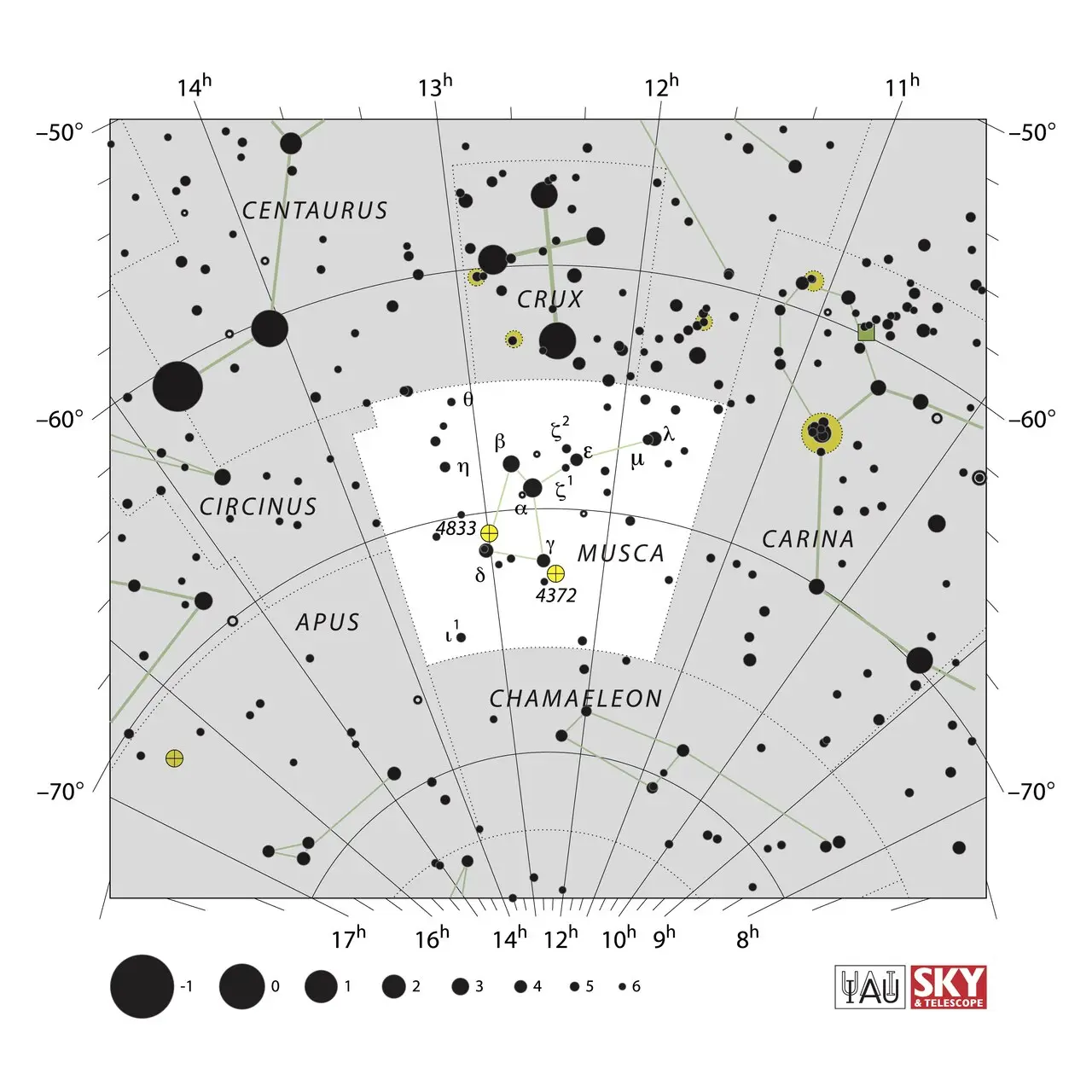
Musca constellation map by IAU and Sky & Telescope magazine (Roger Sinnott & Rick Fienberg) (CC BY 3.0)
Deep sky objects in Musca include the planetary nebulae NGC 5189 (the Spiral Planetary Nebula) and the Engraved Hourglass Nebula (MyCn 18), the Dark Doodad Nebula, a portion of the Coalsack Nebula, the open cluster NGC 4463, and the globular clusters NGC 4833 and NGC 4372.
The best time of the year to observe the stars and deep sky objects in Musca is during the month of May, when the celestial Fly rises higher above the horizon in the early evening. The entire constellation is visible from locations south of the latitude 10° N.
The 10 brightest stars in Musca are Alpha Muscae (mag. 2.69), Beta Muscae (mag. 3.05), Delta Muscae (mag. 3.61), Lambda Muscae (mag. 3.63), Gamma Muscae (mag. 3.87), Epsilon Muscae (mag. 4.0 – 4.3), Mu Muscae (mag. 4.75), Eta Muscae (mag. 4.79), HD 115211 (mag. 4.86), and HD 103079 (mag. 4.89).
Alpha Muscae
| Spectral class | B2 IV–V |
| Variable type | Beta Cephei |
| U-B colour index | −0.854 |
| B-V colour index | −0.219 |
| Apparent magnitude | 2.69 |
| Absolute magnitude | −2.2 |
| Distance | 315 ± 3 light-years (97 ± 1 parsecs) |
| Parallax | 10.34 ± 0.11 mas |
| Radial velocity | +13 km/s |
| Proper motion | RA: −40.20 mas/yr |
| Dec.: −12.80 mas/yr | |
| Mass | 8.8 ± 0.1 M☉ |
| Luminosity | 4,270 ± 100 L☉ |
| Radius | 5.22 ± 0.06 R☉ |
| Temperature | 20,400 K |
| Age | 18.3 ± 3.2 million years |
| Rotational velocity | 114 km/s |
| Surface gravity | 4.06 cgs |
| Constellation | Musca |
| Right ascension | 12h 37m 11.01789s |
| Declination | −69° 08′ 08.0332″ |
| Names and designations | Alpha Muscae, Alpha Mus, α Muscae, α Mus, alf Mus, HD 109668, HR 4798, HIP 61585, HIC 61585, FK5 474, GC 17179, GCRV 7585, HGAM 2009, SAO 251974, SKY# 23570, JP11 2248, CD-68 1104, CPC 21.1 2288, CPD-68 1702, PPM 359520, CEL 4131, CSI -68 1702 41, CSV 6935, ALS 14971, AKARI-IRC-V1 J1237109-690808, GEN# +1.00109668, GSC 09228-03049, N30 2910, NSV 5776, IRAS 12341-6851, 2MASS J12371102-6908080, ROT 1849, TIC 327150358, TYC 9228-3049-1, WEB 10956, UBV 11317, UBV M 18403, TD1 16387, uvby98 100109668, Gaia DR2 5855593454566484608, Gaia DR3 5855593454594292736, CCDM J12372-6908A, IDS 12312-6835 A, WDS J12372-6908A, WDS J12372-6908Aa,Ab |