Gamma Trianguli (γ Tri) is a fast-spinning white main sequence star located approximately 112.3 light-years away in the northern constellation of Triangulum. It was given the proper name Apdu in 2025. With an apparent magnitude of 4.01, it is the third brightest star in Triangulum, after Beta Trianguli (Alaybasan) and Alpha Trianguli (Mothallah). The three stars form the triangle that gives the constellation Triangulum its name.
Star type
Gamma Trianguli is a white main sequence star of the spectral type A1Vnn. The “nn” suffix indicates diffuse absorption lines in the star’s spectrum.
The star has a mass of 2.7 solar masses and a radius 2.09 times that of the Sun. With an effective temperature of 9,210 K, it shines with a luminosity of 28 Suns. It is much younger than the Sun, with an estimated age of only 300 million years.
Gamma Trianguli is an exceptionally fast spinner. It has a projected rotational velocity of 254 km/s.
The star has a dusty debris disk. The disk lies 2.24 arcseconds from the star, corresponding to a physical distance of 80 astronomical units (AU). It has an estimated mass of 2.9 × 10⁻² Earth masses.
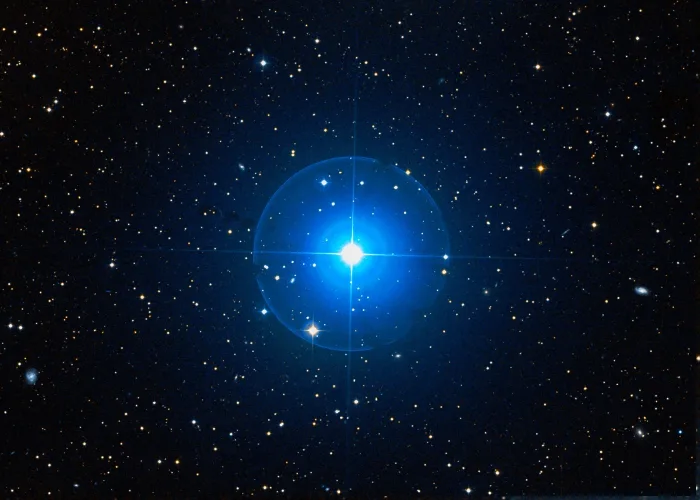
Apdu (Gamma Trianguli), image credit: ESO/Digitized Sky Survey 2 (CC BY 4.0)
Facts
Like many other fast-rotating A-type stars, including the bright Vega, Altair and Fomalhaut, Gamma Trianguli has an oblate shape. Its polar radius is significantly smaller than its radius at the equator. Because the star’s poles are closer to the centre of mass, they are hotter and brighter than the equatorial region.
This phenomenon is called gravity darkening (or gravity brightening). It is common among fast spinning stars. Other bright examples include Rasalhague in the constellation Ophiuchus, Alderamin in Cepheus, Alkaid, Megrez and Phecda in the Big Dipper in Ursa Major, and most bright members of the Pleiades cluster in Taurus.
Gamma Trianguli forms an optical line-of-sight triple with Deltoton (Delta Trianguli) and 7 Trianguli. The three stars are not gravitationally bound to one another. Deltoton is a Sun-like yellow dwarf only 35.2 light-years from the Sun, and 7 Trianguli is an A-type star located approximately 360 light years away.
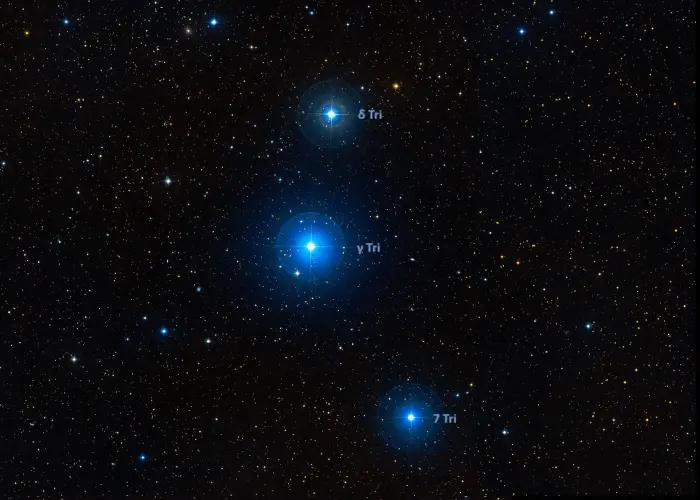
Gamma Trianguli, Delta Trianguli and 7 Trianguli, image credit: ESO/Digitized Sky Survey 2 (CC BY 4.0)
Name
The name Apdu comes from ancient Egyptian astronomy. Apd(w), ȝpd (the Bird) was an Egyptian constellation used in the 2nd millennium BC. The constellation was located in the region of the modern-day Triangulum. The International Astronomical Union’s (IAU) Working Group on Star Names (WGSN) formally approved the name Apdu for Gamma Trianguli to preserve an ancient cultural name on November 13, 2025.
In Chinese astronomy, Gamma Trianguli is known as 天大將軍十 (Tiān Dà Jiāng Jūn shí), the Tenth Star of Heaven’s Great General. It forms the Heaven’s Great General asterism with Almach (Gamma Andromedae), Dajiangjunbei (Phi Persei), Nembus (51 Andromedae), 49 Andromedae, Chi Andromedae, Titawin (Upsilon Andromedae), Tau Andromedae, 56 Andromedae, Alaybasan (Beta Trianguli), and Deltoton (Delta Trianguli). The asterism is part of the greater Bond mansion, which corresponds to the body of the White Tiger of the West.
Location
Gamma Trianguli is easy to find on a clear night because it is part of the triangle asterism that gives the constellation Triangulum its name. It forms the base of the triangle with the brighter Beta Trianguli. The asterism can be found between the bright Mirach and Almach in Andromeda and the flat triangle formed by Hamal, Sheratan and Mesarthim in Aries.
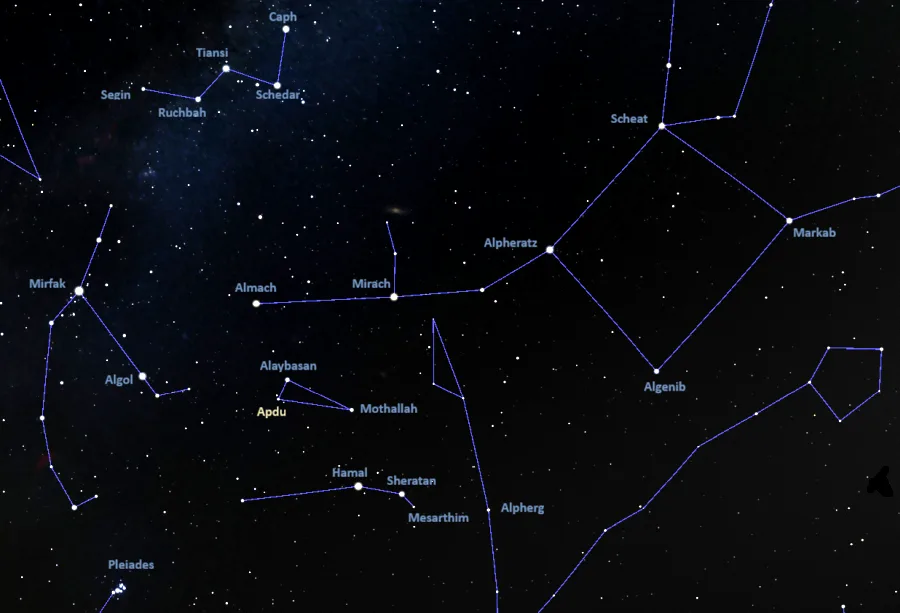
Gamma Trianguli location, image: Stellarium
The relatively bright spiral galaxy NGC 925 appears just east of Gamma Trianguli. Popularly known as the Amatha Galaxy, it can be observed in small and medium telescopes. It is a member of the NGC 1023 Group, named after the Perseus Lenticular Galaxy (NGC 1023) in the neighbouring constellation Perseus.
At declination +34°, Apdu never rises above the horizon for observers south of the latitude 56° S.
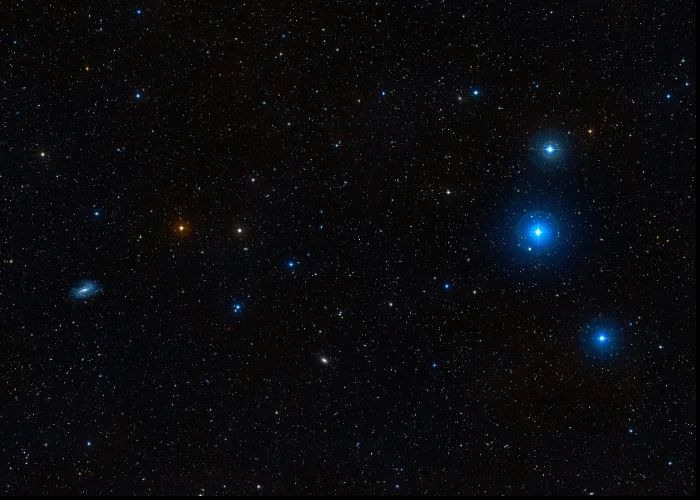
Apdu (Gamma Trianguli) and the Amatha Galaxy (NGC 925), image credit: ESO/Digitized Sky Survey 2 (CC BY 4.0)
Constellation
Gamma Trianguli is located in the constellation Triangulum (the Triangle). Triangulum is one of the smallest northern constellations. Stretching across only 132 square degrees of the sky between the brighter Andromeda and Aries, it is the 78th largest of the 88 constellations.
Triangulum is one of the ancient constellations listed by the Greek astronomer Claudius Ptolemy of Alexandria in the 2nd century CE. In ancient Greece, it was known as Deltoton (Δελτωτόν) because its prominent triangle asterism looks like the Greek letter delta (Δ).
The celestial Triangle is not particularly conspicuous in the sky, but it can be spotted on a clear, dark night from areas without too much light pollution. Its main constellation pattern is formed by its three brightest stars: Alaybasan (Beta Trianguli, mag. 3.00), Mothallah (Alpha Trianguli, mag. 3.42), and Apdu (Gamma Trianguli, mag. 4.01).
Beta Trianguli, the constellation’s lucida, is a binary star composed of two white giants located approximately 141 light-years away. Alpha Trianguli is a triple star system consisting of two evolved F-type stars and a red dwarf. The system lies 63.3 light years away.
Other notable stars in Triangulum include the spectroscopic binary Deltoton (Delta Trianguli), composed of two Sun-like stars, the quadruple star system Triminus (Iota Trianguli), the K-type giant 14 Trianguli, the Mira variable R Trianguli, and the yellow dwarf HD 9446 with at least two orbiting exoplanets.
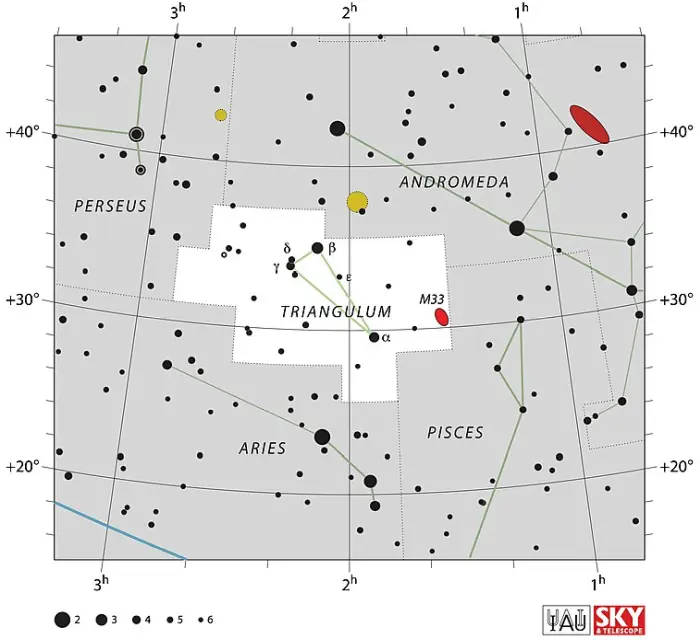
Triangulum constellation map by IAU and Sky&Telescope magazine (Roger Sinnott & Rick Fienberg) (CC BY 3.0)
Triangulum hosts the Triangulum Galaxy (Messier 33), the most distant object visible to the unaided eye. The nearby spiral galaxy is home to some of the most luminous stars known, including the luminous blue variables Var 83, Var A, Var B, Var C, and Romano’s Star (GR 290).
Other deep sky objects in Triangulum include the open star cluster Caldwell 95 (NGC 6025), the Amatha Galaxy (NGC 925), the barred spiral galaxies NGC 672 and NGC 784, the quasar 3C 48, and the elliptical galaxies NGC 860, NGC 785, and NGC 807.
The best time of the year to see the stars and deep sky objects in Triangulum is during the month of December, when the constellation appears higher in the sky in the early evening. The entire constellation can be seen from locations north of the latitude 60° S.
The 10 brightest stars in Triangulum are Alaybasan (Beta Tri, mag. 3.0), Mothallah (Alpha Tri, mag. 3.42), Apdu (Gamma Tri, mag. 4.01), Deltoton (Delta Tri, mag. 4.865), Triminus (Iota Tri, mag. 4.95), 14 Trianguli (mag. 5.14), 7 Trianguli (mag. 5.25), 10 Trianguli (mag. 5.29), 12 Trianguli (mag. 5.37), and 15 Trianguli (mag. 5.396).
Apdu – Gamma Trianguli
| Spectral class | A1Vnn |
| U-B colour index | +0.02 |
| B-V colour index | +0.02 |
| Apparent magnitude | 4.01 |
| Absolute magnitude | +1.35 |
| Distance | 112.3 ± 1.0 light-years (34.4 ± 0.3 parsecs) |
| Parallax | 27.9795 ± 0.4608 mas |
| Radial velocity | +5.11 ± 1.74 km/s |
| Proper motion | RA: 45.253 ± 0.326 mas/yr |
| Dec.: -52.685 ± 0.362 mas/yr | |
| Mass | 2.7 M☉ |
| Luminosity | 28 ± 1 L☉ |
| Radius | 2.09 ± 0.04 R☉ |
| Temperature | 9,210 ± 100 K |
| Age | 300 million years |
| Rotational velocity | 254 km/s |
| Constellation | Triangulum |
| Right ascension | 02h 17m 18.8672733581s |
| Declination | +33° 50′ 49.908545398″ |
| Names and designations | Apdu, Gamma Trianguli, Gamma Tri, γ Trianguli, γ Tri, 9 Trianguli, 9 Tri, HD 14055, HR 664, HIP 10670, SAO 55427, FK5 79, BD+33 397, AG+33 212, PLX 468.00, PPM 67170, CEL 245, GC 2742, GCRV 1264, JP11 614, SKY# 3374, N30 463, GEN# +1.00014055, IRAS 02143+3336, 2MASS J02171888+3350500, PMC 90-93 57, ROT 320, SRS 30079, TD1 1325, TIC 63790159, TYC 2318-1875-1, UBV 2304, UBV M 8847, uvby98 100014055, WEB 2246, WISE J021718.90+335049.4, WISEA J021718.91+335049.6, [DML87] 45, Gaia DR2 326109689896474752, Gaia DR3 326109689896765568 |