Kappa Cassiopeiae (κ Cas), formally named Cexing, is a massive supergiant star located approximately 4,600 light-years away in the constellation Cassiopeia. The hot blue supernova candidate lies in the region of Cassiopeia’s W asterism. With an apparent magnitude of 4.12 – 4.21, it is the ninth brightest star in Cassiopeia.
Star type
Kappa Cassiopeiae is a hot blue supergiant of the spectral type BC0.7 Ia. It has a mass 33 times that of the Sun and a radius 39 times the Sun’s. With a surface temperature of 24,600 K, it is 490,000 times more luminous than the Sun. The supergiant is one of the most luminous stars visible to the unaided eye. A lot of its energy output is in the ultraviolet part of the spectrum.
The letter C in the stellar classification indicates that the star is carbon-rich. Kappa Cassiopeiae was classified as a carbon-rich star by Walborn in 1972 based on its deficiency of nitrogen. However, it may have a lower abundance of carbon than the one indicated by its underabundance of nitrogen.
Kappa Cassiopeiae spins with a projected rotational velocity of 58 km/s. It has an estimated age of only 4.5 million years. Even though it is still a very young star, it has evolved faster than most stars due to its high mass and is probably fusing helium into carbon in its core. It will not be long before it completes its life cycle and goes out as a brilliant supernova.
Kappa Cassiopeiae is classified as an Alpha Cygni variable. Named after the class prototype Deneb (Alpha Cygni) in the constellation Cygnus, Alpha Cygni stars vary in brightness because of non-radial pulsations. Some parts of their surfaces contract while others are expanding, and this causes small, rapid variations in brightness.
The brightness of Kappa Cassiopeiae varies by only a few hundredths of a magnitude with periods of 2 hours, 2.65 days, and 9 nine days. A 2018 study reported a dominant period of 2.7 days.
Other bright Alpha Cygni variables include Rigel (Beta Orionis) and Alnilam (Epsilon Orionis) in the constellation Orion, Aludra (Eta Canis Majoris) and Omicron2 Canis Majoris in Canis Major, Shaomin (Rho Leonis) in Leo, Sigma Cygni in Cygnus, and Nu Cephei in Cepheus.
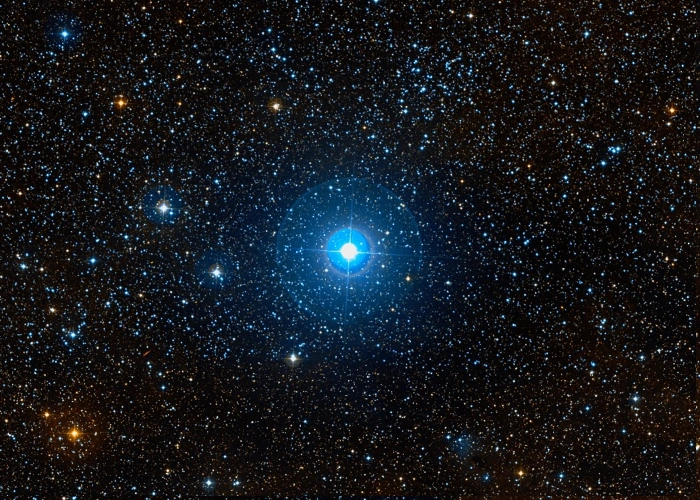
Cexing (Kappa Cassiopeiae), image credit: ESO/Digitized Sky Survey 2 (CC BY 4.0)
Facts
Kappa Cassiopeiae is believed to be a member of the Cassiopeia OB14 (Cas OB14) stellar association. Cassiopeia OB14 is a young group of stars that formed in the same molecular cloud at around the same time. These are hot, massive, luminous O- and B-type stars that will not live very long lives. The group lies at an average distance of 3,600 light-years (1,100 parsecs).
Kappa Cassiopeiae is a runaway star. It is moving through space at an unusually high velocity – 1,100 km/s – relative to the surrounding interstellar medium. The star’s stellar wind and magnetic field produce a prominent bow shock visible 4 light-years ahead of the star. This is comparable to the distance between the Sun and its nearest neighbour, Proxima Centauri. The bow shock is approximately 12 light-years long and 1.8 light-years wide.
As the bow shock collides with the interstellar gas and dust in its path, it becomes visible in the infrared band. It was captured by the Spitzer Space Telescope in 2014.
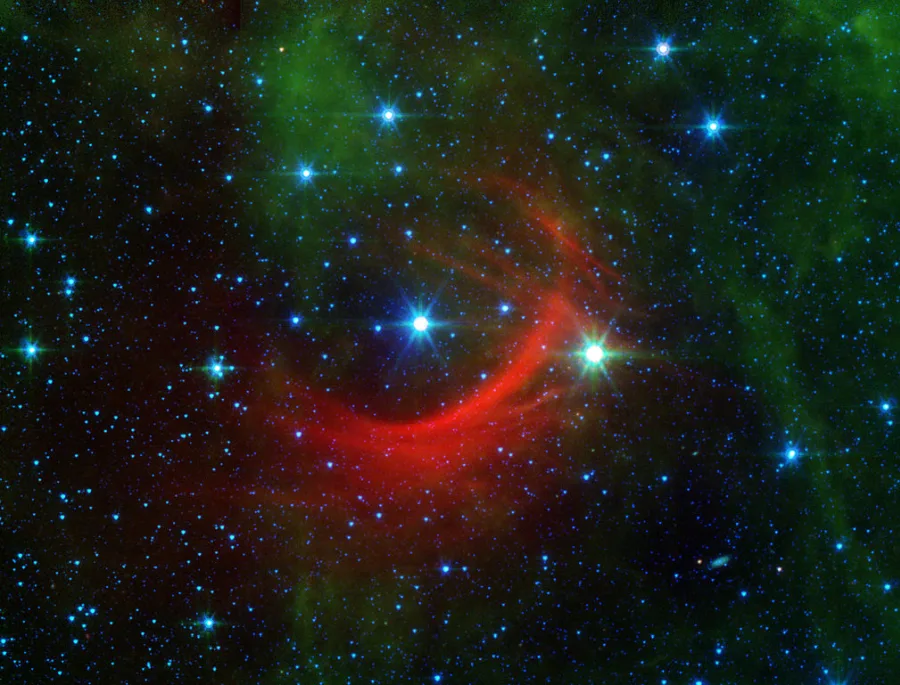
Kappa Cassiopeiae, or HD 2905 to astronomers, is a runaway star—a massive, hot supergiant gone rogue. What really makes the star stand out in this image is the surrounding, streaky red glow of material in its path. Such structures are called bow shocks, and they can often be seen in front of the fastest, most massive stars in the galaxy. Bow shocks form where the magnetic fields and wind of particles flowing off a star collide with the diffuse, and usually invisible, gas and dust that fill the space between stars. How these shocks light up tells astronomers about the conditions around the star and in space. Slow-moving stars like our Sun have bow shocks that are nearly invisible at all wavelengths of light, but fast stars like Kappa Cassiopeiae create shocks that can be seen by Spitzer’s infrared detectors. Incredibly, this shock is created about 4 light-years ahead of Kappa Cassiopeiae, showing what a sizable impact this star has on its surroundings. Image credit: NASA/JPL-Caltech (PD)
Name
The name Cexing means “whip star” in Chinese. It comes from traditional Chinese astronomy. The ancient Chinese called Kappa Cassiopeiae Cè (Whip, 策) and associated it with the horsewhip of the legendary charioteer Wang Liang (Wáng Liáng, 王良). The asterism representing Wang Liang was also formed by Caph (Beta Cassiopeiae), Achird (Eta Cassiopeiae), Schedar (Alpha Cassiopeiae), and Lambda Cassiopeiae.
The name Cè was later transferred to Tiansi (Gamma Cassiopeiae) and Kappa Cassiopeiae became associated with one of Wang Liang’s four horses.
The International Astronomical Union’s (IAU) Working Group on Star Names (WGSN) formally approved the name Cexing for Kappa Cassiopeiae on November 13, 2025.
Location
Kappa Cassiopeiae is easy to find. It is the brightest star in the region just above Cassiopeia’s W, a bright, prominent asterism formed by the constellation’s five brightest stars.
Several well-known deep sky objects appear in the same area. The bright Sailboat Cluster (NGC 225) lies roughly halfway between Kappa and Gamma Cassiopeiae. Tycho’s Supernova (SN 1572) and the open clusters NGC 133 and NGC 146 appear just northwest of the star.
At declination +63°, Kappa Cassiopeiae is best seen from the northern hemisphere. It never rises above the horizon for observers south of the latitude 27° S.
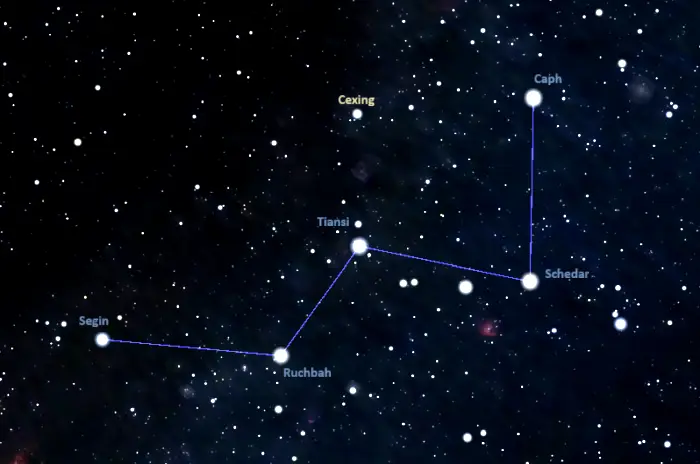
Kappa Cassiopeiae location, image: Stellarium
Constellation
Kappa Cassiopeiae is located in the northern constellation of Cassiopeia. Known for the W asterism formed by its brightest stars, the celestial Queen is one of the most recognizable constellations in the northern celestial hemisphere, along with Ursa Major, Cygnus, Auriga, Pegasus, and Perseus. Like these constellations, Cassiopeia has been known since antiquity and catalogued by the Greek astronomer Ptolemy of Alexandria in his Almagest in the 2nd century AD.
In Greek mythology, the constellation is associated with Cassiopeia, the vain queen who incurred the wrath of the gods by claiming that she (or alternatively her daughter Andromeda) was more beautiful than the Nereids. As punishment, Poseidon sent a sea monster to destroy her kingdom. To appease the sea god, Cassiopeia and her husband Cepheus chained their daughter to a rock and left her for the sea monster. The princess Andromeda was saved by Perseus and the two were later married. The constellations Andromeda (the Princess), Perseus, and Cepheus (the King) lie in the same region of the sky.
Cassiopeia stretches across 598 square degrees of the northern sky and is the 25th largest of the 88 constellations. With four stars brighter than magnitude 3.0, the constellation is easily spotted even from areas with some light pollution.
Schedar (Alpha Cassiopeiae), the brightest star in Cassiopeia, is a K-type giant that shines at magnitude 2.240 from a distance of 228 light years. It is the bottom right star of Cassiopeia’s W.
Other relatively bright stars in the constellation include the F-type giant Caph (Beta Cassiopeiae), the eruptive variable star Gamma Cassiopeiae (Tiansi), the eclipsing binary system Delta Cassiopeiae (Ruchbah), the massive blue main sequence star Segin (Epsilon Cassiopeiae), the nearby yellow dwarf Achird (Eta Cassiopeiae), and the variable blue subgiant Fulu (Zeta Cassiopeiae).
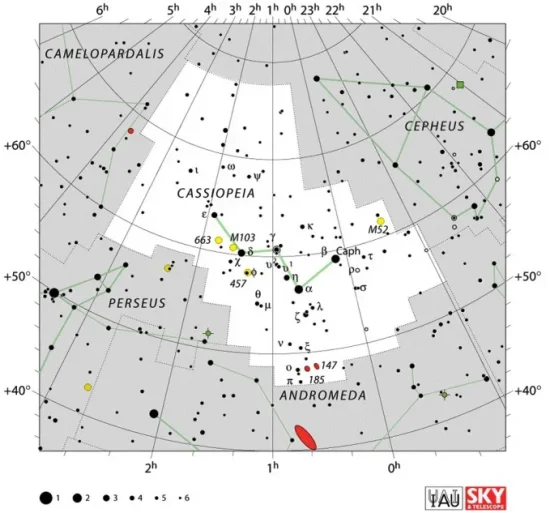
Cassiopeia constellation map by IAU and Sky&Telescope magazine (Roger Sinnott & Rick Fienberg) (CC BY 3.0)
Cassiopeia also hosts the yellow hypergiants Rho Cassiopeiae and V509 Cassiopeiae, the septuple star system AR Cassiopeiae, the F-type supergiant Phi Cassiopeiae, the white hypergiant 6 Cassiopeiae, the rotating ellipsoidal variable AO Cassiopeiae (Pearce’s Star), the variable red supergiants PZ Cassiopeiae (one of the largest stars known) and TZ Cassiopeiae, the orange dwarf HD 219134 with a system of at least five orbiting exoplanets, the variable S-type star S Cassiopeiae, and the Wolf-Rayet stars WR 1, WR 2, and WR 3.
Deep sky objects in Cassiopeia include the bright open clusters Messier 52, Messier 103, the Owl Cluster (NGC 457) and Caroline’s Rose Cluster (NGC 7789), the irregular galaxy IC 10, the Bubble Nebula (NGC 7635), the Heart Nebula (IC 1805), the Soul Nebula (Westerhout 5),the Fish Head Nebula (IC 1795), the Pacman Nebula (NGC 281), the Little Rosette Nebula (Sharpless 2-170), and the supernova remnants Cassiopeia A, the Medulla Nebula, and Tycho’s Supernova.
The best time of the year to observe the stars and deep sky objects in Cassiopeia is during the month of November, when the constellation is high above the horizon in the early evening. The entire constellation is visible from locations north of the latitude 12° S.
The 10 brightest stars in Cassiopeia are Schedar (Alpha Cas, mag. 2.240), Caph (Beta Cas, mag. 2.25–2.31), Tiansi (Gamma Cas, mag. 1.6 – 3.0), Ruchbah (Delta Cas, mag. 2.68), Segin (Epsilon Cas, mag. 3.37), Achird (Eta Cas, mag. 3.44), Fulu (Zeta Cas, mag. 3.59–3.68), Gang (50 Cas, mag. 3.95), Cexing (Kappa Cas, mag. 4.12–4.21), and Theta Cassiopeiae (mag. 4.334).
Cexing – Kappa Cassiopeiae
| Spectral class | BC0.7 Ia |
| Variable type | Alpha Cygni (α Cyg) |
| U-B colour index | −0.776 |
| B-V colour index | +0.0869 |
| J-H colour index | −0.0069 |
| J-K colour index | +0.128 |
| Apparent magnitude (V) | 4.12 – 4.21 |
| Apparent magnitude (U) | 3.50 |
| Apparent magnitude (B) | 4.276 |
| Apparent magnitude (J) | 4.141 |
| Apparent magnitude (H) | 4.148 |
| Apparent magnitude (K) | 4.013 |
| Absolute magnitude | -7.1 |
| Distance | 4,600 light-years (1,400 parsecs) |
| Parallax | 1.0644 ± 0. 0.1627 mas |
| Radial velocity | 0.30 ± 0.8 km/s |
| Proper motion | RA: +3.126 ± 0.144 mas/yr |
| Dec.: -1.835 ± 0.173 mas/yr | |
| Mass | 33 M☉ |
| Luminosity | 490,000 L☉ |
| Radius | 39 R☉ |
| Temperature | 24,600 K |
| Age | 4.5 million years |
| Rotational velocity | 58 km/s |
| Surface gravity | 2.79 cgs |
| Constellation | Cassiopeia |
| Right ascension | 00h 32m 59.9918836206s |
| Declination | +62° 55′ 54.413126128″ |
| Names and designations | Cexing, Kappa Cassiopeiae, Kappa Cas, κ Cassiopeiae, κ Cas, 15 Cassiopeiae, 15 Cas, HD 2905, HR 130, HIP 2599, SAO 11256, FK5 16, BD+62°102, AG+62 54, GC 645, GCRV 301, ALS 6258, CEL 78, PPM 12303, EM* MWC 7, MCW 24, SKY# 887, HGAM 25, Hilt 38, IRCO 2286, JP11 393, LS I +62 128, PMC 90-93 10, GEN# +1.00002905, GSC 04019-03949, ROT 103, N30 100, NSV 195, TIC 419531713, SV* ZI 27, TD1 282, UBV 404, UBV M 7453, IRAS 00301+6239, 2MASS J00330000+6255542, UCAC3 306-16129, uvby98 100002905, WEB 476, [KW97] 3-5, TYC 4019-3949-1, Gaia DR2 430769040655815936, Gaia DR3 430769040662018560 |