Zaurak, Gamma Eridani (γ Eri), is a red giant star located 192 light years away in the constellation Eridanus. With an apparent magnitude that varies between 2.88 and 2.96, it is the fourth brightest star in the constellation, after Achernar, Cursa, and Acamar. It appears in the same area of the sky as Epsilon Eridani, one of the nearest visible stars to the Sun.
Star system
Zaurak is an evolved star with the spectral class M0III-IIIb, indicating a red giant. It has 1.55 times the Sun’s mass and a radius of around 58.7 solar radii. With a surface temperature of 3,779 K, it shines with 634.2 solar luminosities. It spins with a projected rotational velocity of 3.8 km/s.
Gamma Eridani is currently on the asymptotic giant branch (AGB), a late phase in the evolution of intermediate-mass stars. It evolved away from the main sequence over a billion years ago. It is now fusing helium and hydrogen in shells around its core, which consists primarily of carbon and oxygen. The star will next evolve into a cooler and larger red giant similar to the famous variable star Mira in the constellation Cetus.
The brightness of Gamma Eridani was reported to vary by a few hundredths of a magnitude in 1960. The red giant was officially classified as a variable star in 1976 and included in the General Catalogue of Variable Stars in 1977, but its variable class is uncertain. It is listed as a slow irregular variable candidate in the Combined General Catalogue of Variable Stars (2007), while the Simbad database lists it as a long-period variable candidate, a cool, luminous, pulsating AGB star.
Zaurak serves as a spectral standard for the class M0III-IIIb. The star’s spectrum is used as an anchor point for the classification of other stars.
Gamma Eridani is not a single star. In 2024, a team of astronomers led by Pierre Kervella of the Laboratory of Space Studies and Instrumentation in Astrophysics (LESIA), Paris Observatory, identified a common proper motion companion based on the data obtained from the Gaia Early Data Release 3 (Gaia EDR3). The companion has a mass of only 0.1 solar masses and is separated from Zaurak by 1,000 astronomical units (AU). It has a Gaia G-band magnitude of 16.1.
Gamma Eridani A shows a moderate proper motion anomaly (PMa), which indicates the presence of another companion much closer to the star. The close companion may be a low-mass red dwarf with a mass of less than 0.4 solar masses orbiting within 50 AU of the primary component. The red dwarf is too close to Zaurak to be resolved.
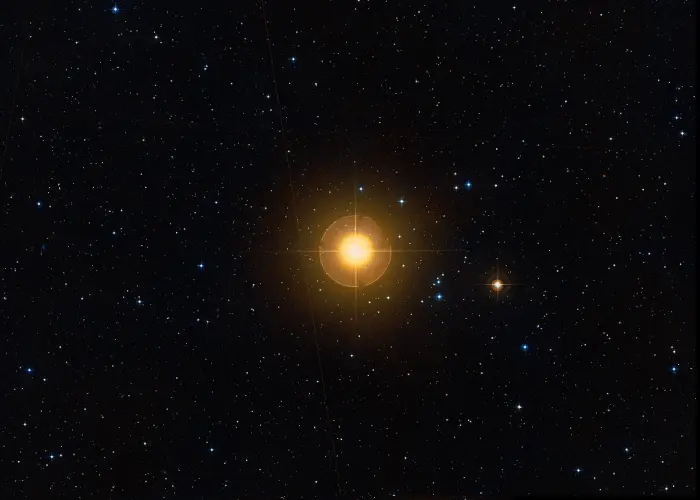
Zaurak (Gamma Eridani), image credit: ESO/Digitized Sky Survey 2 (CC BY 4.0)
Facts
With an apparent magnitude of 2.88 – 2.96, Zaurak is the fourth brightest point of light in Eridanus. Individually, it is the third brightest star, after Achernar (Alpha Eridani) and Cursa (Beta Eridani). Acamar (Theta Eridani), the third brightest star in Eridanus, is a binary star with a combined apparent visual magnitude of 2.88. However, its two components shine at magnitudes 3.18 and 4.11 and are both fainter than Zaurak.
Zaurak is, on average, the 165th brightest star in the sky. It is about as bright as Matar in the constellation Pegasus, Tau Puppis in Puppis, Algorab in Corvus, and Sadalmelik in Aquarius. It just outshines Tianguan in Taurus, Epsilon Leonis in Leo, Alnasl in Sagittarius, and Gamma Hydrae in Hydra.
Zaurak is one of the rare bright M-type giants in the sky. Others include Gacrux in the constellation Crux, Mirach in Andromeda, Yed Prior in Ophiuchus, Tiaki in Grus, Scheat in Pegasus, Menkar in Cetus, and Tejat in Gemini.
Name
The name Zaurak (pronunciation: /ˈzɔːræk/) is the traditional name of Gamma Eridani. It is an Arabic word for “boat.” It was historically also spelled Zaurac. The name comes from the Arabic phrase Al Na’ir al Zaurak, meaning “the bright star of the boat.” In the early 19th century, the German astronomer Christian Ludwig Ideler applied the name Zaurak to Ankaa (Alpha Phoenicis), the brightest star in the constellation Phoenix.
The International Astronomical Union’s (IAU) Working Group on Star Names (WGSN) approved the name for Gamma Eridani on July 20, 2016. The name formally applies only to the brightest component, Gamma Eridani A.
In traditional Chinese astronomy, Gamma Eridani was known as 天苑一 (Tiān Yuàn yī), the First [Star] of Celestial Meadows. It formed the Celestial Meadows asterism with Rana (Delta Eridani), Pi Eridani, Ran (Epsilon Eridani), Zibal (Zeta Eridani), Azha (Eta Eridani), Pi Ceti, Tau1 Eridani, Angetenar (Tau2 Eridani), Tau3 Eridani, Tau4 Eridani, Tau5 Eridani, Tau6 Eridani, Tau7 Eridani, Tau8 Eridani, and Tau9 Eridani. The asterism was part of the larger Hairy Head mansion, which represented the body of the White Tiger of the West.
Location
Zaurak lies in the relatively faint region of the sky between Rigel in Orion and Diphda in Cetus. Epsilon Eridani (Ran), the third nearest visible star or star system to Earth, and Delta Eridani (Rana) appear in the same area.
Zaurak can be found by extending a line from Sirius in Canis Major, the brightest star in the sky, through Mu Leporis in Lepus. Mu Leporis is part of the distinctive constellation figure of the Hare and appears just south of the bright Rigel.
At declination −13° 30′, Gamma Eridani is visible from most places on Earth for at least part of the year. It appears higher above the horizon throughout the northern hemisphere winter.

Zaurak location, image: Stellarium
Constellation
Zaurak is located in the constellation Eridanus (the River). Eridanus is one of the ancient Greek constellations, catalogued by the Greco-Roman astronomer Claudius Ptolemy of Alexandria in his Almagest in the 2nd century CE. In Greek mythology, it is associated with the river into which Phaethon, the son of the Sun god Helios, fell after losing control of his father’s chariot. The name Eridanus was later taken as the Latin name of the river Po, the longest river in Italy.
Eridanus is the sixth largest of the 88 constellations. It stretches across 1,138 square degrees of the predominantly southern sky. It stretches farther from north to south than any other constellation. Its northern end lies near Rigel in Orion, and its southern end is marked by the bright Achernar in the far southern sky.
The northernmost part of the constellation lies on the celestial equator and is visible from virtually any location. However, the southernmost portion of the celestial River is invisible to observers in the mid-northern latitudes. Achernar (Alpha Eridani), the constellation’s brightest and southernmost visible star, never rises for observers north of the latitude 33° N.
With an apparent magnitude of 0.40 – 0.46, Achernar is the ninth brightest star in the sky, slightly outshining the red supergiant Betelgeuse and blue giant Hadar. Achernar is a massive blue main sequence star in a binary system located approximately 139 light-years away. It is the hottest and bluest of the 10 brightest stars in the sky.
Other notable stars in Eridanus include the white giant Cursa (Beta Eridani), the binary star Theta Eridani (Acamar), the orange subgiant Rana (Delta Eridani), the spectroscopic binary system Upsilon4 Eridani, the evolved B-type star Phi Eridani, the red giant Tau4 Eridani, and the giant stars Azha (Eta Eridani), Sceptrum (l Eridani), Theemin (Upsilon2 Eridani) and Beemim (Upsilon3 Eridani).
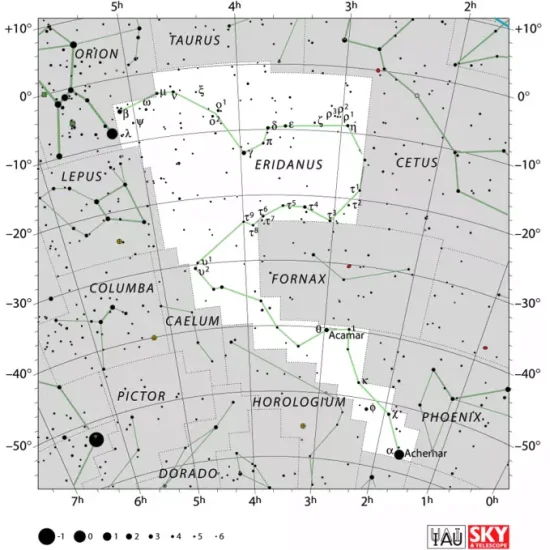
Eridanus constellation map by IAU and Sky&Telescope magazine (Roger Sinnott & Rick Fienberg) (CC BY 3.0)
Eridanus is also home to the yellow dwarf 82 G. Eridani with three orbiting planets, the polar variable EF Eridani, the massive gravitationally lensed system called Mothra, the F-type giant Beid (Omicron1 Eridani), the orange star Keid (Omicron2 Eridani), the host star of the planet Vulcan in Star Trek lore, and the orange dwarf Epsilon Eridani (Ran), the third closest visible star to the Sun.
Deep sky objects in Eridanus include the Witch Head Nebula (IC 2118), the Cleopatra’s Eye Nebula (NGC 1535), the grand design spiral galaxies NGC 1300 and the Eye of God Galaxy (NGC 1232), the spiral galaxies NGC 1325, NGC 1357, NGC 1421, IC 1953 and NGC 1376, and the interacting galaxies Arp 219.
Eridanus also contains the Eridanus Supervoid (WMAP Cold Spot), a vast region devoid of galaxies.
The best time of the year to observe the stars and deep sky objects in Eridanus is during the month of December, when the constellation appears higher above the horizon in the early evening. The entire constellation is visible from locations south of the latitude 32° N.
The 10 brightest stars in Eridanus are Achernar (Alpha Eri, mag. 0.40 – 0.46), Cursa (Beta Eri, mag. 2.796), Acamar (Theta1 Eri, mag. 2.88), Zaurak (Gamma Eri, mag. 2.88 – 2.96), Rana (Delta Eri, mag. 3.51 – 3.56), Upsilon4 Eridani (mag. 3.55), Phi Eridani (mag. 3.55), Chi Eridani (3.70), Tau4 Eridani (mag. 3.57 – 3.72), and Ran (Epsilon Eri, mag. 3.736).
Zaurak – Gamma Eridani
| Spectral class | M0III-IIIb |
| Variable type | Slow irregular variable (Lb) |
| U-B colour index | +1.96 |
| B-V colour index | +1.58 |
| Apparent magnitude | 2.88 – 2.96 |
| Absolute magnitude | -1.19 |
| Distance | 192 ± 3 light-years (58.8 ± 0.8 parsecs) |
| Parallax | 17.0016 ± 0.2254 mas |
| Radial velocity | 60.81 ± 0.25 km/s |
| Proper motion | RA: + 62.227 ± 0.223 mas/yr |
| Dec.: -112.006 ± 0.182 mas/yr | |
| Mass | 1.55 M☉ |
| Luminosity | 634.2 ± 28.6 L☉ |
| Radius | 58.7 ± 0.8 R☉ |
| Temperature | 3,779 ± 34 K |
| Metallicity | +0.00 dex |
| Rotational velocity | 3.8 km/s |
| Surface gravity | 1.52 cgs |
| Constellation | Eridanus |
| Right ascension | 03h 58m 01.7658213057s |
| Declination | −13° 30′ 30.653301544″ |
| Names and designations | Zaurak, Gamma Eridani, Gamma Eri, γ Eridani, γ Eri, 34 Eridani, 34 Eri, HD 25025, HR 1231, HIP 18543, SAO 149283, FK5 149, BD−13 781, GC 4778, GCRV 2274, JP11 839, CSI-13 781 1, IRC -10055, PLX 878.00, PPM 213659, GEN# +1.00025025, N30 816, RAFGL 537, SKY# 6058, SACS 86, CSV 6066, UBV 3879, WEB 3576, YZC 11 929, YZ 0 5238, IRAS 03557-1339, 2MASS J03580177-1330310, [DS98] 48, PMC 90-93 107, GSC 05311-01285, TIC 325685265, TD1 2709, TYC 5311-1285-1, Gaia DR2 5111187420712629632, Gaia DR3 5111187420714898304, AAVSO 0353-13, ADS 2904 A, CCDM J03580-1331A, IDS 03534-1348 A, WDS J03580-1331A |