Intermediate-mass stars are among the most important objects in stellar astronomy. With masses ranging from about 0.6 to 8 solar masses, these stars include our own Sun and many of the brightest stars visible in the night sky. Their life cycles span between 50 million and 20 billion years, depending on their initial mass.
Medium-sized stars pass through a series of well-defined evolutionary stages between the beginning and end of their lives. The longest of these, the main sequence, is characterized by the stable fusion of hydrogen into helium in the stars’ cores. The process releases immense amounts of energy that creates strong pressure that prevents the star from collapsing under gravity. This keeps the star in hydrostatic equilibrium for most of its existence.
After leaving the main sequence, intermediate-mass stars pass through the subgiant branch, the red giant branch, the horizontal branch, the asymptotic giant branch, and the post-asymptotic giant branch, before producing planetary nebulae and ending their lives as white dwarfs.
Nuclear reactions in their cores produce most of the carbon and nitrogen in the universe. When these stars reach the end of their life cycles, they disperse this enriched material into the interstellar medium, where it is recycled to form new generations of stars and planetary systems.
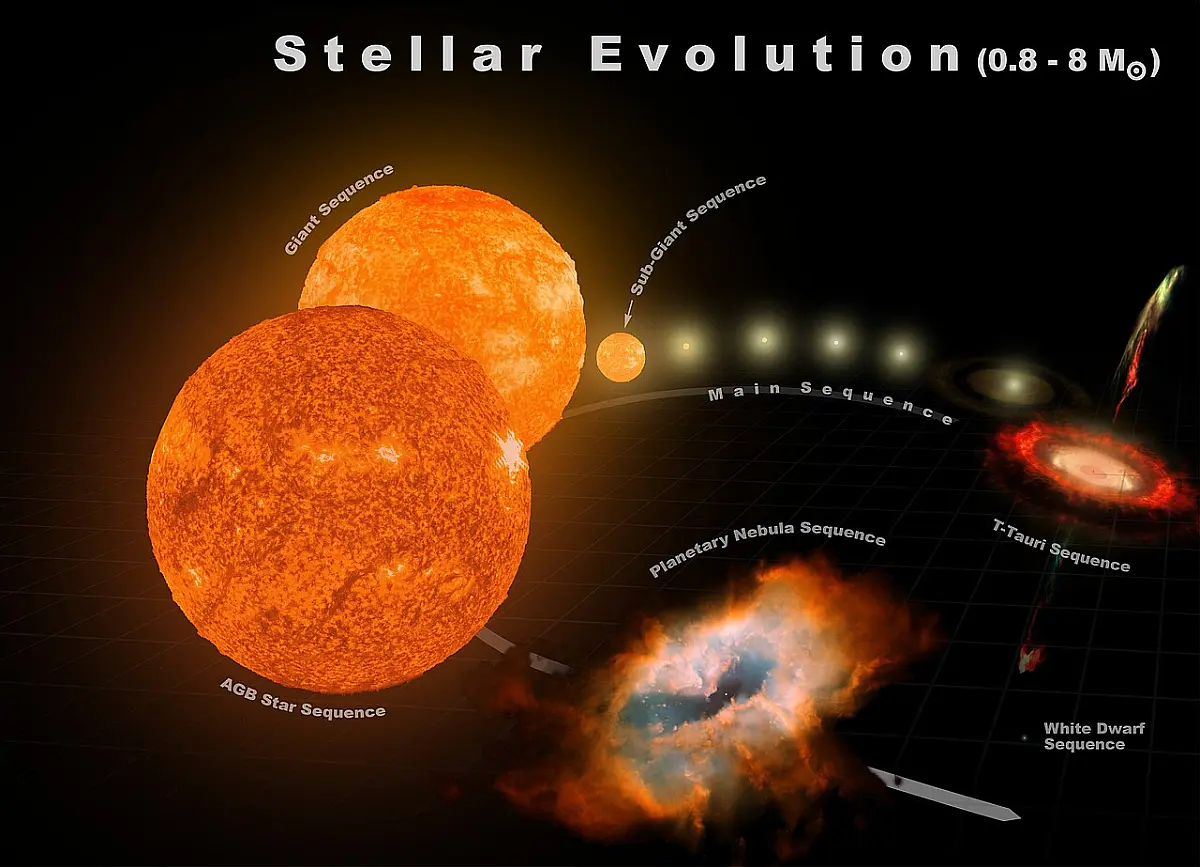
Evolution of intermediate-mass stars, image credit: Antonio Ciccolella (CC BY-SA 4.0)
Definition and general properties
Intermediate-mass stars have initial masses in the range from roughly 0.6 to 0.8 solar masses up to about 8 solar masses. They are stars of the spectral types K, G, F, A, and B, which is to say, orange (K), yellow (G), yellow-white (F), blue-white (A), and blue (B) main sequence stars.
Stars at the lower end of this range overlap with the upper boundary of low-mass stars (red dwarfs), which typically follow a different evolutionary path. The stars at the upper end overlap with high-mass stars that end their lives as supernovae, leaving behind a neutron star or a black hole.
All stars spend most of their lives on the main sequence, fusing hydrogen into helium in their cores. Their lifespans vary enormously across the mass range. The most massive intermediate-mass stars exhaust their hydrogen in roughly 50 million years, while the least massive may remain on the main sequence for up to 20 billion years.
The Sun, with a mass of one solar mass, is a typical intermediate-mass star. It has been on the main sequence for approximately 4.6 billion years and is expected to remain there for roughly another 5 billion years before beginning to evolve into a red giant.
How intermediate-mass stars form
Like all stars, medium-sized stars form within stellar nurseries, large clouds of cold dust and gas known as molecular clouds. Over time, small clumps within these dense clouds collapse under own gravity and form dense cores that will eventually become young stellar objects.
As the cores collapse, they accumulate material from the surrounding cloud, which leads to the formation of protostars. A protostar is defined as a young stellar object that is still in the process of forming and accreting mass from its birth cloud. It may have a circumstellar disk of dust and gas where planetary systems may later form.
When a protostar has gathered all its mass, it emerges from the surrounding clouds and becomes visible for the first time. At this point, it becomes a pre-main sequence star. Pre-main sequence stars with a mass of up to 2 solar masses are known as T Tauri stars, while those with higher mass are called Herbig Ae/Be stars. Our Sun started its life as a T Tauri star.
During the pre-main sequence phase, the young star continues to contract until its temperature is high enough to ignite hydrogen fusion in its core. Once the nuclear fusion of hydrogen begins, the young stellar object becomes a main sequence star.
Main sequence phase
A star joins the main sequence when it begins fusing hydrogen in its core. This is the longest and most stable phase of a star’s life cycle. Stars spend approximately 90 percent of their total lifespan on the main sequence.
Low-mass stars burn their fuel more slowly and stay on the main sequence for billions of years, while more massive stars burn through their supply of hydrogen quickly and evolve into giants within millions of years.
In the intermediate-mass range, orange dwarfs like Epsilon Eridani, Alpha Centauri B, Epsilon Indi and 61 Cygni A and B typically take 50 billion years to exhaust their hydrogen supply. Sun-like yellow dwarfs like Alpha Centauri A, Chara, Tau Ceti and 51 Pegasi take approximately 10 billion years.
Yellow-white stars like Procyon, Porrima and Tabby’s Star take around 3 billion years, and blue-white stars like Sirius, Vega, Altair and Fomalhaut last around 1 billion years. At the upper end, hot blue intermediate-mass stars like Alkaid, Algol and Haedus evolve away from the main sequence after around 100 million years.
| MAIN SEQUENCE LIFETIME OF INTERMEDIATE-MASS STARS | ||||
| Spectral type | Colour | Mass | Lifespan | Examples |
| B | Blue | 2.1–16 | 100 million | Algol, Alkaid, Haedus |
| A | Blue-white | 1.4–2.1 | 1 billion | Sirius, Vega, Altair |
| F | Yellow-white | 1.04–1.4 | 3 billion | Procyon, Porrima, Tabby’s Star |
| G | Yellow | 0.8–1.04 | 10 billion | Rigil Kentaurus, Chara, Tau Ceti |
| K | Orange | 0.45–0.8 | 50 billion | Ran, Toliman, Epsilon Indi |
Hydrogen fusion and energy production
In lower-mass intermediate-mass stars (1.5 M☉), hydrogen fusion proceeds primarily through the proton-proton chain. In this sequence, hydrogen nuclei are directly fused in a series of steps to produce helium.
In more massive intermediate-mass stars, above approximately 1.5 solar masses, the dominant process is the CNO cycle (carbon-nitrogen-oxygen cycle). In this process, hydrogen is fused using carbon, nitrogen and oxygen catalysts.
Both processes convert hydrogen into helium and release energy in the form of radiation. Radiation provides the pressure that prevents gravitational collapse and keeps the star in hydrostatic equilibrium over the course of its main sequence lifetime.
As hydrogen in the core is gradually consumed and replaced by helium, the core slowly contracts and heats up. The outer layers of the star respond by expanding, and the star’s luminosity and temperature increase over time. This gradual brightening continues throughout the main sequence phase.
Leaving the main sequence
When a star has fused most of its core hydrogen supply, energy generation in the core begins to decline. The core contracts under gravity and its temperature rises. The hydrogen in a shell around the core reaches high enough a temperature and pressure to begin fusing, forming a hydrogen-burning shell.
As the hydrogen-fusing shell generates more and more energy, the outer layers of the star expand and cool. The star begins to move away from the main sequence toward the red giant region of the Hertzsprung-Russell diagram.
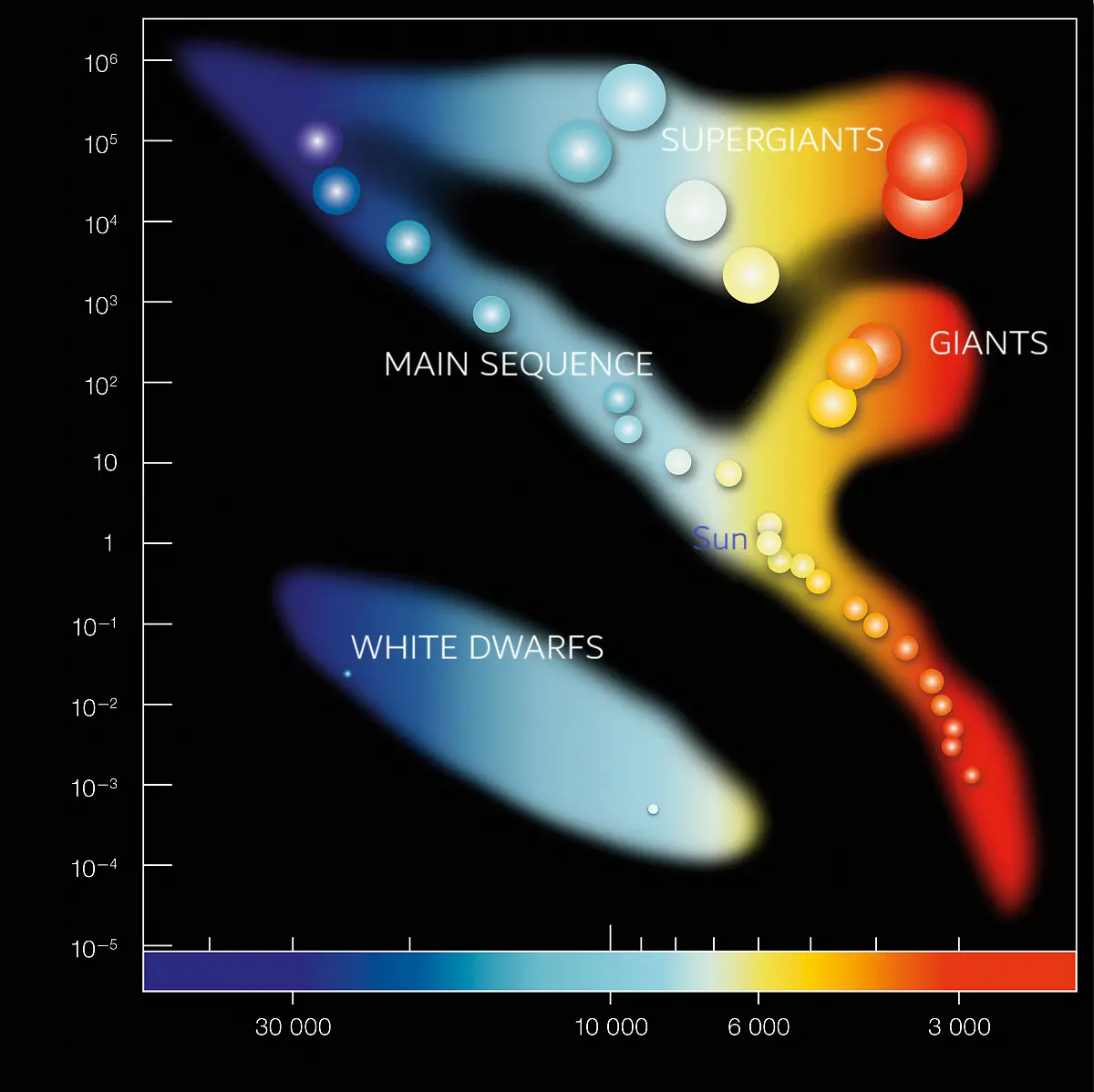
In the Hertzprung-Russell diagram the temperatures of stars are plotted against their luminosities. The position of a star in the diagram provides information about its present stage and its mass. Stars that burn hydrogen into helium lie on the diagonal branch, the so-called main sequence. Red dwarfs lie in the cool and faint corner. When a star exhausts all the hydrogen, it leaves the main sequence and becomes a red giant or a supergiant, depending on its mass. Stars with the mass of the Sun which have burnt all their fuel evolve finally into a white dwarf (left low corner). Image credit: ESO (annotated) (CC BY 4.0)
Red giant phase
The red giant phase is the brightest stage in the life of an intermediate-mass star. It consists of several distinct sub-stages, from the subgiant branch to the post-asymptotic giant branch. As the star produces more energy through shell burning, its hot core pushes its outer layers outward. At this point, the star expands and cools as a luminous red giant.
Subgiant branch
The subgiant branch is the transitional stage between the main sequence and the red giant branch. When a star has burned through its supply of core hydrogen, fusion ceases in the core and the star leaves the main sequence. It begins fusing hydrogen in a shell outside the core.
As more helium is accumulated in the shell, the stellar core increases in mass. The star begins to expand and cool but retains a similar luminosity to the one it had while on the main sequence.
The duration of the subgiant stage depends on the star’s mass. A star’s initial mass affects both its interior structure and the properties of the helium core. A star may stay on the subgiant branch for several million years to a couple of billion years. More massive stars move through this stage more quickly. The brightest subgiants in the sky are Capella Ab and Procyon.
Stars that become subgiants typically have between 0.4 and 8 times the mass of the Sun. Less massive stars are fully convective and do not evolve into subgiants. Stars with masses beyond approximately 8 to 12 solar masses go through a very brief subgiant phase before evolving into supergiants.
Once the hydrogen-burning shell increases enough in temperature, the star expands and becomes more luminous, becoming a red giant.
It should be noted that the subgiant branch does not necessarily correspond to the subgiant luminosity class (IV) in stellar classification. Stars may present as subgiants but be at a different stage of their evolutionary cycle. Evolutionary subgiants can be identified through indicators such as lithium depletion and chemical abundances.
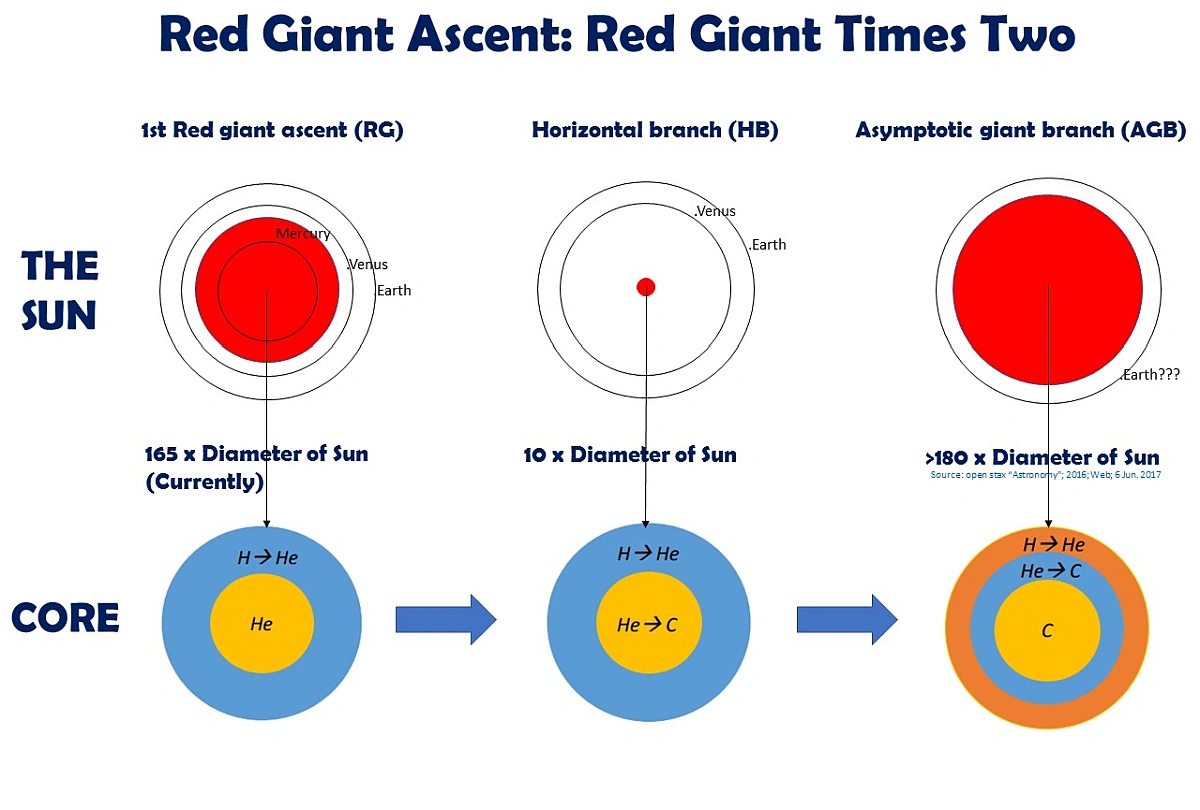
This image displays the red giant ascent of our Sun, which will happen in approximately 5 billion years. As the core runs out of hydrogen and then helium, the core will contract and the outer layers will expand, cool, and become less bright. It will become a red giant star. This will happen in three distinct phases. Image credit: David J. Weber (CC BY-SA 4.0)
Red giant branch (RGB)
The red giant branch (RGB) is the phase in the life of low- to intermediate-mass stars that follows the main sequence and the subgiant phase. It is also called the first giant branch. Stars on this branch are K- and M-type giants. These stars are much larger and more luminous than main sequence stars of the same spectral type. The brightest red giants in the sky include Arcturus, Aldebaran, Pollux, Gacrux, and Dubhe.
Red giant branch stars have an inert helium core surrounded by a hydrogen-burning shell. They fuse hydrogen into helium primarily via the CNO cycle, in which carbon, nitrogen, and oxygen act as catalysts to produce helium nuclei, electron neutrinos, and positrons. The neutrinos escape the star, while the positrons and electrons almost immediately annihilate each other, releasing energy in the form of gamma rays.
When intermediate-mass stars begin ascending the red giant branch, they typically have surface temperatures of around 5,000 K and luminosities ranging from a few times that of the Sun to several thousand times the Sun’s luminosity, depending on mass. Their spectral types are early to mid-K.
As RGB stars continue to produce helium, their cores grow hotter and more massive. As a result, the rate of hydrogen fusion in the surrounding shell increases. This causes the stars to grow in size and luminosity while their surface temperatures slightly decrease.
The stars’ convective outer envelopes become progressively deeper, and eventually the products of fusion are brought from the core to the surface, where they become detectable in the stellar spectra. This event is known as the first dredge-up.
The Schonberg-Chandrasekhar limit and the helium flash
As the helium core grows, it eventually reaches a state where it is no longer in thermal equilibrium. In stars with a mass of less than about 1.5 solar masses, the core becomes degenerate before reaching the Schonberg-Chandrasekhar limit, which is the maximum stable mass of an isothermal core that can support the pressure of an overlying envelope.
Stars with a mass greater than about 6 solar masses never have isothermal cores and leave the main sequence with a core mass already above this limit.
In stars with a mass between about 1.5 and 6 solar masses, the helium core continues to grow until it reaches the Schonberg-Chandrasekhar limit. It then rapidly contracts and increases in temperature, which in turn increases the rate of fusion in the hydrogen shell and the star’s luminosity.
Stars with masses of about 0.6 to 2 solar masses will experience a helium flash, a thermal runaway event in which helium fusion suddenly ignites in the degenerate core. More massive stars, which do not have degenerate cores, ignite helium fusion more gradually, without a flash.
The helium flash initiates stable helium fusion in the stellar core and moves the less massive giant stars to the horizontal branch (HB) of the Hertzsprung-Russell diagram.
During the helium flash, large quantities of helium are fused into carbon in a runaway reaction. Helium fusion causes an increase in temperature, which in turn increases the fusion rate. The temperature rises dramatically, producing a sudden flash of helium fusion. The helium flash lasts only a few minutes but generates energy at a rate comparable to that of the entire Milky Way galaxy.
Horizontal branch (HB)
The energy released in the helium flash is consumed in lifting the degeneracy in the core, allowing the core to thermally expand. This expansion is largely undetectable from the outside. Once the core expands and cools, the surface temperature of the star also decreases rapidly. The surface contracts dramatically over a period of about 10,000 years, and the star moves to the horizontal branch.
During the horizontal branch phase, the star fuses helium in its core via the triple-alpha process and hydrogen in a surrounding shell via the CNO cycle. Its radius gradually decreases and its surface temperature continues to increase.
More massive stars with larger cores move to higher temperatures during the horizontal branch phase. Some begin to pulsate and drift toward the yellow instability strip on the Hertzsprung-Russell diagram. These stars are classified as RR Lyrae variables. They were once Sun-like stars that shed mass on the red giant branch and retained about half the Sun’s mass by the time they reached the horizontal branch.
Asymptotic giant branch (AGB)
Once a red giant star has exhausted the helium at its core, it moves to the asymptotic giant branch (AGB). The hot stellar core is now largely inert and composed of carbon and oxygen. The star continues to fuse hydrogen and helium in two concentric shells surrounding this inert core. All low- to intermediate-mass stars with masses of approximately 0.5 to 8 solar masses pass through this phase in a late stage of their life cycles.
Bright AGB stars include Scheat in Pegasus, Mira in Cetus, Tejat in Gemini, Tiaki in Grus, and Tania Australis in Ursa Major.
Early asymptotic giant branch phase (E-AGB)
The asymptotic giant branch stage is divided into the early AGB phase and the thermally pulsing AGB phase.
In the early AGB phase, the main source of energy is helium fusion in a shell around the inert core. The stars expand enormously during this stage. Their radii may become larger than 215 solar radii, which is equivalent to approximately one astronomical unit (the mean Earth-Sun distance).
Thermally pulsing asymptotic giant branch phase (TP-AGB)
The thermally pulsing AGB phase begins once the helium shell has exhausted its supply of fuel. At this point, the main source of energy is hydrogen fusion in a thin shell. This shell prevents the inner helium shell from fusing stably, restricting it to a very thin layer.
The helium from the hydrogen shell keeps building up and, within tens of thousands of years, it ignites, triggering a helium shell flash.
The helium shell flash causes the star’s luminosity to increase by thousands of times. It then fades over a period of several years. The star expands and cools, and the hydrogen shell burning temporarily stops. When the helium shell burning comes near the base of the hydrogen shell, the temperature increases again and kickstarts the fusion of hydrogen again, restarting the thermal pulse cycle.
The thermal pulses last only a few hundred years. These pulsations cause material from the core to mix into the star’s outer layers, altering the surface composition.
If enough carbon is brought from the core to the surface, a carbon star is formed. Carbon stars like R Leporis (Hind’s Crimson Star) in the constellation Lepus and Y Canum Venaticorum (La Superba) in Canes Venatici are among the reddest stars in the sky.
Mass loss and circumstellar envelopes
Stars on the asymptotic giant branch experience enormous mass loss through strong stellar winds. The rate of mass loss increases during thermal pulses and can result in detached shells of expelled circumstellar material.
The stellar winds of AGB stars are the main production sites of cosmic dust in the universe. As the ejected circumstellar envelope expands away from the hot star, it cools and dust particles form within it.
AGB stars can lose as much as 50 to 70 percent of their total mass. With wind velocities of 5 to 30 kilometres per second, the mass-loss rates range between 10-8 and 10-5 solar masses per year.
AGB stars are typically classified as long-period variables. These are pulsating variable giant or supergiant stars with periods that can range from a few days to more than a thousand days.
Most of these stars are of spectral class M, S, or C, and can be several thousand times more luminous than the Sun. Well-known examples include Mira (Omicron Ceti) and La Superba (Y Canum Venaticorum).
The post-asymptotic giant branch (post-AGB)
Intermediate-mass stars are not massive enough to begin fusing carbon once they have depleted the fuel for shell burning. Instead, they contract again in the post-AGB phase. They expel enormous amounts of material through an intense superwind, and the expelled outer shell forms a protoplanetary nebula, which then evolves into a planetary nebula. The remnant core cools and eventually becomes a white dwarf.
The ejected circumstellar envelope is rich in the heavier elements produced in the star’s interior during its nuclear burning stages. It is during the post-AGB phase that this enriched material is released into the interstellar medium.
Planetary nebulae
The cloud of gas and dust expelled by the central post-AGB star becomes a planetary nebula when the hot stellar core becomes hot enough to ionize it. When the central stellar remnant reaches a temperature of around 30,000 K, it produces enough ultraviolet radiation to excite the surrounding material. This ionized material appears as a complex and colourful planetary nebula in long-exposure photographs.
Despite their name, planetary nebulae have no connection to planets. The term was coined in the 1780s by the astronomer William Herschel, who thought these objects resembled the disk of a planet when viewed through early telescopes.
Structure and appearance
Planetary nebulae take on a wide range of shapes and structures, including rings, hourglasses, and more irregular forms. The shape and complexity of a planetary nebula depend on a variety of factors, including magnetic fields, stellar winds, and the presence of a binary companion. The temperature of the nebular gas averages around 10,000 K.
Typical planetary nebulae have a radius of around one light-year. There is, however, a range of sizes, since these objects expand with age. Younger planetary nebulae are more compact, while older ones have expanded to larger dimensions.
The best-known planetary nebulae in the sky include the Ring Nebula (M57) in the constellation Lyra, the Helix Nebula (NGC 7293) in Aquarius, the Dumbbell Nebula (M27) in Vulpecula, the Butterfly Nebula (NGC 6302) in Scorpius, the Southern Ring Nebula (NGC 3132) in Vela, the Cat’s Eye Nebula (NGC 6543) in Draco, and the Blue Snowball Nebula (NGC 7662) in Andromeda.
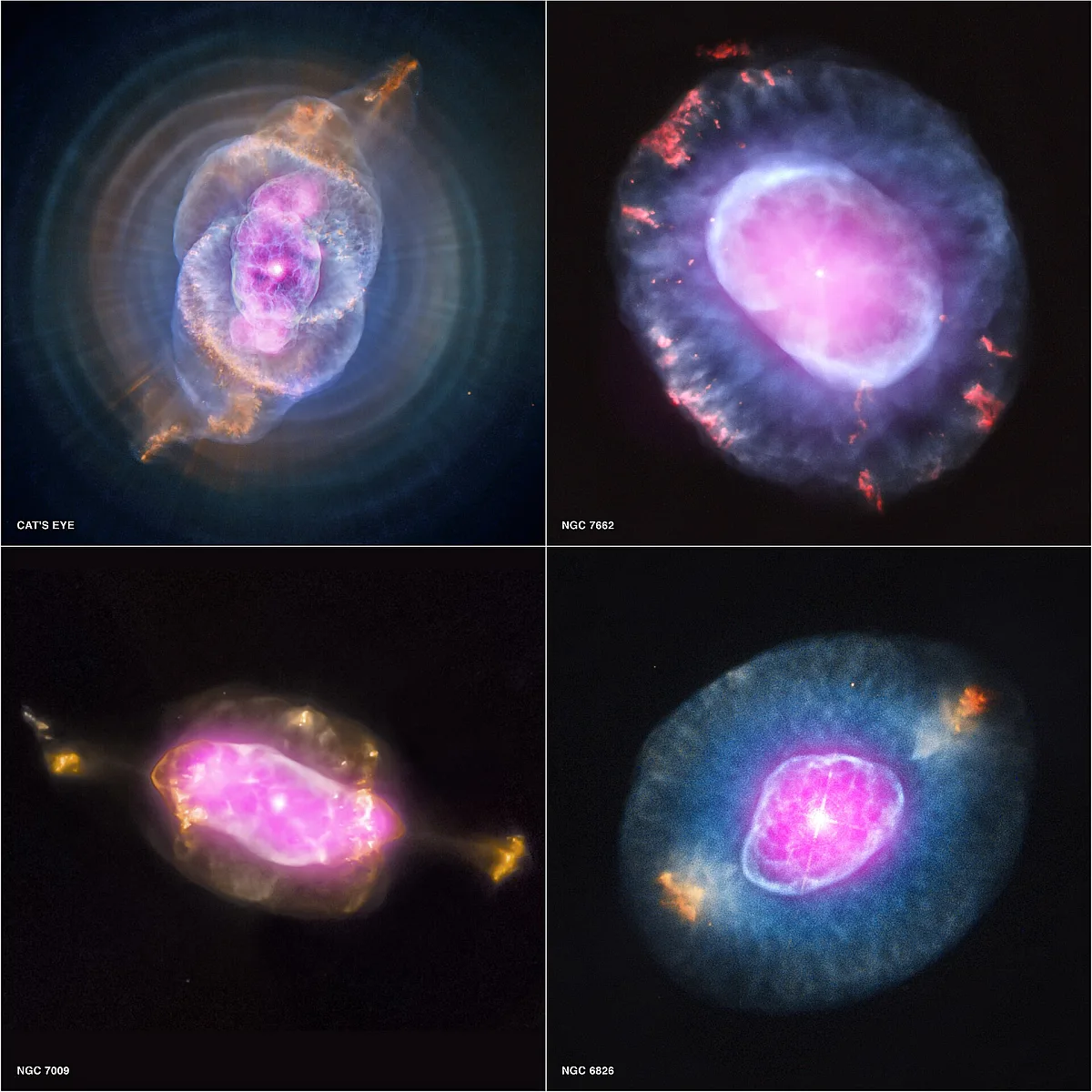
This gallery shows four planetary nebulae from the first systematic survey of such objects in the solar neighborhood made with NASA’s Chandra X-ray Observatory. The planetary nebulae shown here are NGC 6543 (aka the Cat’s Eye Nebula), NGC 7662 (the Blue Snowball Nebula), NGC 7009 (the Saturn Nebula) and NGC 6826 (the Blinking Planetary Nebula). X-ray emission from Chandra is colored purple and optical emission from the Hubble Space Telescope is colored red, green and blue. A planetary nebula is a phase of stellar evolution that the Sun should experience several billion years from now, when it expands to become a red giant and then sheds most of its outer layers, leaving behind a hot core that contracts to form a dense white dwarf star. A wind from the hot core rams into the ejected atmosphere, creating the shell-like filamentary structures seen with optical telescopes. The diffuse X-ray emission is caused by shock waves as the wind collides with the ejected atmosphere. The properties of the X-ray point sources in the center of about half of the planetary nebulae suggest that many central stars responsible for ejecting planetary nebulas have companion stars. Credit: Chandra X-ray Observatory Center, Smithsonian Institution; X-ray: NASA/CXC/RIT/J.Kastner et al.; Optical: NASA/STScI (PD)
Lifespan and dispersal
Planetary nebulae are short-lived by astronomical standards. They last roughly a few tens of thousands of years before dissipating into the interstellar medium.
As these objects expand, the material becomes too spread out to be visible after approximately 10,000 to 50,000 years. The glowing shells then disperse into the surrounding interstellar gas.
Role in chemical evolution
Planetary nebulae are rich in the heavier elements produced via nuclear fusion in the progenitor star’s interior. Once these elements are expelled into space, they are recycled and used to produce new generations of stars.
Stars formed from this enriched material contain higher concentrations of carbon, nitrogen, and other elements, which affects their internal processes and life cycles.
This process of chemical enrichment that occurs over billions of years and multiple stellar generations, has progressively increased the abundance of heavier elements throughout our galaxy.
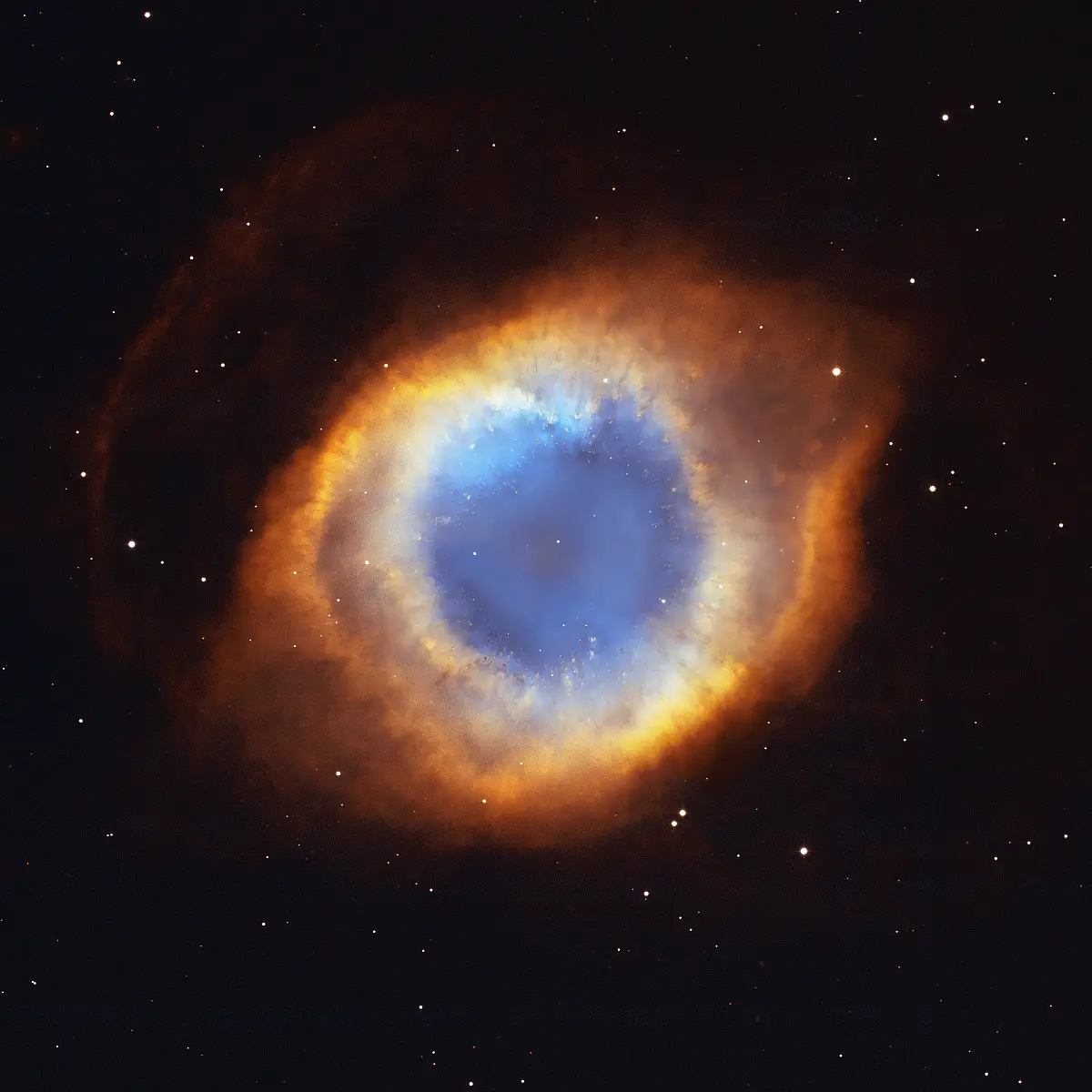
The image of the Helix Nebula shows a fine web of filamentary “bicycle-spoke” features embedded in the colorful red and blue gas ring, which is one of the nearest planetary nebulae to Earth. Because the nebula is nearby, it appears as nearly one-half the diameter of the full Moon. The Helix Nebula is a popular target of amateur astronomers and can be seen with binoculars as a ghostly, greenish cloud in the constellation Aquarius. Larger amateur telescopes can resolve the ring-shaped nebula, but only the largest ground-based telescopes can resolve the radial streaks. After careful analysis, astronomers concluded the nebula really isn’t a bubble, but is a cylinder that happens to be pointed toward Earth. Credit: NASA, NOAO, ESA, the Hubble Helix Nebula Team, M. Meixner (STScI), and T.A. Rector (NRAO) (CC BY 4.0)
White dwarfs
After the planetary nebula phase, the exposed stellar core is left behind as a white dwarf. White dwarfs are the final stage in the evolution of intermediate-mass stars like the Sun. They are dense stellar remnants no longer undergoing nuclear fusion, supported against gravitational collapse only by electron degeneracy pressure.
White dwarfs produced by intermediate-mass stars are typically composed of carbon and oxygen, the end products of helium fusion. They are roughly the size of the Earth, despite containing a mass comparable to that of the Sun.
Without a source of energy to compensate for what they radiate away, white dwarfs slowly cool down over trillions of years and gradually fade. Astronomers believe that they eventually become dark, cold remnants referred to as black dwarfs. However, the cooling timescale of white dwarfs is much longer than the current age of the universe, and no black dwarf has been directly observed yet.
Related articles: