Sarin, Delta Herculis (δ Her), is a spectroscopic binary star system located 75.1 light-years away in the constellation Hercules. It shines at magnitude 3.126 and is the third brightest star in Hercules, after Kornephoros (Beta Herculis) and Tianji (Zeta Herculis). It marks the club bearer’s left shoulder.
Delta Herculis star system
Delta Herculis is a close binary star consisting of two main sequence stars separated by only 0.06 arcseconds. The system appears as a single star to the unaided eye and cannot be resolved even in larger optical telescopes. It has three line-of-sight companions, referred to as Delta Herculis B, C, and D.
The two components of Delta Herculis A, designated Delta Herculis Aa and Delta Herculis Ab, are both hotter, larger and more massive than the Sun. The system has the spectral type A3IV, indicating a blue-white subgiant. The two stars are separated by at least 1.45 astronomical units and have an orbital period of at least 335 days.
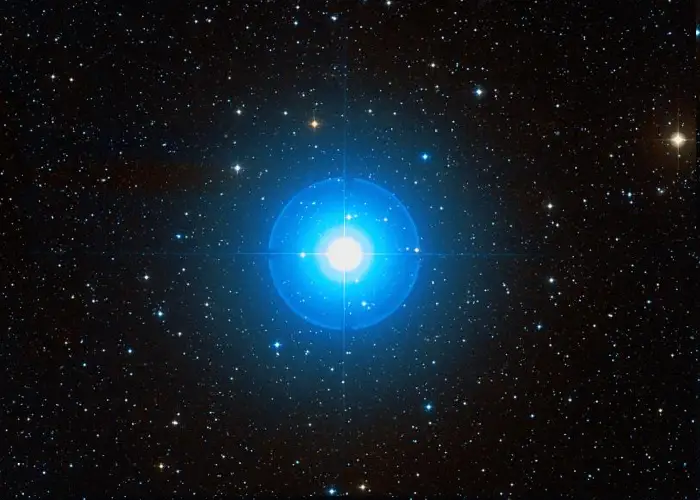
Sarin (Delta Herculis), image credit: ESO/Digitized Sky Survey 2 (CC BY 4.0)
Delta Herculis Aa
Delta Herculis Aa is formally known as Sarin. Even though it presents as a subgiant, the star is still on the main sequence, fusing hydrogen into helium in its core. It has a mass 2.4 times that of the Sun and a radius 2.2 times the Sun’s. With an effective temperature of around 9,620 K, it is 38 times more luminous than the Sun.
Sarin is a very fast spinner. It has a projected rotational velocity of 270 km/s and takes less than nine hours to complete a spin.
The star has an estimated age of 370 million years. It will spend another several hundred million years on the main sequence before it runs out of hydrogen fuel and evolves into a red giant.
Delta Herculis Ab
Delta Herculis Ab is 1.3 magnitudes fainter than the primary component. It has a mass of 1.6 solar masses and a radius of 1.5 solar radii. With a surface temperature of 7,500 K, it is on the border between an A-type and F-type star. It has an energy output 6.8 times that of the Sun.
Line-of-sight companions
The Delta Herculis system has three optical companions, catalogued as Delta Herculis B, C, and D. These stars are not visible to the unaided eye. Delta Herculis B is separated by 8.5 arcseconds from Sarin and has an apparent magnitude of 8.30. Delta Herculis C and D are even fainter, with apparent magnitudes of 10.45 and 10.59.
How bright is Delta Herculis compared to other stars?
Shining at magnitude 3.126, Sarin is the third brightest star in Hercules and, on average, the 196th brightest star in the night sky. It is only slightly fainter than the Persian (Alpha Indi) in the constellation Indus and Wazn (Beta Columbae) in Columba. It is about as bright as Talitha (Iota Ursae Majoris) in Ursa Major and Zeta Arae in Ara, and it just outshines Kappa Centauri in Centaurus, Alpha Lyncis in Lynx, N Velorum in Vela and its Hercules neighbour Nüchuang (Pi Herculis).
A name of unknown origin
The origin of the name Sarin (pronunciation: /ˈsɛərɪn/) is unknown. The name may refer to a part of the body. It appeared in Czech astronomer Antonín Bečvář’s Atlas Coeli Skalnaté Pleso (Skalnaté Pleso Atlas of the Heavens) of 1948.
The International Astronomical Union’s (IAU) Working Group on Star Names (WGSN) approved the name for the primary component on September 12, 2016.
Hercules’ left shoulder
The 17th century Egyptian astronomer Al Achsasi al Mouakket listed Delta Herculis as Menkib al Jathi al Aisr in his Calendarium. The name means “the kneeler’s left shoulder,” referring to the star’s position in Hercules. It was translated into Latin as Humerus Sinister Ingeniculi.
Traditional Chinese name
In Chinese astronomy, Sarin is known as 天市左垣一 (Tiān Shì Zuǒ Yuán yī), the First Star of Left Wall of Heavenly Market Enclosure. The Left Wall of Heavenly Market Enclosure is an asterism formed by Delta Herculis with Maasym (Lambda Herculis), Mu Herculis, Omicron Herculis, 112 Herculis, Okab (Zeta Aquilae), Alya (Theta1 Serpentis), Eta Serpentis, Nu Ophiuchi, Xi Serpentis, and Sabik (Eta Ophiuchi). The asterism is part of the Heavenly Market Enclosure, associated with the emperor’s realm. The 11 stars represent 11 cities/states, and Sarin represents the state of Wei.
How to find Delta Herculis
Delta Herculis is the brightest point of light between Pi Herculis in the Keystone asterism and Rasalhague, the brightest star in the constellation Ophiuchus. With an apparent magnitude of 3.126, the star does not stand out in the sky, but it is easily visible from areas without too much light pollution on a clear night.
The Keystone lies in the region between the bright Vega and Arcturus, and Rasalhague is the brightest point of light between Vega and Antares.
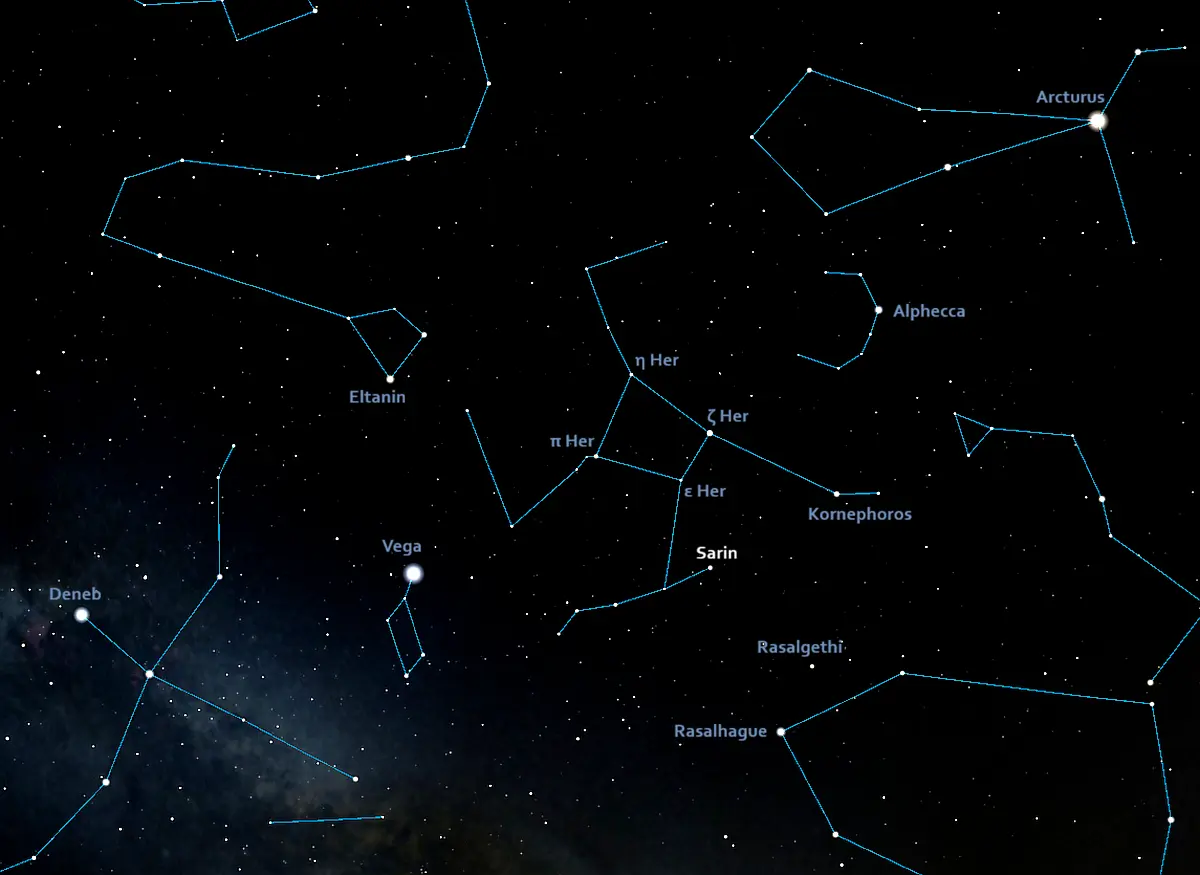
Location of Delta Herculis (Sarin), image: Stellarium (annotated for this article)
Constellation
Sarin is located in the northern constellation of Hercules. The celestial club bearer is the fifth largest constellation in the sky and the second largest constellation in the northern celestial hemisphere, after Ursa Major. It was one of the 48 Greek constellations catalogued by the Greco-Roman astronomer Claudius Ptolemy of Alexandria in his Almagest in the 2nd century AD.
The modern Hercules occupies an area of 1,225 square degrees. The constellation is dominated by the Keystone asterism, a relatively bright star pattern formed by Zeta, Pi, Eta and Epsilon Herculis. The Keystone stars outline the mythical hero’s torso and can be used to find the two brightest deep sky objects in the constellation, the globular clusters Messier 13 (the Hercules Globular Cluster) and Messier 92. Both clusters are visible in binoculars.
Other notable deep sky objects in Hercules include the globular cluster NGC 6229, the interacting pair of galaxies Arp 272, their host cluster Abell 2151 (the Hercules Cluster), the supergiant elliptical galaxy 3C 348 (Hercules A), and the planetary nebulae Abell 39, the White-Eyed Pea Nebula (IC 4593), and the Turtle Nebula (NGC 6210).
The brightest stars in Hercules shine at third magnitude. Kornephoros (Beta Herculis), the constellation’s lucida, is a yellow giant with an apparent magnitude of 2.78. The second brightest star, Zeta Herculis (Tianji) is a close binary star composed of a yellow-white subgiant and a Sun-like yellow dwarf.
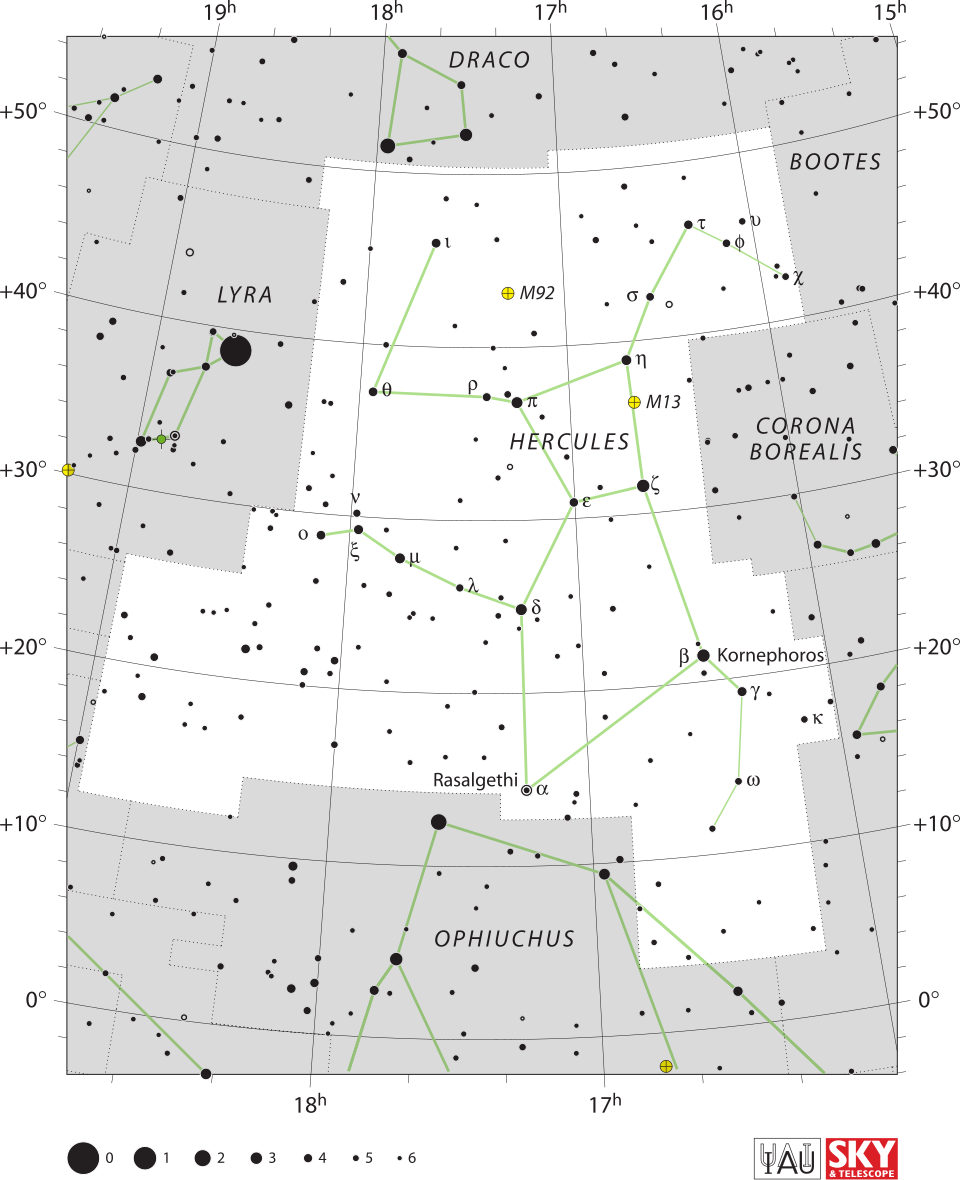
Hercules constellation map by IAU and Sky & Telescope magazine (Roger Sinnott & Rick Fienberg) (CC BY 3.0)
Other relatively bright stars in the constellation include the orange bright giant Pi Herculis, the red supergiant Rasalgethi (Alpha Herculis), the multiple star system Mu Herculis, the spectroscopic binary stars Gamma and Iota Herculis, and the G-type giants Eta and Xi Herculis.
The best time of the year to observe the stars, asterisms and deep sky objects in Hercules is in the month of July, when the constellation appears higher in the sky in the early evening. The entire constellation can be seen from locations north of the latitude 39° S.
The 10 brightest stars in Hercules are Kornephoros (Beta Her, mag. 2.78), Tianji (Zeta Her, mag. 2.81), Sarin (Delta Her, mag. 3.126), Nüchuang (Pi Her, mag. 3.15), Rasalgethi (Alpha Her, mag. 3.350), Mu Herculis (mag. 3.417), Eta Herculis (mag. 3.487), Xi Herculis (mag. 3.70), Gamma Herculis (mag. 3.75), and Tianbang (Iota Her, mag. 3.80).
Sarin – Delta Herculis
| Spectral class | A3IV |
| U-B colour index | +0.7 |
| B-V colour index | +0.08 |
| Apparent magnitude | 3.126 |
| Absolute magnitude | +1.31 |
| Distance | 75.1 ± 0.3 light-years (23.04 ± 0.08 parsecs) |
| Parallax | 43.41 ± 0.15 mas |
| Radial velocity | -40.0 |
| Proper motion | RA: -21.14 mas/yr |
| Dec.: -157.68 mas/yr | |
| Constellation | Hercules |
| Right ascension | 17h 15m 01.91058s |
| Declination | +24° 50′ 21.1451″ |
| Names and designations | Sarin, Delta Herculis, Delta Her, del Her, δ Herculis, δ Her, 65 Herculis, 65 Her, HD 156164, HR 6410, HIP 84379, HIC 84379, SAO 84951, FK5 641, BD+25°3221, AG+24 1725, GJ 3995, GC 23294, GCRV 9948, PLX 3916.00, PPM 105702, SKY# 31083, JP11 2835, TD1 20162, WEB 14243, GEN# +1.00156164, SRS 30641, IRC +20316, GSC 02065-01930, STF 3127A, CSI+25 3221 1, N30 3845, AKARI-IRC-V1 J1715018+245020, HGAM 664, LSPM J1715+2450, NSV 8419, UCAC4 575-056725, USNO-B1.0 1148-00254291, ASCC 788714, PMC 90-93 456, CNS5 4230, ROT 2425, UBV 14633, UBV M 22045, TIC 257582738, BNU 5, WISEA J171501.84+245019.6, WISE J171501.88+245019.2, TYC 2065-1930-1, IRAS 17129+2453, IRAS F17129+2453, 2MASS J17150190+2450212, Gaia DR2 4573412435276520320, Gaia DR3 4573412435280434560, ADS 10424 A, CCDM J17151+2451A, IDS 17109+2457 A, WDS J17150+2450A, WDS J17150+2450Aa,Ab |
Delta Herculis Aa
| Mass | 2.4 M☉ |
| Luminosity | 38 L☉ |
| Radius | 2.2 R☉ |
| Temperature | 9,620 ± 350 K |
| Age | 370 million years |
| Rotational velocity | 270 km/s |
| Surface gravity | 4.11 cgs |
Delta Herculis Ab
| Mass | 1.6 M☉ |
| Luminosity | 6.8 L☉ |
| Radius | 1.5 R☉ |
| Temperature | 7,500 K |