Nüchuang, Pi Herculis (π Her), is an orange bright giant star located 367 light years away in the constellation Hercules. With an apparent magnitude of 3.15, it is the fourth brightest star in the constellation. It is one of the four stars that form the Keystone, one of the most recognizable features of the northern summer sky.
What type of star is Pi Herculis?
Pi Herculis is a young but evolved star that shines at third magnitude from a distance of 367 light-years because it is intrinsically highly luminous. Classified as an orange bright giant, it has a luminosity 1,176 times that of the Sun. The star’s brightness is dimmed by 0.11 magnitudes by intervening dust. Without extinction, Pi Herculis would appear slightly brighter (mag. 3.04).
Pi Herculis has an estimated age of 220 million years, which is only a fraction of the Sun’s age. Even though it is still young by astronomical standards, the star has already entered the late stages of its existence due to its higher mass. It spins at 6.12 km/s and is moving towards the Sun with a radial velocity of -25.57 km/s.
The bright giant is listed as a suspected variable in the 2017 General Catalogue of Variable Stars. A 2020 study found Pi Herculis to show a photometric variability of only 0.0054 magnitudes over a 24-hour period.
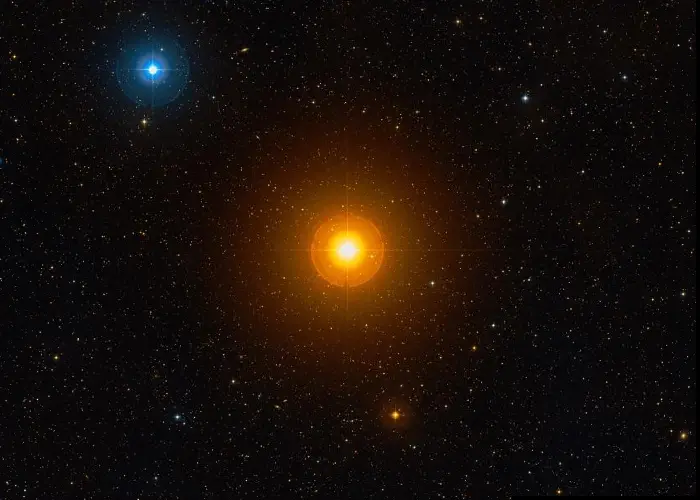
Nüchuang (Pi Herculis), image credit: ESO/Digitized Sky Survey 2 (CC BY 4.0)
Size, mass and evolution
Pi Herculis has a mass of 3.77 solar masses and a radius of 64.02 solar radii. It has already burned through the supply of hydrogen fuel in its core and expanded to its present size as it evolved into a giant. If it were placed at the centre of the solar system, it would extend to almost 80% of Mercury’s orbit. The stellar parameters of Pi Herculis are derived from angular diameter measurements with the Navy Precision Optical Interferometer (NPOI) in 2017.
The luminous giant started its life as a hot blue main sequence star of the spectral type B. Now, it is believed to be fusing helium in its core.
The star is following the evolutionary path of intermediate-mass stars. It is not massive enough to go out as a supernova when it reaches the end of its life. Like the Sun and its Keystone neighbours, it will instead produce a planetary nebula and slowly fade as a white dwarf for billions of years. Even though it is the youngest of the Keystone stars, it will be the first to go.
Radial velocity variations
In 1999, astronomers Artie P. Hatzes and William D. Cochran of the McDonald Observatory reported radial velocity variability with a period of 613 days in Pi Herculis. The variations may be explained by non-radial pulsations, star spots coupled with rotational modulation, or the presence of a substellar companion with a mass at least 27 times that of Jupiter orbiting at a separation of 3 astronomical units from the star.
No planets or brown dwarfs have been confirmed in the Pi Herculis system to date. Non-radial pulsations (some parts of the stellar surface expanding while others contract) are the most likely explanation for the variations.
If Pi Herculis hosted a planet, the planet would have to orbit 37 astronomical units (Earth – Sun distances) from the luminous star to be in the habitable zone. This is about halfway the distance between the orbits of Neptune and Pluto in the solar system.
Spectral classification
Pi Herculis has the spectral type K3 II, indicating an orange (K) star with the luminosity class of a bright giant (II), placing it between an ordinary giant and supergiant. With a surface temperature of 4,223 K, the young star is much cooler than the Sun.
Pi Herculis has the same spectral class as Tarazed (Gamma Aquilae), the brighter of the two stars flanking Altair. Tarazed is slightly older (270 Myr), less massive (3.51 M☉), larger (91.81 R☉), and more than twice as luminous (2,146 L☉). With an apparent visual magnitude of 2.712, it is brighter than Pi Herculis, even though it lies at a greater distance, 395 light-years away.
How bright is Pi Herculis compared to other stars?
Pi Herculis shines at magnitude 3.15 and is visible from areas without too much light pollution. It is the fourth brightest star in Hercules, after Kornephoros (Beta Herculis), Tianji (Zeta Herculis), and Sarin (Delta Herculis).
Pi Herculis is, on average, the 200th brightest star in the night sky. It is only imperceptibly fainter than its Hercules neighbour Sarin, Kappa Centauri in Centaurus, and Alpha Lyncis in Lynx. It is about as bright as N Velorum in Vela, and it just outshines Pipit (Nu Puppis) in Puppis, Theta Ursae Majoris in Ursa Major, Aldhibah in Draco, Phi Sagittarii in Sagittarius, and Haedus in Auriga.
Northeastern corner of the Keystone
Pi Herculis marks the northeastern vertex of the Keystone, a relatively bright star pattern that corresponds to the torso of Hercules. The asterism is also formed by Eta, Epsilon, and Zeta Herculis.
Pi Herculis is the youngest and most massive of the four stars. It is also, by far, the most distant. Despite the distance, it is the second brightest star in the Keystone, after Zeta Herculis. Zeta appears brighter because it is around 10 times closer to us, at a distance of 35 light-years.
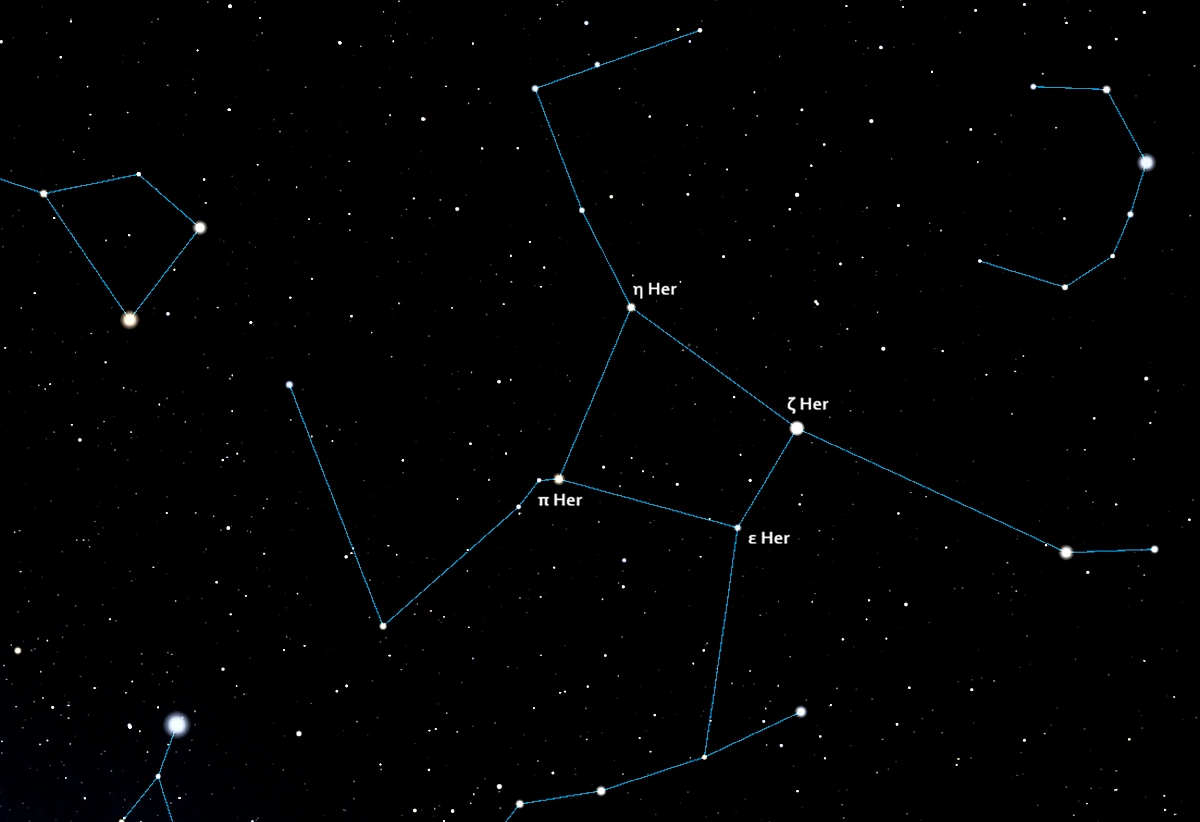
The Keystone in Hercules, image: Stellarium (annotated for this article)
Name
The name Nüchuang comes from the name of the Chinese asterism 女床 (Nǚ Chuáng), Woman’s Bed), formed by Pi Herculis, 69 Herculis, and Rho Herculis. In traditional Chinese astronomy, the star pattern was part of the Heavenly Market Enclosure. It was associated with the emperor’s concubines.
The International Astronomical Union’s (IAU) Working Group on Star Names (WGSN) approved the name on May 14, 2026.
How to find Pi Herculis
Pi Herculis is easy to find because it is relatively bright and part of a recognizable asterism, the Keystone. The Keystone lies in the region between the bright Vega and the semi-circle representing the Northern Crown. Pi Herculis is the nearest of the Keystone stars to Vega.
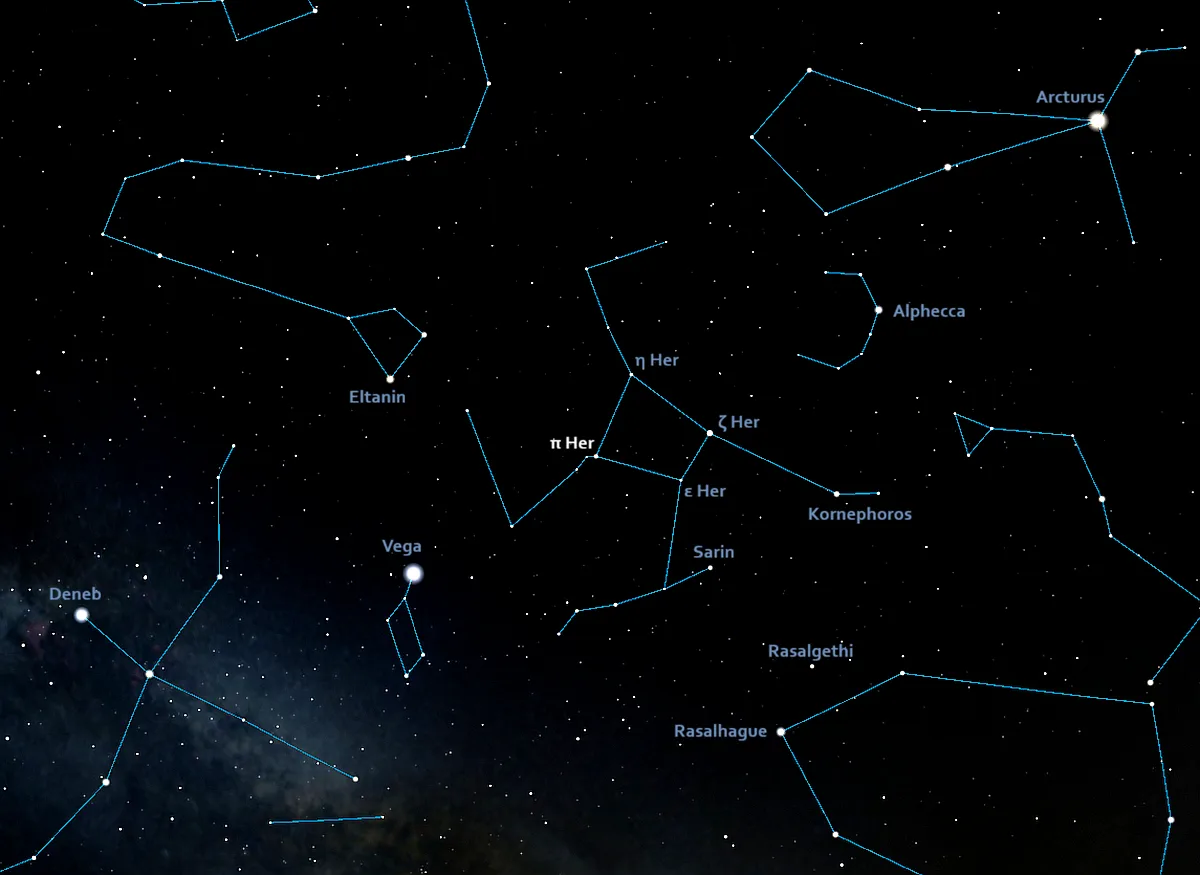
Pi Herculis location, image: Stellarium (annotated for this article)
A nearby deep sky object: Messier 92
Pi Herculis can be used to find the bright globular cluster M92. With an apparent magnitude of 6.4, the ancient cluster is on the border of unaided eye visibility and can be spotted in binoculars and small telescopes. It appears close to the imaginary line connecting Pi Herculis with Rastaban in the constellation Draco. Rastaban and the brighter Eltanin mark the celestial Dragon’s eyes and can be found by extending a line through the beam of the Northern Cross in Cygnus.
Messier 92 can also be found along the line connecting Eta and Iota Herculis. The brighter Messier 13 lies between Eta and Zeta Herculis.
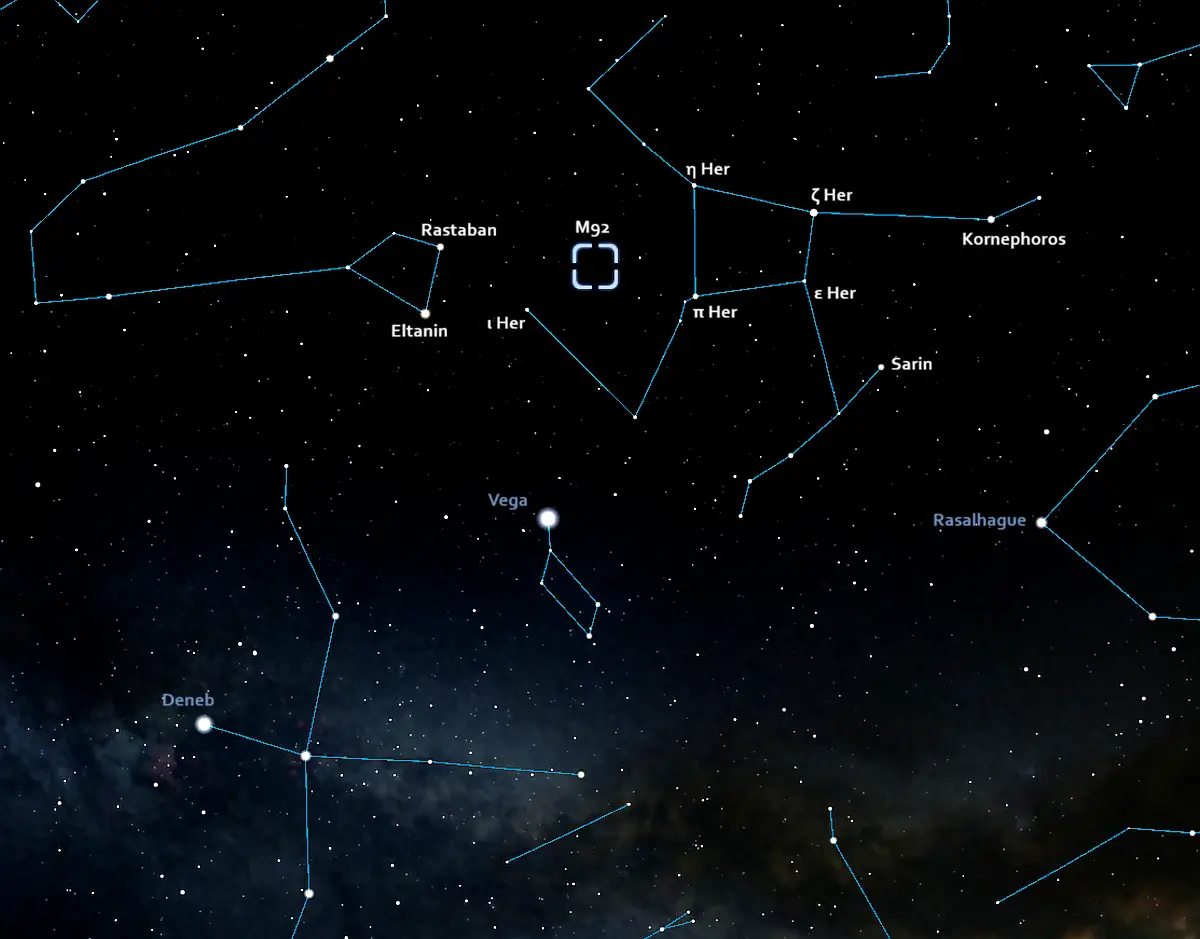
Pi Herculis, Rastaban and Messier 92, image: Stellarium (annotated for this article)
Constellation
Pi Herculis is located in the constellation Hercules. Named after the Roman mythological hero, the constellation stretches across an area of 1,225 square degrees of the northern sky. It is the second largest northern constellation, after Ursa Major, and the fifth largest of the 88 constellations.
Hercules was one of the 48 ancient constellations catalogued by Ptolemy of Alexandria in the 2nd century CE. Even though it is large, it does not contain any first or second magnitude stars that would make it more prominent in the sky.
The brightest star in the constellation is Kornephoros (Beta Herculis), a G-type red clump giant that shines at magnitude 2.78 from a distance of around 139 light-years. The only other star in Hercules brighter than magnitude 3.0 is Tianji (Zeta Herculis), a spectroscopic binary system located 35 light-years away.
Other bright stars in Hercules include the binary systems Delta Herculis (Sarin), Gamma Herculis and Iota Herculis (Tianbang), the multiple star systems Alpha Herculis (Rasalgethi) and Mu Herculis, and the yellow giants Eta and Xi Herculis.
The constellation hosts two bright globular clusters listed in the Messier catalogue, Messier 13 and Messier 92. Other deep sky objects in Hercules include the radio galaxy Hercules A, the globular cluster NGC 6229, the colliding galaxies Arp 272, and the planetary nebulae NGC 6210 (the Turtle Nebula), IC 4593 (the White-Eyed Pea Nebula), and Abell 39.
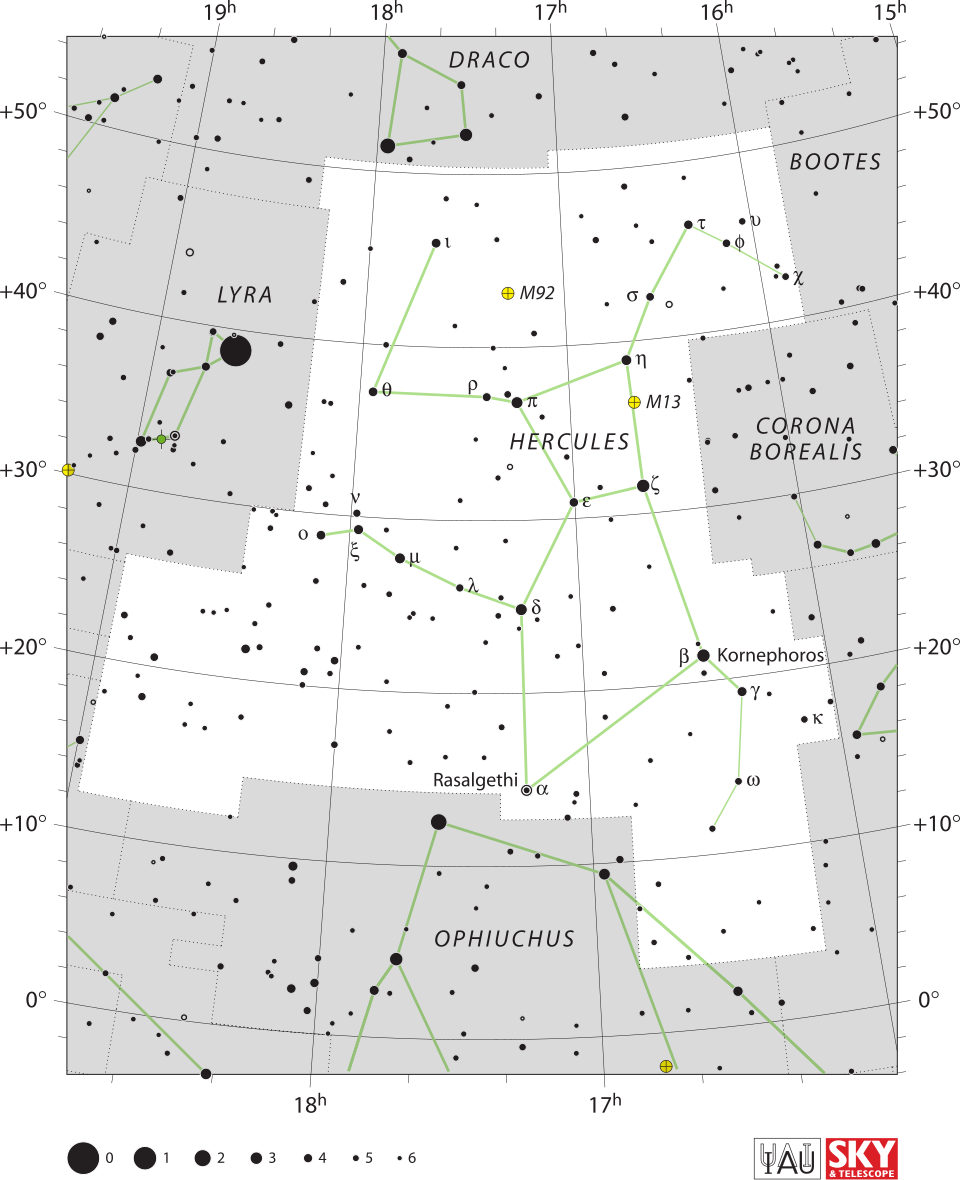
Hercules constellation map by IAU and Sky & Telescope magazine (Roger Sinnott & Rick Fienberg) (CC BY 3.0)
The best time of the year to see the stars and deep sky objects in Hercules is in July, when the celestial club bearer appears higher above the horizon in the early evening. The entire constellation is visible from locations north of the latitude 39° S.
The 10 brightest stars in Hercules are Kornephoros (Beta Her, mag. 2.78), Tianji (Zeta Her, mag. 2.81), Sarin (Delta Her, mag. 3.126), Nüchuang (Pi Her, mag. 3.15), Rasalgethi (Alpha Her, mag. 3.350), Mu Herculis (mag. 3.417), Eta Herculis (mag. 3.487), Xi Herculis (mag. 3.70), Gamma Herculis (mag. 3.75), and Tianbang (Iota Her, mag. 3.80).
Nüchuang – Pi Herculis
| Spectral class | K3 II |
| Variable type | Suspected |
| U-B colour index | +1.66 |
| B-V colour index | +1.45 |
| Apparent magnitude | 3.15 |
| Absolute magnitude | -2.10 (-2.22 to -1.97) |
| Distance | 367 ± 5 light-years (112 ± 2 parsecs) |
| Parallax | 8.8991 ± 0.1323 mas |
| Radial velocity | – 25.57 ± 0.20 km/s |
| Proper motion | RA: – 27.402 ± 0.144 mas/yr |
| Dec.: +2.925 ± 0.170 mas/yr | |
| Mass | 3.77 ± 0.2 M☉ |
| Luminosity | 1,176 ± 67 L☉ |
| Radius | 64.02 R☉ (63.11 – 64.91 R☉) |
| Temperature | 4,223 ± 53 K |
| Metallicity | 0.01 ± 0.1 dex |
| Age | 220 ± 40 million years |
| Rotational velocity | 6.12 km/s |
| Surface gravity | 1.26 ± 0.05 cgs |
| Constellation | Hercules |
| Right ascension | 17h 15m 02.83424s |
| Declination | +36° 48′ 32.9816″ |
| Names and designations | Nüchuang, Pi Herculis, Pi Her, π Herculis, π Her, 67 Herculis, 67 Her, HD 156283, HR 6418, HIP 84380, HIC 84380, SAO 65890, FK5 643, BD+36 2844, AG+36 1494, PLX 3921.00, PPM 80052, SKY# 31084, GC 23302, GCRV 9955, RAFGL 1950, GSC 02604-01774, IRC +40295, PMC 90-93 457, GEN# +1.00156283, JP11 2839, N30 3846, DO 15875, NSV 8431, ROT 2428, WISE J171502.79+364832.7, TD1 20187, TIC 85521725, WEB 14244, UBV 14675, UBV M 22064, IRAS 17133+3651, 2MASS J17150285+3648329, TYC 2604-1774-1, Gaia DR2 1339952869194709120, Gaia DR3 1339952869195300608 |