Paradys, Alpha Apodis (α Aps), is a giant star located approximately 498 light years away in the southern constellation of Apus (the Bird of Paradise). With an apparent magnitude of 3.83, it is the constellation’s brightest star. Located in the far southern sky, the evolved star is invisible from most of the northern hemisphere.
What type of star is Alpha Apodis?
Alpha Apodis is an orange giant of the spectral type K3IIICN0.5. The CN0.5 suffix indicates a higher abundance of cyanide (CN). The star has a mass around 4.46 times that of the Sun and a surface temperature of 4,090 K.
Paradys has ceased fusion of hydrogen in its core and evolved away from the main sequence. It is now on the red giant branch (RGB). It has expanded to a size of around 65 solar radii and shines with 1,072 solar luminosities.
With a mass of 4.46 solar masses, Alpha Apodis is not massive enough to end its life as a supernova. Instead, it follows the evolutionary path of intermediate-mass stars. Like the Sun, when it reaches the end of its life cycle, it will eject its outer gaseous envelope to form a planetary nebula and slowly fade as a dim white dwarf for billions of years.
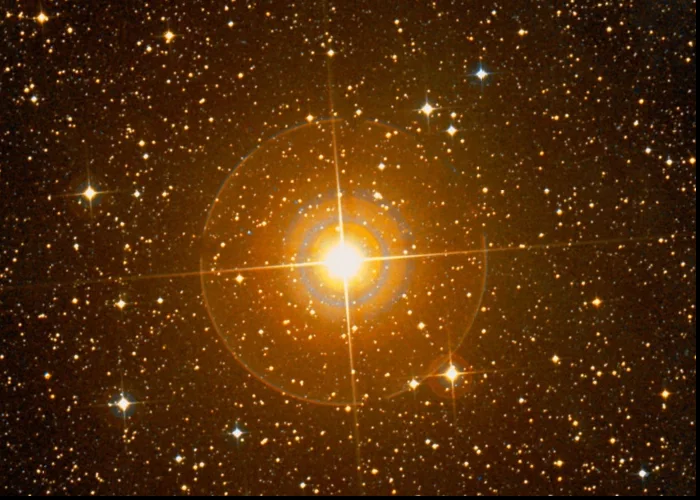
Paradys (Alpha Apodis), image credit: ESO/Digitized Sky Survey 2 (CC BY 4.0)
Name
The name Paradys comes from the Dutch name for the constellation Apus, Paradys-vogel. The name was originally used for Apus by the Dutch-Flemish astronomer and cartographer Petrus Plancius, who created the constellation in 1598.
The International Astronomical Union’s (IAU) Working Group on Star Names (WGSN) officially approved the name on May 18, 2025.
Chinese name of Alpha Apodis
In Chinese astronomy, Paradys is known as 異雀八 (Yì Què bā), the Eighth Star of Exotic Bird. It forms an asterism called Exotic Bird with Zeta Apodis, Iota Apodis, Beta Apodis, Gamma Apodis, Delta Octantis, Delta1 Apodis, Eta Apodis, and Epsilon Apodis.
Stars in the region of the south celestial pole were catalogued in China in the early 17th century based on the star charts created by western astronomers. Exotic Bird and other far southern asterisms were adapted into the Chinese system during the compilation of the Chongzhen calendar, which introduced European astronomy and mathematics to China.
How to find Alpha Apodis
Alpha Apodis lies in the region between the bright Atria in Triangulum Australe and Miaplacidus in Carina. It can be found using the stars of the Southern Cross. A line extended from Imai through Acrux points in its direction. Alternatively, a line drawn from Rigil Kentaurus (Alpha Centauri) through Xami (Alpha Circini) also leads to the star.
At declination -79°, Paradys never rises above the horizon for observers north of the latitude 11° N. For most locations in the southern hemisphere, the star is circumpolar, i.e. it never sets and can be seen throughout the year.
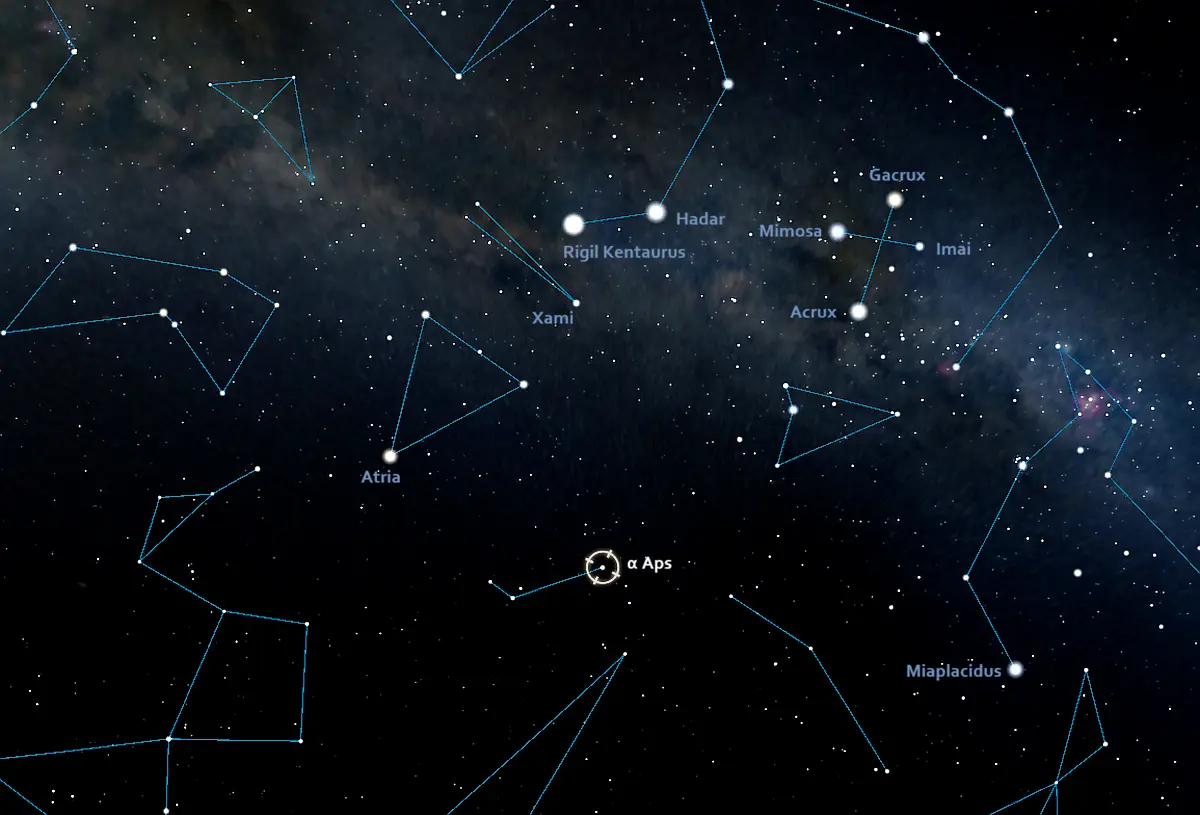
Location of Alpha Apodis, image: Stellarium (annotated for this article)
The globular cluster IC 4499 lies almost directly south of Alpha Apodis. It can be observed in small and medium telescopes.
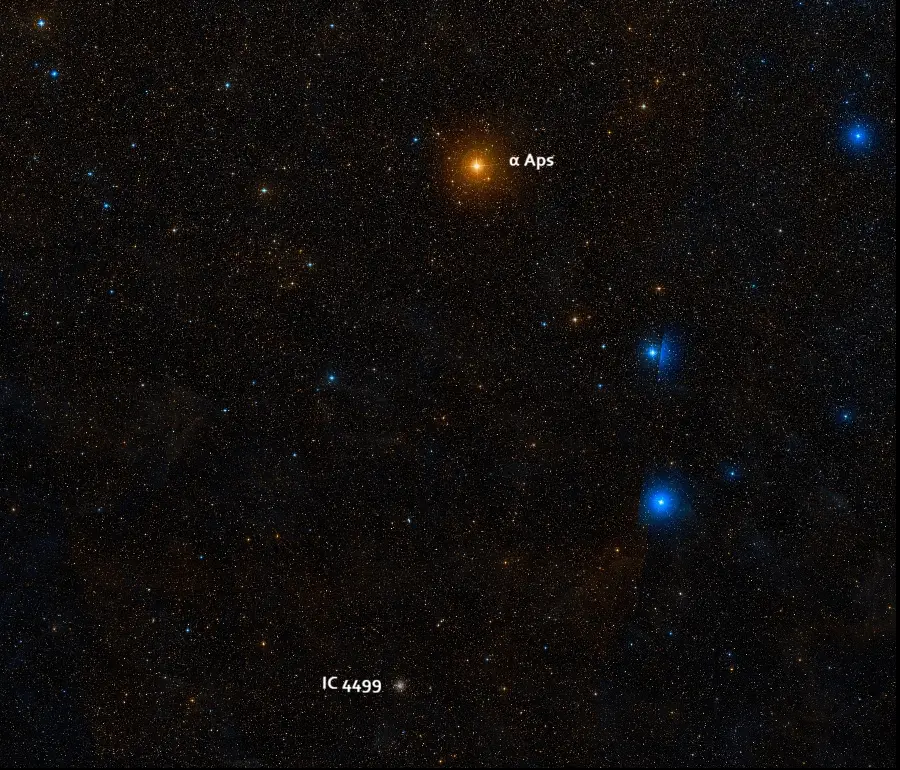
Alpha Apodis and IC 4499, image credit: ESO/Digitized Sky Survey 2 (CC BY 4.0)
Constellation
Alpha Apodis is located in the constellation Apus. The celestial Bird-of-Paradise was created by Petrus Plancius in the late 16th century based on observations of the Dutch explorers Pieter Dirkszoon Keyser and Frederick de Houtman. The constellation first appeared on Plancius’ celestial globe in 1598 and was later included in German astronomer Johann Bayer’s star atlas Uranometria (1603). In 1756, the French astronomer Nicolas Louis de Lacaille charted the Apus stars and gave 12 of them Bayer designations.
Apus is one of the southernmost constellations in the sky. Located in the region of the south celestial pole, it is largely invisible from the northern hemisphere. With its brightest star shining at magnitude 3.83, the constellation cannot be seen at all from heavily light-polluted urban areas.
The constellation contains a total of only 39 stars that are theoretically visible to the unaided eye (brighter than magnitude 6.5).
The five brightest stars in Apus – Alpha, Gamma, Beta, Delta1, and Zeta Apodis – are all evolved giants. Gamma Apodis is a yellow giant, Beta and Zeta Apodis are orange giants, and Delta1 Apodis is a red giant. The chemically peculiar Eta Apodis is the only other star in the constellation brighter than magnitude 5.0.
Other visible stars in Apus include the hot blue Gamma Cassiopeiae variable Epsilon Apodis, the orange giants Delta2 Apodis and R Apodis, and the hot blue binary system Iota Apodis.
The constellation also hosts the variable red giants Theta Apodis and NO Apodis, the carbon star S Apodis, the yellow subgiant HD 134606 with a system of five orbiting planets, and the luminous blue variable candidate Godzilla in the gravitationally lensed Sunburst Galaxy.
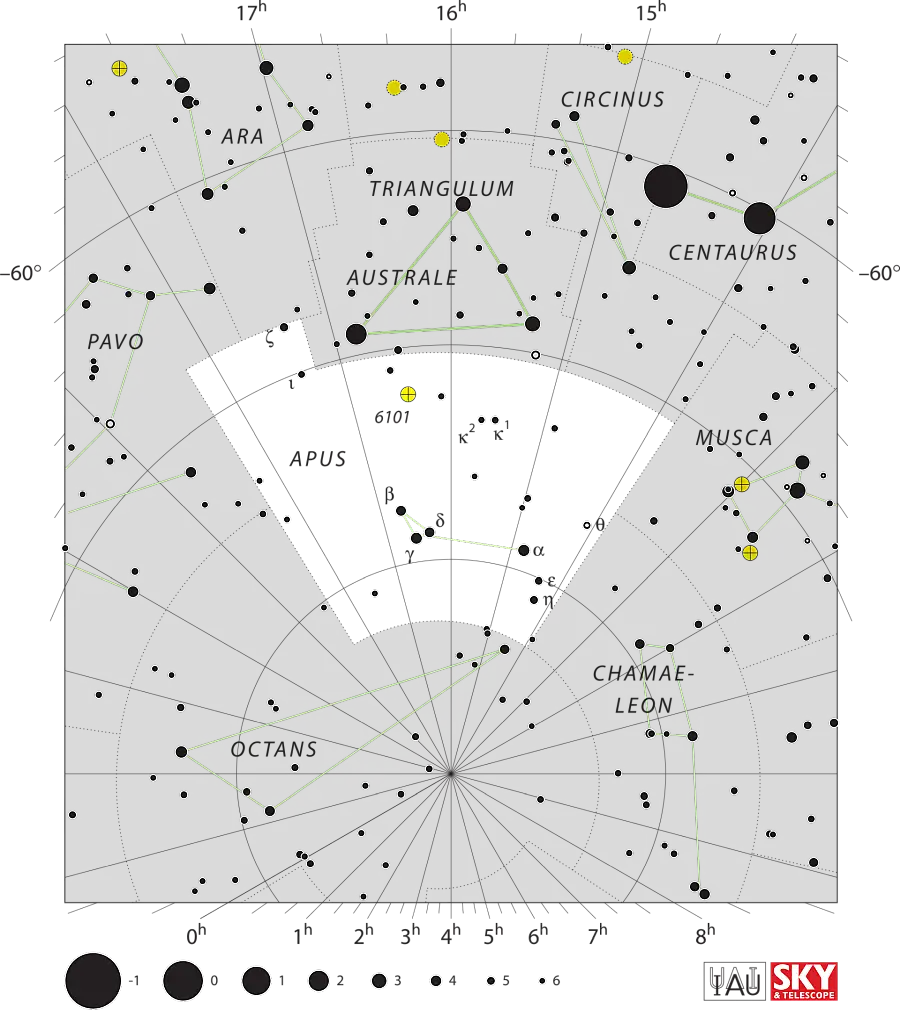
Apus constellation map by IAU and Sky&Telescope magazine (Roger Sinnott & Rick Fienberg) (CC BY 3.0)
Deep sky objects in Apus include the relatively bright globular clusters NGC 6101 and IC 4499, the spiral galaxies NGC 6392, IC 4633 and IC 4635, and the planetary nebula Henize 2-131.
The best time of the year to observe the stars and deep sky objects in Apus is during the month of July, when the constellation appears higher above the horizon in the early evening. The entire constellation is visible from locations south of the latitude 5° N.
The 10 brightest stars in Apus are Paradys (Alpha Aps, mag. 3.83), Gamma Apodis (mag. 3.86), Beta Apodis (mag. 4.24), Delta1 Apodis (mag. 4.66 – 4.87), Zeta Apodis (mag. 4.78), Eta Apodis (mag. 4.89), Epsilon Apodis (mag. 5.06), Delta2 Apodis (mag. 5.27), R Apodis (mag. 5.36) and Iota Apodis (mag. 5.41).
Paradys – Alpha Apodis
| Spectral class | K3IIICN0.5 |
| U-B colour index | +1.68 |
| B-V colour index | +1.43 |
| R-I colour index | +1.43 |
| Apparent magnitude | 3.83 |
| Absolute magnitude | -1.67 |
| Distance | 498 ± 9 light-years (153 ± 3 parsecs) |
| Parallax | 6.5509 ± 0.1133 mas |
| Radial velocity | -0.10 ± 0.7 km/s |
| Proper motion | RA: -5.133 ± 0.163 mas/yr |
| Dec.: -16.299 ± 0.132 mas/yr | |
| Mass | 4.46 ± 0.22 M☉ |
| Luminosity | 1,072 ± 22 L☉ |
| Radius | 59.51 ± 2.98 R☉ or 65 ± 5 R☉ |
| Temperature | 4,090 ± 80 K |
| Metallicity | -0.3 dex |
| Constellation | Apus |
| Right ascension | 14h 47m 51.71203s |
| Declination | −79° 02′ 41.1032″ |
| Names and designations | Paradys, Alpha Apodis, Alpha Aps, α Apodis, α Aps, alf Aps, HD 129078, HR 5470, HIP 72370, SAO 257193, FK5 542, HIC 72370, SKY# 26871, GC 19834, WEB 12442, GCRV 8558, PPM 372410, PLX 3315.00, GSC 09436-02393, N30 3328, TIC 446344706, CPC 21.3 1786, CPD-78 893, UBV 12790, UBV M 20297, GEN# +1.00129078, IRAS 14415-7850, 2MASS J14475174-7902409, TYC 9436-2393-1, Gaia DR2 5773473920381370240, Gaia DR3 5773473920382493440 |