Zeta Cygni (ζ Cyg) is a relatively bright binary star located in the region of the Swan’s wing in the constellation Cygnus. Formally named Tianjinnan, it lies 149.5 light-years away and shines at magnitude 3.26. Appearing along the beam of the Northern Cross, the giant star is used as a guide for finding the Veil Nebula, one of the most prominent supernova remnants in the northern sky.
Closer studies of the primary component, a yellow giant, have revealed it to be somewhat stranger than its steady yellow glow suggests. The star is a prototype for the class of mild barium stars, whose atmospheres contain an unexpected overabundance of barium and other heavy elements.
The barium surplus is not something the star cooked up itself. It is a chemical signature of an unseen binary companion, transferred across space when the Zeta Cygni system was much younger and the secondary component, now a dim white dwarf, was the more massive component.
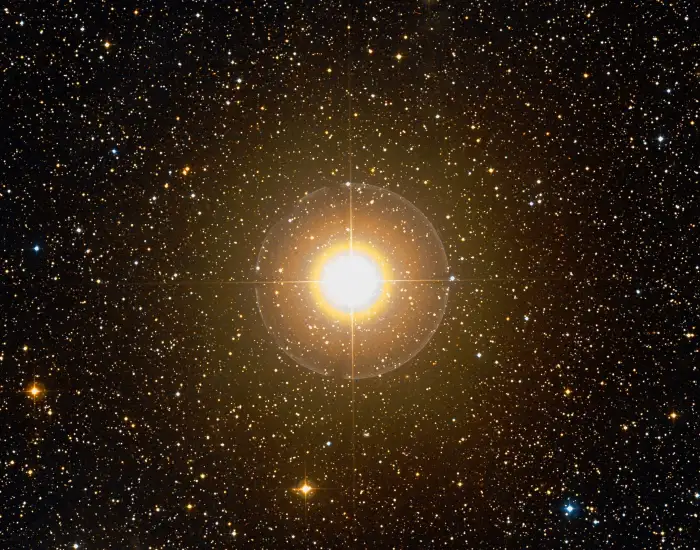
Tianjinnan (Zeta Cygni), image credit: ESO/Digitized Sky Survey 2 (CC BY 4.0)
A tale of two stars: The Zeta Cygni system
Zeta Cygni is a binary star system composed of an evolved yellow giant and an invisible white dwarf companion. The stars have an orbital period of 6,489 ± 31 days (17.8 years). To the unaided eye, they appear as a single star and are difficult to resolve even in the largest telescopes.
The white dwarf was marginally resolved with the Wide Field and Planetary Camera 2 on the Hubble Space Telescope (HST) in May 2000. At the time, it was separated by only 0.032 arcseconds from the giant primary component. The astronomers observed the stars close to their smallest projected angular separation and estimated that the system’s semi-major axis should be around 0.19 arcseconds, making Zeta Cygni more easily resolvable by Hubble at other orbital phases.
Zeta Cygni A: The yellow giant
Zeta Cygni A is an evolved yellow giant star of the spectral type G8 IIIp. In terms of evolution, it is believed to be a red clump giant, a horizontal branch star that has undergone a helium flash and is now fusing helium into heavier elements in its core. With a mass of 3.05 solar masses, it is following the evolutionary cycle of intermediate-mass stars and will end its life as a white dwarf surrounded by a planetary nebula.
Zeta Cygni A has expanded to a size of 15 solar radii and, with a surface temperature of 4,910 K, it has an energy output of 112 solar luminosities. The star is a very slow spinner, with a projected rotational velocity of around 0.4 km/s. It has an estimated age of 200 million years.
Barium enrichment: A chemical gift from a long-lost companion
Zeta Cygni has about triple the abundance of barium in its atmosphere compared to our Sun and is also enriched in other heavy elements. The overabundance traces the evolution of the Zeta Cygni system, showing the effect that the white dwarf had on the now-primary component in a previous phase of its life.
The stellar remnant Zeta Cygni B was once the more massive of the two components. Because of its larger mass, it burned through its supply of hydrogen and evolved away from the main sequence faster than Zeta Cygni A. When the star was on the asymptotic giant branch (AGB), it synthesized barium and other elements, which were then mixed by convection to its surface. As it lost mass toward the end of its AGB phase, the expelled material was accreted by Zeta Cygni A.
In 2003, Yushchenko et al. estimated main-sequence masses of 3.0 and 2.5 solar masses for the white dwarf and the barium star and a wind velocity of 15 km s-1. This means that Zeta Cygni A accreted about half a solar mass through mass transfer from its more massive companion.
Observations of barium stars indicate that they all have companions that contaminate them with the heavier elements. Other relatively bright mild barium stars include Azha (Eta Eridani) in the constellation Eridanus, Nekkar (Beta Boötis) in Boötes, Pabilsang (Nu2 Sagittarii) in Sagittarius, and Alphard (Alpha Hydrae) in Hydra.
Zeta Cygni B: The invisible white dwarf companion
The white dwarf Zeta Cygni B has the spectral class DA4.2, indicating a hydrogen-rich outer layer. The stellar remnant has only 0.6 solar masses left of its original mass since it expelled its outer gaseous layers at the end of its life. With an estimated apparent magnitude of 13.2, it is well below unaided eye visibility, like any other white dwarf.
The presence of Zeta Cygni B was first reported by Erika Böhm-Vitense in 1980. In 1983, Dominy & Lambert estimated an effective temperature of 12,000 K for the remnant.
How bright is Zeta Cygni?
With an apparent magnitude of 3.26, Tianjinnan is easily visible to the unaided eye under normal sky conditions. It is invisible from major cities and bright urban areas (Bortle class 9), where high light pollution washes out all but the brightest stars.
Zeta Cygni is the sixth brightest star in Cygnus, after the five stars that form the Northern Cross (Deneb, Sadr, Aljanah, Fawaris, and Albireo). On a clear night, it appears as the extended wing of the Swan.
Tianjinnan is, on average, the 211th brightest star in the sky. It is slightly fainter than Tabit in the constellation Orion, Epsilon Leporis in Lepus, Kappa Ophiuchi in Ophiuchus, and G Scorpii in Scorpius. It is about as bright as Errai in the constellation Cepheus, Delta Lupi in Lupus, and Yed Posterior in Ophiuchus.
The name Tianjinnan: Zeta Cygni in Chinese mythology
Tianjinnan, the formal proper name of Zeta Cygni A, comes from traditional Chinese astronomy and means “southern star of Tianjin.”
Tianjin (the Celestial Ferry or Celestial Ford) is a constellation that represents a bridge across the Milky Way that allows two star-crossed lovers, the Cowherd and the Weaver Girl, to meet once a year. Other stars in the constellation include Sadr (Gamma Cygni), Fawaris (Delta Cygni), 30 Cygni, Deneb (Alpha Cygni), Nu Cygni, Enduri Senggu (Tau Cygni), Upsilon Cygni, and Aljanah (Epsilon Cygni). The Celestial Ferry is part of the larger Girl mansion, one of the northern mansions of the Black Tortoise.
In Chinese mythology, the Cowherd (Niulang) and the Weaver Girl (Zhinü) were banished to opposite sides of the great river in the sky (the Milky Way) because their love was forbidden. However, once a year, they can reunite when a flock of magpies form a bridge across the river. Zhinü and Niulang are represented by the bright Vega and Altair, their children by Tarazed and Alshain (the stars flanking Altair), and in some versions of the tale Deneb is the fairy who acts as a chaperone when they meet.
The International Astronomical Union’s Working Group on Star Names (WGSN) formally approved the name Tianjinnan for the primary component of the Zeta Cygni system on July 16, 2026.
Finding Zeta Cygni in the night sky
Zeta Cygni is easy to find on a clear, dark night because it appears as the extension of the beam of the Northern Cross. The star is the brightest point of light in the region between Deneb in Cygnus and Enif in Pegasus. It lies along the imaginary line drawn from Fawaris through Sadr.
At declination +30°, Zeta Cygni is visible from locations north of the latitude 59° S, which is to say from any location outside the Antarctic Circle.
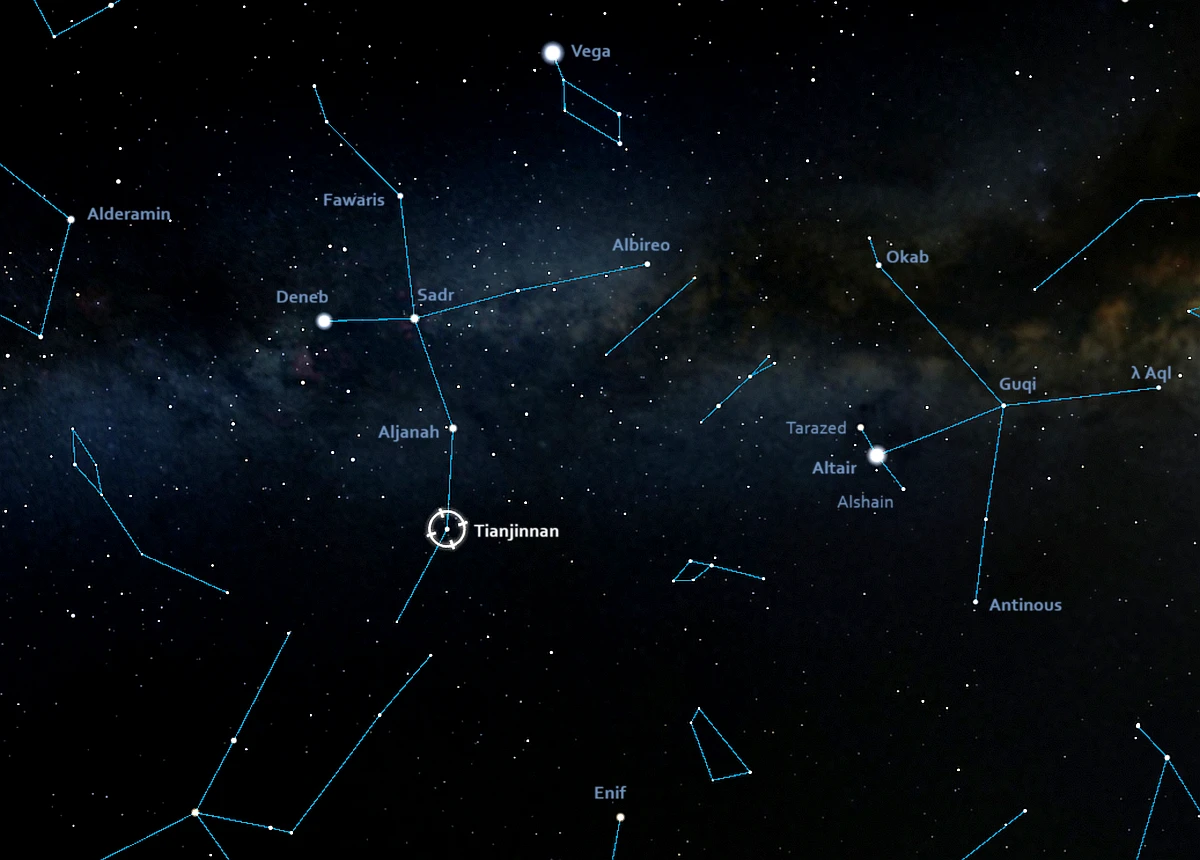
Location of Zeta Cygni (Tianjinnan), image credit: Stellarium (annotated for this article)
Using Tianjinnan to find the Veil Nebula
Zeta Cygni can be used to find the Veil Nebula, one of the largest supernova remnants in the northern sky. The complex of ionized gas is the remnant of a star 20 times more massive than the Sun that went out as a supernova between 10,000 and 20,000 years ago.
The nebula has since expanded to a size of about 3 degrees. Even though it has an apparent magnitude of 7, it has very low surface brightness and is best seen in exceptionally good conditions, on a moonless night away from city lights, using an OIII filter.
The Eastern Veil appears about a degree southwest of the midpoint of the imaginary line connecting Zeta and Epsilon Cygni, while the Western Veil (the Witch’s Broom Nebula) lies in the same line of sight as the magnitude 4.22 yellow giant 52 Cygni.
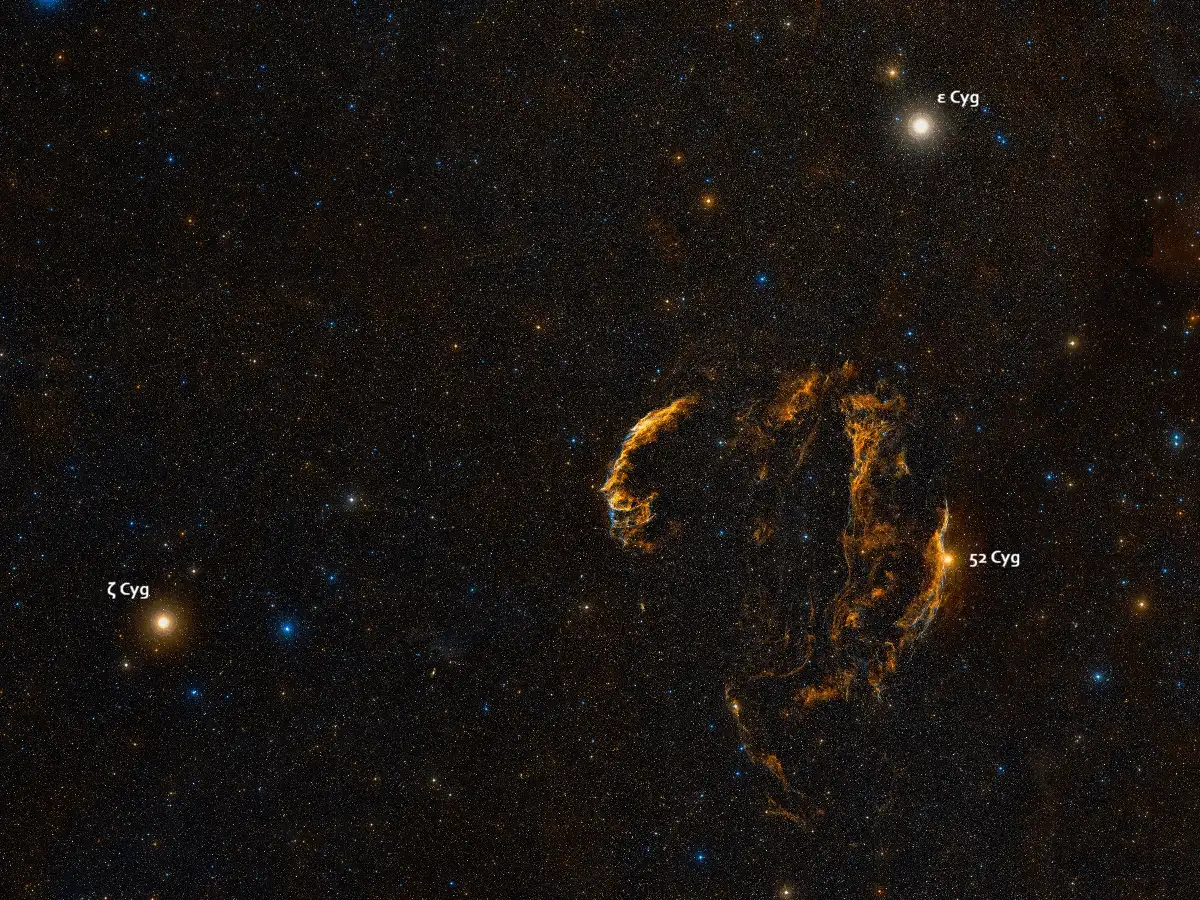
Zeta Cygni, Aljanah (Epsilon Cygni) and the Veil Nebula, image credit: ESO/Digitized Sky Survey 2 (CC BY 4.0)
Constellation
Tianjinnan is located in the constellation Cygnus. The Swan is one of the best-known northern constellations. It is easily recognizable for the Northern Cross asterism, which dominates the sky overhead during the northern hemisphere summer and early autumn. The bright star pattern corresponds to the main body of the Swan.
The blue supergiant Deneb (Alpha Cygni), the brightest star in Cygnus, is the 18th brightest star in the night sky. It marks the top of the Northern Cross and the tail of the celestial Swan. The young supernova candidate shines at magnitude 1.25 and serves as the prototype for the Alpha Cygni variables.
Other stars of the Northern Cross are also in the late phases of their evolutionary cycles. Sadr (Gamma Cygni) is an F-type supergiant, Aljanah (Epsilon Cygni) and Albireo (Beta Cygni) are orange giants, and Fawaris (Delta Cygni) is a blue-white giant. Aljanah, Fawaris and Albireo are all multiple star systems.
Other relatively bright stars in Cygnus include the spectroscopic binary system Xi Cygni, the A-type star Iota2 Cygni, the yellow giant Kappa Cygni (near the radiant of the Kappa Cygnids), and the orange giant Almighzal (Eta Cygni).
Cygnus is also home to the red hypergiant NML Cygni, one of the largest known stars, the hypergiant luminous blue variable P Cygni, the nearby orange dwarf system 61 Cygni (Bessel’s Star), the Delta Cephei variable X Cygni, and the unusual star system KIC 8462852 (Boyajian’s Star), nicknamed the WTF Star.
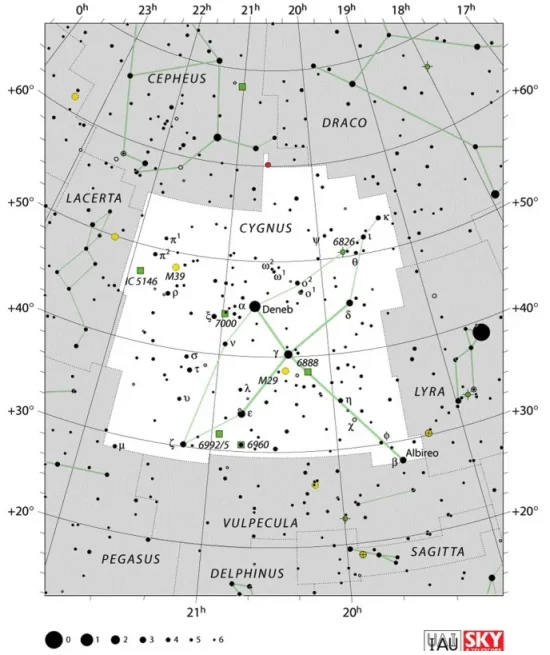
Cygnus constellation map by IAU and Sky&Telescope magazine (Roger Sinnott & Rick Fienberg) (CC BY 3.0)
The constellation hosts many stars with confirmed exoplanets, discovered by the Kepler and KELT missions. These include the Sun-like stars Kepler-11, Kepler-22 and Kepler-452, the red dwarf Kepler-186, and the blue-white star KELT-9b, which hosts the hottest known exoplanet, the ultra-hot Jupiter KELT-9b.
The best-known deep sky objects in Cygnus include the Gamma Cygni Nebula near Sadr, the North America Nebula (NGC 7000) and Pelican Nebula (IC 5070) near Deneb, the Crescent Nebula (NGC 6888), the Blinking Planetary Nebula (NGC 6826), the Footprint Nebula (Minkowski 92), the Jewel Bug Nebula (NGC 7027), and the bright open clusters Messier 29 and Messier 39.
The best time of the year to observe the stars and deep sky objects in Cygnus is during the month of September, when the constellation appears the highest in the sky in the early evening. The entire constellation can be seen from locations north of the latitude 40° S.
The 10 brightest stars in Cygnus are Deneb (Alpha Cyg, mag. 1.25), Sadr (Gamma Cyg, mag. 2.23), Aljanah (Epsilon Cyg, mag. 2.48), Fawaris (Delta Cyg, mag. 2.87), Albireo (Beta Cyg, mag. 2.90), Tianjinnan (Zeta Cyg, mag. 3.21), Xi Cygni (mag. 3.73), Enduri Senggu (Tau Cyg, mag. 3.65 – 3.75), Iota2 Cygni (mag. 3.77), and Kappa Cygni (mag. 3.814).
Tianjinnan – Zeta Cygni
| Spectral class | G8IIIa + DA4.2 |
| U-B colour index | +0.77 |
| B-V colour index | +0.98 |
| Apparent magnitude | 3.26 |
| Absolute magnitude | -0.01 |
| Distance | 149.5 ± 0.9 light-years (45.8 ± 0.3 parsecs) |
| Parallax | 21.8130 ± 0.1375 mas |
| Radial velocity | +16.72 ± 0.09 km/s |
| Proper motion | RA: -3.792 ± 0.130 mas/yr |
| Dec.: -45.429 ± mas/yr | |
| Mass | 3.05 M☉, 0.6 M☉ |
| Luminosity | 112 L☉ |
| Radius | 15 R☉ |
| Temperature | 4,910 K, 12,000 K |
| Metallicity | -0.04 dex |
| Age | 0.2 billion years |
| Rotational velocity | 0.4 ± 0.5 km/s |
| Surface gravity | 2.41 cgs |
| Constellation | Cygnus |
| Right ascension | 21h 12m 56.18594s |
| Declination | +30° 13′ 36.8957″ |
| Names and designations | Tianjinnan, Zeta Cygni, Zeta Cyg, ζ Cygni, ζ Cyg, 64 Cygni, 64 Cyg, HD 202109, HR 8115, HIP 104732, HIC 104732, SAO 71070, FK5 797, WEB 19047, PPM 86219, PLX 5103.00, BD+29 4348, AG+30 2302, GC 29661, GCRV 13338, JP11 3322, GEN# +1.00202109, RAFGL 2723, BAS 7, GSC 02702-02764, IRC +30472, SKY# 40368, PMC 90-93 560, MFU 232, N30 4690, CSI+29 4348 1, SRS 30797, UBV 18350, UBV M 25545, uvby98 100202109, FYM 141A, ROT 3090, WD 2110+300, SBC9 2958, YZ 30 12254, [L91b] 339, IRAS 21107+3001, 2MASS J21125619+3013370, TD1 27823, TIC 76956031, TYC 2702-2764-1, Gaia DR2 1851924859347035520, Gaia DR3 1851924859353116928, BUP 227A, IDS 21086+2949 AD, CCDM J21129+3014A, WDS J21129+3014A, WDS J21129+3014Aa,Ab |