Shaomin, Rho Leonis (ρ Leo), is a blue supergiant star located approximately 2,900 light-years away in the zodiac constellation of Leo. With an apparent magnitude that varies from 3.83 to 3.90, it is the 10th brightest star in the constellation.
Rho Leonis is the most massive of Leo’s bright stars. With a mass almost 20 times that of the Sun, the supergiant is a supernova candidate.
What type of star is Rho Leonis?
Rho Leonis is an evolved massive star with the spectral class B1 Iab, indicating an intermediate-luminosity supergiant appearing blueish in colour. The star has a mass of 19.9 solar masses and a radius around 28 times that of the Sun. With a surface temperature of 21,700 K, it shines with a luminosity of 151,000 Suns.
Rho Leonis spins with a projected rotational velocity of 49 km/s, taking 12.5 days to complete a rotation. The star has an estimated age of only 9.12 million years.
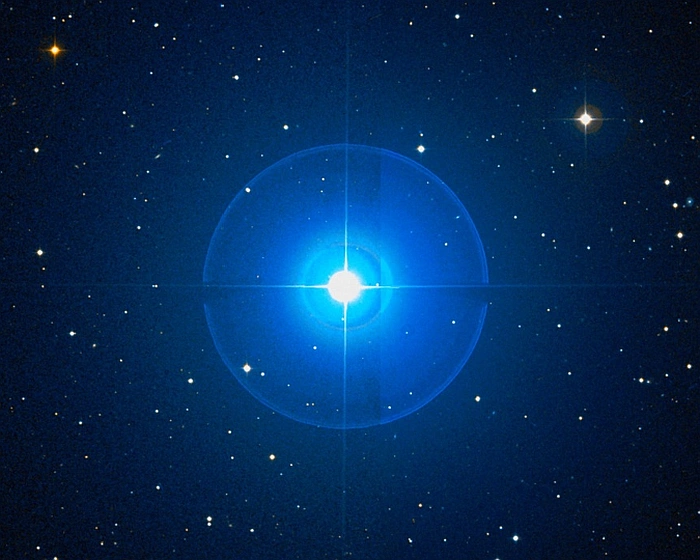
Shaomin (Rho Leonis), image credit: ESO/Digitized Sky Survey 2 (CC BY 4.0)
Evolutionary stage
Rho Leonis is currently going through a blue loop stage of its evolutionary cycle. After spending time as a red supergiant, the massive star has evolved back to hotter temperatures. The term “blue loop” refers to the star making a loop towards the hotter (bluer) side of the Hertzsprung-Russell diagram.
Massive and luminous stars like Rho Leonis lose mass quickly enough during the red supergiant phase to become smaller, hotter and bluer. Some stay blue supergiants while others evolve back into red supergiants.
Shaomin is massive enough to go out as a bright supernova at the end of its life cycle. It will keep fusing progressively heavier elements until it develops an iron core. At that point, its core will collapse and trigger the supernova.
Related: Life Cycle of Massive Stars
Brightness variations in Rho Leonis
Rho Leonis is classified as an Alpha Cygni variable. Like Deneb (Alpha Cygni) in Cygnus, it shows non-radial pulsations (some parts of its surface expand while others are contracting) that are causing irregular variations in brightness. The mechanism behind the pulsations of Alpha Cygni stars is poorly understood but it is linked to variations in iron opacity.
Rho Leonis shows brightness variations of 0.032 magnitudes with a period of 3.427 days.
Other bright Alpha Cygni variables include Rigel and Alnilam in Orion, Aludra in Canis Major, Kappa Cassiopeiae in Cassiopeia, and Polis in Sagittarius. All these stars are A- and B-type supergiants.
Search for a companion
Rho Leonis may have a fainter companion, whose presence has not been conclusively confirmed. The companion has been reported to be just over a magnitude fainter and separated by only 0.01 arcseconds from Shaomin.
In 1969, Richard B. Herr listed Rho Leonis as a binary system subject to occultations by the Moon. In 1970, de Vegt and Pansch mentioned it as a known double spectroscopic binary system.
However, speckle interferometry with the Southern Astrophysical Research Telescope (SOAR) in Chile from 2009 to 2023 did not resolve the companion. The team of researchers, led by Andrei Tokovinin of the Cerro Tololo Inter-American Observatory, listed Rho Leonis as a likely spurious pair. The findings strongly indicated that the companion does not exist.
However, the companion has not been completely ruled out. In 2025, a team of astronomers led by V. A. Checha of Tartu Observatory, Estonia, reported a spectroscopic phase curve with a sawtooth-like shape that may be interpreted as radial pulsation or it may indicate a close binary companion and a periodic mass exchange between the components, as well as the possible presence of a circumbinary disk.
Facts
Rho Leonis lies only 0.15° north of the ecliptic, the apparent path of the Sun and planets across the sky. The star is periodically eclipsed by the Moon and the planets. It was during a lunar occultation that astronomers detected the light variations that indicated the presence of a companion.
Shaomin has a high peculiar velocity relative to nearby stars and is classified as a runaway star. It is moving away from the Sun at 42 km/s and its proper motion is taking it 1.56 astronomical units per year in a transverse direction.
Name
The name Shaomin (少民) comes from traditional Chinese astronomy. Rho and Omicron Leonis were the southernmost stars in the Chinese Xuanyuan (轩辕) constellation. Other bright Leo stars that were part of the constellation include Regulus, Algieba, Adhafera, Rasalas, Epsilon Leonis, and Eta Leonis. Xuanyuan is the name of the Yellow Emperor, a legendary figure in Chinese lore. The constellation was part of the larger Star mansion, one of the southern mansions of the Vermilion Bird.
The Xuanyuan constellation had a shape that resembled a Chinese dragon, and Rho Leonis (Shaomin) and Omicron Leonis (Taimin) marked the dragon’s right and left horns. The words Taiming and Shaoming mean “more bright” and “less bright.” Omicron Leonis, now formally named Subra, is slightly brighter than Rho Leonis.
In Chinese astrology, the stars of Xuanyuan represent the group of empresses and consorts. Taimin was associated with the clan of the Empress Dowager, while Shaomin represented the clan of the Empress.
The International Astronomical Union’s (IAU) Working Group on Star Names (WGSN) formally approved the name Shaomin for Rho Leonis on July 18, 2024.
How to find Rho Leonis
Rho Leonis lies near the familiar constellation figure of Leo and can be found using the brighter stars of the Sickle. It appears southeast of Regulus, near the imaginary line extended from Epsilon Leonis at the tip of the Sickle through Eta Leonis.
The stars of the Sickle can be found by drawing a line from Megrez through Phecda in the Big Dipper across the sky.
At declination +09°, Shaomin is visible from virtually any location. The best time to see it is during the northern hemisphere spring, when Leo is prominent in the evening sky.
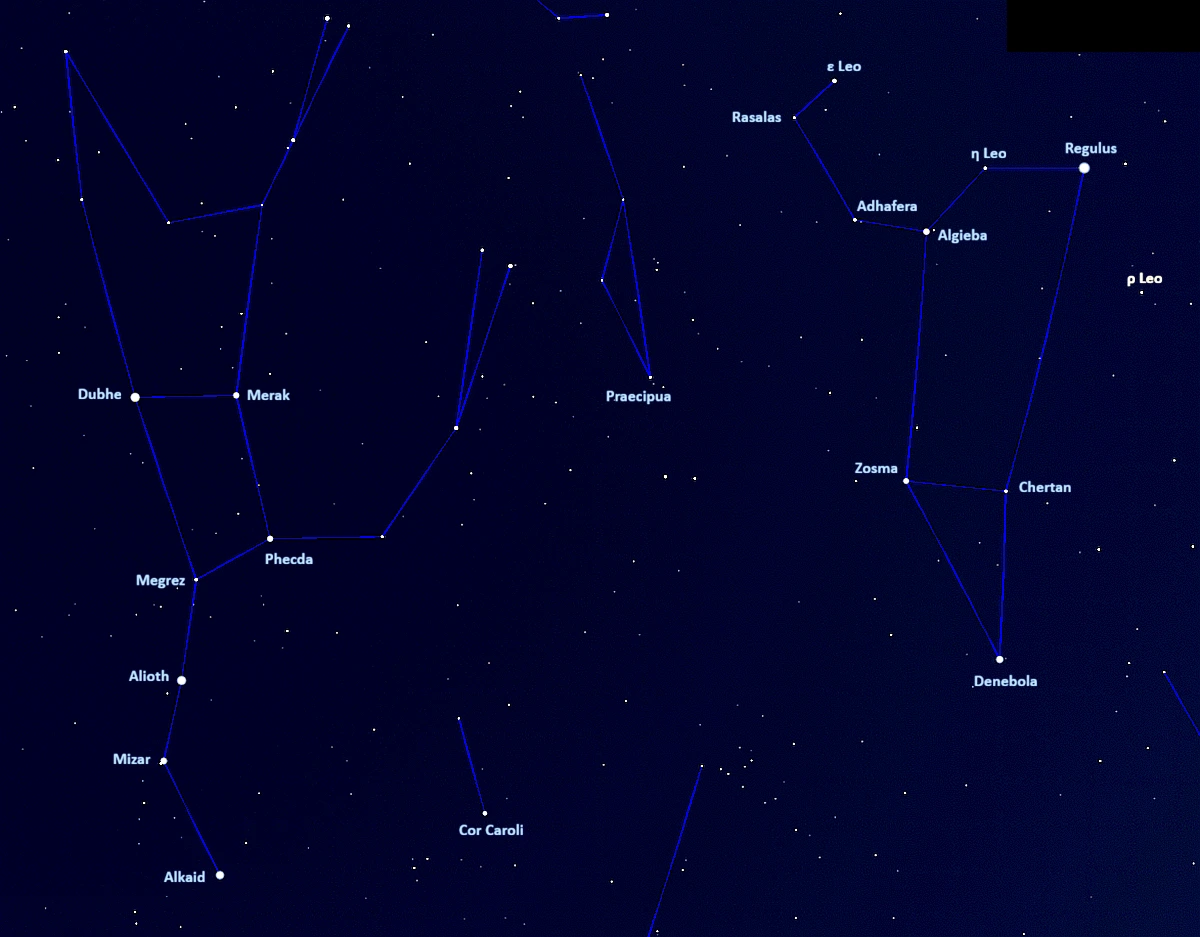
Location of Shaomin (Rho Leonis), image: Stellarium (annotated for this article)
Constellation
Rho Leonis is located in the constellation Leo. The Lion is one of the 48 ancient Greek constellations, catalogued by the astronomer Ptolemy of Alexandria in his Almagest in the 2nd century AD. In Greek mythology, it is associated with the Nemean lion, a mythical beast with golden fur that was impervious to attack, defeated by Heracles as part of his twelve labours.
Leo is the 12th largest constellation in the sky. It occupies 947 square degrees of the predominantly northern sky around the celestial equator. Like all equatorial constellations, it is visible from almost all locations on Earth for at least part of the year.
Leo is one of the more recognizable zodiac constellations. Like the other constellations that lie on the ecliptic, it is invisible for about a month each year when it is aligned with the Sun.
Regulus, the constellation’s brightest star, shines at magnitude 1.40 from a distance of 79.3 light years. The hot, massive star marks the Lion’s heart and appears at the base of the Sickle asterism.
Other bright stars in Leo include the variable, fast-spinning Denebola (Beta Leonis), the red giant binary system Gamma Leonis (Algieba), the A-type stars Zosma (Delta Leonis) and Chertan (Theta Leonis), the yellow-white giant Adhafera, the yellow giants Epsilon Leonis and Subra (Omicron Leonis), the blue supergiant Eta Leonis, and the K-type giant Rasalas (Mu Leonis).
Leo also contains the red dwarf stars K2-18 with a system of two orbiting planets and Wolf 359, one of the closest stars to Earth, the Mira variable R Leonis, the carbon star CW Leonis, Caffau’s Star (one of the oldest stars known), and the gravitationally lensed star Icarus, one of the most distant stars discovered to date.
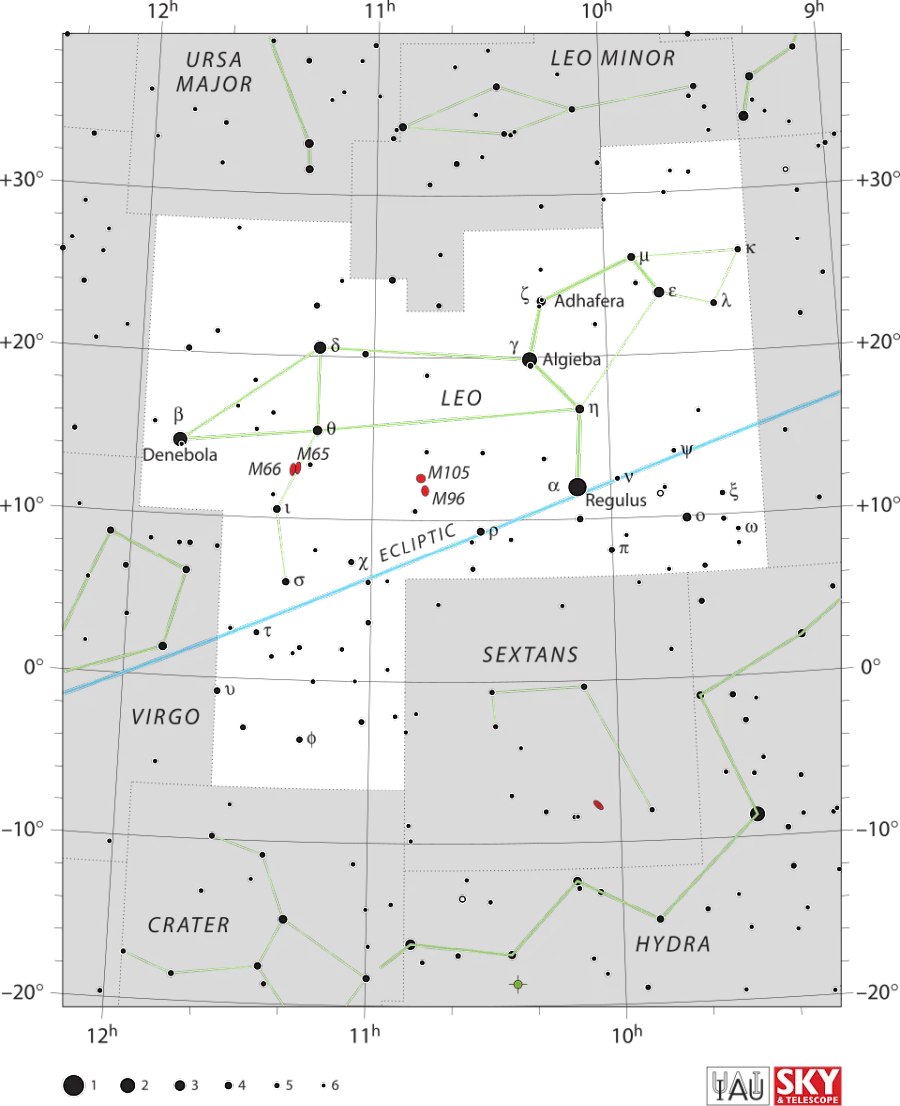
Leo constellation map by IAU and Sky&Telescope magazine (Roger Sinnott & Rick Fienberg) (CC BY 3.0)
Leo is known for its bright galaxies and galaxy groups. The best-known of these are the Leo Triplet, consisting of Messier 65, Messier 66 and the Hamburger Galaxy, and the Leo I Group, which contains Messier 95, Messier 96, and Messier 105.
The constellation also hosts the protoplanetary Frosty Leo Nebula, the Owl Galaxy (NGC 3758), the Loony Galaxy (NGC 3239), and the gravitationally lensed system called the Cosmic Horseshoe.
The best time of the year to observe the stars and deep sky objects in Leo is during the month of April, when the celestial Lion appears higher above the horizon in the evening.
The 10 brightest stars in Leo are Regulus (Alpha Leo, mag. 1.40), Algieba (Gamma Leo, mag. 2.08), Denebola (Beta Leo, mag. 2.113), Zosma (Delta Leo, mag. 2.56), Epsilon Leonis (mag. 2.98), Chertan (Theta Leo, mag. 3.324), Adhafera (Zeta Leo, mag. 3.33), Eta Leonis (mag. 3.486), Subra (Omicron Leo, mag. 3.52), and Shaomin (Rho Leo, mag. 3.9).
Shaomin – Epsilon Leonis
| Spectral class | B1 Iab |
| Variable type | Alpha Cygni |
| U-B colour index | -0.945 |
| B-V colour index | -0.153 |
| Apparent magnitude | 3.83 – 3.90 |
| Absolute magnitude | −6.19 ± 0.2 |
| Distance | 2,900 ± 230 light-years (900 ± 70 parsecs) |
| Parallax | 1.5913 ± 0.3135 mas |
| Radial velocity | +42.0 ± 0.8 km/s |
| Proper motion | RA: -6.350 ± 0.312 mas/yr |
| Dec.: -3.300 ± 0.240 mas/yr | |
| Mass | 19.9 ± 1.0 M☉ |
| Luminosity | 151,000 L☉ (125,500 – 181,600 L☉) |
| Radius | 28 ± 3 R☉ |
| Temperature | 21,700 ± 200 K |
| Metallicity | -0.06 dex |
| Age | 9.12 million years (8.21 – 10 Myr) |
| Rotational velocity | 49.0 ± 2.4 km/s |
| Rotation | 12.5 ± 0.7 days |
| Surface gravity | 2.87 ± 0.04 cgs |
| Constellation | Leo |
| Right ascension | 10h 32m 48.6703908997s |
| Declination | +09° 18′ 23.705339948″ |
| Names and designations | Shaomin, Rho Leonis, Rho Leo, ρ Leonis, ρ Leo, 47 Leonis, 47 Leo, HD 91316, HR 4133, HIP 51624, SAO 118355, FK5 396, BD+10 2166, AG+09 1321, GC 14487, GCRV 6602, PLX 2467.00, PPM 156938, SKY# 20239, CSV 101135, MCW 550, N30 2499, WRH 19AB, GEN# +1.00091316, ALS 14811, TD1 14928, GSC 00838-01485, PMC 90-93 286, JP11 1957, TIC 392834850, UBV 9703, UBV M 16322, WEB 9417, uvby98 100091316, IRAS 10301+0933, 2MASS J10324867+0918237, TYC 838-1485-1, WISE J103248.67+091823.7, [HFE83] 734, AAVSO 1027+09, Gaia DR2 3870025847369434752, Gaia DR3 3870025847369674624, CCDM J10328+0918AB, IDS 10275+0949 AB, WDS J10328+0918AB |