Muliphein, Gamma Canis Majoris (γ CMa), is a hot blue bright giant star located approximately 430 light years away in the constellation Canis Major. With an apparent magnitude of 4.10, it is visible to the unaided eye from areas without too much light pollution. The evolved star marks the Great Dog’s neck. Along with the brighter Mirzam, it flanks Sirius, the brightest star in the sky.
Star type
Muliphein is a blue bright giant of spectral type B8II, measuring 6.08 times the Sun’s radius and 4.15 times its mass. With an effective temperature of 11,732 K, the star shines 537 times more luminously than the Sun and is receding from our solar system at a radial velocity of +31.1 km/s.
Muliphein rotates with a projected velocity of 30 km/s, completing one full rotation every 6.214 days. The star’s high surface temperature, strong luminosity, and expanded radius indicate it has exhausted the hydrogen in its core and entered a more advanced evolutionary phase, now burning heavier elements.
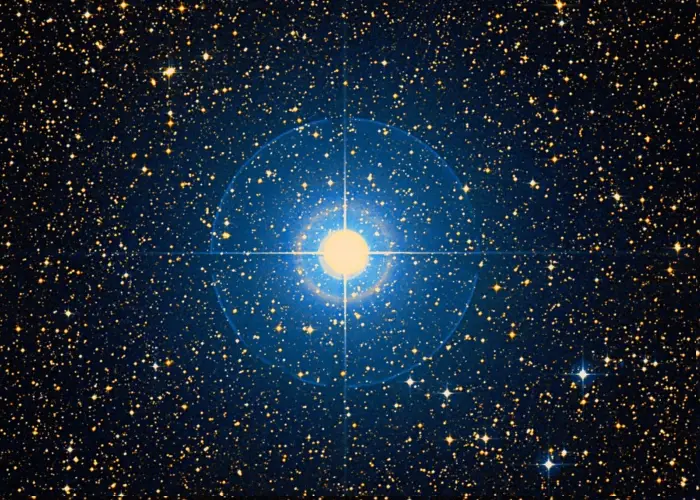
Muliphein (Gamma Canis Majoris), image credit: ESO/Digitized Sky Survey 2 (CC BY 4.0)
Facts
Muliphein may have a spectroscopic companion at an angular separation of 0.332 arcseconds. The star’s binary nature was first suggested by Scheider in 1981. The candidate companion was identified by Schöller et al. in 2010.
Gamma Canis Majoris was classified as a mercury-manganese star by P. Renson and J. Manfroid in 2009. Mercury-manganese stars (HgMn stars) are hot, chemically peculiar stars whose atmospheres contain abnormally high abundances of mercury, manganese, and other elements. The overabundance of these elements is believed to be caused by some atoms sinking due to gravity while others are lifted outwards by radiation pressure. Other bright examples of these stars include Alpheratz in the constellation Andromeda, Gienah in Corvus, and Elnath in Taurus.
Muliphein is one of the 27 stars featured on the flag of Brazil. Each star represents a Brazilian Federal Unit. Gamma Canis Majoris symbolizes the state of Rondônia.
Name
The name Muliphein (pronunciation: /ˈmjuːlɪfeɪn/) comes from the Arabic muħlifayn, which refers to “two things” and the “swearing of an oath.” It was historically also spelled Muliphen.
The origin of the name begins with the Arabic names hadari and al-wazn. In Arabic discussions of these names, they were said to be muhlifain, two things casing dispute (regarding the stars’ identification). The name al-muhlifain was mistakenly taken as the name of hadari and al-wazn together. It was transliterated and changed into Muliphein, and then arbitrarily assigned to Gamma Canis Majoris. The names Hadar and Wezen now apply to the bright Beta Centauri in the constellation Centaurus and Delta Canis Majoris in Canis Major.
Gamma Centauri has the traditional proper name Muhlifain, which shares the same Arabic root, but has not been formally approved for γ Cen by the International Astronomical Union (IAU).
The name Muliphein was approved by the IAU’s Working Group on Star Names (WGSN) on August 21, 2016.
Even though it is not among the 10 brightest stars of Canis Major, Muliphein has the Bayer designation Gamma Canis Majoris. The reason for this is uncertain but may be because of the star’s location near the brighter Sirius and Mirzam. German astronomer Johann Bayer likely assigned the Greek letter designations to Canis Major stars going from north to south. Adhara, the constellation’s second brightest star, got the designation Epsilon.
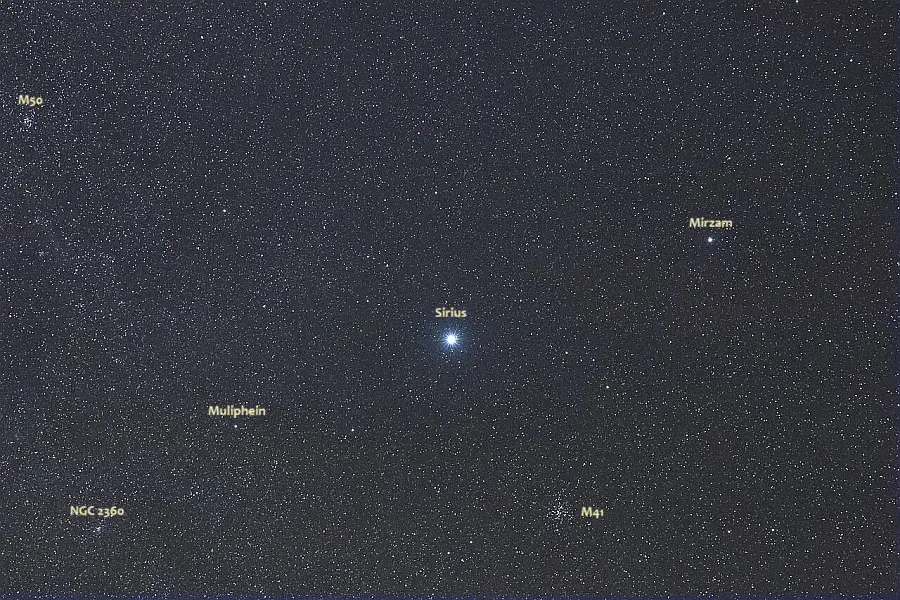
Sirius (α CMa), Muliphein (γ CMa) on the left, Mirzam (β CMa) on the right, and star clusters M41 (lower right), M50 (upper left), and NGC 2360 (lower left). Image credit: Christos Doudoulakis (annotated for this article) (CC BY-SA 4.0)
Location
Gamma Canis Majoris is easy to find on a clear night because it lies near Sirius, the luminary of Canis Major and the brightest star in the Earth’s sky. It can be found close to the imaginary line extended from Mirzam (Beta Canis Majoris) through Sirius.
Muliphein appears in the same region as Caroline’s Cluster (NGC 2360) and the Thor’s Helmet Nebula (NGC 2359). Named after its discoverer, the German astronomer Caroline Herschel, NGC 2360 is a bright open cluster that can be easily spotted in binoculars. It appears east of Muliphein. Thor’s Helmet Nebula (NGC 2359) is a popular astrophotography target located northeast of the star.
At declination -16°, Muliphein is visible from virtually anywhere for at least part of the year.
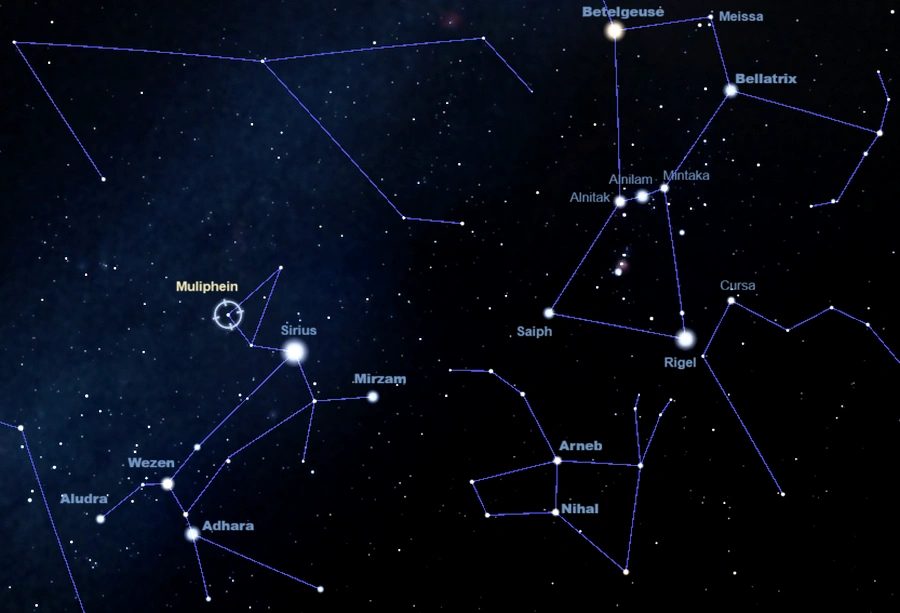
Muliphein location, image: Stellarium (annotated for this article)
Constellation
Muliphein is located in the constellation Canis Major. The Great Dog is one of the ancient Greek constellations, catalogued by the astronomer Ptolemy of Alexandria in his Almagest in the 2nd century BCE. In Greek mythology, it is associated with the larger of the two dogs following the huntsman Orion and chasing the celestial Hare represented by the constellation Lepus. The constellation is sometimes taken to represent the mythical dog Laelaps that would never fail to catch its prey.
Canis Major occupies an area of 380 square degrees of the sky south of the celestial equator. It is one of the brightest and best-known southern constellations. It contains Sirius (Alpha Canis Majoris), the brightest star in the sky, and four other stars brighter than magnitude 3.0.
Sirius, the constellation’s lucida, shines at magnitude -1.46. It is one of our nearest neighbours, located only 8.61 light-years away.
Other bright stars in the constellation include the blue bright giants Adhara (Epsilon Canis Majoris) and Mirzam (Beta Canis Majoris), the blue supergiants Aludra (Eta Canis Majoris) and Omicron2 Canis Majoris, the yellow-white supergiant Wezen (Delta Canis Majoris), the orange supergiants Nganurganity (Sigma Canis Majoris) and Omicron1 Canis Majoris, and the B-type main sequence stars Furud (Zeta Canis Majoris) and Kappa Canis Majoris.
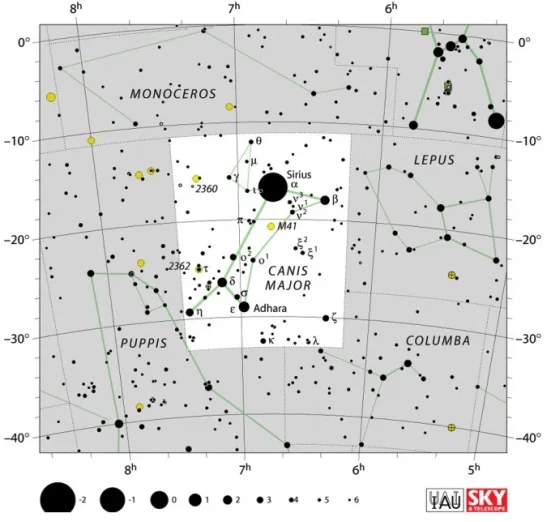
Canis Major constellation map by IAU and Sky&Telescope magazine (Roger Sinnott & Rick Fienberg) (CC BY 3.0)
The fainter notable stars in Canis Major include the hot blue multiple star system Tau Canis Majoris, the brightest member of the open cluster Caldwell 64 (the Tau Canis Majoris Cluster), the carbon star W Canis Majoris, and the Wolf-Rayet stars WR 7, the central star of the Thor’s Helmet Nebula (NGC 2359), and EZ Canis Majoris at the centre of the Dolphin Head Nebula (Sh2-308).
The constellation is also home to the red supergiant VY Canis Majoris, one of the largest known stars.
Bright deep sky objects in Canis Major include the open clusters Messier 41, NGC 2360 (Caroline’s Cluster), the Tau Canis Majoris Cluster (NGC 2362) and NGC 2354, the disputed Canis Major Dwarf Galaxy, the interacting pair of galaxies NGC 2207 and IC 2163, and the emission nebulae known as the Thor’s Helmet (NGC 2359) and the Dolphin Head Nebula (Sh2-308).
The best time of the year to observe Muliphein and other stars and deep sky objects in Canis Major is during the month of February, when the constellation appears higher above the horizon in the early evening. The entire constellation is visible from locations south of the latitude 60° N.
The 10 brightest stars in Canis Major are Sirius (Alpha CMa, mag. -1.46), Adhara (Epsilon CMa, mag. 1.50), Wezen (Delta CMa, mag. 1.824), Mirzam (Beta CMa, mag. 1.985), Aludra (Eta CMa, mag. 2.45), Furud (Zeta CMa, mag. 3.025), Omicron2 Canis Majoris (mag. 3.043), Nganurganity (Sigma CMa, mag. 3.43 – 3.51), Kappa Canis Majoris (mag. 3.40 – 3.97), and Omicron1 Canis Majoris (mag. 3.78 – 3.99).
Muliphein – Gamma Canis Majoris
| Spectral class | B8II |
| U-B colour index | −0.45 |
| B-V colour index | −0.13 |
| Apparent magnitude | 4.10 |
| Absolute magnitude | −1.4 |
| Distance | 430 ± 10 light-years (132 ± 3 parsecs) |
| Parallax | 7.5819 ± 0.1868 mas |
| Radial velocity | +31.1 ± 0.2 km/s |
| Proper motion | RA: −0.931 ± 0.146 mas/yr |
| Dec.: −11.435 ± 0.162 mas/yr | |
| Mass | 4.15 ± 0.06 M☉ |
| Luminosity | 537 ± 25 L☉ |
| Radius | 6.08 ± 0.17 R☉ |
| Temperature | 11,732 K (11,692 – 11,770 K) |
| Metallicity | −0.24 dex |
| Rotational velocity | 30 km/s |
| Rotation | 6.214 days |
| Surface gravity | 3.51 ± 0.02 cgs |
| Constellation | Canis Major |
| Right ascension | 07h 03m 45.4934693195s |
| Declination | −15° 37′ 59.833212992″ |
| Names and designations | Muliphein, Muliphen, Gamma Canis Majoris, Gamma CMa, γ Canis Majoris, γ CMa, 23 Canis Majoris, 23 CMa, HD 53244, HR 2657, HIP 34045, SAO 152303, GC 9320, GCRV 4641, FK5 271, BD−15°1625, PPM 218074, SKY# 12655, ALS 15803, CEL 1539, JP11 4546, WEB 6825, GSC 05963-01938, GEN# +5.11210030, N30 1538, Renson 14650, UBV 6939, UBV M 12803, UBV M 40651, WISE J070345.51-153759.8, WISEA J070345.51-153759.9, SACS 153, PMC 90-93 195, YZ 105 2427, uvby98 511210030, IRAS 07015-1533, 2MASS J07034549-1537593, AKARI-IRC-V1 J0703455-153759, [HFE83] 483, TIC 148109427, TD1 8987, TYC 5963-1938-1, Gaia DR2 2936152657029237888, Gaia DR3 2936152657031151232 |