Eta Leonis (η Leo) is a blue supergiant located 1,270 light years away in the zodiac constellation of Leo. With an apparent magnitude of 3.486, it is the eighth brightest star in the constellation. It is one of the six stars that form the Sickle, an asterism that outlines the celestial Lion’s head and mane.
What type of star is Eta Leonis?
Eta Leonis is a blue supergiant star of the spectral type A0 Ib. With a mass 10 times that of the Sun, the evolved star is a supernova candidate. It has a radius 47 times that of the Sun and, with an effective temperature of 9,600 K, it shines with 19,000 solar luminosities. The star spins with a projected rotational velocity of 2 km/s.
Eta Leonis has an estimated age of only 25 million years. Even though it is still a very young star, it has evolved quickly because of its high mass. It only has a few million years left before it reaches the end of its life cycle and goes out as a luminous supernova.
Related: Life-Cycle of Massive Stars
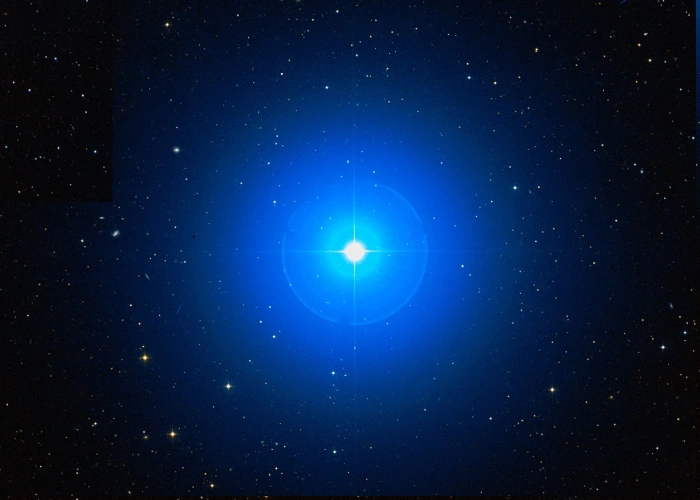
Eta Leonis, image credit: ESO/Digitized Sky Survey 2 (CC BY 4.0)
Blue supergiant in a blue loop phase
Eta Leonis is believed to be in a blue loop phase of its evolutionary cycle. During this stage, an evolved star becomes hotter before cooling again. The word loop refers to the shape of the evolutionary track on the Hertzsprung-Russell diagram, where the star forms a loop towards the blue side of the diagram after passing through the red giant branch.
In the life of a massive star, the blue loop stage lasts for about a million years. Canopus, an A-type bright giant with a similar mass, is also currently going through this phase.
Binary or multiple star system
Eta Leonis is believed to be a multiple star system. However, the number of components and their orbital elements are uncertain. Even though the star was observed both during lunar occultations and using speckle interferometry, the observations did not yield the same results.
Eta Leonis was identified as an occultation binary system by Wilson in 1941. Wilson found that the two components were separated by at least 40 astronomical units.
High-resolution speckle imaging later supported the binary interpretation, but the configuration of the system remains unknown.
Facts
Eta Leonis serves as a spectral standard for the class A0 Ib. The star’s spectrum has been used as a stable anchor point in the Morgan-Keenan spectral classification system since 1943.
The luminosity class Ib refers to a subclass of less luminous supergiants that fall between bright supergiants (Ia) and bright giants (II). Other bright A-type supergiants in this subclass include Aspidiske and Upsilon Carinae in the constellation Carina and Iota2 Scorpii in Scorpius.
While Eta Leonis is impressive in size and mass, it is modest compared to more luminous A-type supergiants. The brighter and more distant Deneb (A2 Ia) has a mass between 15.5 and 19 solar masses and shines at magnitude 1.25 from a distance of 2,615 light-years, and the supergiant V533 Carinae (A5 Iae) is visible to the unaided eye from a distance of 9,200 light-years.
Shining at magnitude 3.486, Eta Leonis is similar in brightness to Sheliak (Beta Lyrae) in the constellation Lyra, Achird (Eta Cassiopeiae) in Cassiopeia, Eta Ceti, Kaffaljidhma (Gamma Ceti) and Tau Ceti in Cetus, Delta Boötis in Boötes, Eta Herculis in Hercules, Nganurganity (Sigma Canis Majoris) in Canis Major, and Alula Borealis (Nu Ursae Majoris) in Ursa Major.
The star lies close to the ecliptic and is occasionally occulted by the Moon. It was first interpreted as a binary system during a lunar occultation.
Sickle of Leo
Eta Leonis is one of the bright Leo stars that form the Sickle, a prominent star pattern that looks like a backward question mark. The Sickle is formed by Eta Leonis with Regulus, Algieba, Adhafera, Rasalas, and Epsilon Leonis. In the constellation figure of Leo, it represents the Lion’s head and mane. The bright Regulus, Leo’s brightest star, appears at the base of the asterism and marks the Lion’s heart.
Located 1,270 light-years away, Eta Leonis is by far the most distant of the Sickle stars. It lies at over 15 times the distance of Regulus (79 ly). It is also the most intrinsically luminous of the six stars and the only supernova candidate in the group.
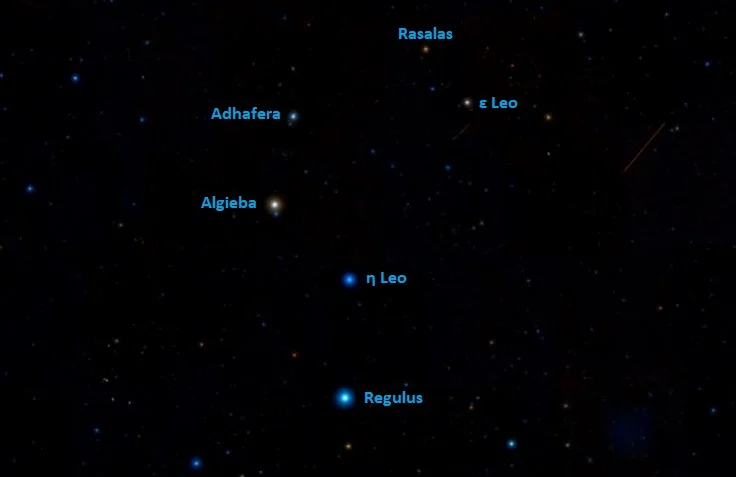
The Sickle of Leo, image credit: ESO/Digitized Sky Survey 2, annotated for this article (CC BY 4.0)
Name
Eta Leonis does not have a proper name formally approved by the International Astronomical Union (IAU).
In old Arabic astronomy, the star formed the lunar mansion known as Al Jabhah (“the forehead”), which outlined the forehead of the Lion. Some sources used the name Al Jabhah for Eta Leonis specifically. The name shares the same origin with the IAU-approved names Algieba (Gamma Leonis), Dschubba (Delta Scorpii), and Jabbah (Nu Scorpii). All these names are derived from the Arabic word for “the forehead.”
How to find Eta Leonis
Eta Leonis is easy to find because it is part of one of most recognizable spring asterisms, the Sickle of Leo. It is the closest star in the Sickle to the bright Regulus.
The Sickle can be found using the stars of the Big Dipper. A line drawn from Megrez through Phecda, the inner stars of the Big Dipper’s bowl, points in the direction of the Lion’s head.
At declination +16° 45′, Eta Leonis is visible from all but the southernmost locations on Earth for at least part of the year.
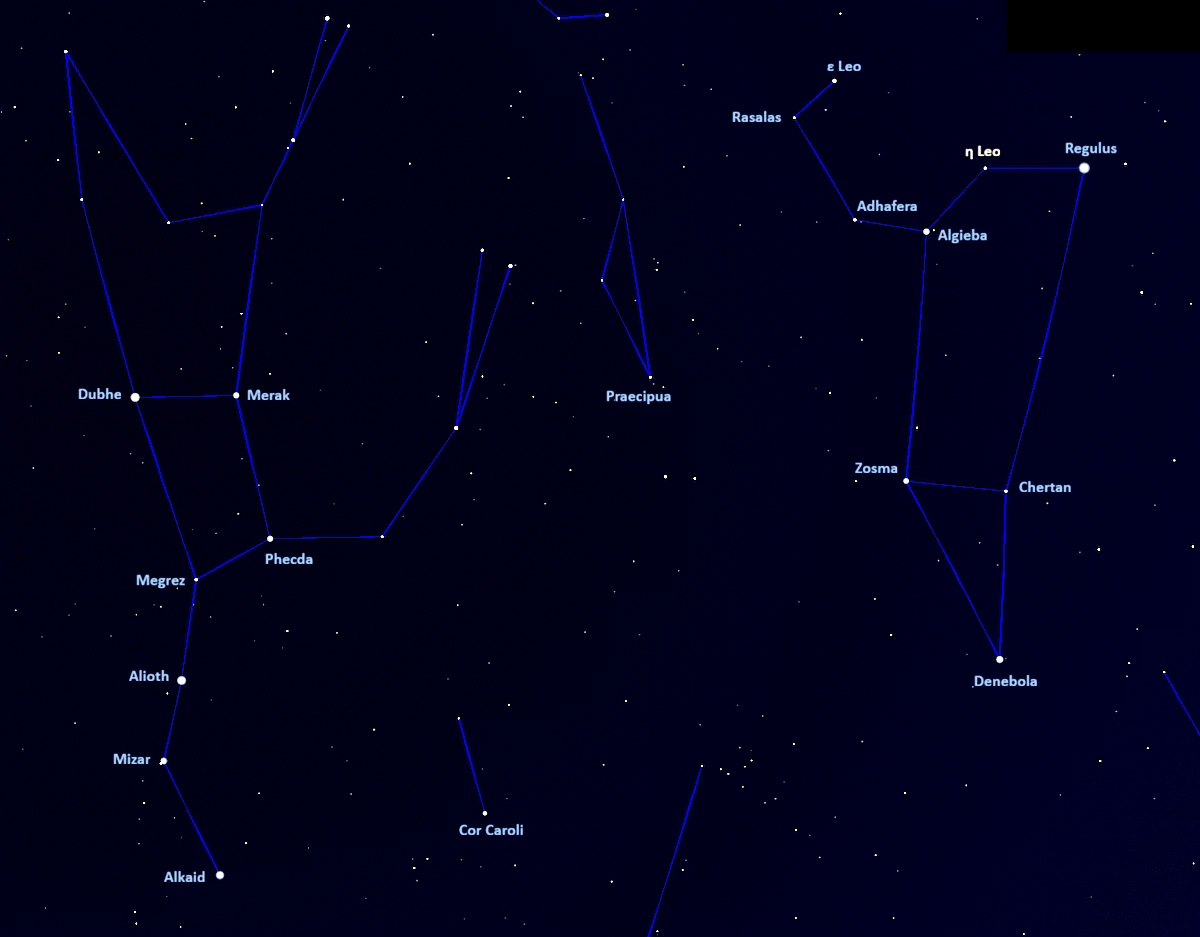
Eta Leonis location, image: Stellarium (annotated for this article)
Constellation
Eta Leonis is located in the constellation Leo. The celestial Lion is one of the Greek constellations, catalogued by the Greco-Roman astronomer Claudius Ptolemy of Alexandria in his Almagest in the 2nd century AD. In Greek mythology, it was associated with the Nemean lion, a mythical beast defeated by Heracles as part of his twelve labours.
Leo is one of the largest and most recognizable constellations in the sky. Stretching across 947 square degrees of the predominantly northern sky, it is the 12th constellation in size. Its southernmost portion lies on the celestial equator. Like all equatorial constellations, the Lion is visible from virtually anywhere.
The constellation is a member of the zodiac family. It lies on the ecliptic (the Sun’s apparent path across the sky) and is invisible in the night sky for about a month each year, when it aligns with the Sun.
Regulus (Alpha Leonis), the brightest star in Leo, is the 21st brightest star in the sky. It is a multiple star system with an apparent magnitude of 1.40.
Other bright stars in Leo include the A-type main sequence stars Denebola (Beta Leonis), Zosma (Delta Leonis), and Chertan (Theta Leonis), the orange giants Algieba (Gamma Leonis) and Rasalas (Mu Leonis), the yellow giants Epsilon Leonis and Subra (Omicron Leonis), the yellow-white giant Adhafera (Zeta Leonis), and the hot blue supergiant Shaomin (Rho Leonis).
Leo also hosts the red dwarfs Wolf 359, one of the nearest stars to Earth, and K2-18 with two orbiting exoplanets, the red carbon star CW Leonis, the Mira variable R Leonis, Icarus (MACS J1149 Lensed Star 1), one of the most distant stars known, and Caffau’s Star (SDSS J102915+172927), one of the oldest stars discovered to date.
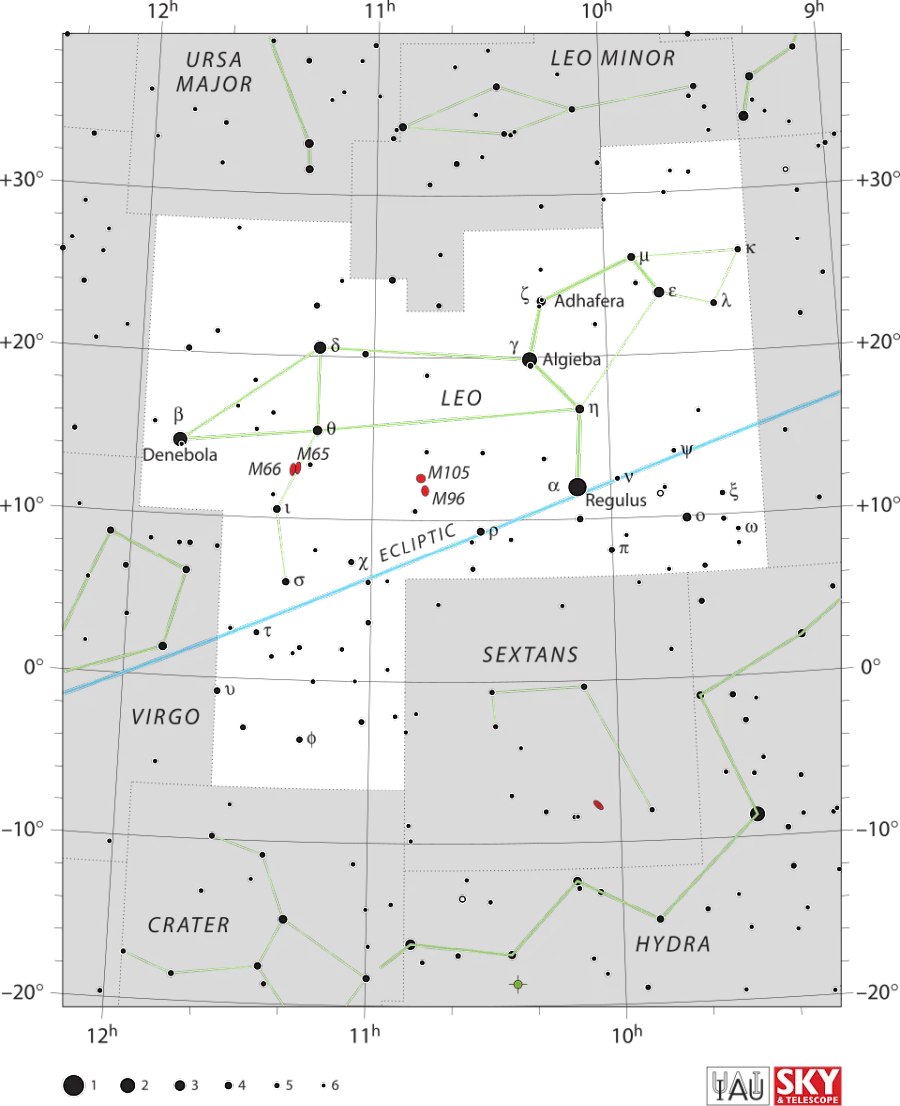
Leo constellation map by IAU and Sky&Telescope magazine (Roger Sinnott & Rick Fienberg) (CC BY 3.0)
Leo contains several bright deep sky objects. The galaxy groups Leo I (Messier 95, Messier 96 and Messier 105) and the Leo Triplet (Messier 65, Messier 66 and NGC 3628) appear in the region between Regulus and Denebola.
Other deep sky objects in the constellation include the Owl Galaxy (NGC 3758), the Frosty Leo Nebula, and the gravitationally lensed system known as the Cosmic Horseshoe.
The best time of the year to observe the stars and deep sky objects in Leo is in April, when the constellation appears higher in the sky in the early evening. Leo cannot be seen from mid-August to mid-September, when the Sun appears to pass through it.
The 10 brightest stars in Leo are Regulus (Alpha Leo, mag. 1.40), Algieba (Gamma Leo, mag. 2.08), Denebola (Beta Leo, mag. 2.113), Zosma (Delta Leo, mag. 2.56), Epsilon Leonis (mag. 2.98), Chertan (Theta Leo, mag. 3.324), Adhafera (Zeta Leo, mag. 3.33), Eta Leonis (mag. 3.486), Subra (Omicron Leo, mag. 3.52), and Rho Leonis (mag. 3.9).
Eta Leonis
| Spectral class | A0 Ib |
| U-B colour index | −0.206 |
| B-V colour index | −0.026 |
| Apparent magnitude | 3.486 |
| Absolute magnitude | -5.54 |
| Distance | 1,270 ± 80 light-years (390 ± 20 parsecs) |
| Parallax | 1.7965 ± 0.3051 mas |
| Radial velocity | 2.82 ± 0.02 km/s |
| Proper motion | RA: -1.118 ± 0.395 mas/yr |
| Dec.: -0.655 ± 0.448 mas/yr | |
| Mass | 10 M☉ |
| Luminosity | 19,000 L☉ |
| Radius | 47 R☉ |
| Temperature | 9,600 K |
| Metallicity | -0.04 |
| Age | 25 million years |
| Rotational velocity | 2 km/s |
| Surface gravity | 2.00 cgs |
| Constellation | Leo |
| Right ascension | 10h 07m 19.9523915176s |
| Declination | +16° 45′ 45.587968398″ |
| Names and designations | Eta Leonis, Eta Leo, η Leonis, η Leo, 30 Leonis, 30 Leo, HD 87737, HR 3975, HIP 49583, SAO 98955, FK5 379, BD+17°2171, AG+17 1099, PPM 127121, GC 13899, GCRV 6405, SKY# 19483, GSC 01412-01695, GEN# +1.00087737, JP11 1892, N30 2412, WEB 9145, SRS 30379, MCW 549, NSV 4738, PMC 90-93 273, ROT 1531, PLX 2380.00, TD1 14568, TIC 357308783, UBV 9435, UBV M 15943, uvby98 100087737, IRAS 10046+1700, 2MASS J10071994+1645455, TYC 1412-1695-1, WRH 18A, Gaia DR2 622052899597361920, Gaia DR3 622052899598187392, CCDM J10073+1646A, IDS 10019+1715 A, WDS J10073+1646A |