Biham, Theta Pegasi (θ Peg), is a binary system located approximately 92 light years away in the constellation Pegasus. Shining at magnitude 3.52, it is the constellation’s eight brightest star. It appears in the head of Pegasus, in the same region as the bright Enif, and marks the Winged Horse’s eye.
What kind of star is Biham?
Biham is a larger and brighter star than the Sun. It has around 2.09 times the Sun’s mass and a radius of 2.62 solar radii.
The extra size and mass make it much more luminous than our parent star. Biham shines with about 23.7 times the Sun’s luminosity. Its surface temperature of about 7,872 K also makes it much hotter than the Sun, giving it the white glow typical of an A-type star. It has the spectral type A2V.
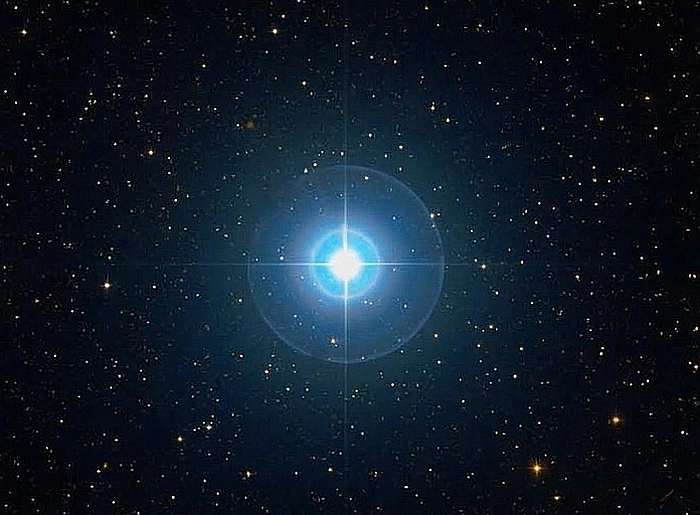
Biham (Theta Pegasi), image credit: ESO/Digitized Sky Survey 2 (CC BY 4.0)
A fast spinner with a low-iron composition
Like many other A-type stars, Biham spins very quickly. Its projected rotational velocity is 136 km/s, compared to the Sun’s 2 km/s. Given the star’s radius, this means that Biham completes a full rotation in less than a day, in about 23 hours. In comparison, the Sun’s equatorial regions take around 24 days, while its polar regions take over 30 days.
With a metallicity of -0.38, Biham has about 42% of the Sun’s iron abundance. That makes it somewhat metal-poor compared with our own star.
Age and evolution
With an estimated age of around 448 million years, Biham is still very young compared with the Sun’s 4.6 billion years. A star of around 2 solar masses burns through its hydrogen much faster than the Sun does, so Biham’s lifetime on the main sequence will be much shorter than the Sun’s.
A-type stars typically spend about 1 billion years burning hydrogen in their cores before evolving into giants, while our Sun has a main sequence lifespan of 10 billion years. Like all intermediate-mass stars, Biham will end its life as a white dwarf surrounded by a planetary nebula.
A closer look at the Theta Pegasi star system
For years, astronomers suspected that Biham had a binary companion. In 2020, a team led by Sarah Steiger of the Department of Physics at the University of California finally photographed the fainter star using the Subaru Telescope in Hawaii. They reported the discovery in The Astronomical Journal in 2021.
The companion, Theta Pegasi B, is a red dwarf with only 28% of the Sun’s mass and an effective temperature of 3,200 K. It shines with only around 0.00525 solar luminosities. The two stars have a moderately eccentric orbit, with a semimajor axis of 6.55 astronomical units.
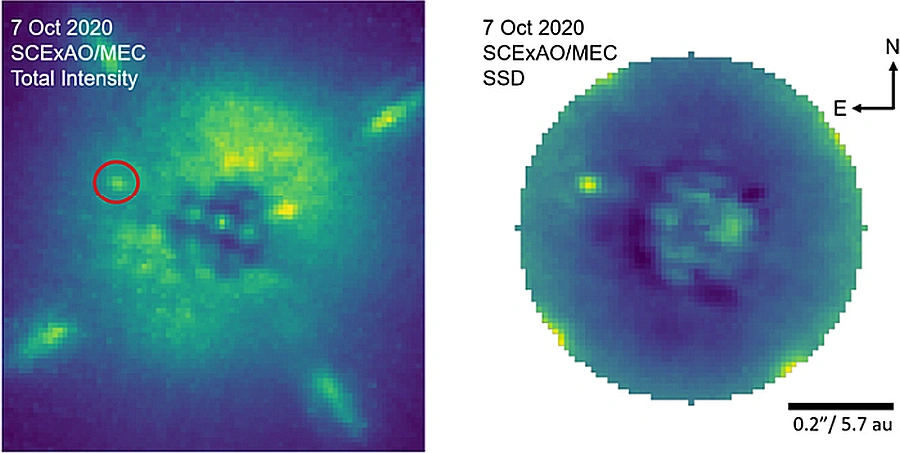
Theta Pegasi B. Left: total intensity image of HIP 109427 B taken with SCExAO/MEC at Y and J band where the location of the companion has been circled in red. Right: SSD IC /IS image of HIP 109427 B. Here the companion is plainly visible as well as dark regions at the edge of the coronagraph showing the removal of pinned speckles from the total intensity image, image credit: Steiger et al. (2021)
Biham’s place in the Winged Horse
In depictions of the constellation Pegasus, Biham marks Pegasus’ eye, while the supergiant Enif (Epsilon Pegasi), the constellation’s brightest star, marks the horse’s muzzle.
The nearby Homam (Zeta Pegasi) is the brightest point of light in Pegasus’ neck, and the stars of the Great Square of Pegasus outline the horse’s torso. Pegasus’ front legs appear in the direction of the Cygnus constellation. One is marked by Matar (Eta Pegasi) and Neichu (Pi2 Pegasi), and the other by Sadalbari (Mu Pegasi), Ligong (Lambda Pegasi), Jiu (Iota Pegasi), and Kappa Pegasi.
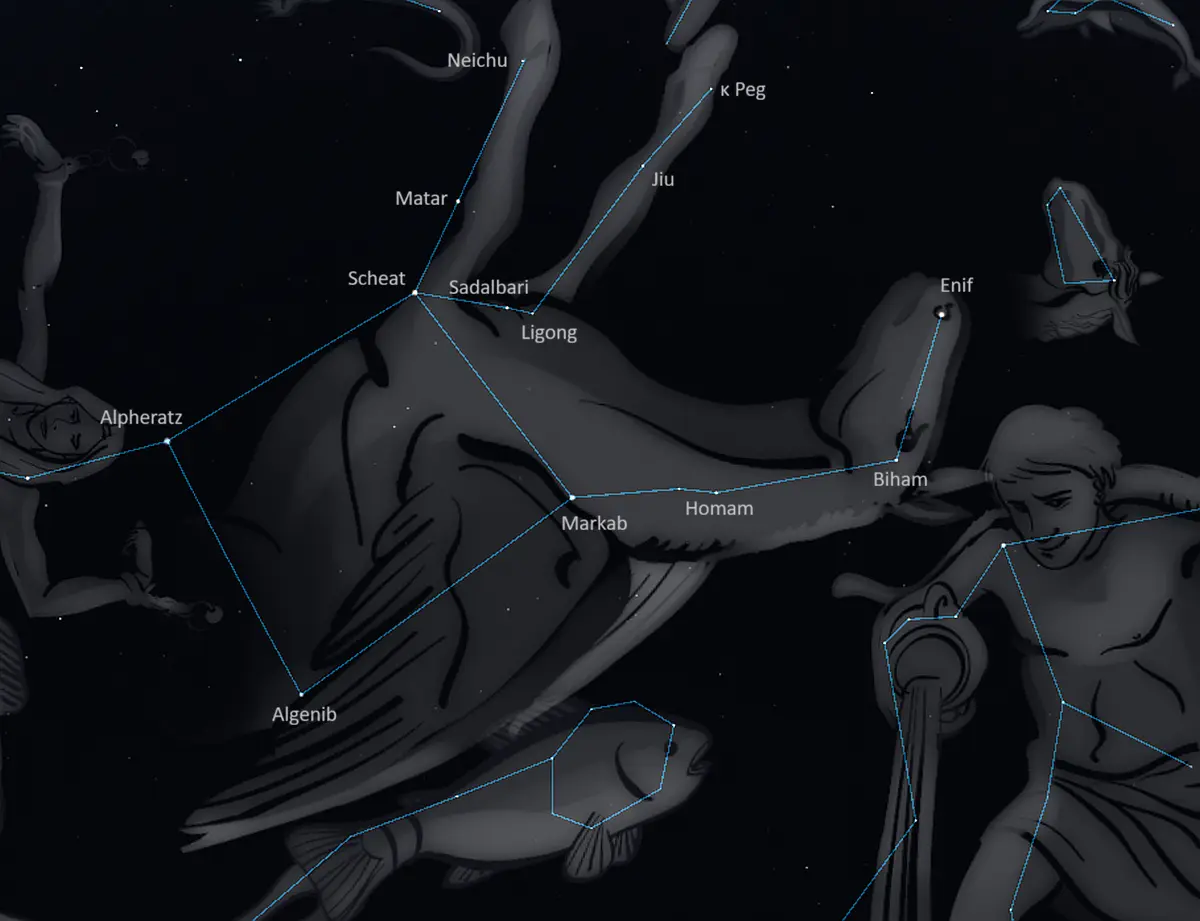
The constellation figure of Pegasus, image: Stellarium (annotated for this article)
The origin of the name Biham
The name Biham (pronunciation: /ˈbaɪ.æm/) comes from the Arabic phrase s’ad al Biham, meaning “Lucky Stars of the Young Beasts.” It was historically also spelled Baham. The International Astronomical Union’s (IAU) Working Group on Star Names (WGSN) formally approved the name Biham for Theta Pegasi A on August 21, 2016.
Theta Pegasi is one of the several stars in this region of the sky with “lucky” names. Others include Sadalsuud (“the Luck of Lucks”), Sadalmelik (“the Lucky Star of the King”), Sadalbari (“the Lucky Star of the Splendid One”), and Sadachbia (“the Lucky Star of the Tents”). Additionally, Lambda Pegasi was traditionally called Sadalpheretz (“the Luck of the Horseman”), Zeta Aquarii was known as Sadaltager (“the Luck of the Merchant”), and the name Nashira comes from a phrase meaning “the Lucky One.”
While these stars have a shared naming convention and lie in the same area, in the constellations Pegasus, Aquarius, and Capricornus, there is no surviving unified story connecting them. Some of them were associated with heliacal risings and seasonal change and others with a favourable economic context. The names were standardized in medieval Arabic astronomy and then passed into European star catalogues and modern usage. Some were formally approved by the IAU, while others remain unofficial (e.g. Sadalpheretz, Sadaltager).
Theta Pegasi in the ancient Chinese sky
In traditional Chinese astronomy, Theta Pegasi is known as 危宿二 (Wēi Sù èr), the Second Star of Rooftop. It forms the Rooftop asterism (危宿, Wēi Sù) with Sadalmelik (Alpha Pegasi) in the constellation Aquarius and its brighter Pegasus neighbour Enif (Epsilon Pegasi). The three stars form a flat triangle near the Water Jar of Aquarius. The asterism is part of the larger Roof mansion, one of the northern mansions of the Black Tortoise.
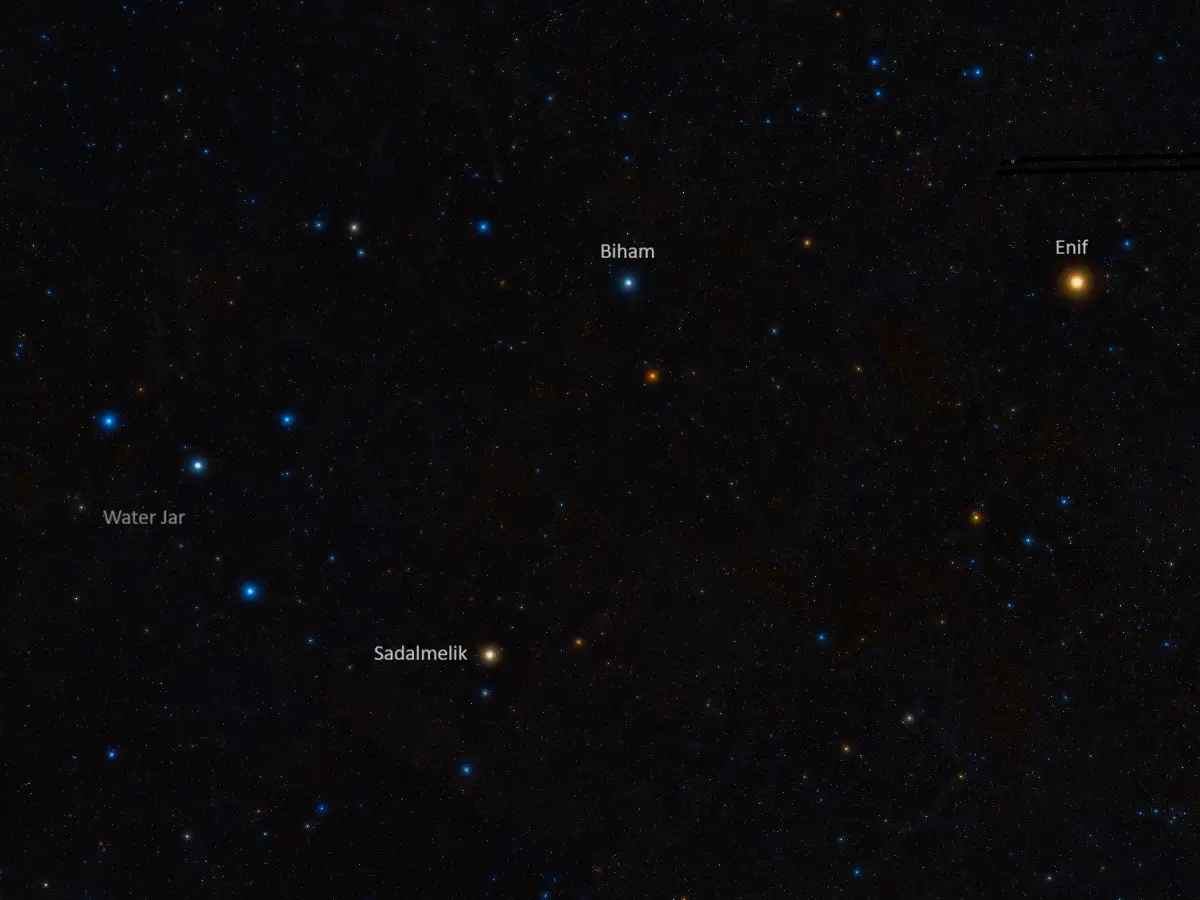
The Chinese Rooftop asterism, image credit: ESO/Digitized Sky Survey 2 (CC BY 4.0)
How to find Biham
Theta Pegasi is part of Pegasus’ head and does not appear very close to the Great Square of Pegasus, the asterism that dominates the constellation and makes it easy to identify. The star lies in the same region as the Water Jar, a smaller and fainter asterism in Aquarius. The right side of the Y in the Water Jar points in Biham’s direction.
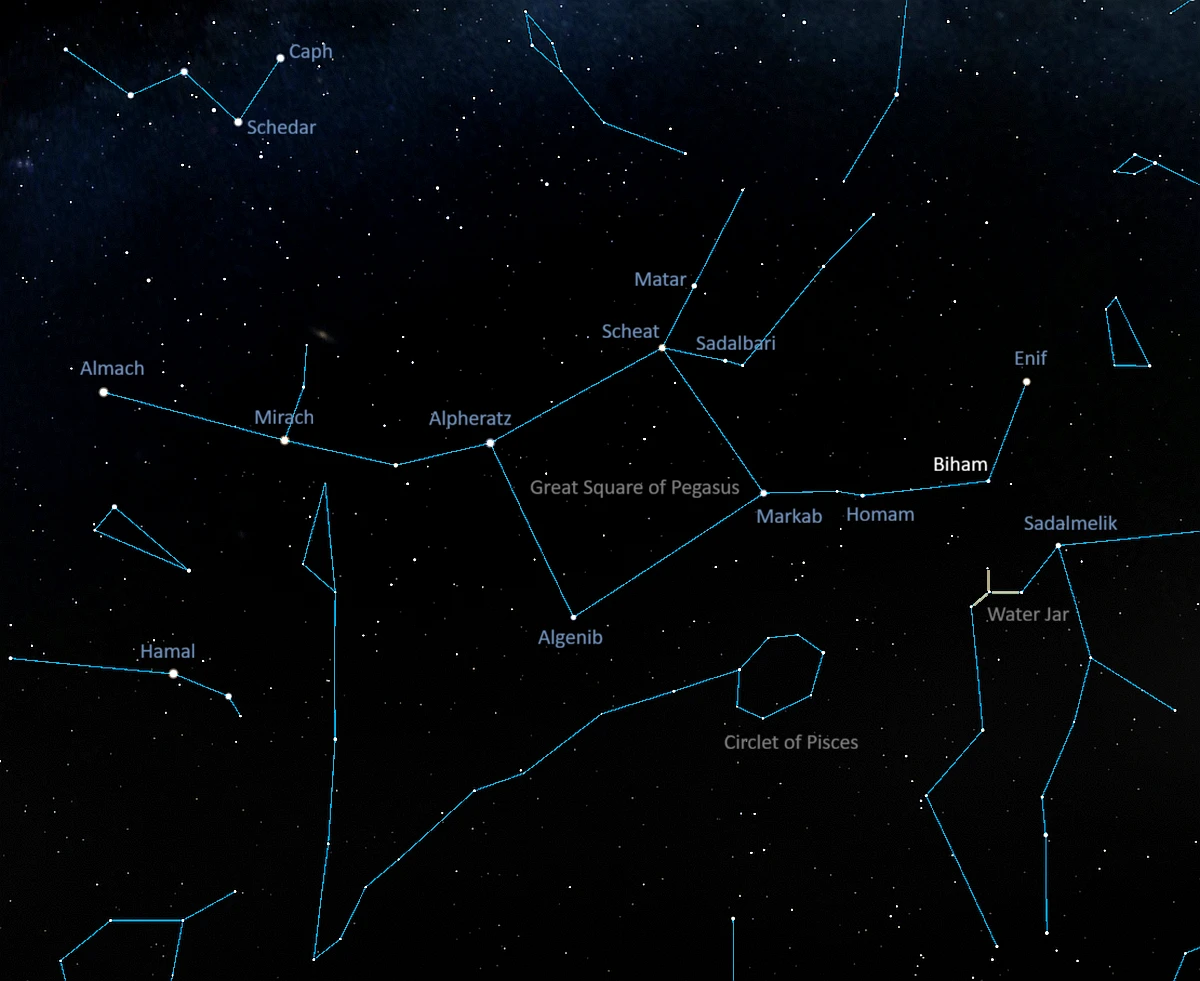
Location of Theta Pegasi, image: Stellarium (annotated for this article)
Biham’s home: The constellation Pegasus
Biham is one of the brightest stars in the northern constellation of Pegasus. The Winged Horse was one of the 48 Greek constellations listed by the Greco-Roman astronomer Ptolemy in the 2nd century CE. In Greek mythology, Pegasus was a flying horse with special powers, born from the blood of the Gorgon Medusa, a monster defeated by Perseus. It is associated with the myth of Bellerophon, a Corinthian slayer of monsters who captured and tamed it.
Pegasus is the seventh largest of the 88 modern constellations, stretching across 1,121 square degrees of the northern sky. It is one of the easiest northern constellations to identify because its three bright stars – Scheat (Beta Pegasi), Markab (Alpha Pegasi), and Algenib (Gamm Pegasi) – form the Great Square of Pegasus with Alpheratz (Alpha Andromedae) in the neighbouring constellation Andromeda. The Great Square is prominent in the evening sky throughout the northern hemisphere autumn.
The supergiant Enif (Epsilon Pegasi), the brightest star in Pegasus, is a second magnitude star. It has an apparent magnitude of 2.399 and lies roughly 690 light-years away. Other bright stars in the constellation include the red giant Scheat, the evolved blue-white star Markab, the variable blue subgiant Algenib, the yellow bright giant Matar, the hot blue star Homam, and the yellow giant Sadalbari.
Pegasus also hosts IK Pegasi, one of the nearest supernova candidates to the Sun, the chemically peculiar star Delta Scuti star Salm, and the yellow dwarf 51 Pegasi (Helvetios), the first main sequence star discovered to have an orbiting planet.
Pegasus contains many famous deep sky objects, among them Stephan’s Quintet of galaxies, the Einstein Cross (a gravitationally lensed quasar), the Superman Galaxy (NGC 7479), the Little Sombrero Galaxy (NGC 7814), the Fried Egg Galaxy (NGC 7742), and the bright spiral galaxy NGC 7331. The brightest deep sky object in the constellation is the Great Pegasus Cluster, a globular cluster listed as Messier 15 in Charles Messier’s catalogue.
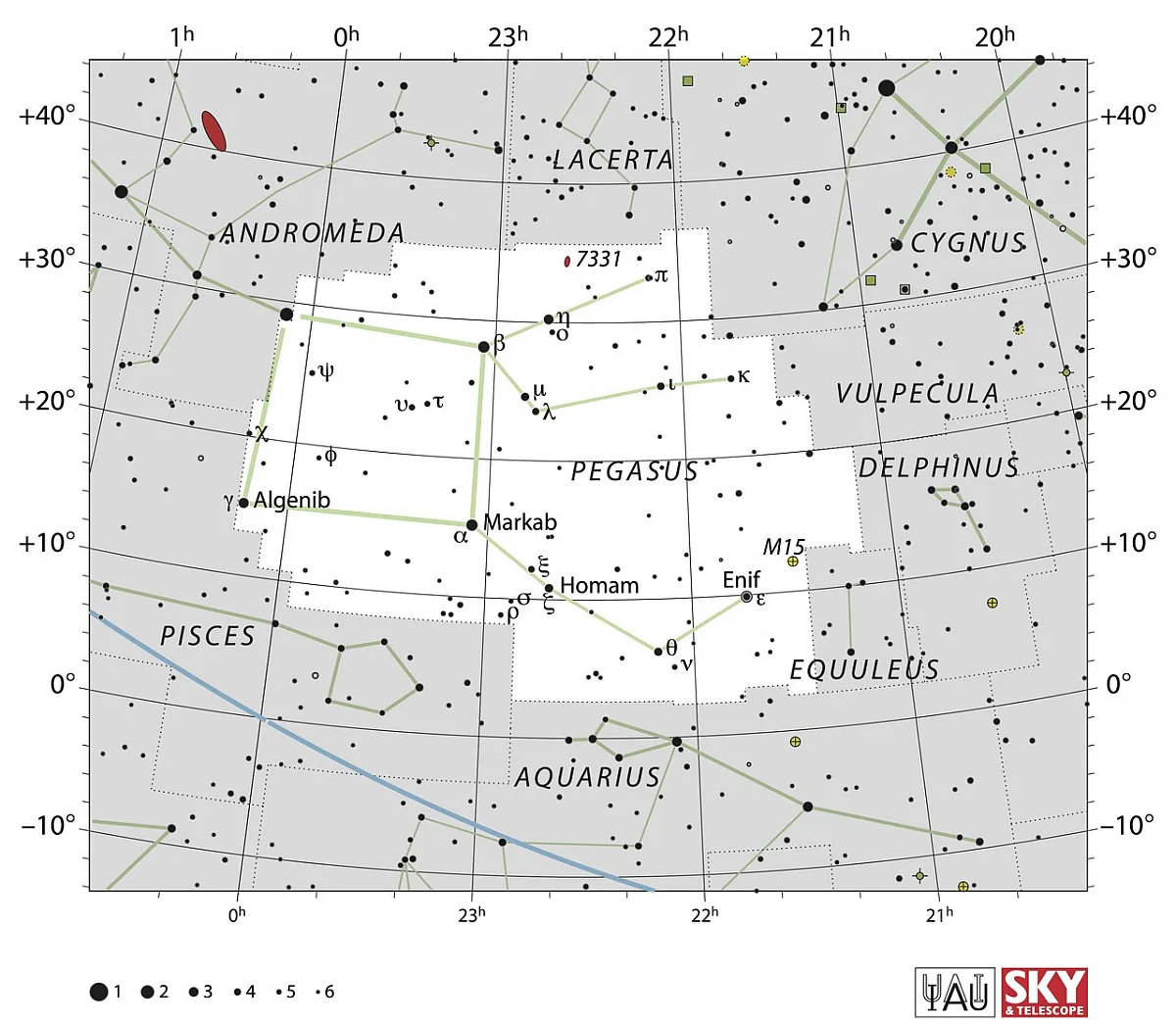
Pegasus constellation map by IAU and Sky&Telescope magazine (Roger Sinnott & Rick Fienberg) (CC BY 3.0)
The best time of the year to observe the stars and deep sky objects in Pegasus is in October, when the constellation appears higher above the horizon in the early evening. The entire constellation can be seen from locations north of the latitude 60° S.
The 10 brightest stars in Pegasus are Enif (Epsilon Peg, mag. 2.399), Scheat (Beta Peg, mag. 2.42), Markab (Alpha Peg, mag. 2.48), Algenib (Gamma Peg, mag. 2.84), Matar (Eta Peg, mag. 2.95), Homam (Zeta Peg, mag. 3.414), Sadalbari (Mu Peg, mag. 3.514), Biham (Theta Peg, mag. 3.52), Jiu (Iota Peg, mag. 3.77), and Ligong (Lambda Peg, mag. 3.93).
Biham – Theta Pegasi
| Spectral class | A2V + M4-5.5 |
| B-V colour index | 0.086 ± 0.002 |
| Apparent magnitude | 3.52 |
| Absolute magnitude | 1.24 |
| Distance | 92 ± 2 light-years (28.3 ± 0.7 parsecs) |
| Parallax | 35.34 ± 0.85 mas |
| Radial velocity | −7.9 ± 2.4 km/s |
| Proper motion | RA: +282.18 mas/yr |
| Dec.: +30.46 mas/yr | |
| Constellation | Pegasus |
| Right ascension | 22h 10m 11.98528s |
| Declination | +06° 11′ 52.3078″ |
| Names and designations | Biham, Baham, Theta Pegasi, Theta Peg, tet Peg, θ Pegasi, θ Peg, 26 Pegasi, 26 Peg, HD 210418, HR 8450, HIP 109427, HIC 109427, SAO 127340, PPM 172728, GJ 9771, PLX 5362.00, BD+05 4961, AG+05 3241, FK5 834, JP11 3458, LTT 16484, NLTT 53109, GSC 00565-01999, NSV 14057, GC 31013, GCRV 13930, CSV 102151, SKY# 42241, LSPM J2210+0611, HGAM 1052, WEB 19660, ASCC 1088144, PMC 90-93 584, ROT 3226, TD1 28827, GEN# +1.00210418, N30 4884, TIC 468285170, VSP 57A, WISEA J221012.17+061152.5, YZ 5 11135, IRAS 22076+0557, 2MASS J22101198+0611522, UBV 18949, UBV M 26173, USNO-B1.0 0961-00579177, uvby98 100210418, TYC 565-1999-1, Gaia DR2 2720428303852169216, Gaia DR3 2720428303852574336, WDS J22102+0612A |
Theta Pegasi A
| Mass | 2.09 ± 0.16 M☉ |
| Luminosity | 23.7 ± 1.1 L☉ |
| Radius | 2.623 ± 0.083 R☉ |
| Temperature | 7,872 ± 82 K |
| Metallicity | -0.38 dex |
| Age | 448 million years |
| Rotational velocity | 136 km/s |
| Surface gravity | 3.95 cgs |
Theta Pegasi B
| Mass | 0.280 M☉ (0.221 – 0.46 M☉) |
| Luminosity | 0.00525 L☉ |
| Temperature | 3,200 K |
| Surface gravity | 5.5 cgs |