Delta Cephei (δ Cep) is a multiple star system located approximately 890 light-years away in the northern constellation Cepheus (the King). Its main star, a yellow supergiant, is the prototype for a class of pulsating variable stars known as the Cepheid variables.
Cepheids are among the most important variable stars in the history of astronomy. The link between their pulsation period and luminosity has allowed astronomers to measure distances to objects far beyond the Milky Way.
The discovery of the period-luminosity relation became a cornerstone of extragalactic astronomy. It provided key evidence that the Great Andromeda Nebula and other “spiral nebulae” were in fact independent galaxies and that the Milky Way did not lie at the centre of the universe.
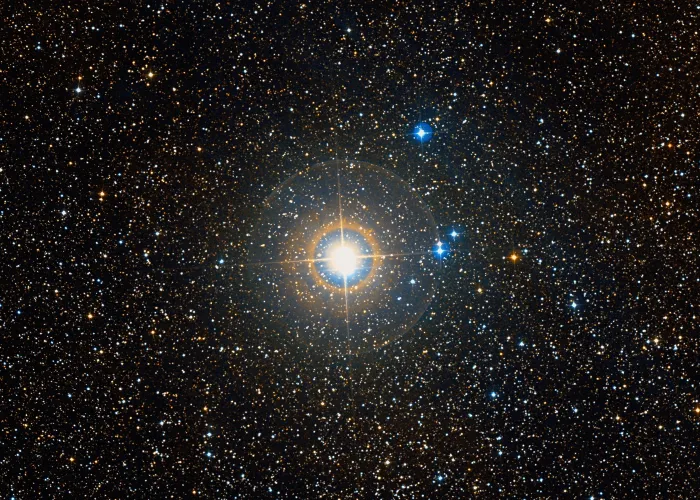
Delta Cephei, image credit: ESO/Digitized Sky Survey 2 (CC BY 4.0)
The Delta Cephei star system
Delta Cephei is a quadruple star system composed of two binary pairs, designated Delta Cephei A and Delta Cephei C, which are separated by about 40 arcseconds in the sky. Delta Cephei A contains the famous Cepheid and varies in brightness from magnitude 3.48 to 4.37. The fainter Delta Cephei C has an apparent magnitude of 6.3 and can be spotted in binoculars. Interstellar dust and gas along the 890-light-year line of sight dim the system’s brightness by about 0.23 magnitudes.
Both visual components are themselves spectroscopic binary stars consisting of more massive primary components and smaller, fainter companions. The system is widely regarded to be a member of the Cepheus OB6 association, a loose family of stars identified by de Zeeuw et al. in 1999. The brightest member of Cepheus OB6, the orange supergiant Zeta Cephei, appears close to Delta Cephei in the sky.
The two main components of Delta Cephei are designated A and C because the faint optical companion originally catalogued as Delta Cephei B turned out to be a background object, unrelated to the system. In literature, the component C is sometimes referred to as B.
Delta Cephei Aa
Delta Cephei Aa, the primary component, is a lower-luminosity yellow supergiant of spectral type F5Ib-G1Ib. It has a mass of around 5.26 solar masses and a radius 41.2 to 45.3 times that of the Sun. With an effective temperature of 5,499 to 6,595 K, it is around 1,949 times more luminous than the Sun.
The supergiant star spins at 9 km/s and has an estimated age of 100 – 130 million years. Its high energy output and pulsations are causing a high rate of mass loss. The star is expelling roughly a solar mass of material every million years.
The ejected material travels at around 35 km/s and forms a nebula around 3.26 light-years (1 pc) across. As the star’s strong stellar wind collides with the interstellar medium, it creates a bow shock. The surrounding nebula is heated by the hot blue companion, Delta Cephei C, causing it to glow in the infrared.
Delta Cephei A was discovered to be a spectroscopic binary star by Anderson et al. in 2015. The researchers observed the star with the HERMES instrument for three years and measured its radial velocity. After removing the wobble caused by the star’s pulsations, they noticed a much slower wobble that indicated the presence of an unseen companion.
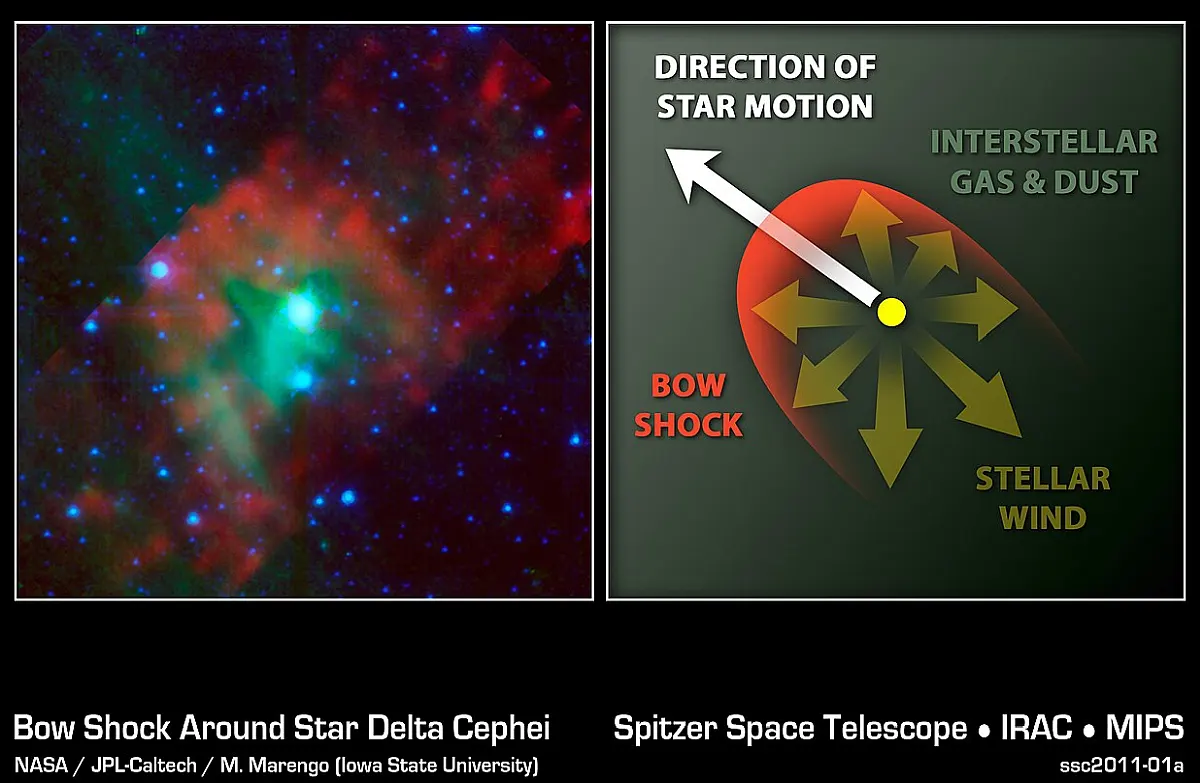
Infrared image from NASA’s Spitzer Space Telescope (left) shows Delta Cephei with a red, arc-shaped bow shock to its left. The shock forms as the star’s wind of gas and dust hits interstellar material while the star moves through space (diagram, right). It was the first direct evidence that Cepheids lose mass. Because this material can obscure a Cepheid’s apparent brightness, and so its calculated distance, the finding matters for the cosmic distance ladder. Delta Cephei’s companion star, just below it, illuminates the region, helping astronomers calculate the star’s mass-loss rate. Image credit: NASA/JPL-Caltech/M. Marengo (Iowa State) (PD)
Delta Cephei Ab
Delta Cephei Ab, the hidden companion, is a much smaller star, with a mass of only 0.72 solar masses. Upon its discovery, Anderson et al reported an orbital period of around 2,201 days (six years), with an eccentricity of about 0.65. The star is at least 100 times fainter than Delta Cephei Aa in visible light, which is why telescopes had not directly detected it in the system’s spectrum.
In 2024, Nardetto et al. refined the system’s parameters based on observations with the HARPS-N spectrograph mounted at the Telescopio Nazionale Galileo. The astronomers found an orbital period of around 9.32 years with an eccentricity of 0.71, and a semimajor axis of 0.029 arcseconds. The mass of Delta Cephei Ab was refined to 0.72 ± 0.11 solar masses.
Delta Cephei Ca
The Delta Cephei C system has a combined spectral type B7IV or B8IV, indicating a hot blue primary component that is coming to the end of its main sequence lifetime. The subgiant star has a mass of 4.78 solar masses and a radius 5.25 times that of the Sun. With an effective temperature of 11,161 K, it shines with a luminosity of 248 Suns. It has an estimated age of 112 million years and spins at 24.8 km/s.
Delta Cephei Cb
The presence of Delta Cephei Cb was proposed by Herbig in the 1960s. In 2002, a Hubble study found that Delta Cephei C did not appear to move in a simple straight line across the sky. Instead, its measured positions showed a small, curved, long-term wobble, an astrometric signature that can be caused by the gravity of an unseen companion. Fitting that wobble with an orbit suggested a companion with a period of about 1.07 years, a mass of roughly 1.6 solar masses, and a separation of about 1.9 astronomical units. The companion’s mass was later refined to 1.99 M☉.
The prototype of Cepheid variables
Delta Cephei Aa serves as the prototype for a class of variable stars known as the Cepheid variables. These are pulsating stars that swell and shrink in a regular rhythm, causing variations in apparent brightness over periods that last from a few days to around 50 days.
The pulsations are closely linked to the stars’ changes in size, temperature and luminosity. Because a star’s brightness depends on both its size and temperature, the changes work together to create the steady cycle of brightness variations.
During a single cycle, the radius of a Cepheid variable can change by as much as 10 – 20 percent and its temperature can swing by about 1,000 K. As a result, the star’s colour can slightly shift from a warmer yellow-white to cooler yellow-orange. Some Cepheids roughly double in luminosity from their dimmest to brightest point.
Classical Cepheids like Delta Cephei are luminous yellow giants or supergiants that typically have several to more than 10 times the Sun’s mass and are thousands of times more luminous.
Cepheid variable animation, image: Wikimedia Commons/ Merikanto (CC BY-SA 4.0)
Variations in brightness, size, temperature and luminosity
Delta Cephei varies in brightness from magnitude 3.48 to 4.37 over a period of 5.366249 days. Over this period, the star’s spectral type changes from F5 (yellow-white) to the cooler G1 (yellow) as its temperatures fluctuates from 6,595 to 5,499 K. As the star pulsates, its radius varies between 41.2 and 45.3 solar radii. It reaches maximum brightness during its expansion phase, after the surface has begun moving outward.
The variability of Delta Cephei was discovered by the young English amateur astronomer John Goodricke in 1784. The star was not the first Cepheid variable to be discovered. English astronomer and Goodricke’s friend and collaborator Edward Pigott had detected the periodic variability of Eta Aquilae earlier that year.
Goodricke announced his discovery in a letter to Nevil Maskelyne, Astronomer Royal, dated November 24, 1785. He reported a periodical variation of 5 days, 8 hours, and 37 ½ minutes.
Other bright classical Cepheids
Even though Delta Cephei is the class prototype, it is not the brightest classical Cepheid in the sky. Polaris, the North Star, holds the title, with brightness variations in the range from magnitude 1.86 to 2.13. It is the only Cepheid variable that shines at second magnitude. The yellow supergiants l Carinae and Beta Doradus are also slightly brighter than Delta Cephei, and Pagru (Eta Aquilae) has a similar brightness range.
Other visible Cepheids include Mekbuda in the constellation Gemini, X and W Sagittarii in Sagittarius, T Antliae in Antlia, S Sagittae in Sagitta, AX Circini in Circinus, and AH Velorum in Vela.
Leavitt’s period-luminosity law for classical Cepheids
In 1908, American astronomer Henrietta Swan Leavitt discovered a relationship between classical Cepheids’ period and luminosity by studying variable stars in the Small Magellanic Cloud. She found that Cepheids with longer periods are brighter and that the periods can be used as indicators of the stars’ luminosities. By comparing a Cepheid’s intrinsic luminosity with its apparent magnitude, astronomers can estimate its distance.
Leavitt’s law makes Cepheids useful as standard candles, cosmic mile markers that allow astronomers to measure distances to Cepheids in other galaxies and distant star clusters. The ability to accurately measure distances to objects far beyond the Milky Way moved astronomy forward by leaps and bounds in the early 20th century.
Leavitt’s groundbreaking discovery made it possible for American astronomer Edwin Hubble to prove that the Andromeda Galaxy was, in fact, a galaxy, and for Hubble and Belgian theoretical physicist Georges Lemaître to provide the first observational evidence for the expansion of the universe (the Hubble–Lemaître law, whose proportionality is the Hubble constant).
Does Delta Cephei have a proper name?
As of 2026, Delta Cephei does not have a former proper name approved by the International Astronomical Union (IAU). The star does not have any Greek, Latin or Arabic traditional names. It is known by its Bayer designation, Delta Cephei. It has the Flamsteed designation 27 Cephei and is listed as HD 213306 in the Henry Draper Catalogue (HD).
In Chinese astronomy, Delta Cephei is known as the First Star of Zao Fu (造父, Zào Fù). Zao Fu is a traditional Chinese constellation representing the legendary charioteer Zaofu (Tsao Fu), who carried King Mu of Zhou to paradise to taste the peaches of immortality. According to legend, once they reached Mount Kunlun, the emperor ate the peaches and the charioteer and his horses were carried up to the heavens.
The Zao Fu constellation is also formed by Epsilon Cephei, Zeta Cephei, Mu Cephei, and Nu Cephei. It is part of the larger Rooftop mansion, one of the northern mansions of the Black Tortoise.
How to find Delta Cephei
Delta Cephei is easy to identify because it appears next to the brighter Zeta Cephei, which stands out in the relatively faint constellation figure of Cepheus. Both stars lie in the southeastern part of Cepheus, close to the border with Lacerta.
Alderamin, the brightest star in Cepheus, can be found along the line extended from Schedar through Caph, the rightmost stars of Cassiopeia’s W. Alderamin forms the base of the stick house figure than dominates the constellation with Zeta and Delta Cephei.
At declination +58°, Delta Cephei is circumpolar for most northern observers and never rises from locations south of the latitude 32° S. It always stays below the horizon for observers in New Zealand, southern Australia and South Africa, Uruguay, and most of Argentina and Chile.
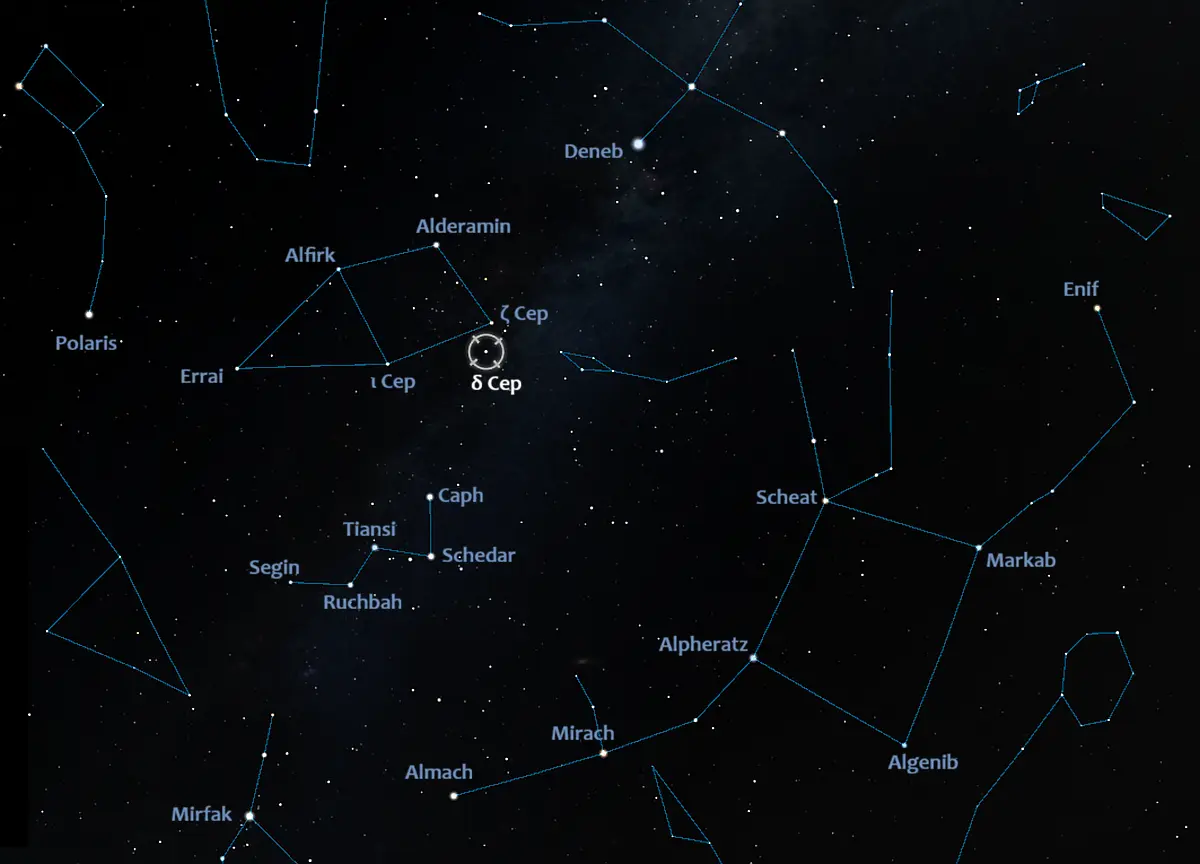
Delta Cephei location, image: Stellarium (annotated for this article)
Deep sky objects near Delta Cephei
Several diffuse nebulae appear in the same area as Delta Cephei. The famous Wizard Nebula (NGC 7380) can be found along the line extended from Zeta Cephei through Delta Cephei. The faint Sharpless 135 (Sh2-135) appears in the region between the two stars, and the Lion Nebula (Sh2-132) forms an almost equilateral triangle with the stars. The three emission nebulae are best seen in long-exposure photographs.
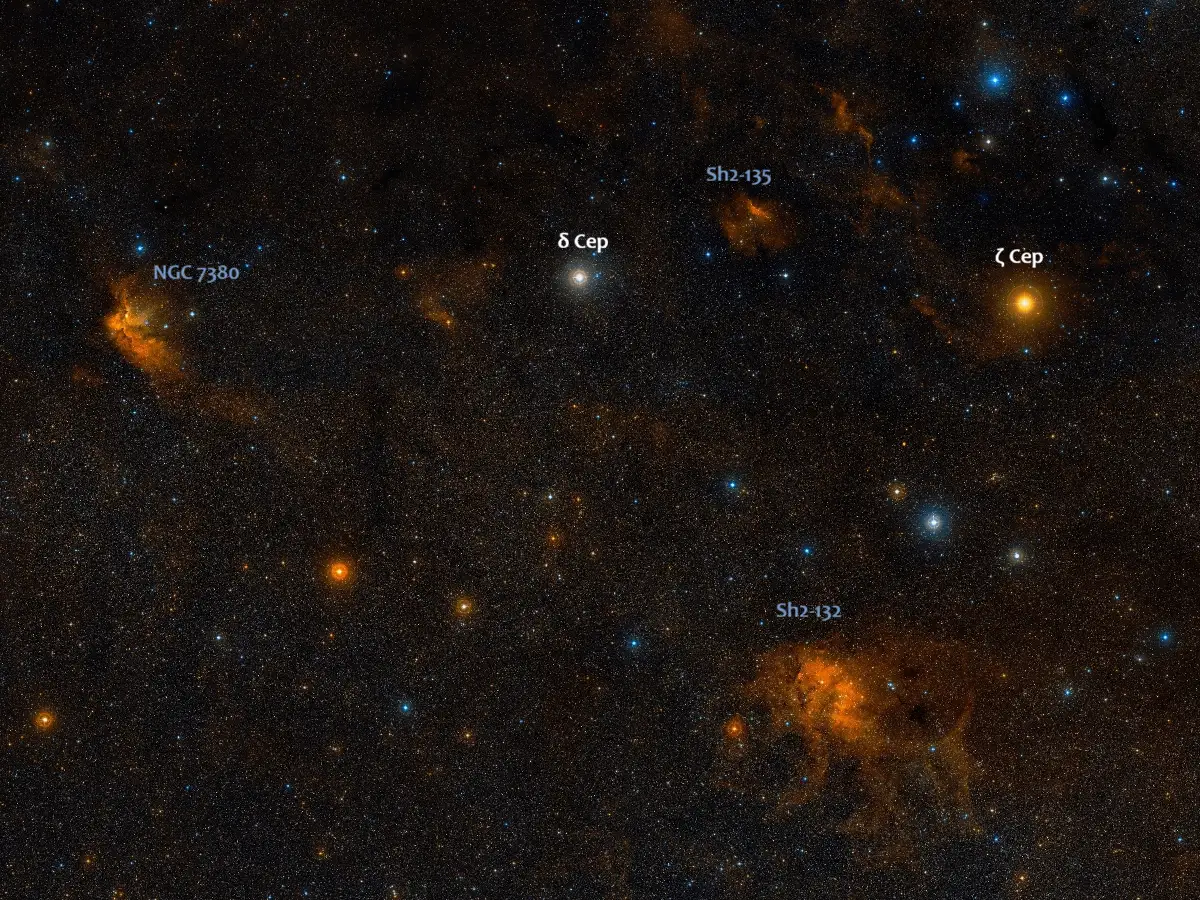
Deep sky objects near Delta Cephei, image credit: ESO/Digitized Sky Survey 2 (CC BY 4.0)
Delta Cephei’s home: Cepheus constellation
Delta Cephei is one of the brightest stars in the constellation Cepheus (the King). Cepheus is one of the 48 Greek constellations, catalogued by Ptolemy of Alexandria in the 2nd century CE. In Greek mythology, it represents King Cepheus of Aethiopia, husband of Queen Cassiopeia and father of Andromeda.
In the myth, Cassiopeia boasted that she was more beautiful than the Nereids, the sea nymphs, which enraged the sea god Poseidon. He sent the sea monster Cetus to ravage the kingdom, and an oracle declared that the only way to end the devastation was to sacrifice Andromeda. Cepheus gave in, and Andromeda was chained to a rock by the sea to await the monster. She was saved at the last moment by the hero Perseus, who later married her. All five figures in the story, Cepheus, Cassiopeia, Andromeda, Perseus and Cetus, became constellations.
Cepheus stretches across 588 square degrees of the far northern sky and is the 27th largest of the 88 modern constellations. Even though it is large, it is relatively faint and can be difficult to spot from light-polluted areas. The constellation’s brightest star, Alderamin (Alpha Cephei), is at the dim end of second magnitude (2.46) and the only star brighter than magnitude 3.0 in the constellation. On clear, dark nights, Cepheus can be spotted just above the bright W of Cassiopeia.
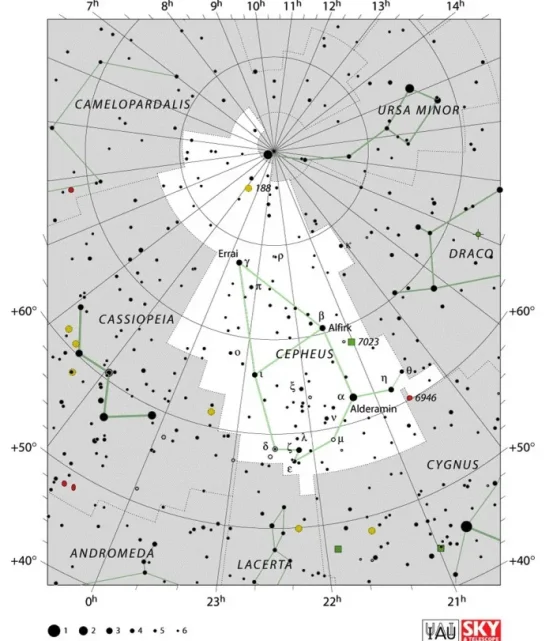
Cepheus constellation map by IAU and Sky&Telescope magazine (Roger Sinnott & Rick Fienberg) (CC BY 3.0)
Other relatively bright stars in the constellation include the orange giants Errai (Gamma Cephei), with an orbiting exoplanet, and Iota Cephei, the massive blue star system Beta Cephei (Alfirk), the orange supergiant Zeta Cephei, the orange subgiant Eta Cephei, the Delta Scuti variable Epsilon Cephei, the white giant Theta Cephei, and the red supergiant Mu Cephei (Garnet Star), one of the reddest stars known.
Cepheus also hosts the nearby red dwarf system Krüger 60, the blue supergiants Nu Cephei and Lambda Cephei, the red supergiants VV Cephei and V354 Cephei, and the hypergiant RW Cephei. The last three are among the largest stars known.
Cepheus is known for its many nebulae and star clusters. These include the Polarissima Cluster (Caldwell 1, NGC 188), the planetary Bow-Tie Nebula (Caldwell 2, NGC 40), and the diffuse nebulae IC 1396 (the Elephant’s Trunk Nebula), the Cave Nebula (Caldwell 9), the Question Mark Nebula (NGC 7822), the Wizard Nebula (NGC 7380), the Lion Nebula (Sh2-132), the Rosebud Nebula (NGC 7129), the Valentine Rose Nebula (Sh2-174), the Ghost Nebula (Sh2-136), the Flying Bat Nebula (Sh2-129), and the dark Seahorse Nebula (Barnard 150) and Shark Nebula (LDN 1235). Cepheus also hosts the Fireworks Galaxy (NGC 6946), a spiral galaxy known for its many supernovae, located on the border with the constellation Cygnus.
Cepheus is circumpolar for most northern observers, making its stars and deep sky objects visible throughout the year. Located in the region of the north celestial pole, it largely stays below the horizon for observers in the southern hemisphere. The entire constellation is visible from locations north of the latitude 1° S. The best time to see it is in the month of November, when it appears higher in the sky in the early evening.
The 10 brightest stars in Cepheus are Alderamin (Alpha Cep, mag. 2.5141), Errai (Gamma Cep, mag. 3.21), Alfirk (Beta Cep, mag. 3.23), Zeta Cephei (mag. 3.35), Eta Cephei (mag. 3.426), Iota Cephei (mag. 3.507), Delta Cephei (mag. 3.48–4.37), Epsilon Cephei (mag. 4.18), Theta Cephei (mag. 4.22), and Garnet Star (Mu Cep, mag. 4.23).
Delta Cephei A
| Spectral class | F5Ib–G1Ib + B8IV |
| Variable type | Classical Cepheid |
| U-B colour index | +0.36 |
| B-V colour index | +0.60 |
| Apparent magnitude (V) | 3.48 – 4.37 |
| Absolute magnitude | −3.47 ± 0.10 (−3.94 to −3.05) |
| Distance | 890 ± 20 light-years (273 ± 7 parsecs) |
| Parallax | 3.66 ± 0.10 mas |
| Radial velocity | -17.28 ± 0.08 km/s |
| Proper motion | RA: +14.560 mas/yr |
| Dec.: +3.238 mas/yr | |
| Mass (δ Cep Aa, Ab) | 5.26 (+1.26 / −1.4) M☉; 0.72 ± 0.11 M☉ |
| Luminosity | 1,949 ± 107 L☉ |
| Radius | 41.2 – 45.3 R☉ |
| Temperature | 5,499 – 6,595 K |
| Metallicity | +0.08 dex |
| Age | 100–130 Myr |
| Rotational velocity | 9 km/s |
| Surface gravity | 1.81–1.91 cgs |
| Constellation | Cepheus |
| Right ascension | 22h 29m 10.2626640314s |
| Declination | +58° 24′ 54.697613650″ |
| Names and designations | Delta Cephei, Delta Cep, δ Cephei, δ Cep, 27 Cephei, 27 Cep, HD 213306, HR 8571, HIP 110991, SAO 34508, BD+57 2548, FK5 847, GC 31421, TIC 415741355, TYC 3995-1479-1, IRAS 22273+5809, 2MASS J22291029+5824549, Gaia DR2 2200153454723522432, Gaia DR3 2200153454733285248, AAVSO 2225+57, ADS 15987 A, CCDM J22292+5825A, IDS 22254+5754 A, WDS J22292+5825A |
Delta Cephei C
| Spectral class | B7IV |
| Variable type | Suspected variable (NSV 25915) |
| U-B colour index | -0.33 |
| B-V colour index | -0.02 |
| Apparent magnitude (V) | 6.30 |
| Parallax | 3.4544 ± 0.0509 mas |
| Radial velocity | +40.17 ± 2.97 km/s |
| Proper motion | RA: +13.772 mas/yr |
| Dec.: +3.702 mas/yr | |
| Mass (δ Cep Ca, Cb) | 4.78 M☉; 1.99 M☉ |
| Luminosity | 248 L☉ |
| Radius | 5.25 R☉ |
| Temperature | 11,161 K |
| Metallicity | -0.42 dex |
| Age | 112 million years |
| Rotational velocity | 24.8 km/s |
| Surface gravity | 4.31 cgs |
| Constellation | Cepheus |
| Right ascension | 22h 29m 09.2467s |
| Declination | +58° 24′ 14.747″ |
| Names and designations | δ Cep B, δ Cep C, HD 213307, HIP 110988, SAO 34506, BD+57 2547, GC 31419, NSV 25915, TYC 3995-1480-1, 2MASS J22290927+5824149, Gaia DR2 2200153214212849024, Gaia DR3 2200153214212849024, TIC 415752999, STF 4058C, ADS 15987 C, CCDM J22292+5825C, IDS 22254+5754 C, WDS J22292+5825C |