Kappa Crucis (κ Cru) is a bright blue supergiant located approximately 7,500 light years away in the southern constellation Crux. With an apparent magnitude of 5.94, it is faintly visible to the unaided eye from areas without light pollution.
The massive supergiant star appears in the region of the Southern Cross. It is one of the brightest members of the Jewel Box Cluster (NGC 4755), a bright young open star cluster visible without binoculars in good conditions.
What type of star is Kappa Crucis
Kappa Crucis is a hot blue supergiant star of the spectral type B3Ia. The luminosity class Ia indicates a bright supergiant. The star has 23 times the mass of the Sun and shines with a luminosity of 151,000 Suns. It spins at 70 km/s. The surface temperature of 16,300 K gives it a blue-white glow.
With a mass of 23 solar masses, Kappa Crucis follows the evolutionary path of high-mass stars. When it reaches the end of its life cycle, it will go out as a luminous supernova.
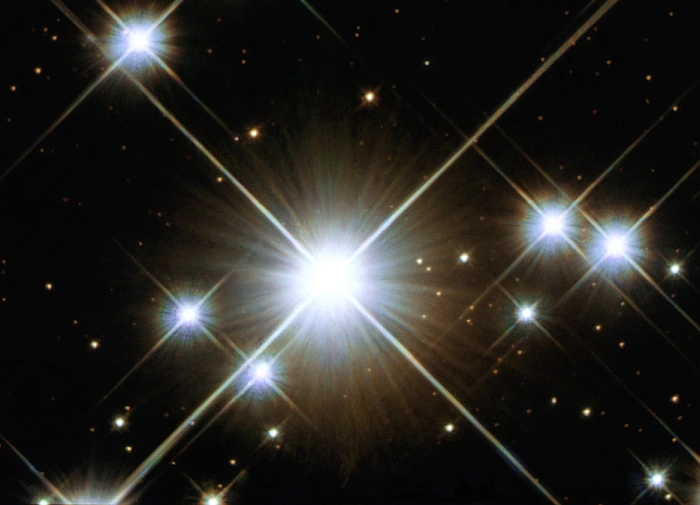
Kappa Crucis captured by the Hubble Space Telescope (cropped from original), image: NASA/ESA and Jesús Maíz Apellániz (Instituto de Astrofísica de Andalucía, Spain) (PD)
A spectroscopic binary system
In 2012, a radial velocity spectroscopic survey of O- and B-type stars detected radial velocity variations in the spectral lines of Kappa Crucis. The variations indicate that the star has a close spectroscopic companion. The companion has not been directly resolved and its properties are unknown.
The researchers found the Kappa Crucis system to be a single-lined spectroscopic binary (SB1), a system in which only the spectrum of the primary component is visible. The presence of the companion is inferred from the spectrum shifting towards the blue and then towards red, indicating orbiting motion.
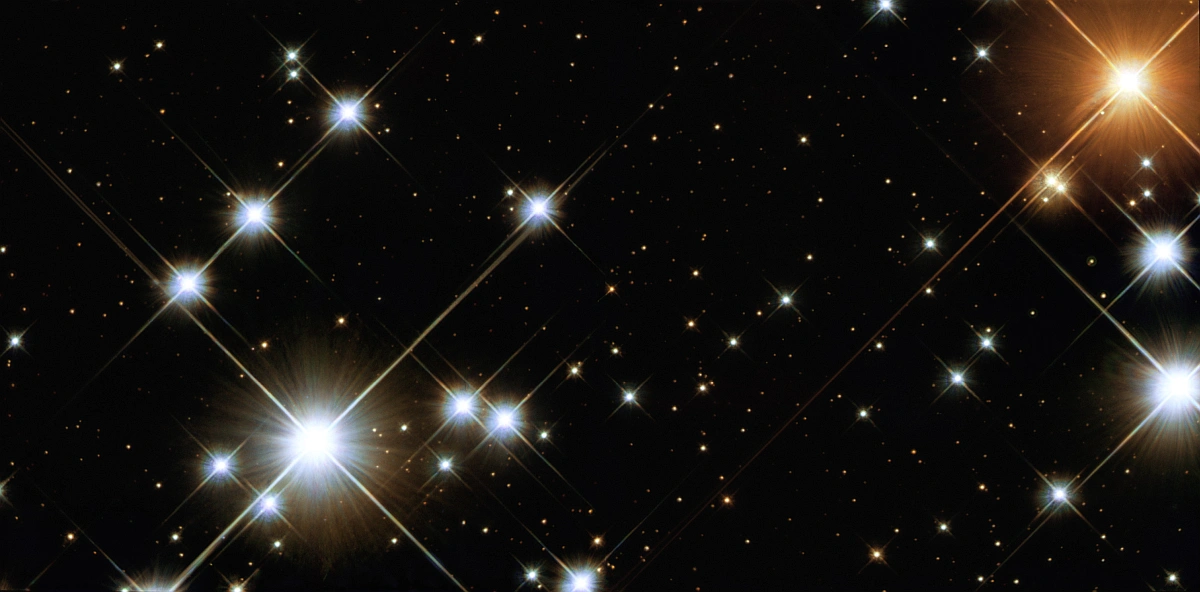
This image is a “close-up” view from the NASA/ESA Hubble Space Telescope of NGC 4755, or the Jewel Box cluster. Several very bright, pale blue super-giant stars (eg. κ Crucis on the left, HD 111934 on the lower right and HIP 62913 in the middle right), a solitary ruby-red super-giant (HIP 62918 – upper right) and a variety of other brilliantly coloured stars are visible in the image, as well as many much fainter ones, often with intriguing colours. The huge variety in brightness exists because the brighter stars are 15 to 20 times the mass of the Sun, while the dim points are less than half the mass of the Sun. This is the first image of an open galactic cluster with imaging extending from the far ultraviolet to the near-infra-red. Image credit: NASA/ESA and Jesús Maíz Apellániz (Instituto de Astrofísica de Andalucía, Spain) (PD)
Kappa Crucis Cluster
Kappa Crucis is one of the brightest stars in the Jewel Box Cluster (NGC 4755), an open cluster visible to the unaided eye. Discovered by the French astronomer Nicolas Louis de Lacaille with a small refractor from South Africa in 1751-1752, the Jewel Box is one of the youngest open clusters known. It has an estimated age of only 11-16 million years. Its members belong to the Centaurus OB1 association, a large stellar family of massive, gravitationally unbound O- and B-type stars.
NGC 4755 was named the Jewel Box by the British astronomer John Herschel, who first observed the cluster in March 1834. The cluster is commonly referred to as the Kappa Crucis Cluster, after its only bright member with a Bayer designation.
Like Kappa Crucis, other bright stars in the Jewel Box Cluster are massive, evolved supergiants. The brightest members, the A-type supergiant DS Crucis and B-type supergiant HR 4887, shine at magnitudes 5.741 and 5.77. Other bright members include the blue supergiant BU Crucis and red supergiant DU Crucis. Like Kappa Crucis, these stars are supernova candidates.
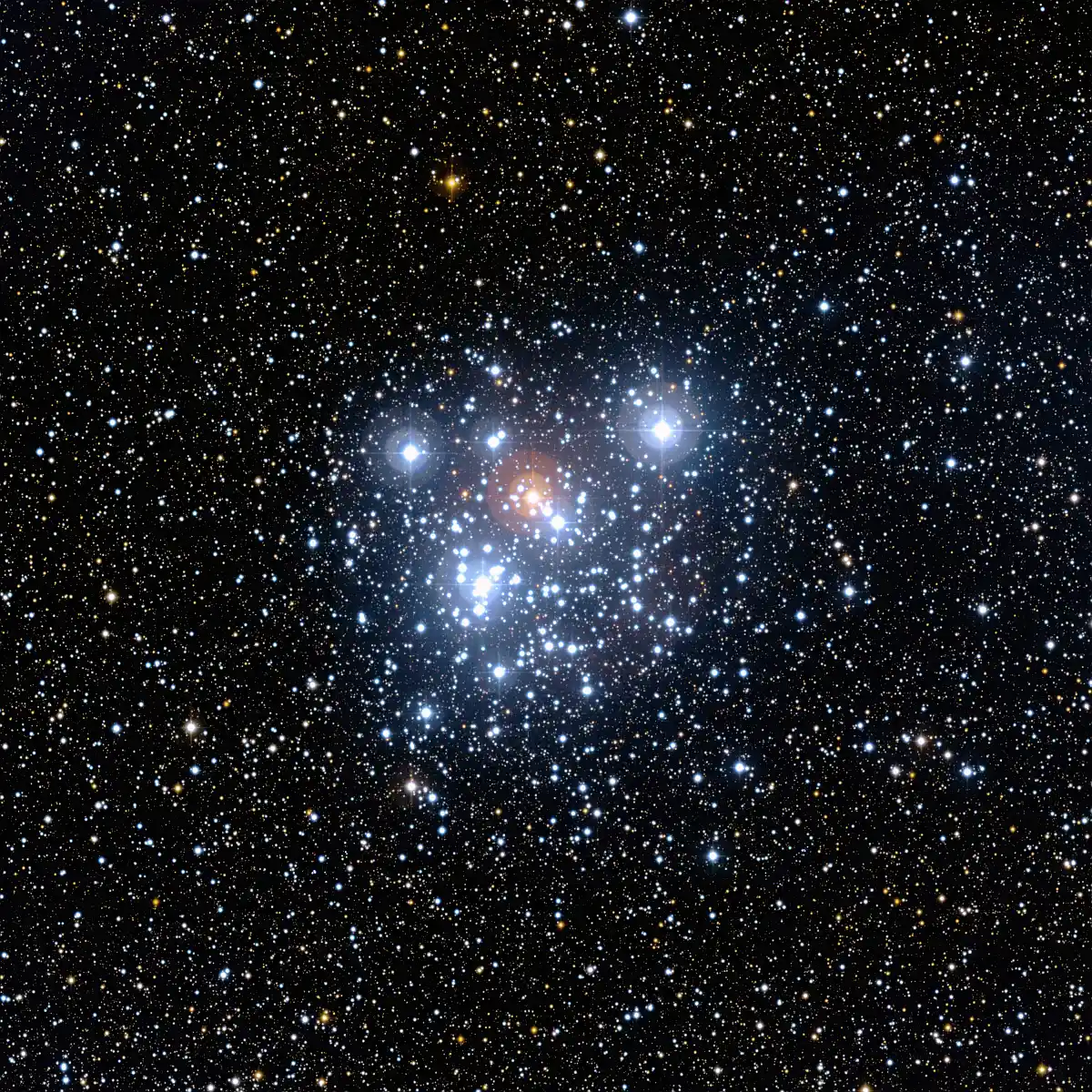
This image of the well-known NGC 4755 cluster or Jewel Box was taken with the Wide Field Imager (WFI) on the MPG/ESO 2.2-metre telescope at ESO’s La Silla Observatory. It highlights the cluster and its rich surroundings in all their multicoloured glory. Image credit: ESO (CC BY 4.0)
Name
Kappa Crucis does not have a proper name formally approved by the International Astronomical Union (IAU). It is catalogued as HD 111973 in the Henry Draper Catalogue, HIP 62931 in the Hipparcos catalogue, and SAO 252077 in the Smithsonian Astrophysical Observatory Star Catalog. In research papers, it is sometimes referred to as NGC 4755 2, in reference to its position in the Jewel Box Cluster.
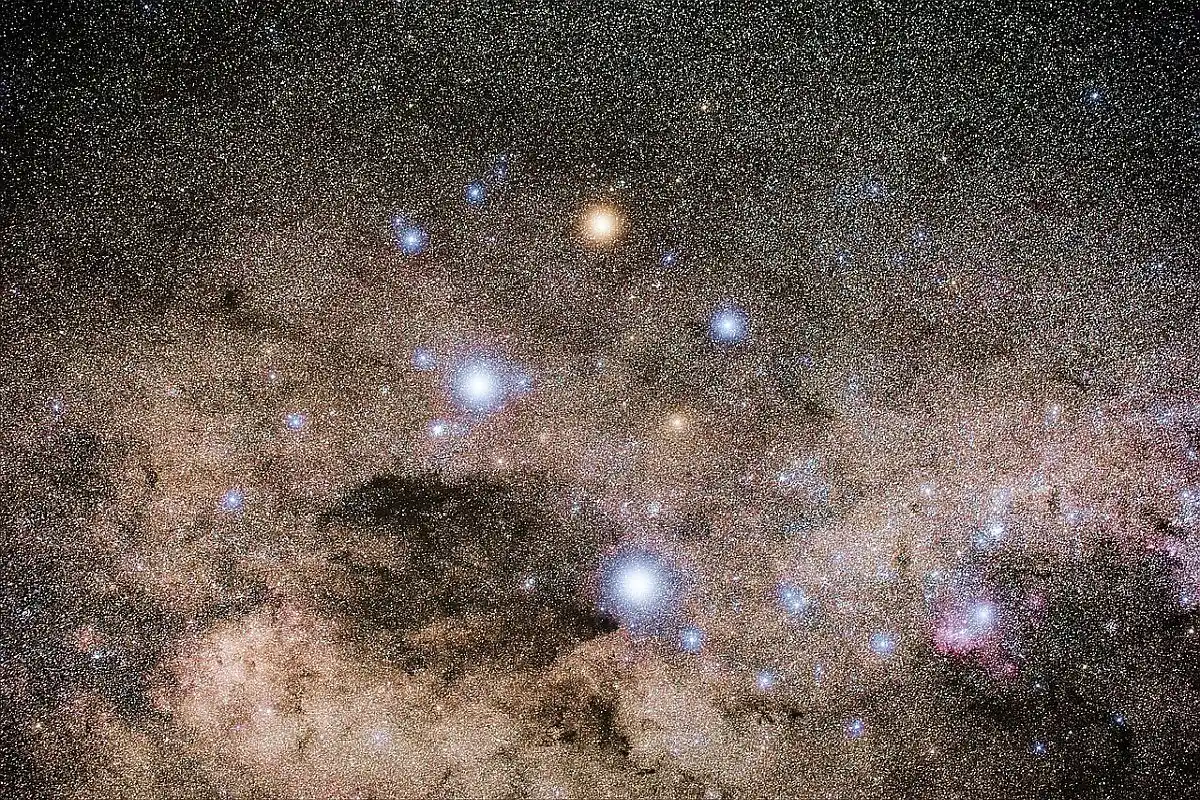
Wide field photo of the Crux (Southern Cross) constellation. The Coalsack Dark Nebula can be seen as the dark area below-right in the constellation. The Kappa Crucis Cluster appear next to Mimosa, the leftmost star of the Southern Cross. Image credit: Wikimedia Commons/Naskies (CC BY-SA 3.0)
Finding Kappa Crucis in the night sky
Kappa Crucis is very easy to find because it lies in the region of the Southern Cross, the most recognizable asterism in the southern celestial hemisphere. The supergiant appears just southeast of Mimosa (Beta Crucis), the second brightest star in Crux.
At declination -60°, Kappa Crucis and the celestial Jewel Box are largely invisible from the northern hemisphere. They never rise above the horizon for observers north of the latitude 29° N.
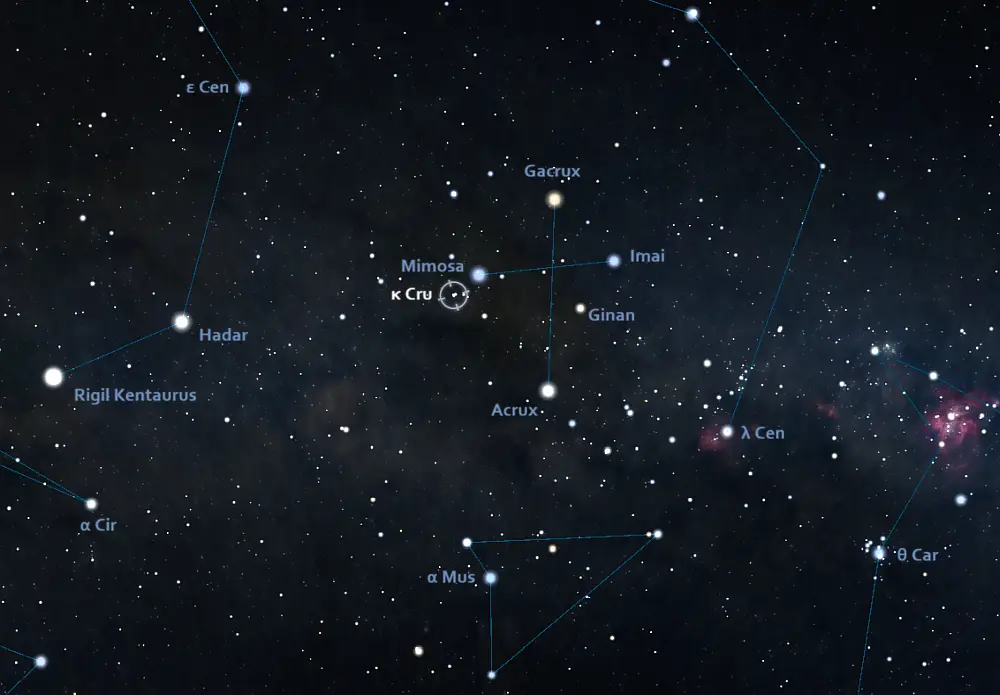
Kappa Crucis location, image: Stellarium (annotated for this article)
Locating Kappa Crucis in the Jewel Box
Kappa Crucis appears in the central region of the Jewel Box Cluster, where several bright cluster members form an asterism that looks like the letter “A.” Kappa Crucis marks the bottom right (southern) leg of the “A.”
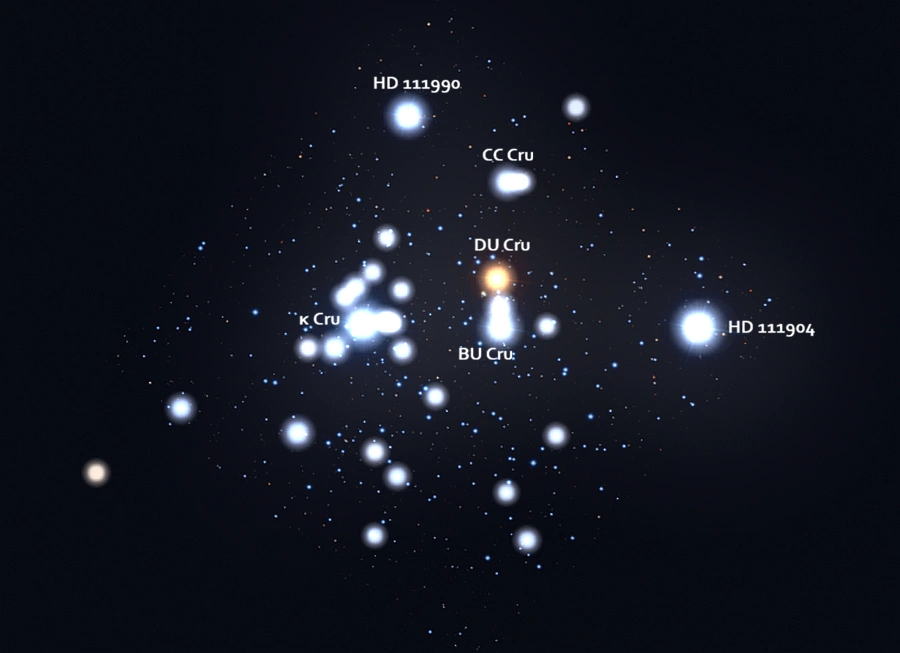
Location of Kappa Crucis in the Jewel Box Cluster (NGC 4755), image: Stellarium (annotated for this article)
Constellation
Kappa Crucis is located in the constellation Crux. Crux is the smallest of the 88 modern constellations, stretching across only 68 square degrees of the far southern sky. Dominated by the bright Southern Cross asterism, it is one of the most familiar constellations in the southern hemisphere. Its prominent diamond-shaped star pattern is featured on many flags, including those of Australia, New Zealand, and Brazil.
Most bright stars in Crux are believed to be members of the Scorpius-Centaurus association, the nearest family of hot, luminous O- and B-type stars to the Sun.
Acrux (Alpha Crucis), the constellation’s brightest star, is the 13th brightest star in the sky. The massive blue star is supernova candidate and lies 348 light-years away. Mimosa (Beta Crucis), the second brightest star in Crux, is the 20th brightest star in the sky. Like Acrux, it will end its life as a brilliant supernova.
Other bright stars in Crux include the red giant Gacrux (Gamma Crucis), the hot blue subgiants Imai (Delta Crucis) and Mu1 Crucis, the orange giants Ginan (Epsilon Crucis) and Iota Crucis, and the blue main sequence stars Zeta Crucis and Lambda Crucis.
In addition to the Jewel Box Cluster, deep sky objects in the constellation include the dark Coalsack Nebula, the Dragonfish Nebula, and the open clusters NGC 4103 and NGC 4609.
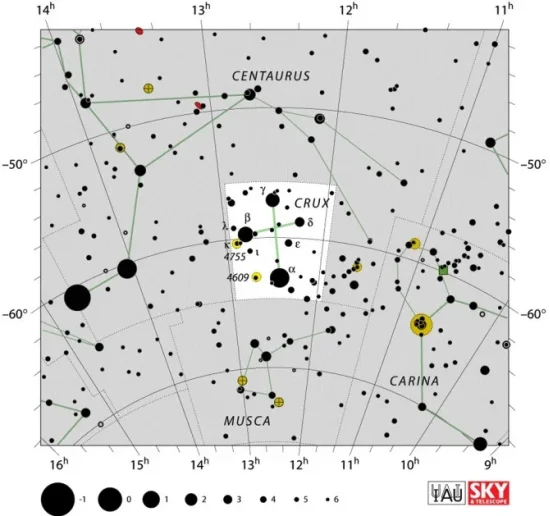
Crux constellation map by IAU and Sky&Telescope magazine (Roger Sinnott & Rick Fienberg) (CC BY 3.0)
The best time of the year to observe the stars and deep sky objects in Crux is during the month of May, when the constellation appears higher above the horizon in the early evening.
The 10 brightest stars in Crux are Acrux (Alpha Cru, mag. 0.76), Mimosa (Beta Cru, mag. 1.25), Gacrux (Gamma Cru, mag. 1.64), Imai (Delta Cru, mag. 2.79), Ginan (Epsilon Cru, mag. 3.58), Mu1 Crucis (mag. 4.03), Zeta Crucis (mag. 4.04), Eta Crucis (mag. 4.14), Theta1 Crucis (mag. 4.30), and Lambda Crucis (mag. 4.602).
Kappa Crucis
| Spectral class | B3Ia |
| U-B colour index | -0.58 |
| B-V colour index | +0.22 |
| Apparent magnitude | 5.94 |
| Absolute magnitude | -7.1 |
| Distance | 7,500 light years (2,300 parsecs) |
| Parallax | 0.5061 ± 0.0489 mas |
| Radial velocity | -3.5 km/s |
| Proper motion | RA: -5.197 ± 0.038 mas/yr |
| Dec.: -0.984 ± 0.045 mas/yr | |
| Mass | 23 M☉ |
| Luminosity | 151,000 L☉ |
| Temperature | 16,300 K |
| Rotational velocity | 70 km/s |
| Constellation | Crux |
| Right ascension | 12h 53m 48.9198156672s |
| Declination | −60° 22′ 34.469837436″ |
| Names and designations | Kappa Crucis, Kappa Cru, κ Crucis, κ Cru, kap Cru, HD 111973, HR 4890, HIP 62931, SAO 252077, GC 17492, GCRV 7711, PPM 359729, WEB 11158, SKY# 23979, CD-59 4460, CPC 20.1 3740, CPD-59 4555, UCAC4 149-117167, AKARI-IRC-V1 J1253487-602233, NGC 4755 2, uvby98 247550002, ALS 2813, Cl* NGC 4755 BK 53, Cl* NGC 4755 AS B, TIC 436267716, Cl* NGC 4755 ESL 2, TYC 8989-3110-1, IRAS 12508-6006, 2MASS J12534890-6022344, GEN# +2.47550002, UBV 11599, LS 2813, UBV M 34427, Gaia DR1 6056404405672614784, Gaia DR2 6056404410010177792, Gaia DR3 6056404410020246400 |