Kulou, Iota Centauri (ι Cen) is a white main sequence star located 58.8 light-years away in the southern constellation of Centaurus. With an apparent magnitude of 2.73, it is easily visible to the unaided eye. It is the ninth brightest star in Centaurus. In most depictions of the constellation, the star marks the Centaur’s shoulder.
What type of star is Iota Centauri?
Iota Centauri is a white main sequence star similar to Vega. It has the spectral type A2 V. It appears much fainter than Vega because it is both less luminous and lies at more than twice the distance.
Like many other A-type stars, Kulou is a fast spinner. It has a projected rotational velocity of 90.3 km/s. Like Vega, it shows an excess emission in the infrared, which indicates the presence of a circumstellar debris disk.
The disk of dust has an orbital radius of 6 astronomical units (Earth-Sun distances) from the star. The dust appears more luminous than that typically found in stars of a similar age. This may be explained by collisions between planetesimals or by unusual properties of these objects.
Astronomers have not detected any planets orbiting Iota Centauri. A 2023 study listed the star as one of the most promising targets for detecting Earth- to super-Jovian mass planets in the mid-infrared over the next decade.
Iota Centauri is, on average, the 124th brightest star in the night sky. Shining at magnitude 2.73, it is similar in brightness to Porrima in the constellation Virgo, Hatysa in Orion, Athebyne in Draco, Theta Carinae in Carina, and Cebalrai in Ophiuchus.
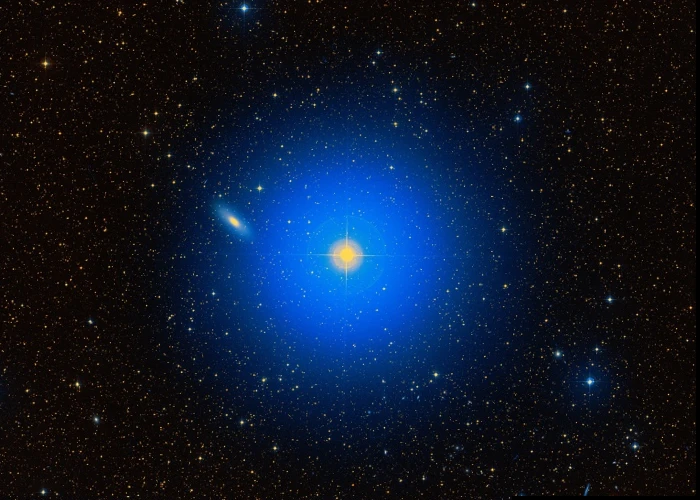
Kulou (Iota Centauri), image credit: ESO/Digitized Sky Survey 2 (CC BY 4.0)
Temperature and luminosity
Iota Centauri has a surface temperature of 9,160 ± 70 K and shines with 22.91 solar luminosities. It is classified as a main sequence star of the spectral type A2 V. The high effective temperature gives the star a white or bluish white glow.
Compared to other bright A-type main sequence stars, Kulou is less luminous than Sirius and Vega, but more luminous than Altair and Fomalhaut. It appears much fainter than the luminaries of Aquila and Piscis Austrinus because these stars lie in the Sun’s neighbourhood.
Mass and radius
Iota Centauri has a mass 2.03 times that of the Sun and a radius of 1.9 solar radii. It is smaller and less massive than Vega and Castor, and slightly larger but less massive than Sirius. It is more massive than both Altair and Fomalhaut.
Age and evolutionary stage
Iota Centauri has an estimated age of 350 – 413 million years. It is still on the main sequence, and its main source of energy is the nuclear fusion of hydrogen into helium in its core.
Even though it is much younger than the Sun, Kulou will evolve away from the main sequence faster because it is more massive. Like the Sun and Vega, it follows the evolutionary path of intermediate-mass stars.
Name
The name Kulou (库楼) comes from ancient Chinese astronomy. It means “arsenal.” It referred to an ancient super-constellation located in the area of the modern-day Centaurus and Lupus, dating back to the 2nd century BC.
The International Astronomical Union’s (IAU) Working Group on Star Names (WGSN) officially approved the name Kulou on February 17, 2025.
In traditional Chinese astronomy, Iota Centauri was known as 柱十一 (Zhǔ shíyī), the Eleventh Star of Pillars. It formed the Pillars asterism with Upsilon2 Centauri, Upsilon1 Centauri, Iota Lupi, Tau1 Lupi, V761 Centauri, Psi Centauri, 4 Centauri, 3 Centauri, 1 Centauri, and Pi Centauri. The asterism was part of the larger Horns mansion, which represented the horns of the Azure Dragon.
How to find Iota Centauri
Iota Centauri is one of the northernmost bright stars in Centaurus. It appears along the imaginary line drawn from Antares in Scorpius through Menkent in Centaurus.
Iota Centauri can be used to find the bright galaxy Centaurus A and the globular cluster Omega Centauri. Both appear south of the star. Centaurus A appears west of the triangle formed by Theta, Nu and Mu Centauri, and Omega Centauri lies west of Zeta Centauri.
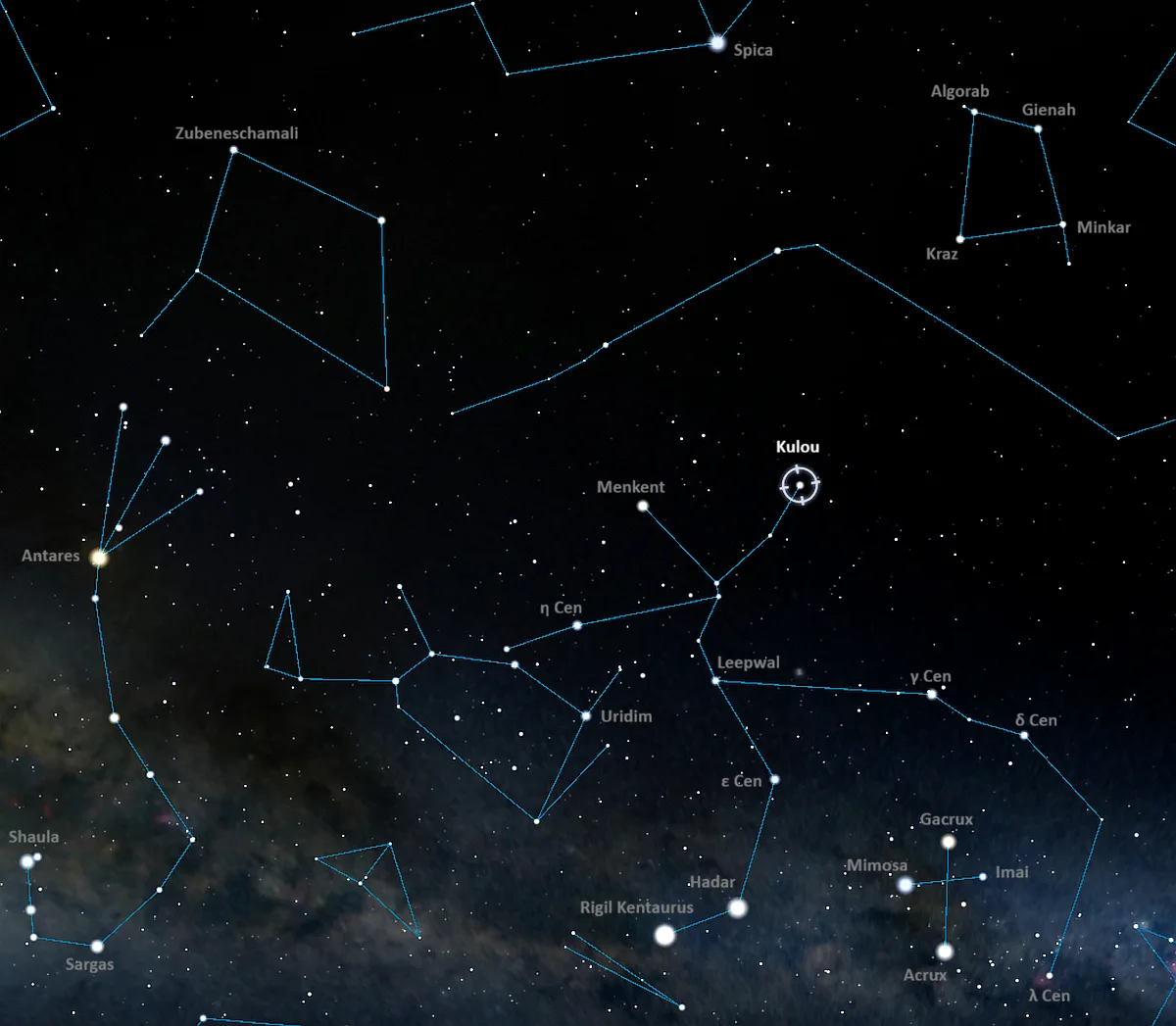
Location of Iota Centauri, image: Stellarium (annotated for this article)
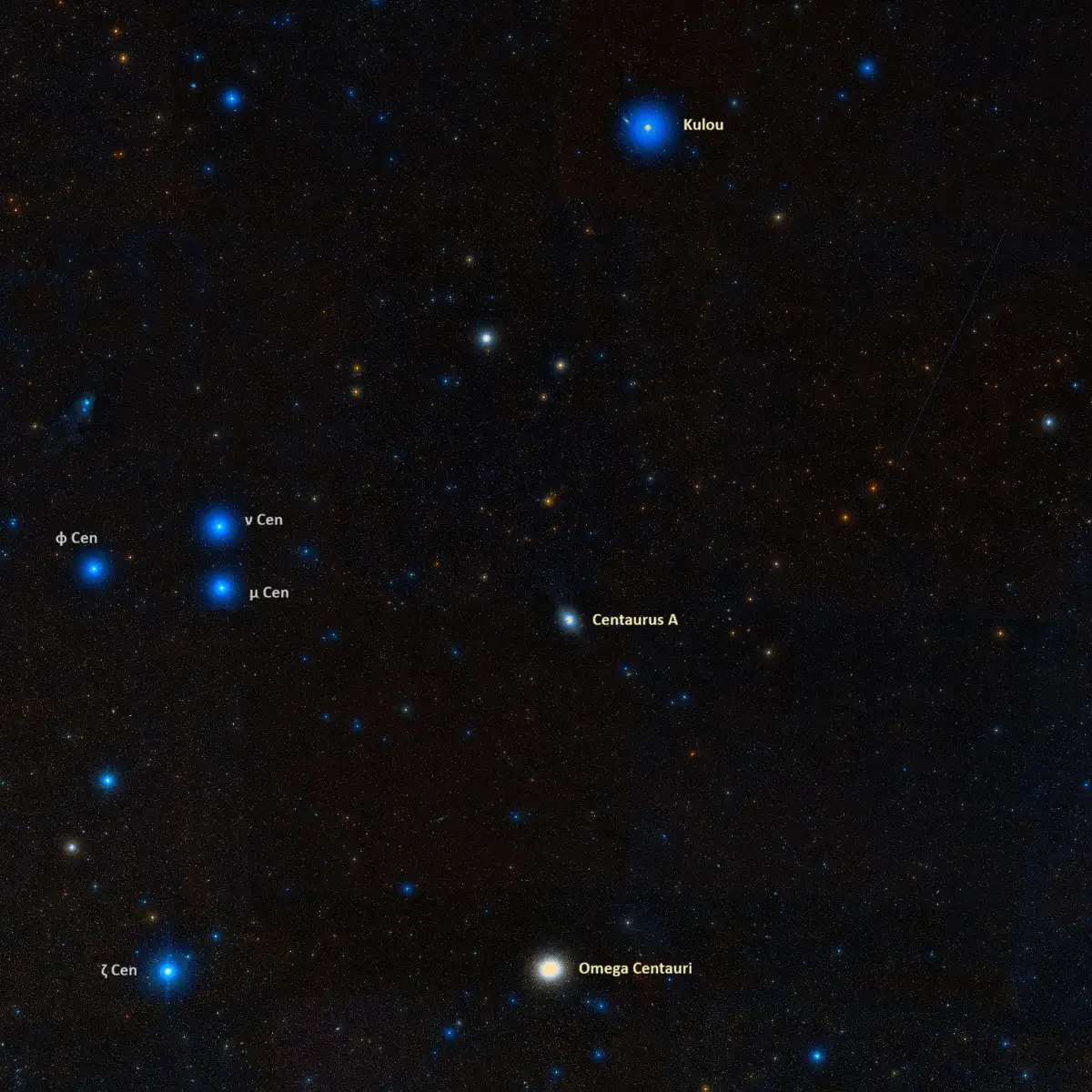
Kulou, Omega Centauri and Centaurus A, image credit: ESO/Digitized Sky Survey 2 (CC BY 4.0)
Iota’s Ghost: NGC 5102
Iota Centauri appears near the lenticular galaxy NGC 5102 in the sky. The magnitude 10.4 galaxy lies 12.7 million light years away and is a member of the Centaurus A/M83 Group of galaxies. It was discovered by the English astronomer John Herschel in 1835. Because of its proximity to the bright star, the galaxy is known as Iota’s Ghost.
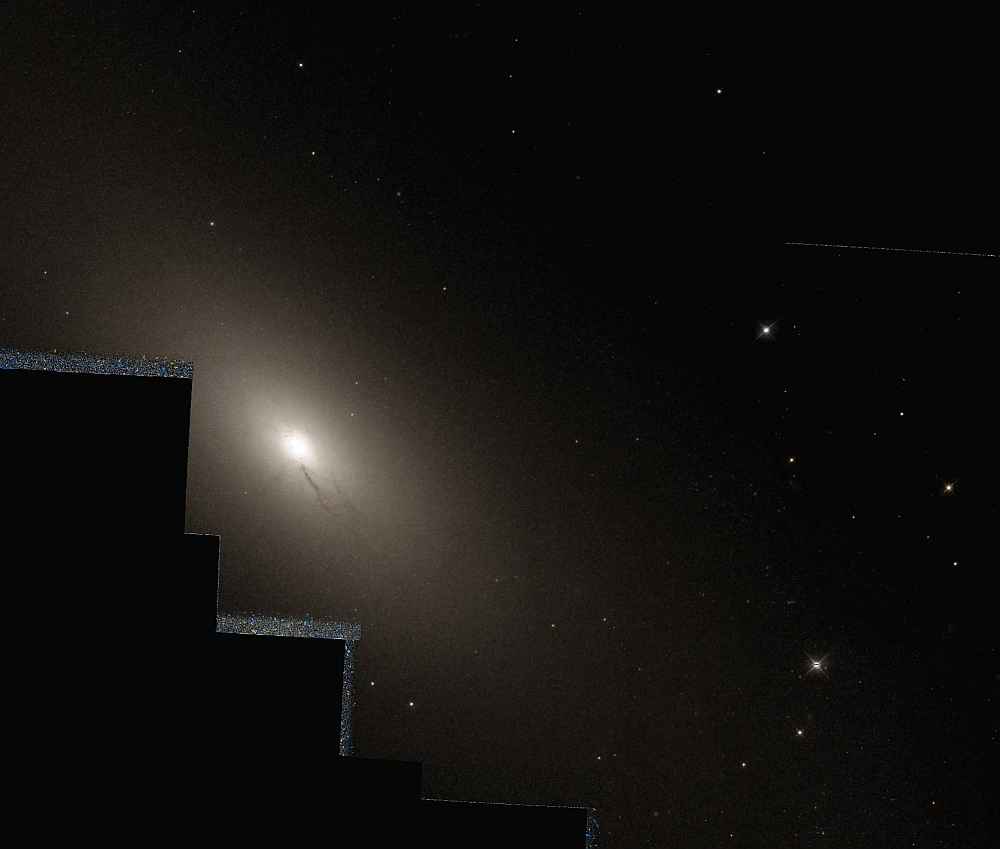
Iota’s Ghost (NGC 5102), based on observations made with the NASA/ESA Hubble Space Telescope, and obtained from the Hubble Legacy Archive, which is a collaboration between the Space Telescope Science Institute (STScI/NASA), the Space Telescope European Coordinating Facility (ST-ECF/ESA) and the Canadian Astronomy Data Centre (CADC/NRC/CSA) (CC BY-SA 3.0)
Where and when to observe
At declination -37°, Iota Centauri is best seen from the southern hemisphere. It never rises above the horizon for observers north of the latitude 52° N.
The best time of the year to observe the stars of Centaurus is during the month of May, when the constellation appears higher in the sky in the early evening.
Constellation
Kulou is located in the constellation Centaurus. The celestial Centaur is one of the brightest and largest constellations in the sky. Stretching across 1,060 square degrees of the southern sky, it is the ninth largest of the 88 constellations. It is one of the Greek constellations, catalogued by Ptolemy of Alexandria in in the 2nd century AD.
Centaurus hosts Alpha and Beta Centauri (Rigil Kentaurus and Hadar), the third and 11th brightest stars in the sky. Alpha Centauri is the nearest star system to the Sun and contains the faint M-type star Proxima Centauri, the closest individual star to Earth. Hadar is a hot blue giant in a triple star system located 361 light-years away. Alpha and Beta Centauri are known as the Southern Pointers because they point towards the Southern Cross, an asterism commonly used to find the southern celestial pole.
Other bright stars in Centaurus include the K-type giant Menkent (Theta Centauri), the evolved A-type binary star Gamma Centauri, the hot blue giants Epsilon Centauri and Lambda Centauri, the B-type subgiant Zeta Centauri (Leepwal), and blue main sequence stars Eta Centauri and Delta Centauri.
Centaurus also contains the white dwarf known as the Diamond Star or Lucy, the Mira variable R Centauri, the chemically peculiar Przybylski’s Star, and the variable hypergiant V766 Centauri, one of the largest stars discovered to date.
The constellation is home to many well-known deep sky objects. These include the bright globular cluster Omega Centauri, the open cluster NGC 3766 (the Pearl Cluster), the Running Chicken Nebula (IC 2944), the Blue Planetary Nebula (NGC 3918), the protoplanetary Boomerang Nebula, the radio galaxy Centaurus A, the barred spiral galaxy NGC 4945, and the Backward Galaxy (NGC 4622).
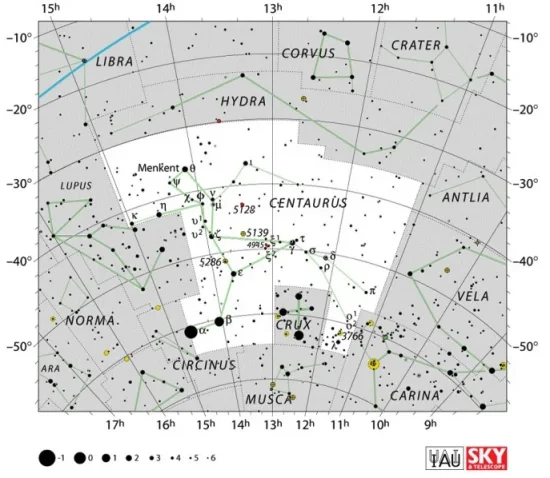
Centaurus constellation map by IAU and Sky&Telescope magazine (Roger Sinnott & Rick Fienberg) (CC BY 3.0)
Centaurus is best seen from the southern hemisphere. The entire constellation is visible from locations south of the latitude 25° S.
The 10 brightest stars in Centaurus are Alpha Centauri (mag. -0.27), Hadar (Beta Cen, mag. 0.61), Menkent (Theta Cen, mag. 2.06), Gamma Centauri (mag. 2.17), Epsilon Centauri (mag. 2.30), Eta Centauri (mag. 2.35), Leepwal (Zeta Cen, mag. 2.55), Delta Centauri (mag. 2.57), Kulou (Iota Cen, mag. 2.73), and Lambda Centauri (mag. 3.13).
Kulou – Iota Centauri
| Spectral class | A2 V |
| U-B colour index | +0.01 |
| B-V colour index | +0.03 |
| Apparent magnitude | 2.73 |
| Absolute magnitude | +1.47 |
| Distance | 58.8 ± 0.2 light-years (18.02 ± 0.06 parsecs) |
| Parallax | 56.0571 ± 1.1147 mas |
| Radial velocity | +0.10 ± 0.6 km/s |
| Proper motion | RA: -339.615 ± 1.588 mas/yr |
| Dec.: -82.181 ± 1.593 mas/yr | |
| Mass | 2.03 ± 0.03 M☉ |
| Luminosity | 22.91 L☉ (21.88 – 23.99 L☉) |
| Radius | 1.9 ± 0.05 R☉ |
| Temperature | 9,160 ± 70 K |
| Metallicity | -0.46 dex |
| Age | 350 – 413 million years |
| Rotational velocity | 90.3 km/s |
| Surface gravity | 4.11 cgs |
| Constellation | Centaurus |
| Right ascension | 13h 20m 35.8128156095s |
| Declination | −36° 42′ 44.296492410″ |
| Names and designations | Kulou, Iota Centauri, Iota Cen, ι Centauri, ι Cen, HD 115892, HR 5028, HIP 65109, SAO 204371, GJ 508.1, GJ 9441, FK5 496, LTT 5138, NLTT 33743, SRS 30496, PLX 3048.00, PPM 291265, CPC 18 6388, CPD-36 5880, CD-36 8497, JP11 2385, GC 18039, GCRV 7925, SKY# 24636, CNS5 3286, SACS 287, PMC 90-93 352, ROT 1956, WEB 11498, GEN# +1.00115892, IRAS 13177-3626, 2MASS J13203582-3642443, UBV 12043, UBV M 19277, uvby98 100115892, N30 3057, TIC 30753143, TYC 7275-2074-1, Gaia DR2 6165699748415726848, Gaia DR3 6165699748417797504 |