Beta Trianguli (β Tri) is a binary star system located approximately 141 light-years away in the constellation Triangulum. It is formally named Alaybasan. With a combined apparent magnitude of 3.00, it is the brightest point of light in Triangulum. It forms a prominent elongated triangle with the fainter Mothallah (Alpha Trianguli) and Apdu (Gamma Trianguli).
Star system
Beta Trianguli is a double star composed of two white giants of the spectral types A8III and A3III. The two components have an orbital period of 31.3884 days and orbit each other at a distance of 0.330 astronomical units (AU), or 33% of the average distance from the Earth to the Sun. Individually, the two stars have apparent magnitudes of 3.44 and 4.19.
Beta Trianguli A and Beta Trianguli B form a close double-lined spectroscopic binary system. The two components cannot be resolved in telescopes but spectral lines from both stars are visible in the system’s spectrum. The star system emits an infrared excess, which indicates the presence of a circumbinary dust ring. The ring is believed to stretch from 50 to 400 AU from the stars.
Beta Trianguli A (formally known as Alaybasan) is the larger and more massive of the two components. It has 3.52 times the Sun’s mass and a radius 4.38 times that of the Sun. With a surface temperature of 7,683 K, it is around 60.3 times more luminous than the Sun. The evolved star spins with a projected rotational velocity of 70 km/s. It has an estimated age of 400 million years.
Beta Trianguli B has a mass of around 1.37 solar masses and a radius of 2.44 solar radii. It has an effective temperature of 8,759 K and shines with 31.6 solar luminosities. It is believed to be 450 million years old.
Shining at magnitude 3.0, Beta Trianguli is the brightest star in Triangulum and, on average, the 172nd brightest star in the sky. It is only slightly fainter than Alnasl (Gamma2 Sagittarii) in the constellation Sagittarius and Gamma Hydrae in Hydra. It is about as bright as Iota1 Scorpii in Scorpius, Okab (Zeta Aquilae) in Aquila, and Psi Ursae Majoris in Ursa Major. It just outshines Pherkad (Gamma Ursae Minoris) in Ursa Minor, Xamidimura (Mu1 Scorpii) in Scorpius, Aldhanab (Gamma Gruis) in Grus, and Sarvvis (Delta Persei) in Perseus.
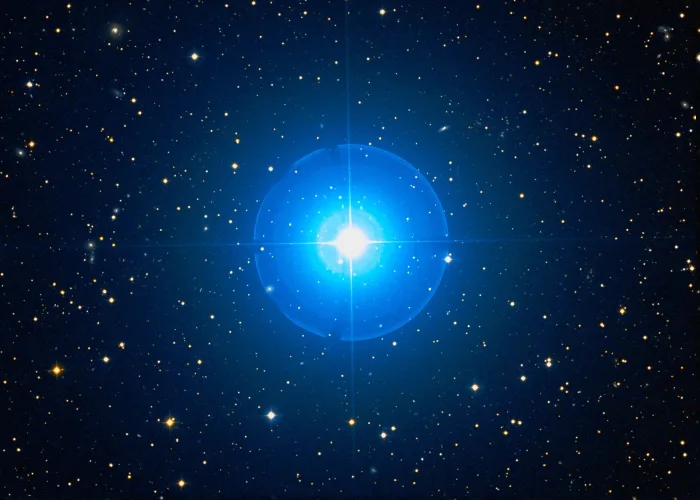
Alaybasan (Beta Trianguli), image credit: ESO/Digitized Sky Survey 2 (CC BY 4.0)
Name
The name Alaybasan comes from the Arabic Al-Aybasān, meaning “the Two Joints (of bones).” It refers to the two joints of Aries. In old Arabic astronomy, Beta Trianguli formed the Al-Aybasān asterism with Mothallah (Alpha Trianguli). The name was sometimes written as Al-Anīsān (the Two Friends”). The two stars were also known as Al Mīzān, meaning “the scale beam.”
The International Astronomical Union’s (IAU) Working Group on Star Names (WGSN) approved the name Alaybasan on November 7, 2025. The name formally applies only to the primary component in the system, Beta Trianguli A.
In traditional Chinese astronomy, Beta Trianguli was known as 天大將軍九 (Tiān Dà Jiāng Jūn jiǔ), the Ninth Star of Heaven’s Great General. It formed the Heaven’s Great General asterism with Almach (Gamma Andromedae), Dajiangjunbei (Phi Persei), Nembus (51 Andromedae), 49 Andromedae, Chi Andromedae, Titawin (Upsilon Andromedae), Tau Andromedae, 56 Andromedae, Apdu (Gamma Trianguli), and Deltoton (Delta Trianguli). The asterism was part of the larger Bond mansion, which represented the body of the White Tiger.
Location
Beta Trianguli appears close to the imaginary line connecting the brighter Almach in the constellation Andromeda and Hamal in Aries. The star forms the base of the triangle that gives Triangulum its name with the fainter Apdu (Gamma Trianguli), while Mothallah (Alpha Trianguli) forms the apex. The triangle asterism is easily spotted between Andromeda and Aries on a clear, dark night from areas without too much light pollution.
At declination +35°, Alaybasan can be seen from locations north of the latitude 55° S.
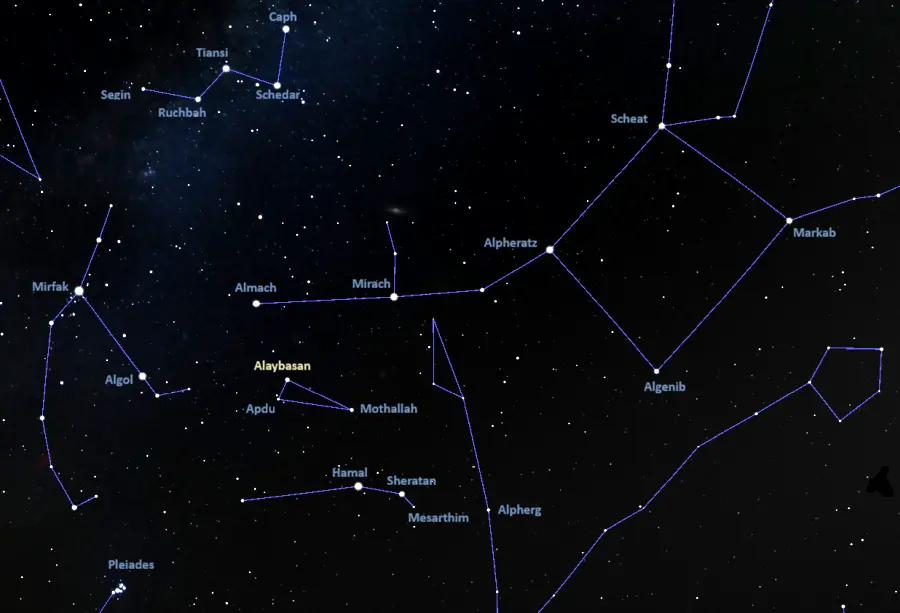
Beta Trianguli location, image: Stellarium
Constellation
Beta Triangulum is located in the northern constellation of Triangulum. Like other ancient constellations, Triangulum was catalogued by Claudius Ptolemy of Alexandria in his Almagest in the 2nd century BC. It is the third smallest northern constellation, after Equuleus and Sagitta. Occupying an area of 132 square degrees, it is the 78th constellation in size out of 88.
In ancient Greece, Triangulum was called Deltoton (Δελτωτόν). Its constellation figure – an elongated triangle – looks like the Greek letter delta. In 2025, the IAU commemorated the constellation’s ancient name by formally naming Delta Trianguli Deltoton.
Triangulum does not contain any exceptionally bright stars. Alaybasan and Mothallah (Alpha Trianguli) are the only stars in the constellation brighter than magnitude 3.0.
Other notable stars in Triangulum include the fast-spinning A-type star Apdu (Gamma Trianguli), the spectroscopic binary star Delta Trianguli, the white giant 12 Trianguli, the multiple star system Iota Trianguli (Triminus), and the red giants R Trianguli and 15 Trianguli.
Triangulum hosts the famous Triangulum Galaxy (NGC 598, M33), a bright spiral galaxy in the Local Group. Other deep sky objects in the constellation include the Amatha Galaxy (NGC 925), the spiral galaxies NGC 784 and NGC 672, the quasar 3C 48, the elliptical galaxies NGC 785 and NGC 860, and the bright open star cluster Caldwell 95.
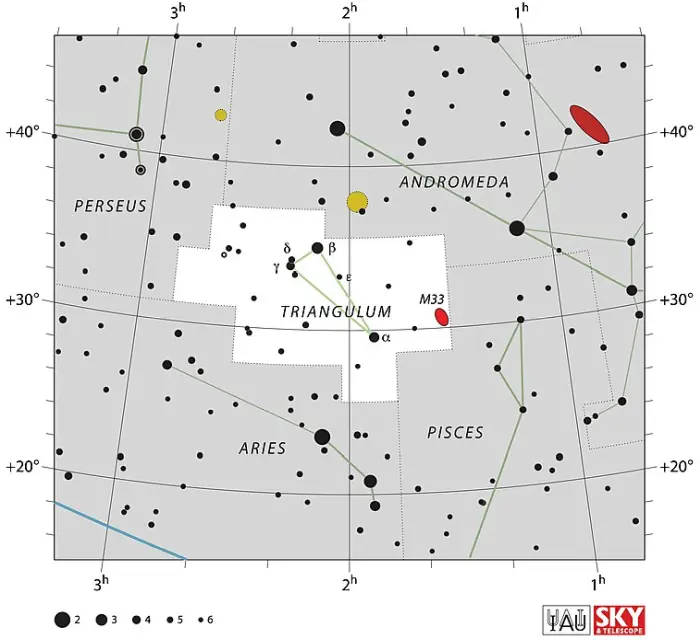
Triangulum constellation map by IAU and Sky&Telescope magazine (Roger Sinnott & Rick Fienberg) (CC BY 3.0)
The best time of the year to see the stars and deep sky objects in Triangulum is during the month of December, when the constellation climbs higher in the sky in the early evening. The entire constellation is visible from locations north of the latitude 60° S.
The 10 brightest stars in Triangulum are Alaybasan (Beta Tri, mag. 3.0), Mothallah (Alpha Tri, mag. 3.42), Apdu (Gamma Tri, mag. 4.01), Deltoton (Delta Tri, mag. 4.865), Triminus (Iota Tri, mag. 4.95), 14 Trianguli (mag. 5.14), 7 Trianguli (mag. 5.25), 10 Trianguli (mag. 5.29), 12 Trianguli (mag. 5.37), and 15 Trianguli (mag. 5.396).
Alaybasan – Beta Trianguli
| Spectral class | A8III / A3III |
| U-B colour index | +0.11 |
| B-V colour index | +0.21 / 0.07 |
| Apparent magnitude | 3.00 (3.44 + 4.19) |
| Absolute magnitude | −0.136 (0.305 + 0.1055) |
| Distance | 141 ± 3 light-years (43.2 ± 0.8 parsecs) |
| Parallax | 23.169 ± 0.434 mas |
| Radial velocity | 12.30 ± 0.66 km/s |
| Proper motion | RA: +149.16 ± 0.35 mas/yr |
| Dec.: –39.10 ± 0.35 mas/yr | |
| Constellation | Triangulum |
| Right ascension | 02h 09m 32.62712s |
| Declination | +34° 59′ 14.2694″ |
| Names and designations | Alaybasan, Beta Trianguli, Beta Tri, β Trianguli, β Tri, 4 Trianguli, 4 Tri, HD 13161, HR 622, HIP 10064, SAO 55306, FK5 75, BD+34°381, AG+34 207, CEL 212, GC 2572, GCRV 1171, SKY# 3166, PLX 439.00, PPM 67012, JP11 596, ASCC 555210, GEN# +1.00013161, SRS 30075, LSPM J0209+3459, IRC +30034, N30 439, ROT 299, SBC7 77, SBC9 111, PMC 90-93 53, TD1 1243, UBV 2162, UBV M 8719, uvby98 100013161, IRAS 02065+3445, IRAS F02065+3445, 2MASS J02093261+3459143, TIC 63584475, USNO-B1.0 1249-00029921, WEB 2110, TYC 2317-1647-1, Gaia DR3 329384516560293248 |
Beta Trianguli A
| Mass | 3.52 ± 0.27 M☉ |
| Luminosity | 60.3 L☉ (47.9 – 75.9 L☉) |
| Radius | 4.38 R☉ |
| Temperature | 7,683 K |
| Age | 0.40 billion years (0.25 – 0.63 Gyr) |
| Rotational velocity | 70 km/s |
| Surface gravity | 3.70 cgs |
Beta Trianguli B
| Mass | 1.37 ± 0.09 M☉ |
| Luminosity | 31.6 L☉ (28.2 – 35.5 L☉) |
| Radius | 2.44 R☉ |
| Temperature | 8,759 K |
| Age | 0.45 billion years (0.36 – 0.57 Gyr) |