119 Tauri (119 Tau) is a red supergiant located approximately 1,800 light-years away in the constellation Taurus. It has been nicknamed Ruby Star because of its striking red colour. It has the variable star designation CE Tauri.
With an apparent magnitude that varies between 4.23 and 4.54, the supergiant star is visible to the unaided eye. It appears near Zeta Tauri, the star that marks the Bull’s southern horn, and the famous supernova remnant Messier 1 (the Crab Nebula).
Star type
119 Tauri has the spectral type M2Iab-Ib, indicating a star between an intermediate-luminosity red supergiant and a less luminous supergiant. The star has a mass 14.37 times that of the Sun and is a supernova candidate. It has a radius of 587 to 593 solar radii and a surface temperature of 3,801 to 3,820 K.
The Ruby Star is 66,000 times more luminous than the Sun. Even though it is still a very young star, with an estimated age of only 13.9 million years, it has evolved quickly because of its high mass. It has only millions of years left before it goes out as a brilliant supernova.
119 Tauri is a very similar star to the supergiant Betelgeuse (Alpha Orionis) in the constellation Orion. However, it is over three times more distant than Betelgeuse and appears considerably fainter. Its light is dimmed by 0.8 magnitudes by intervening dust. Even though it appears very red, the supergiant is not a carbon star.
Like Betelgeuse, the Ruby Star is classified as a semiregular variable (type SRc). Its brightness varies from magnitude 4.23 to 4.54 with a period of 165 days.
Semiregular variables are cool giant and supergiant stars whose brightness varies due to pulsations. These are unstable stars in the late stages of their evolutionary cycles. Other examples of type SRc variables include Garnet Star (Mu Cephei) in the constellation Cepheus, T Ceti in Cetus, Rasalgethi (Alpha Herculis) in Hercules, VX Sagittarii in Sagittarius, and RW Cygni in Cygnus.
Even though Ruby Star is classified as a pulsating variable star, significant changes in its angular diameter over time have not been detected. Astronomers measured the star’s angular diameter during lunar occultations and using very-long-baseline interferometry (VLBI).
In 1982, researchers found an angular diameter of 9.0 ± 0.2 milliarcseconds (mas) for the supergiant in visible light and 17 ± 1 mas in H-alpha during a lunar occultation. The H-alpha measurement indicates the presence of a circumstellar hydrogen emission region that spans almost twice the star’s visible diameter.
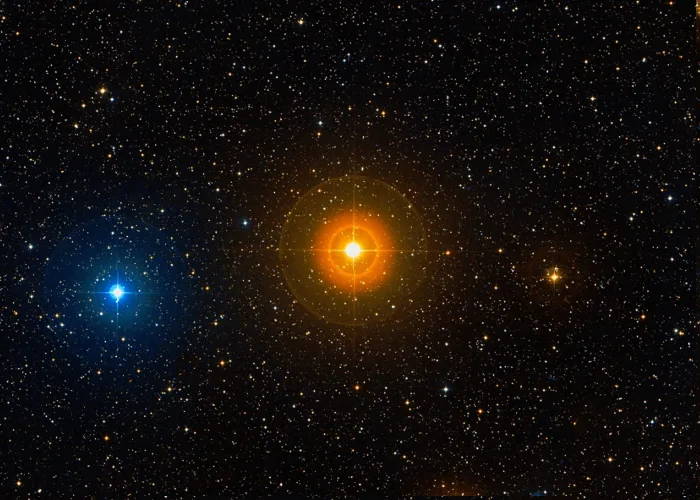
Ruby Star (119 Tauri), image credit: ESO/Digitized Sky Survey 2 (CC BY 4.0)
Name
119 Tauri does not have a proper name formally approved by the International Astronomical Union (IAU). It is popularly known as the Ruby Star because of its distinctly red colour. It was given this nickname by the astronomer Abdul Ahad in an article published in 2004. Ahad had previously ranked 119 Tauri as the second reddest of all stars visible to the unaided eye, after Mu Cephei (Garnet Star), in his Red Star Catalogue, compiled in the 1980s.
Ruby Star is commonly referred to by its Flamsteed designation 119 Tauri and its variable star designation CE Tauri. It is listed as HD 36389 in the Henry Draper Catalogue (HD), HR 1845 in the Yale Bright Star Catalogue, and HIP 25945 in the Hipparcos catalogue.
119 Tauri shares the nickname Ruby Star with the carbon star RT Capricorni in the constellation Capricornus. RT Capricorni is sometimes known as Herschel’s Ruby Star because it was named by the British astronomer John Herschel, who spotted it in February 1830 and described it as “perhaps the finest of my ‘ruby stars.’”
Location
119 Tauri lies in the eastern part of Taurus, near the border with Orion. It appears near Tianguan (Zeta Tauri), the star that marks the Bull’s southern horn. The famous Crab Nebula (M1) lies in the same region of the sky, about a degree northwest of Zeta Tauri.
Like Elnath (Beta Tauri) at the Bull’s northern horn, Zeta Tauri can be found by following the line of the V-shaped Hyades cluster. It lies about a third of the way from Elnath to Betelgeuse in Orion.
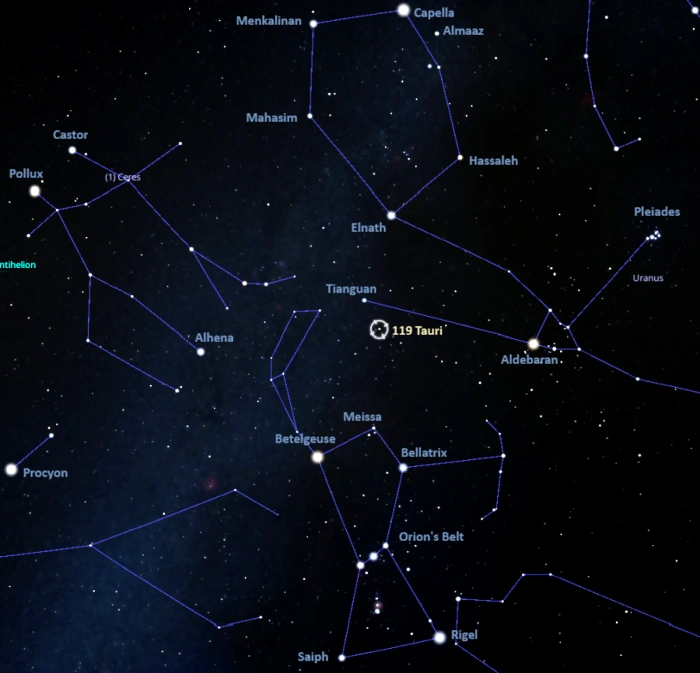
Ruby Star location, image: Stellarium
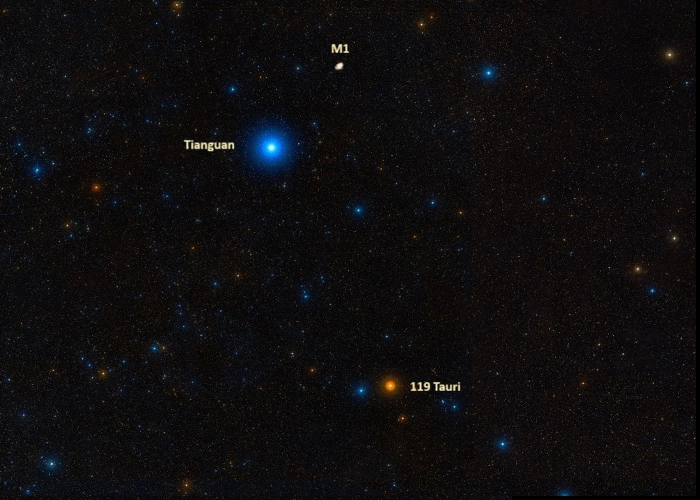
119 Tauri, Zeta Tauri and Messier 1, image credit: ESO/Digitized Sky Survey 2 (CC BY 4.0)
Constellation
The Ruby Star is located in the zodiac constellation of Taurus. The celestial Bull is one of the 48 Greek constellations catalogued by the Greco-Roman astronomer Claudius Ptolemy of Alexandria in his Almagest in the 2nd century BC. It is one of the oldest and best-known constellations in the night sky. In Greek mythology, it is associated with the tale of Zeus assuming the form of a white bull while pursuing Europa.
Taurus is the 17th largest constellation in the sky. It stretches across 797 square degrees of the predominantly northern sky. It is one of the 15 equatorial constellations, visible from virtually anywhere for at least part of the year.
Taurus is best-known for hosting Aldebaran (Alpha Tauri), the 14th brightest star in the sky, and two exceptionally bright nearby open clusters: the Pleiades and the Hyades. The two large star clusters form an asterism known as the Golden Gate of the Ecliptic. Both are easily visible to the unaided eye, even from light-polluted areas.
Aldebaran, the constellation’s brightest star, is a K-type giant star with an apparent magnitude that varies between magnitude 0.75 and 0.95. It appears in the same line of sight as the Hyades cluster even though it is not a member.
Other bright stars in Taurus include the luminous blue giants Elnath (Beta Tauri) and Tianguan (Zeta Tauri), the hot blue main sequence star Lambda Tauri, and the massive blue Pleiades members Alcyone (Eta Tauri), Atlas (27 Tauri) and Electra (17 Tauri). The brightest Hyades stars include Chamukuy (Theta Tauri), Ain (Epsilon Tauri), Prima Hyadum (Gamma Tauri) and Secunda Hyadum (Delta Tauri).
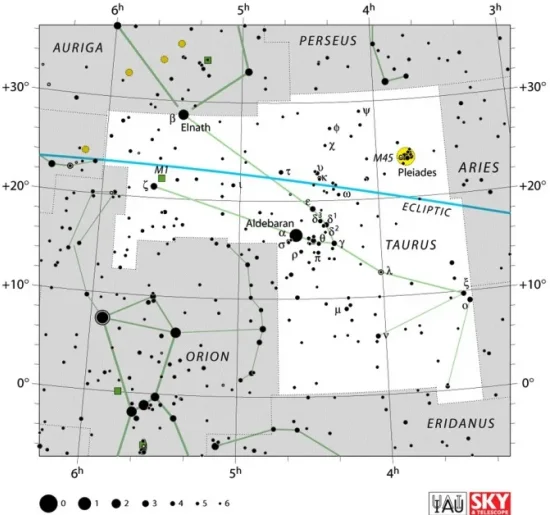
Taurus constellation map by IAU and Sky&Telescope magazine (Roger Sinnott & Rick Fienberg) (CC BY 3.0)
The constellation also hosts the variable stars T Tauri and RV Tauri, the quadruple star system Xi Tauri, and the yellow dwarf HD 37124 with three orbiting planets.
Other than the Pleiades and the Hyades, deep sky objects in Taurus include the bright supernova remnant known as the Crab Nebula (Messier 1), the planetary nebula NGC 1514 (the Crystal Ball Nebula), the reflection nebulae LBN 777 (the Baby Eagle Nebula) and NGC 1555 (Hind’s Variable Nebula), the supernova remnant Sharpless 2-240 (the Spaghetti Nebula), and the colliding galaxies NGC 1409 and NGC 1410.
The best time of the year to observe the stars and deep sky objects in Taurus is during the month of January, when the constellation rises higher above the horizon in the early evening. The entire constellation can be seen from locations north of the latitude 60° S.
The 10 brightest stars in Taurus are Aldebaran (Alpha Tau, mag. 0.86), Elnath (Beta Tau, mag. 1.65), Alcyone (Eta Tau, mag. 2.87), Tianguan (Zeta Tau, mag. 2.97), Chamukuy (Theta2 Tauri, mag. 3.40), Lambda Tauri (mag. 3.47), Ain (Epsilon Tau, mag. 3.53), Omicron Tauri (mag. 3.61), Atlas (27 Tau, mag. 3.63), and Prima Hyadum (Gamma Tau, mag. 3.654).
CE Tauri – 119 Tauri
| Spectral class | M2Iab-Ib |
| Variable type | Semiregular variable (SRc) |
| U-B colour index | +2.23 |
| B-V colour index | +2.08 |
| Apparent magnitude | 4.23 – 4.54 |
| Absolute magnitude | -5.20 |
| Distance | 1,800 light-years (550 parsecs) |
| Parallax | 1.5207 ± 0.2661 mas |
| Radial velocity | +23.75 ± 0.44 km/s |
| Proper motion | RA: + 0.957 ± 0.286 mas/yr |
| Dec.: -4.511 ± 0.170 mas/yr | |
| Mass | 14.37 M☉ (11.6 – 16.37 M☉) |
| Luminosity | 66,000 L☉ |
| Radius | 587 – 593 R☉ |
| Temperature | 3,801 – 3,820 K |
| Metallicity | 0.0 |
| Age | 13.9 million years (11.4 – 14.9 Myr) |
| Surface gravity | +0.05 cgs (-0.12 – 0.16 cgs) |
| Constellation | Taurus |
| Right ascension | 05h 32m 12.7516308641s |
| Declination | +18° 35′ 39.251766506″ |
| Names and designations | Ruby Star, 119 Tauri, 119 Tau, CE Tauri, CE Tau, HD 36389, HR 1845, HIP 25945, SAO 94628, BD+18°875, AG+18 459, PLX 1253.00, PPM 121070, GC 6841, GCRV 3354, JP11 1123, SKY# 8886, GEN# +1.00036389, GSC 01301-00707, YZ 18 1563, AAVSO 0526+18, DO 11336, IRC +20112, PMC 90-93 5888, RAFGL 767, TIC 367174762, TYC 1301-707-1, IRAS 05292+1833, 2MASS J05321276+1835394, UBV 21346, WEB 5046, Gaia DR2 3400796031718128256, Gaia DR3 3400796031719045632 |