Zeta Persei (ζ Per) is a massive blue supergiant and a supernova candidate located in the constellation Perseus. With an apparent magnitude of 2.86, it is the constellation’s third brightest star, after Mirfak and Algol.
The luminous star is the brightest member of the Perseus OB2 association, a family of hot, young stars that is also called the Zeta Persei association after its brightest member.
What type of star is Zeta Persei?
Zeta Persei is a blue supergiant of the spectral type B1 Ib. It serves as a spectral standard for its class. The class Ib indicates a lower luminosity supergiant.
The star has a mass of around 14.5 solar masses and a radius 26-27 times that of the Sun. Its surface burns at 20,800 K, giving it the bluish-white glow of a B-type star. The supergiant spins at 40 km/s and shines with a luminosity of 47,039 Suns.
Zeta Persei is a very young star. With an estimated age of only 12.6 million years, it has barely begun its life by Sun-like standards, but it is already racing toward the end. It has evolved away from the main sequence within only a few million years and is destined to go out as a luminous supernova in the relatively near future.
The star’s exact distance is uncertain. The parallax obtained in the Gaia Data Release 3 (GDR3) places the star 846 light-years (259 parsecs) away, while earlier measurements of its Ca II lines suggest a much greater distance of 1,300 light-years (400 pc).
The supergiant has a companion at a separation of 12.9 arcseconds. The 9th magnitude companion is physically separated from Zeta Persei by at least 4,000 astronomical units. The two stars share a common motion through space.
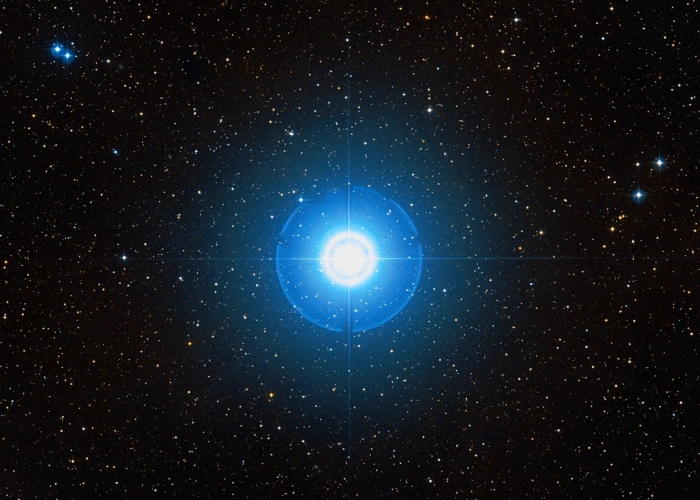
Zeta Persei, image credit: ESO/Digitized Sky Survey 2 (CC BY 4.0)
How bright is Zeta Persei?
Zeta Persei has an apparent visual magnitude of 2.86 and is visible even from big cities in clear skies. It is, on average, the 140th brightest star in the night sky.
It is slightly fainter than Kaus Borealis in Sagittarius, Algenib in Pegasus, Tureis in Puppis, and Beta Trianguli Australis in Triangulum Australe. It is about as bright as Beta Arae in Ara and Deneb Algedi in Capricornus, and just outshines Alpha Arae in Ara, Alcyone in the Pleiades cluster in Taurus, and Vindemiatrix in Virgo.
A member of the Perseus OB2 association
Zeta Persei is the most prominent member of the Perseus OB association (Per OB2). The young stellar family is also known as the Zeta Persei association. The members of the moving group are young, massive, luminous O- and B-type stars that formed in the same molecular cloud at around the same time. They share a common motion through space.
The Perseus OB2 region is home to many bright and dark nebulae that comprise the Perseus OB2 molecular cloud. Two of these regions, the Embryo Nebula (NGC 1333) and the Omicron Persei Cluster (IC 348), contain young B-type stars and several hundred pre-main sequence stars.
The Perseus molecular cloud is almost invisible at optical wavelengths, except for the clusters associated with NGC 1333 and IC 348, but its dust glows in the mid and far-infrared.
Where does Zeta Persei lie in Perseus?
In the constellation figure of Perseus, Zeta Persei appears in the mythical hero’s foot along with the fainter Atik (Omicron Persei). The brighter Mirfak (Alpha Persei) is part of Perseus’ torso and Algol (Beta Persei) forms the head of Medusa with Rho, Pi, and Omega Persei.
Some sources (e.g. Stellarium) place Zeta Persei as the southernmost star in the Segment of Perseus, an asterism that makes Perseus easily recognizable. The asterism consists of a line of stars that curves from Miram (Eta Persei) in Perseus’ head to Zeta Persei in the foot.
Even though it is the most visible part of Perseus, there is no single view as to which stars form the Segment. Most observers agree that it is formed by Miram (Eta Persei), Gamma Persei, Mirfak (Alpha Persei) and the surrounding Alpha Persei Cluster, Sigma, Psi, and Delta Persei. Some include the bright Double Cluster as the northernmost point of light in the Segment.
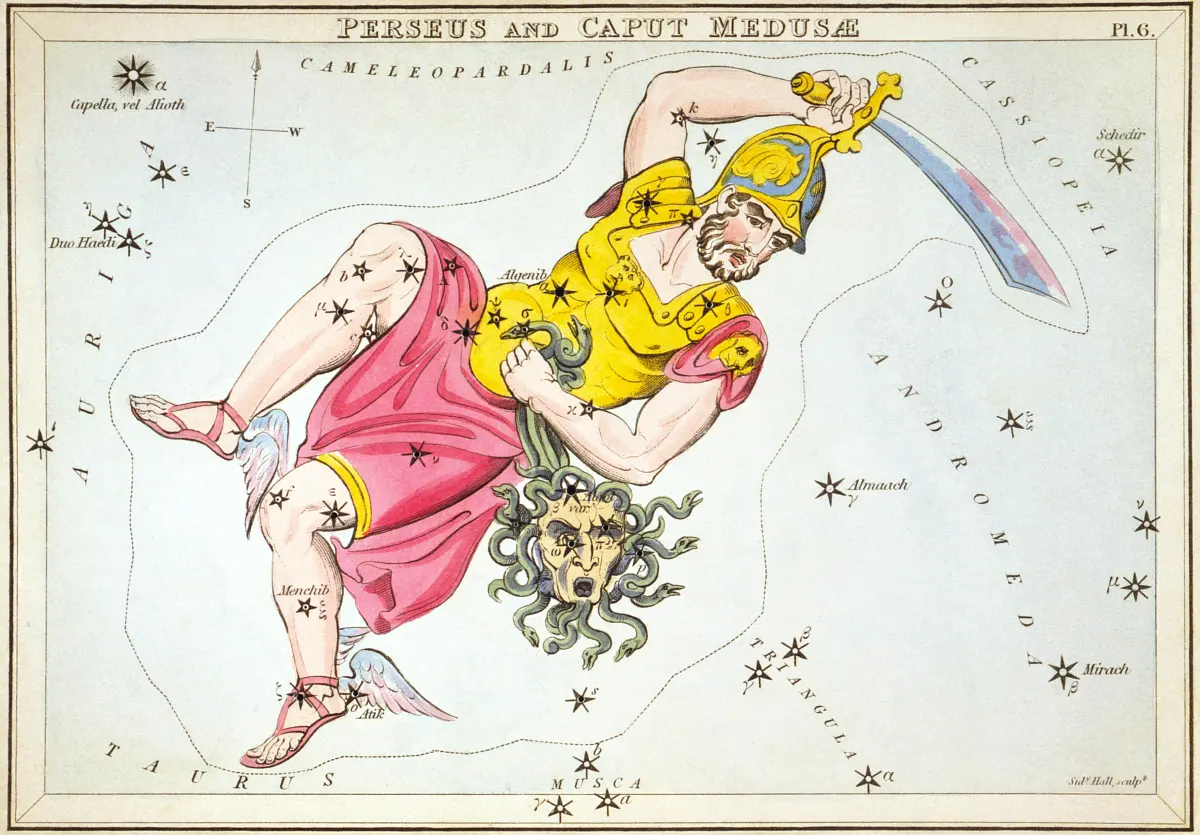
Perseus and Caput Medusæ, plate 6 in Urania’s Mirror, a set of celestial cards accompanied by A familiar treatise on astronomy… by Jehoshaphat Aspin, 1825
Does Zeta Persei have a proper name?
Zeta Persei shared the traditional name Atik with Omicron Persei. The name is derived from the Arabic ‘atiq al-Thurayya, meaning “the collarbone of the Pleiades.” The International Astronomical Union (IAU) formally approved the name for Omicron Persei in 2016. As of 2026, Zeta Persei still does not have a proper name adopted by the IAU.
In traditional Chinese astronomy, the supergiant is known as the Fourth Star of Rolled Tongue. It forms the Rolled Tongue (捲舌, Juǎn Shé) asterism with Nu Persei, Áldu (Epsilon Persei), Menkib (Xi Persei), Atik (Omicron Persei), and ο Persei. The asterism is part of the larger Hairy Head mansion, which represents the body of the White Tiger.
How to find Zeta Persei in the night sky
Zeta Persei lies in the southernmost part of Perseus, close to the border with Taurus. It appears in the same region of the sky as the bright Pleiades.
The star can be found by drawing a line from Aldebaran through Ain, the two stars marking the Bull’s eyes, towards north. It is the brightest point of light roughly a third of the way from Hassaleh in Auriga’s Hexagon to Hamal in Aries.
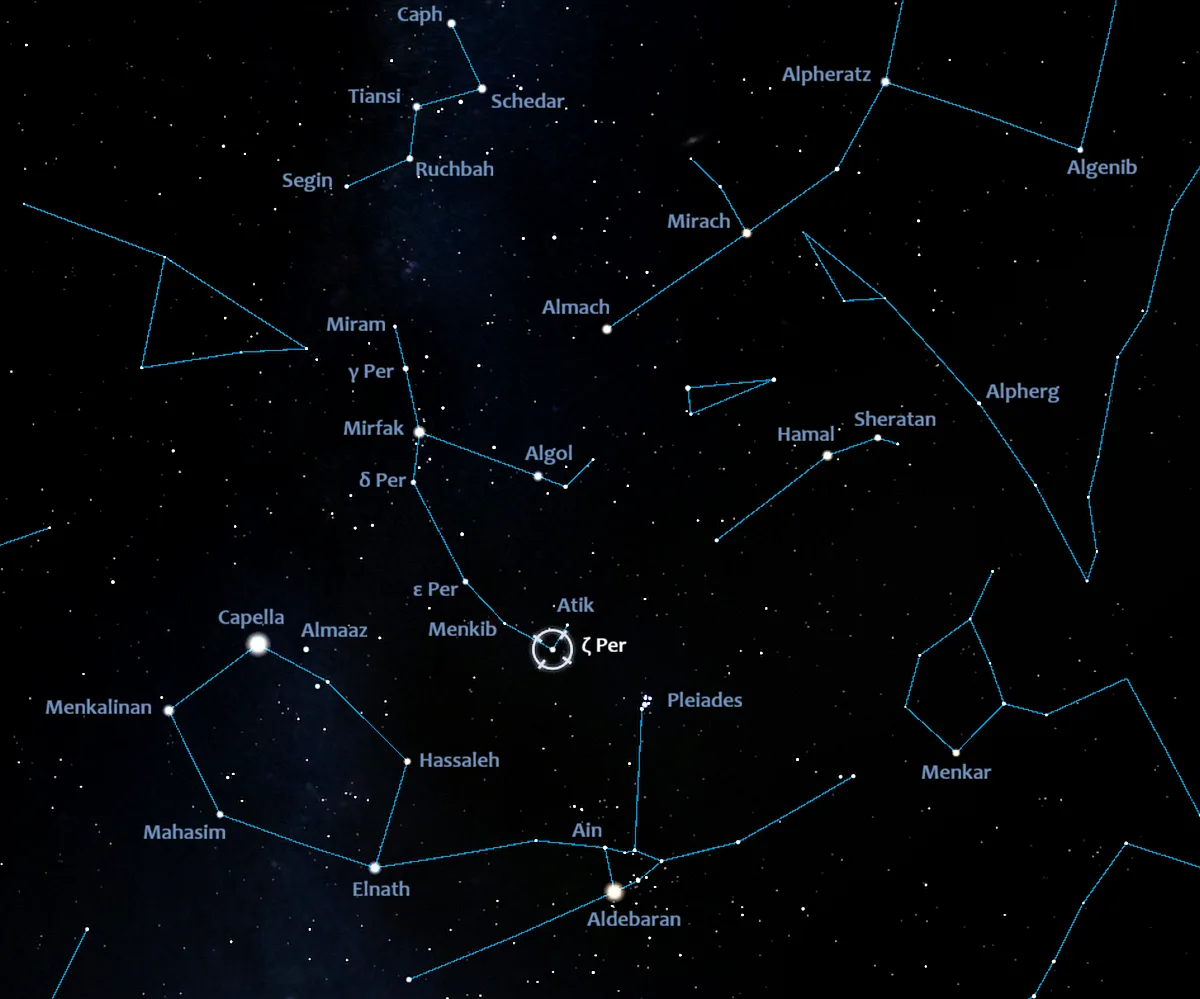
Zeta Persei location, image: Stellarium (annotated for this article)
Best time of year to spot it
Zeta Persei and other stars in Perseus are best seen during the northern hemisphere autumn and early winter, when they appear higher above the horizon in the early evening.
Is Zeta Persei visible from the southern hemisphere?
Zeta Persei is the southernmost bright star in Perseus and is visible from any inhabited location for at least part of the year. At declination +32°, it never rises for locations south of the latitude 58° S (the Antarctic Circle).
Perseus: Zeta Persei’s home constellation
Zeta Persei lies in the constellation of Perseus. Representing the legendary Greek hero, Perseus is usually depicted holding a sword in one hand and the head of the Gorgon Medusa in the other. It is located in the same area as several other Greek constellations linked with the myth of Perseus, including Andromeda, Cassiopeia, Cepheus, and Pegasus. These constellations were catalogued by the Greek astronomer Claudius Ptolemy in his Almagest in the 2nd century CE.
Perseus stretches across 615 square degrees of the northern sky and is the 24th largest of the 88 constellations. Best known for hosting the radiant of the Perseid meteor shower, Perseus is easy to spot in the region between the familiar W of Cassiopeia and Auriga’s Hexagon. It rises just before the bright Pleiades.
Mirfak (Alpha Persei), the brightest star in Perseus, is a yellow-white supergiant that shines at magnitude 1.82 from a distance of around 510 light-years. Algol (Beta Persei), the constellation’s second brightest star is a multiple star system that serves as the prototype for a class of eclipsing binary stars known as Algol variables.
Other bright stars in Perseus include the hot blue giants Áldu (Epsilon Persei) and Sarvvis (Delta Persei), the Algol variable Gamma Persei, the red bright giant Rho Persei, the red supergiant Miram (Eta Persei), the yellow-white bright giant Nu Persei, the yellow giant Misam (Kappa Persei), the massive blue star system Omicron Persei (Atik), and the luminous O-type blue giant Menkib (Xi Persei).
Perseus is known for its many star clusters and nebulae. Deep sky objects in the constellation include the bright open clusters Messier 34, the Alpha Persei Cluster, and the Double Cluster (NGC 869 and NGC 884), all visible to the unaided eye in clear, dark skies, the Stingray Cluster (NGC 1342), the bright planetary nebula Messier 76 (the Little Dumbbell Nebula), the large emission nebula NGC 1499 (the California Nebula), the Northern Trifid Nebula (NGC 1579), and the Embryo Nebula (NGC 1333). The constellation also hosts the enormous spiral galaxy known as the Godzilla Galaxy (UGC 2885) and the radio galaxy Perseus A (NGC 1275), which lies at the centre of the Perseus Cluster of galaxies.
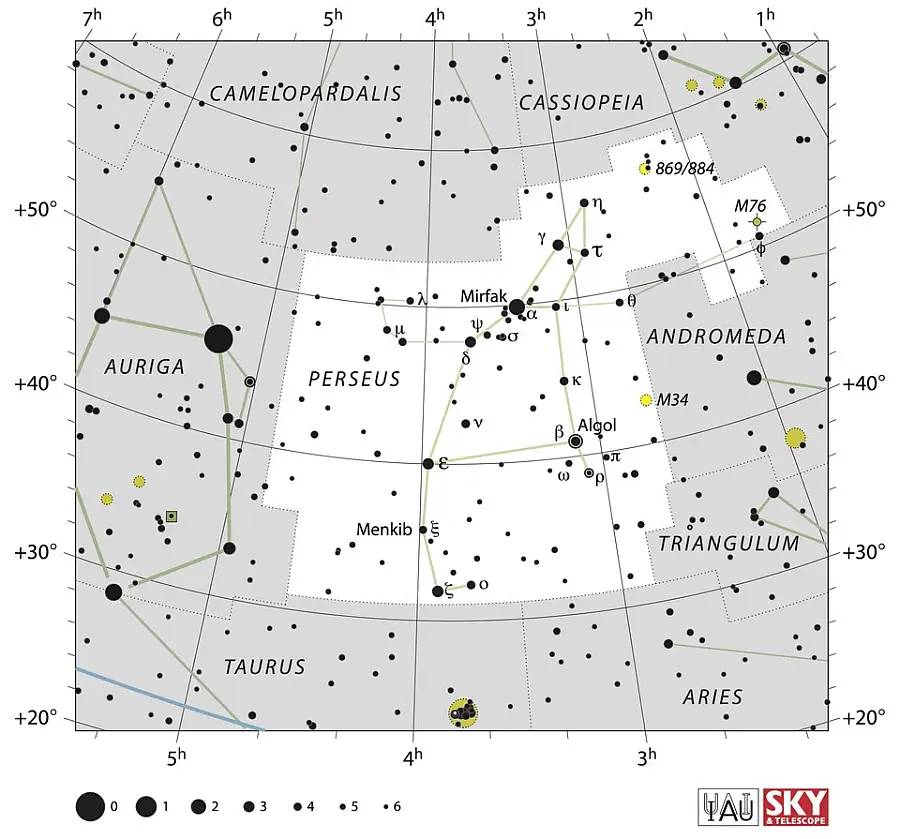
Perseus constellation map by IAU and Sky&Telescope magazine (Roger Sinnott & Rick Fienberg) (CC BY 3.0)
The best time of the year to observe the stars and deep sky objects in Perseus is in the month of December, when the constellation appears higher in the sky in the early evening. The entire constellation is visible from locations north of the latitude 35° S. Its northern part stays below the horizon for observers in New Zealand and southern Australia and Africa.
The 10 brightest stars in Perseus are Mirfak (Alpha Per, mag. 1.806), Algol (Beta Per, mag. 2.09), Zeta Persei (mag. 2.86), Áldu (Epsilon Per, mag. 2.88), Gamma Persei (mag. 2.93), Sarvvis (Delta Per, mag. 3.01), Rho Persei (mag. 3.39), Miram (Eta Per, mag. 3.79), Nu Persei (mag. 3.80), and Misam (Kappa Per, mag. 3.80).
Zeta Persei
| Spectral class | B1 Ib |
| U-B colour index | -0.72 |
| B-V colour index | +0.10 |
| Apparent magnitude | 2.86 |
| Absolute magnitude | -4.55 ± 0.1 |
| Distance | 846 light-years (259 parsecs) or 1,300 ± 200 ly (400 ± 64 pc) |
| Parallax | 3.8556 ± 0.4169 mas |
| Radial velocity | 20.60 ± 0.8 km/s |
| Proper motion | RA: +7.274 mas/yr |
| Dec.: -9.141 mas/yr | |
| Mass | 14.5 ± 1.9 M☉ |
| Luminosity | 47,039 L☉ |
| Radius | 26–27 R☉ |
| Temperature | 20,800 K |
| Age | 12.6 ± 1.5 million years |
| Rotational velocity | 40 km/s |
| Constellation | Perseus |
| Right ascension | 03h 54m 07.92143s |
| Declination | +31° 53′ 01.0869″ |
| Names and designations | Zeta Persei, Zeta Per, ζ Persei, ζ Per, 44 Persei, 44 Per, HD 24398, HR 1203, HIP 18246, HIC 18246, SAO 56799, PPM 68893, PLX 856.00, SKY# 5968, GC 4688, GCRV 2230, AG+31 368, FK5 144, BD+31 666, HGAM 301, ROT 574, NSV 1397, GEN# +1.00024398A, GSC 02361-02820, PMC 90-93 104, UCAC4 610-010865, WEB 3522, AKARI-IRC-V1 J0354079+315300, uvby98 100024398 A, IRC +30068, ALS 14763, WISE J035407.90+315301.8, YPAC 14, CSI+31 666 1, SRS 30144, 1RXS J035407.3+315255, XEST 27-079, CSV 100357, N30 800, 2XMM J035407.8+315300, CSI+31 666 6, 2E 902, JP11 828, 2E 0350.9+3144, MCW 252, UBV 3778, UBV M 9778, IRAS 03509+3144, 2MASS J03540793+3153011, TIC 94367286, TYC 2361-2820-1, Gaia DR2 168726523211214592, Gaia DR3 168726523212358272, ADS 2843 A, CCDM J03541+3153A, IDS 03478+3135 A, WDS J03541+3153A |