The Peony Star (WR 102ka) is a slash star located approximately 26,000 light-years away in the constellation Sagittarius. It lies in the region of the Galactic centre, not far from the Milky Way’s central supermassive black hole. Despite its young age, it is not a member of any known star cluster.
Named after the surrounding Peony Nebula, WR 102ka is one of the most luminous stars known in our galaxy, along with the better-known Eta Carinae. Even though it blazes with a luminosity of 3.3 million Suns, the massive star is hidden from view by dense interstellar dust clouds in the Milky Way’s centre and was only discovered in infrared surveys in the early 21st century.

Colour composite WISE image of WR 102ka. Red is at ∼22 μm, green is at ∼12 μm, blue is at ∼3.4 μm. Image size is 3.6 arcmin × 3.6 arcmin. North is up and east is to the left. Wide-field Infrared Survey Explorer (WISE) image, credit: Oskinova et al., “One of the most massive stars in the Galaxy may have formed in isolation” (2013)
Sizing up the Peony Star: Mass, radius, and temperature
The Peony Star has the spectral type Ofpe/WN9, indicating an evolved massive star with combined spectral lines of a luminous blue supergiant and a Wolf-Rayet star. The star has an estimated mass of 100 solar masses and a radius of 97 solar radii. It shines with 3,300,000 solar luminosities and has a surface temperature of 25,000 K.
In 2008, Barniske et al. derived the stellar properties using the K-band spectra and mid-infrared data from the Spitzer Space Telescope and reported that the Peony Star was among our galaxy’s most luminous stars. The team found a logarithmic luminosity of 6.5 ± 0.2 and a surface temperature of 25,100 K.
The currently accepted value of 100 M☉ is based on observations with the SINFONI spectrograph on ESO’s Very Large Telescope (VLT) and comes from a 2013 study by Oskinova et al. The updated luminosity of 3.3 million Suns and an effective temperature of 25,000 K come from a 2026 study by Bernini-Peron et al.
What are slash stars?
Slash stars are transitional stars between hot blue O-type supergiants (Of-type stars) and nitrogen-sequence Wolf-Rayet (WN) stars. They have intermediate spectral features that combine the traits of these two stellar types, and their spectral classes use a slash notation.
Slash stars like WR 102ka show both high-temperature absorption lines typically seen in the most massive blue supergiants and strong emission lines of helium and nitrogen produced by the strong stellar winds of Wolf-Rayet stars.
Born big: An original mass of 150-200 solar masses
The Peony Star had an initial mass of 150 – 200 solar masses on the main sequence, which placed it among the Milky Way’s most massive stars. The star is a supernova candidate and, depending on its final core mass, it may go out in a brilliant flash, or it may instead collapse directly into a black hole.
Because of its exceptionally large mass, WR 102ka has a powerful influence on its immediate environment. The star’s intense ultraviolet light and strong mass loss through a stellar wind ionize and shape the surrounding compact nebula. The stellar wind has a terminal velocity of around 400 km s-1.

If our galaxy, the Milky Way, were to host its own version of the Olympics, the title for the brightest known star would go to a massive star called Eta Carina. However, a new runner-up — now the second-brightest star in our galaxy — has been discovered in the galaxy’s dusty and frenzied interior. This image from NASA’s Spitzer Space Telescope shows the new silver medalist, circled in the inset above, in the central region of our Milky Way. Dubbed the ‘Peony nebula’ star, this blazing ball of gas shines with the equivalent light of 3.2 million suns. The reigning champ, Eta Carina, produces the equivalent of 4.7 million suns worth of light — though astronomers say these estimates are uncertain, and it’s possible that the Peony nebula star could be even brighter than Eta Carina. If the Peony star is so bright, why doesn’t it stand out more in this view? The answer is dust. This star is located in a very dusty region jam packed with stars. In fact, there could be other super bright stars still hidden deep in the stellar crowd. Spitzer’s infrared eyes allowed it to pierce the dust and assess the Peony nebula star’s true brightness. Likewise, infrared data from the European Southern Observatory’s New Technology Telescope in Chile were integral in calculating the Peony nebula star’s luminosity. The Peony nebula, which surrounds the Peony nebula star, is the reddish cloud of dust in and around the white circle. This is a three-color composite showing infrared observations from two Spitzer instruments. Blue represents 3.6-micron light and green shows light of 8 microns, both captured by Spitzer’s infrared array camera. Red is 24-micron light detected by Spitzer’s multiband imaging photometer. Image credit: NASA/JPL-Caltech/Potsdam Univ. (PD)
Formed in isolation?
The Peony Star does not belong to any known stellar clusters, which means that it either formed in isolation or was dynamically ejected from its parent cluster. The massive star lies roughly 62 light-years (19 pc) from the Central Cluster and the Milky Way’s central supermassive black hole, Sagittarius A*.
In 2013, a team of astronomers led by L. M. Oskinova of the Institute for Physics and Astronomy, University of Potsdam, investigated the environment around the Peony Star and other apparently isolated massive stars in the region of the Galactic centre to learn more about their origin. Some of these stars were found to display bow shocks, indicating that they were expelled from their birthplace.
This was not the case with WR 102ka, which showed no bow shock. For this reason, the researchers proposed that the star was born in isolation, outside of any star cluster. A massive cluster in the star’s vicinity would have been detected, and the three known clusters in the region of the Milky Way’s centre – the Central Cluster, Quintuplet Cluster, and Arches Cluster – have properties that do not match those of the Peony Star.
The Quintuplet Cluster (the home of the Pistol Star) and the Central Cluster are both older than WR 102ka. The Arches Cluster has the right age and mass, but it makes little sense that only the most massive member was ejected from the cluster while many less massive ones are still gravitationally bound to it.
Combined with the absence of a bow shock or any stars with similar properties in the vicinity, these findings led the astronomers to conclude that the Peony Star still resides in or near its original birthplace, where it formed in relative isolation. The study by Oskinova et al. was published in the Monthly Notices of the Royal Astronomical Society in December 2013.
The presence of the Peony Nebula supports this conclusion. The nebula formed in an earlier evolutionary phase of WR 102ka, and the star still appears in the nebula’s centre.

Location of the Peony Star in the Galactic centre, Spitzer IRAC 8µm archive image of the GC. Credit: Barniske, Oskinova, Hamann, “Two extremely luminous WN stars in the Galactic center with circumstellar emission from dust and gas” (2008)
Is the Peony Star a luminous blue variable in disguise?
In 2004, Clark et al. proposed WR 102ka as a luminous blue variable candidate. Luminous blue variables (LBVs) are a rare, short-lived class of massive stars known for their dramatic outbursts and changes in brightness. They are generally believed to represent a transitional phase in the evolution of some exceptionally massive stars, between the main sequence and the Wolf-Rayet phase.
The Peony Star may be an LBV in quiescence, meaning that it is currently in a relatively stable period between major outbursts.
How does the Peony Star stack up against the Milky Way’s brightest?
The Peony Star is one of the most luminous stars in the Milky Way. With an energy output of 3.3 million Suns, it is more than twice as luminous as the Pistol Star in the Quintuplet Cluster.
However, WR 102ka is not quite as luminous as Eta Carinae (4 million L☉) in the Carina Nebula, Westerhout 49-2 (4,365,000 L☉) in the star-forming region Westerhout 49 in Aquila, V4998 Sagittarii (4,000,000 L☉) near the Quintuplet Cluster, and the current Milky Way record holder, the Wolf-Rayet star G0.238-0.071 (5,012,000 L☉), also located near the Galactic centre in Sagittarius.
In comparison, the overall record holder, the Wolf-Rayet star R136a1 in the R136 cluster, shines with around 7.244 million solar luminosities. The star resides in the Tarantula Nebula, the largest stellar nursery in the Large Magellanic Cloud (LMC).
Life in the fast lane: Evolution of WR 102ka
Massive stars like WR 102ka live very short lives compared to modest-sized stars like the Sun. They exhaust their supply of hydrogen fuel in their cores much faster and evolve away from the main sequence within only millions of years. In comparison, our Sun will spend a total of 10 billion years on the main sequence, fusing hydrogen into helium.
Even though it is close to the end of its life, the Peony Star is only around 2 million years old. It is rapidly losing mass and will ultimately go out as a core-collapse supernova. When it goes off, it will likely kick off a wave of star formation. The shock wave from the supernova will compress the surrounding gas and the expelled material will be recycled to give birth to a new generation of stars.
Related article: Life Cycle of Massive Stars
Peony Nebula: The flower-shaped nebula that gave WR 102ka its name
The Peony Star is surrounded by the Peony Nebula, a flower-shaped cloud of gas and dust that was probably produced by the massive star itself as it kept shedding material. The nebula has an apparent radius of around 50 arcseconds.
WR 102ka has long been known as the Peony Star or Peony Nebula Star because of its association with the nebula. The International Astronomical Union’s (IAU) Working Group on Star Names (WGSN) formally approved the name Peony Star on June 13, 2026.

The Peony Nebula, image credit: NASA/JPL-Caltech/Potsdam Univ. (PD)
Piercing the dust: How WR 102ka was discovered
Concealed by copious amounts of dust, the Peony Star is invisible to optical telescopes and was only discovered in infrared surveys in 2002 and 2003.
In 2003, Homeier et al. reported the discovery and classified WR 102ka as a WN10 star, a late nitrogen-sequence Wolf-Rayet star. WN10 stars are often called cool slash stars because their spectra share characteristics of classical Wolf-Rayet stars and Ofpe stars (massive, luminous stars with emission lines of helium and nitrogen).
The star’s spectrum was obtained with the SOFI instrument on the European Southern Observatory’s (ESO) 3.6 m New Technology Telescope (NTT) and the OSIRIS instrument on the Cerro Tololo Inter-American Observatory’s (CTIO) Blanco 4 m telescope from 2000 to 2002.

The Peony Star (WR 102ka) captured by Spitzer, image credit: NASA/JPL-Caltech/Potsdam Univ. (PD)
Peony Star’s location in Sagittarius
The Peony Star lies in the region of the Galactic centre, in the western part of Sagittarius. It appears near the Cepheid variable X Sagittarii (mag. 4.5), and its location can be roughly pinpointed using the stars of the Teapot. The star appears about a third of the way from Kaus Media, the middle star of the Archer’s bow, to the bright Antares in Scorpius.

Location of the Peony Star (WR 102ka) near the Teapot, image: Stellarium (annotated for this article)
Constellation
The Peony Star is located in the constellation Sagittarius. The Archer is one of the oldest constellations in the sky, and one of the most conspicuous zodiac constellations. It was catalogued as one of the 48 ancient constellations by the Greek astronomer Ptolemy of Alexandria in his Almagest in the 2nd century CE. In Greek lore, it represents a centaur (possibly Chiron) and is also associated with the satyr Crotus, the mythical inventor of archery.
Occupying 867 square degrees of the southern sky, Sagittarius is the 15th largest of the 88 modern constellations. It is one of the most recognizable constellations in the southern celestial hemisphere. Its eight bright stars form the Teapot, a bright asterism located next to the Milky Way’s bright band.
The brightest star in the constellation is Kaus Australis (Epsilon Sagittarii), a luminous blue subgiant located 143 light-years away. The binary star forms the Archer’s bow with the orange giants Kaus Media (Delta Sagittarii) and Kaus Borealis (Lambda Sagittarii).
Nunki (Sigma Sagittarii), the second brightest star in Sagittarius, is the nearest core-collapse supernova candidate to the Sun. The binary system lies 224.7 light-years away. Its primary component is a massive blue B-type main sequence star.
Other bright stars in the constellation include the triple star Ascella (Zeta Sagittarii), the orange giants Alnasl (Gamma2 Sagittarii) and Tau Sagittarii, the massive triple star Nu1 Sagittarii (Ainalrami), the white subgiant Albaldah (Pi Sagittarii), and the blue supergiant Polis (Mu Sagittarii).
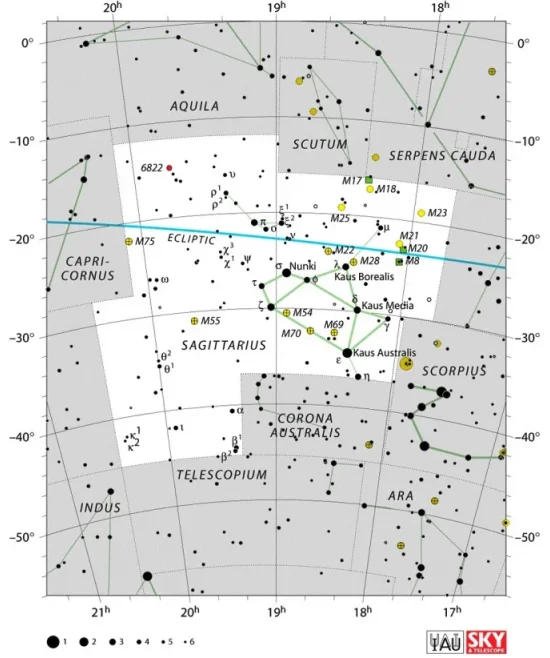
Sagittarius constellation map by IAU and Sky&Telescope magazine (Roger Sinnott & Rick Fienberg) (CC BY 3.0)
The stars with the Bayer designations Alpha and Beta Sagittarii are not among the constellation’s brightest stars. The B-type main sequence star Rukbat (Alpha Sgr, mag. 3.97), the binary system Arkab Prior (Beta1 Sgr, mag. 4.01) and yellow-white star Arkab Posterior (Beta2 Sgr, mag. 4.29) lie in the southern part of Sagittarius and are largely invisible from the mid-northern latitudes.
Other notable stars in the constellation include the luminous blue variable V4647 Sagittarii, also known as the Pistol Star, the red supergiants KW Sagittarii and VX Sagittarii, both among the largest stars discovered to date, the born-again star known as Sakurai’s Object (V4334 Sgr), the Pinwheel Star (WR 104), and the red dwarf Ross 154, one of the nearest stars to the Sun.
Sagittarius contains many bright deep sky objects, including more Messier objects than any other constellation. Objects visible in small telescopes include the Lagoon Nebula (M8), the Trifid Nebula (M20), the Omega Nebula (M17), the bright globular clusters M28, M55, M70 and M75, and the open clusters M18, M23, and M25.
Other deep sky objects in the constellation include the Little Gem Nebula (NGC 6818), the Red Spider Nebula (NGC 6537), the Eye of Sauron Nebula (M1-42), the Garden Sprinkler Nebula (Hen 3-1475), the Chinese Dragon Nebula (NGC 6559), Barnard’s Galaxy (NGC 6822), and the globular clusters NGC 6638, NGC 6544, and the Chandelier Cluster (NGC 6723).
Sagittarius also hosts the Milky Way’s central black hole, Sagittarius A*, and the massive Galactic centre clusters known as the Quintuplet Cluster, the Central Cluster, and the Arches Cluster.
The best time of the year to observe the stars and deep sky objects in Sagittarius is during the northern hemisphere summer, when the constellation climbs higher above the horizon in the early evening.
The 10 brightest stars in Sagittarius are Kaus Australis (Epsilon Sgr, mag. 1.85), Nunki (Sigma Sgr, mag. 2.05), Ascella (Zeta Sgr, mag. 2.59), Kaus Media (Delta Sgr, mag. 2.70), Kaus Borealis (Lambda Sgr, mag. 2.82), Albaldah (Pi Sgr, mag. 2.89), Alnasl (Gamma² Sgr, mag. 2.98), Heryibwia (Eta Sgr, mag. 3.11), Nandou (Phi Sgr, mag. 3.17), and Tau Sagittarii (mag. 3.326).
Peony Star – WR 102ka
| Spectral class | Ofpe/WN9 |
| J-H colour index | 2.7 |
| J-K colour index | 4.2 |
| Apparent magnitude (J) | 12.978 |
| Apparent magnitude (H) | 10.267 |
| Apparent magnitude (K) | 8.84 |
| Distance | 26,000 light-years (8,000 parsecs) |
| Radial velocity | 60 km/s |
| Mass | ~100 M☉ |
| Luminosity | 3,300,000 L☉ |
| Radius | 97 R☉ |
| Temperature | 25,000 K |
| Age | 2 million years |
| Constellation | Sagittarius |
| Right ascension | 17h 46m 18.12s |
| Declination | -29° 01′ 36.5″ |
| Names and designations | Peony Star, Peony Nebula Star, WR 102ka, TIC 322756954, 2MASS J17461811-2901366, ISOGAL-P J174618.2-290136, MSX6C G000.0003-00.1743, SSTGC 630166, SSTGLMC G000.0002-00.1744, [MKN2009] 1249, [OSH2014] 21 |