Prima Hyadum, Gamma Tauri (γ Tau) is a giant star located approximately 154 light-years away in the constellation Taurus. With an apparent magnitude of 3.654, it is the tenth brightest star in Taurus. The evolved star is one of the brightest members of the Hyades, the closest open star cluster to the Sun. It marks the tip of the V in the celestial Bull’s head.
What type of star is Prima Hyadum?
Prima Hyadum has the spectrum of a yellow giant of the spectral type G8III. It has 2.70 times the Sun’s mass and a radius of 13.4 solar radii. With an effective temperature of around 4,844 K, it is 85 times more luminous than the Sun.
Gamma Tauri is believed to be a binary or multiple star system. The primary component is a red clump giant, an evolved star on the horizontal branch that has undergone a helium flash and is now fusing helium into carbon and oxygen in its core. It has similar properties to Capella (G8III), which appears much brighter because it lies only 43 light-years away.
Prima Hyadum spins with a projected rotational velocity of 4 km/s, taking 253 days to complete a rotation. It has an estimated age of 430 to 530 million years.
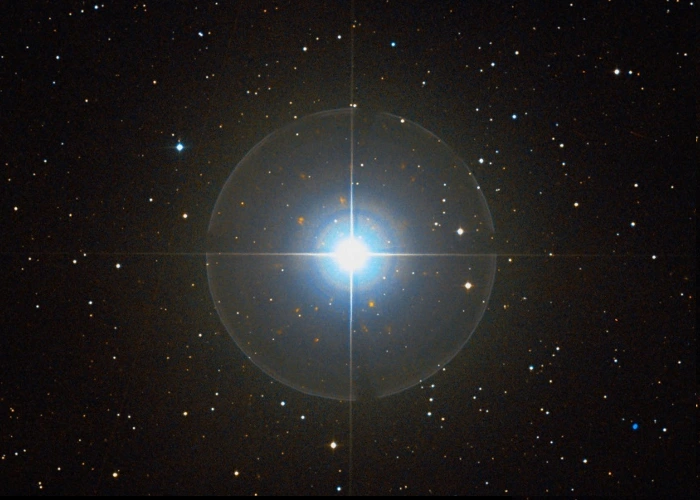
Prima Hyadum (Gamma Tauri), ESO/Digitized Sky Survey 2 (CC BY 4.0)
Anchor of the Hyades
Prima Hyadum is the third brightest member of the Hyades cluster, after Chamukuy (Theta2 Tauri) and Ain (Epsilon Tauri). It lies within 2.5 parsecs of the cluster’s centre.
The bright star cluster lies 153 light-years away. With an apparent magnitude of 0.5 and apparent size of 330 arcminutes (more than 5 degrees), it is easily observed without binoculars from areas without too much light pollution. It is catalogued as Caldwell 41, Melotte 25, and Collinder 50.
The Hyades cluster is the nearest open cluster to the Sun. It is believed to be around 625 million years old. It has a core radius of 10 light years and an estimated mass of 400 solar masses. The cluster’s tidal radius spans 33 light-years.
Aldebaran, the brightest star in Taurus and one of the brightest stars in the sky, appears in the same line of sight as the Hyades but is not a member. The red giant lies only 67 light-years away.
The bright star cluster has been known to observers since pre-historic times. In Greek mythology, the Hyades were the seven daughters of the Oceanid Aethra and the Titan Atlas, who held the celestial sphere on his shoulders. They were half-sisters to the Pleiades and the Hesperides.
In Greek lore, the seven nymphs were transformed into a star cluster by Zeus after the loss of their brother Hyas in a hunting accident. They were said to be forever mourning Hyas. The mythical sisters were associated with rain and known as the “rain-makers” or the “rainy ones.”
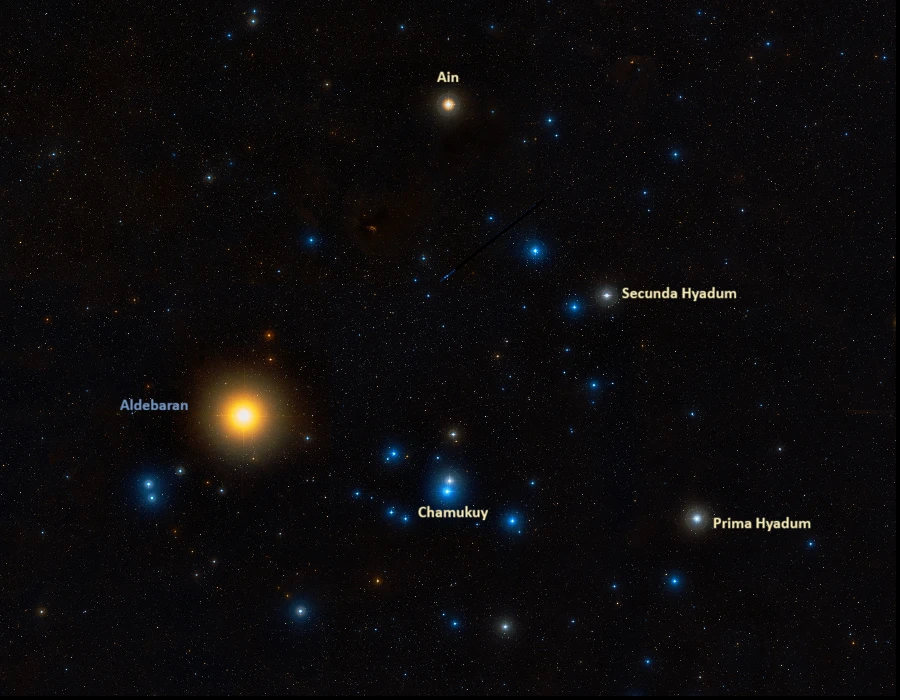
Hyades stars, image credit: ESO/Digitized Sky Survey 2 (CC BY 4.0)
Head of the Bull
Aldebaran and the brightest Hyades stars – Chamukuy (Theta2 Tauri), Ain (Epsilon Tauri), Prima Hyadum (Gamma Tauri) and Secunda Hyadum (Delta1 Tauri) – form a V-shaped asterism that is traditionally seen as the head of the Bull. In the constellation figure of Taurus, Aldebaran and Ain represent the Bull’s eyes and Prima Hyadum marks its nose.
Like Gamma Tauri, these bright stars have already evolved away from the main sequence and expanded into giants. Chamukuy is a variable A-type giant in a multiple star system located 157 light-years away. Ain is a K-type red clump giant that hosts the first planet discovered in an open cluster. Secunda Hyadum is a G-type red clump giant in a spectroscopic binary system located 156 light-years away.
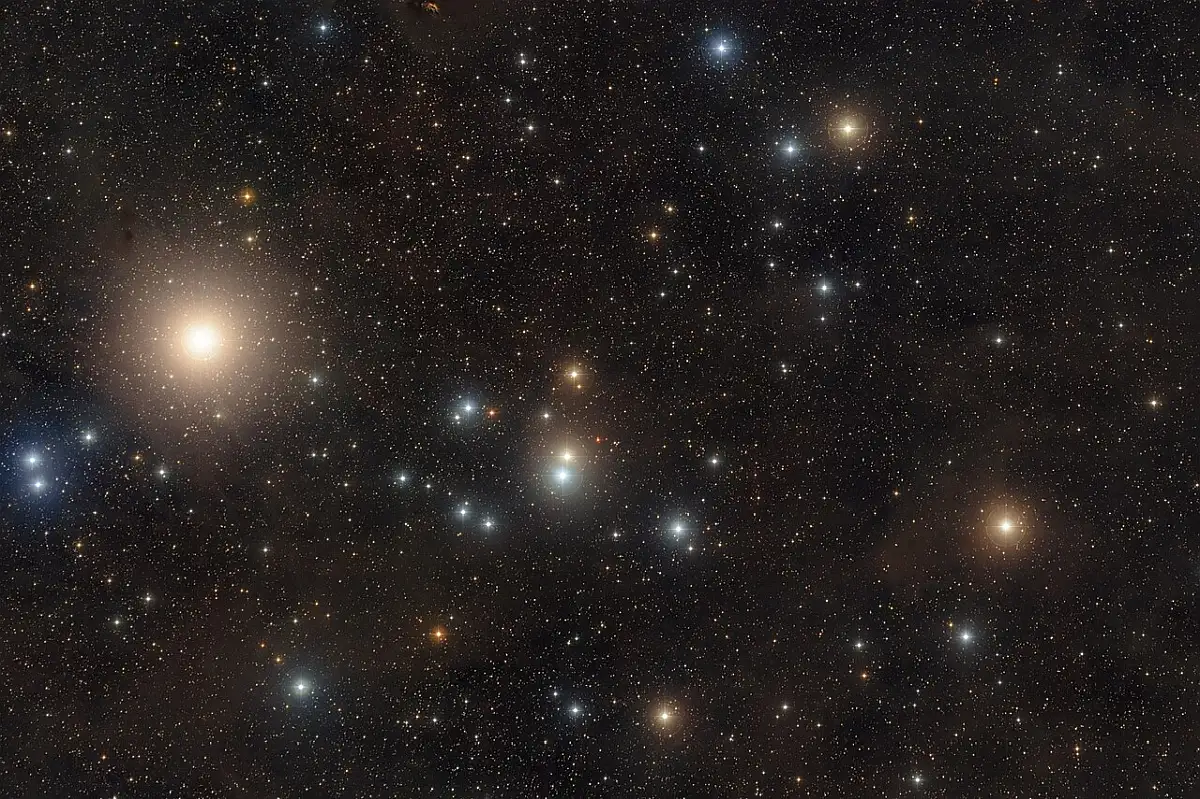
Aldebaran and the Hyades (scaled) Credit: ESO/DSS2, Giuseppe Donatiello (CC0 1.0)
Name and meaning
The name Prima Hyadum (pronunciation: /ˌpraɪmə ˈhaɪədəm/) means “the First of the Hyades.” The star was historically also called Hyadum I, while the fainter Delta1 Tauri was known as Hyadum II or Secunda Hyadum.
The International Astronomical Union’s (IAU) Working Group on Star Names (WGSN) approved the name Prima Hyadum for Gamma Tauri on September 5, 2017.
In traditional Chinese astronomy, Gamma Tauri is known as 畢宿四 (Bì Xiù sì), the Fourth Star of Net. It forms the Net asterism with Ain (Epsilon Tauri), Delta3 Tauri, Secunda Hyadum (Delta1 Tauri), Aldebaran (Alpha Tauri), Chamukuy (Theta2 Tauri), 71 Tauri, and Lambda Tauri. The asterism is part of the larger Net mansion, which represents the body of the White Tiger.
How to find Gamma Tauri
Prima Hyadum is easy to find because it is part of one of the brightest and largest open clusters in the sky. The Hyades and Aldebaran can be found using the bright stars of Orion’s Belt, Alnitak, Alnilam, and Mintaka. A line extended through the Belt to the northwest leads to the Hyades.
Gamma Tauri marks the pointed tip of the Hyades’ V asterism and appears just west of Aldebaran.
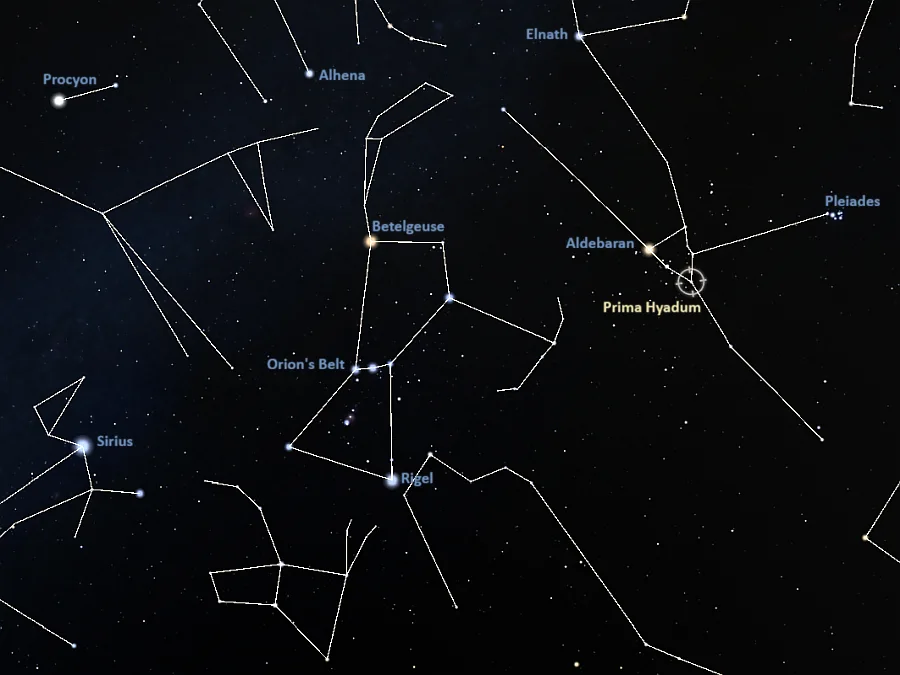
Gamma Tauri location, image: Stellarium (annotated for this article)
Where is Prima Hyadum visible
At declination +15° 38′, Prima Hyadum is close enough to the celestial equator to be visible from most locations on Earth. The constellation Taurus is visible for most of the year at some point in the night, except from mid-May to early July, when it is aligned with the Sun.
Constellation
Prima Hyadum is located in the constellation Taurus. The celestial Bull is one of the ancient constellations catalogued by Claudius Ptolemy of Alexandria in his Almagest in the 2nd century AD. In Greek mythology, it is linked with the story of Zeus taking on the form of a white bull while pursuing Europa.
Taurus occupies 797 square degrees of the predominantly northern sky and is the 17th largest of the 88 modern constellations. It is one of the 12 zodiac constellations. It lies on the ecliptic (the Sun’s apparent path across the sky) and cannot be seen in the night sky for about a month each year when the Sun appears to pass through it.
Taurus is also one of the 15 equatorial constellations and can be seen from virtually anywhere for at least part of the year.
The celestial Bull is best-known for hosting the giant Aldebaran, the 14th brightest star in sky, and the Pleiades and Hyades open clusters, both easily visible without binoculars. The two bright star clusters form an asterism known as the Golden Gate of the Ecliptic. The ecliptic passes between the clusters, and the Moon and the planets are often seen passing through this region of the sky.
Other than Aldebaran, bright stars in Taurus include the hot blue giants Elnath (Beta Tauri) and Tianguan (Zeta Tauri) at the Bull’s horns, the bright Pleiades stars Alcyone (Eta Tauri) and Atlas (27 Tauri), the Hyades stars Chamukuy (Theta2 Tauri) and Ain (Epsilon Tauri), the yellow giant Omicron Tauri and the massive triple star system Lambda Tauri.
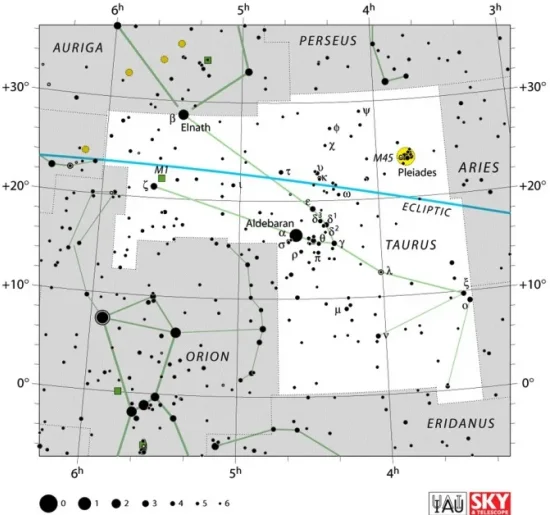
Taurus constellation map by IAU and Sky&Telescope magazine (Roger Sinnott & Rick Fienberg) (CC BY 3.0)
The Taurus constellation also contains the variable class prototypes T Tauri and the yellow supergiant RV Tauri, the quadruple star system Xi Tauri, and the red supergiant 119 Tauri, popularly known as Ruby Star, one of the reddest stars visible to the unaided eye.
Deep sky objects in Taurus include the Pleiades and Hyades star clusters, the bright supernova remnants known as the Crab Nebula (M1) and the Spaghetti Nebula (Sh2-240), the planetary nebula NGC 1514 (the Crystal Ball Nebula), the reflection nebulae LBN 777 (the Baby Eagle Nebula) and NGC 1555 (Hind’s Variable Nebula), and the interacting pair of galaxies NGC 1409 and NGC 1410.
The best time of the year to observe the stars and deep sky objects in Taurus is during the month of January, when the celestial Bull is prominent in the evening sky. The entire constellation can be seen from locations north of the latitude 60° S.
The 10 brightest stars in Taurus are Aldebaran (Alpha Tau, mag. 0.86), Elnath (Beta Tau, mag. 1.65), Alcyone (Eta Tau, mag. 2.87), Tianguan (Zeta Tau, mag. 2.97), Chamukuy (Theta2 Tauri, mag. 3.40), Lambda Tauri (mag. 3.47), Ain (Epsilon Tau, mag. 3.53), Omicron Tauri (mag. 3.61), Atlas (27 Tau, mag. 3.63), and Prima Hyadum (Gamma Tau, mag. 3.654).
Prima Hyadum – Gamma Tauri
| Spectral class | G8III |
| U-B colour index | +0.84 |
| B-V colour index | +0.99 |
| Apparent magnitude | 3.654 |
| Absolute magnitude | 0.22 |
| Distance | 154 ± 9 light years (47 ± 3 parsecs) |
| Parallax | 21.6645 ± 0.1831 mas |
| Radial velocity | 38.458 ± 0.0007 km/s |
| Proper motion | RA: +115.29 mas/yr |
| Dec.: -23.86 mas/yr | |
| Mass | 2.70 ± 0.13 M☉ |
| Luminosity | 85 L☉ |
| Radius | 13.4 ± 0.2 R☉ |
| Temperature | 4,844 ± 47 K |
| Metallicity | +0.11 dex |
| Age | 430 – 530 million years |
| Rotational velocity | 4 km/s |
| Rotation | 253 days |
| Surface gravity | 2.58 – 2.61 cgs |
| Constellation | Taurus |
| Right ascension | 04h 19m 47.6039239005s |
| Declination | +15° 37′ 39.511385129″ |
| Names and designations | Prima Hyadum, Hyadum I, Gamma Tauri, Gamma Tau, γ Tauri, γ Tau, 54 Tauri, 54 Tau, HD 27371, HR 1346, HIP 20205, SAO 93868, FK5 159, BD+15°612, AG+15 356, BLM 1, GC 5226, GCRV 2486, CSV 102439, JP11 4797, 2E 975, 2E 0416.9+1530, NSV 1553, PLX 954.02, PPM 119792, SKY# 6630, EPIC 200007765, GEN# +5.20250028, N30 889, PMC 90-93 114, EUVE J0419+15.6, 1RXS J041947.6+153740, 2RE J041945+153637, 2RE J0419+153, RE J0419+153, RE J041944+153624, TD1 3025, TIC 435911332, SRS 30159, GSC 01264-01009, WEB 3852, UBV 4176, UBV M 41234, UCAC4 529-008241, uvby98 520250028, IRAS 04169+1530, 2MASS J04194757+1537395, IRC +20074, YZ 15 1137, TYC 1264-1009-1, Gaia DR2 3312052249216467328, Gaia DR3 3312052249215275904, CCDM J04198+1538AB, WDS 04198+1538, WDS J04198+1538AB, Melotte 25 MMU 28, Melotte 25 S 1, Melotte 25 28 |