R Doradus (R Dor) is a pulsating variable red giant located 178 light years away in the southern constellation of Dorado (the Dolphinfish). The asymptotic giant branch star has an apparent magnitude that varies between 4.78 and 6.32 and is visible to the unaided eye from areas without too much light pollution. It is one of the brightest stars in the infrared K band and near-infrared J band.
R Doradus has a larger angular diameter than any other star except the Sun as seen from Earth. While it is not among the physically largest stars known, the aging red giant has a radius of almost 300 solar radii. If placed at the centre of our solar system, the star’s surface would almost touch the orbit of Mars.
What type of star is R Doradus?
R Doradus is a red giant star of the spectral type M8III:e. It has a mass of 0.7 – 1 solar masses and a radius around 298 times that of the Sun. With an effective temperature of 2,710 K, it is 4,350 times more luminous than the Sun. The giant is much older than our parent star, with an estimated age of 6 – 14 billion years.
With a projected rotational velocity of 1 km/s, R Doradus takes 57.5 years to complete a spin. In comparison, the Sun has a rotational velocity of 1.997 km/s and an apparent rotational period of around 25.6 days at the equator and 33.5 days at the poles.
The spin rate of R Doradus is over 100 times faster than expected for an AGB star, which indicates that the star may have a close companion that affects its rotation.
Even though it has expanded to an exceptionally large size, R Doradus remains surprisingly regular in its pulsations. As one of the nearest AGB stars to the Sun, it is quietly rewriting astronomers’ assumptions about how large, stable, and long-lived an evolved star can be.
However, the true importance of R Doradus lies in what it reveals about how Sun-like stars end their lives. The star’s relative proximity, giant size and relative calm allow astronomers to observe, in unprecedented detail, the processes that occur in the late stages of the life of a star that was once similar to the Sun. By resolving its surface, atmosphere, and slow stellar winds, astronomers are using R Doradus as a natural laboratory for testing models of stellar evolution and refining predictions about the distant future of Sun-like stars.
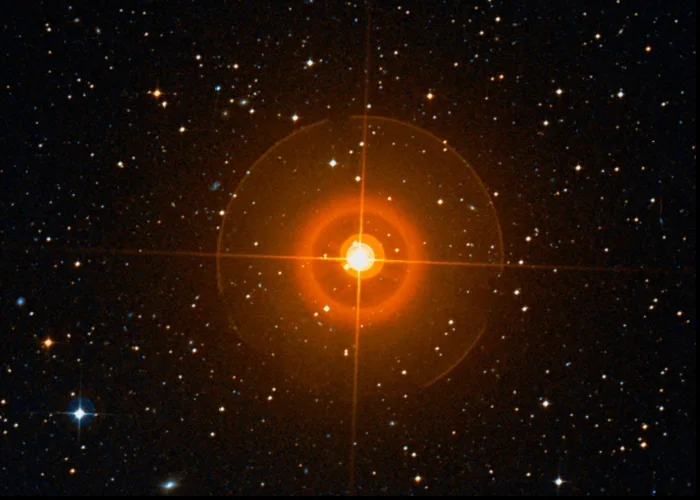
R Doradus, image credit: ESO/Digitized Sky Survey 2 (CC BY 4.0)
A star on the asymptotic giant branch (AGB)
R Doradus is currently on the asymptotic giant branch (AGB), a late evolutionary stage in the life of intermediate-mass stars. AGB stars have an inert carbon-oxygen core and are fusing helium into carbon in a shell near the core and hydrogen into helium in another shell. The main source of energy during this phase is helium fusion.
The radius of an AGB star can become larger than one astronomical unit and the star can lose 50 to 70 percent of its initial mass. R Doradus’ radius of 298 solar radii corresponds to 2.77 astronomical units or 415 million kilometres.
As the star expands in the red giant phase, it becomes increasingly unstable and starts to lose mass. In AGB stars like R Doradus, the high mass loss rate results in the formation of a circumstellar envelope of material.
R Doradus is classified as a semiregular variable (type SRb). It was identified as a variable star by the American astronomer Benjamin Apthorp Gould in 1874.
Semiregular variables are typically red giant and supergiant stars whose brightness varies due to pulsations. Astronomers have identified pulsation periods of 117.3, 175 and 332 days for R Doradus. When the star’s variations are regular, it is similar to a Mira variable but shows less dramatic changes in brightness.
Other relatively bright stars in this class (SRb) include Brachium in the constellation Libra, La Superba in Canes Venatici, Rho Persei in Perseus, R Lyrae in Lyra, L2 Puppis in Puppis, and possibly Mirach in Andromeda.
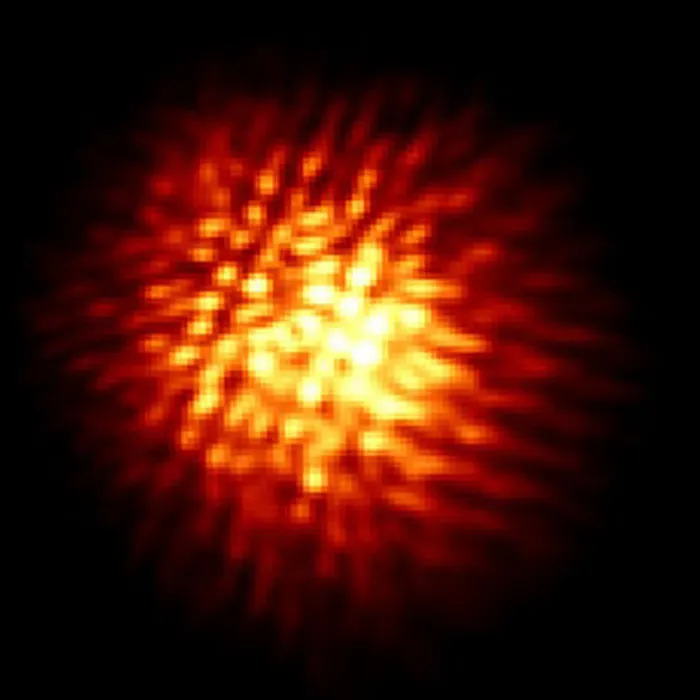
R Doradus in infrared, New Technology Telescope (ESO) picture, credit: ESO (CC BY 4.0)
Bigger than Betelgeuse? Understanding stellar scale
While R Doradus is a behemoth compared to most stars, Sun-like stars do not become the largest stars known when they evolve away from the main sequence. Red giants expand to enormous sizes, but it is the massive stars like Stephenson 2-18, WOH G64, RSGC1-F01, NML Cygni, VY Canis Majoris, and VX Sagittarii that grow to record-breaking sizes of over a thousand solar radii. These stars are exceptionally massive red supergiants that would stretch past the orbit of Jupiter if placed at the centre of the solar system.
Even more moderate-sized supergiants like Betelgeuse and Antares are larger than R Doradus. These bright stars have estimated radii of 640 – 764 and 680 times that of the Sun.
In comparison, famous AGB stars like Mira (Omicron Ceti) in the constellation Cetus and La Superba (Y Canum Venaticorum) in Canes Venatici are only slightly larger and more massive than R Doradus. The semiregular variable La Superba has a mass of 1.2 solar masses and a radius 315 times that of the Sun, while the variable class prototype Mira has a mass of 1.18 solar masses and a radius of 332 – 402 solar radii.
Apparent size
R Doradus has the largest angular diameter of any star. In 1997, a team of astronomers led by T. R. Bedding of the University of Sydney, Australia, measured a uniform disk diameter of 57 ± 5 milliarcseconds (mas) for the giant in the near infrared using interferometry. In 2009, researchers found a limb-darkened disk of 51.18 ± 2.24 mas.
In comparison, Betelgeuse, the star with the second largest angular diameter, has a diameter of around 45 mas. While it is physically much larger than R Doradus, the red supergiant appears smaller because it lies 408 – 548 light-years away, at a much greater distance.
Discovery of convective bubbles with ALMA
Images of R Doradus obtained with the Atacama Large Millimeter/submillimeter Array (ALMA) in Chile in July and August 2023 revealed giant bubbles on the star’s surface. The bubbles are produced by the convection motions inside the giant star. They are 75 times the size of the Sun but much less dense than the Earth’s atmosphere.
The hot bubbles appear on the star’s surface and then cool and sink back into the star on timescales from three weeks to a month. The mixing motion results in the distribution of the heavy elements produced by nuclear fusion in the star’s interior throughout the star.
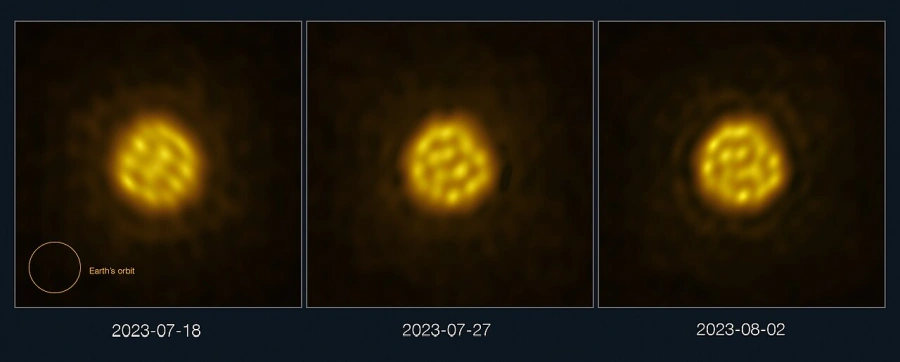
Astronomers have captured a sequence of images of a star other than the Sun in enough detail to track the motion of bubbling gas on its surface. The images of the star, R Doradus, were obtained with the Atacama Large Millimeter/submillimeter Array (ALMA), a telescope co-owned by ESO, in July and August 2023. This panel shows three of these real images, taken with ALMA on 18 July, 27 July and 2 August 2023. The giant bubbles — 75 times the size of the Sun — seen on the star’s surface are the result of convection motions inside the star. The size of the Earth’s orbit is shown for scale. Image credit: ALMA (ESO/NAOJ/NRAO)/W. Vlemmings et al. (CC BY 4.0)
What R Doradus reveals about stellar life cycles
The large size and proximity of R Doradus make it possible for astronomers to directly observe the processes associated with the asymptotic giant branch phase of the stellar life cycle. Observations of the giant star have provided new insights into how late-stage stars transport energy, lift material into their atmospheres, and gradually shed mass into space.
R Doradus does not overturn what we know about AGB stars, but it reveals certain phases of stellar evolution with exceptional clarity because of its immense size and relative proximity. Its size and relatively gentle, regular pulsations show that that a star can expand to gigantic proportions before becoming dramatically unstable. This helps astronomers refine models of when mass loss accelerates near the end of stellar evolution.
Because its atmosphere, pulsations, and slow outflow of gas and dust can be directly resolved, R Doradus provides a rare, real-time view of how aging stars “breathe,” shed their outer layers, and enrich the galaxy with heavy elements. The giant offers one of the most realistic previews we have of the distant future awaiting our own Sun.
How to find R Doradus
R Doradus lies in the faint constellation of Dorado, near the small constellation figure of Reticulum. Reticulum is found roughly halfway between the bright Canopus in the constellation Carina and Achernar in Eridanus. Its brightest stars – Rhombus (Alpha Reticuli), Beta Reticuli, Delta Reticuli, and Epsilon Reticuli – form a rhomboid asterism. R Doradus is part of a smaller rhomboid next to Alpha Reticuli that is faintly visible to the unaided eye on a clear night.
At declination -62°, R Doradus is best seen from the southern hemisphere. It never rises above the horizon from locations north of the latitude 28° N.
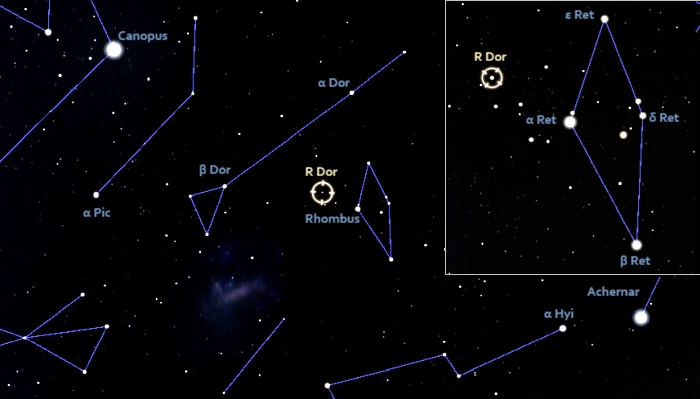
R Doradus location, image: Stellarium (annotated for this article)
Constellation
R Doradus is located in the constellation Dorado. The celestial Dolphinfish was introduced by the Dutch-Flemish astronomer Petrus Plancius in the 16th century. It was first charted by Dutch navigators and Plancius created it based on their observations. Before the Age of Discovery, the stars of Dorado were largely unknown to European observers.
Dorado is the 72nd constellation in size out of 88. It occupies an area of only 179 square degrees of the southern sky. It does not contain any first or second magnitude stars. The constellation’s brightest star, the white giant Alpha Doradus, has an apparent magnitude of 3.27.
Dorado contains many interesting stars, notable mostly for their exceptional mass and luminosity. They include the record-holding Wolf-Rayet stars R136a1 and BAT99-98 in the Large Magellanic Cloud, both among the most massive and luminous stars known, and the red hypergiant WOH G64, possibly the largest star known. The constellation also hosts the massive O-type star VFTS 102, one of the fastest spinning stars discovered to date.
Other notable stars in Dorado include the Cepheid variable Beta Doradus, the luminous blue variable S Doradus, the variable class prototype Gamma Doradus, the hypervelocity star HE 0437−5439 (HVS3), the yellow hypergiant HD 33579, the Wolf-Rayet binary star HD 38282, the blue hypergiant R 126 (HD 37974), and the heartbeat star MACHO 80.7443.1718.
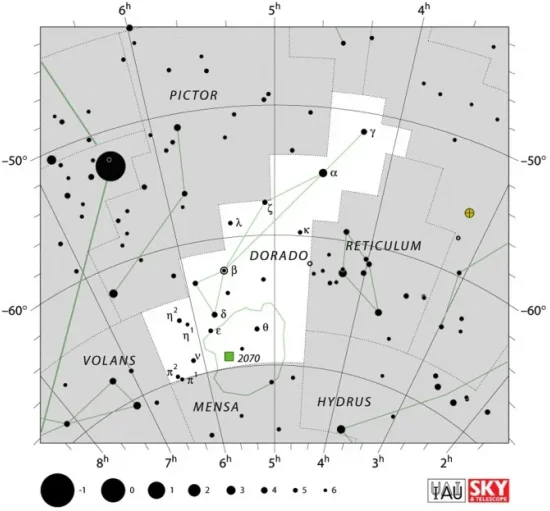
Dorado constellation map by IAU and Sky&Telescope magazine (Roger Sinnott & Rick Fienberg) (CC BY 3.0)
Dorado hosts the Large Magellanic Cloud (LMC), a satellite galaxy of the Milky Way that is visible to the unaided eye in good conditions. The LMC contains many notable deep sky objects, including the Tarantula Nebula (NGC 2070) with the central massive cluster R136, the Supernova 1987A, the Dragon’s Head Nebula (NGC 2035), and the Ghost Head Nebula (NGC 2080).
The constellation is also home to the Dorado Group of galaxies, which includes the spiral galaxy NGC 1566 (the Spanish Dancer Galaxy) and the interacting pair NGC 1549 and NGC 1553.
The best time of the year to observe the stars and deep sky objects in Dorado is during the month of January, when the constellation rises higher above the horizon in the evening. The entire constellation can be seen from locations south of the latitudes 20° N.
The 10 brightest stars in Dorado are Alpha Doradus (mag. 3.27), Beta Doradus (mag. 3.46 – 4-08), Gamma Doradus (mag. 4.25), Delta Doradus (mag. 4.34), HD 40409 (mag. 4.65), Zeta Doradus (mag. 4.82), Theta Doradus (mag. 4.82), Eta2 Doradus (mag. 5.01), Nu Doradus (mag. 5.06), and Epsilon Doradus (mag. 5.11).
R Doradus
| Spectral class | M8III:e |
| Variable type | Semiregular variable (SRb) |
| U-B colour index | +0.86 |
| B-V colour index | +1.58 |
| Apparent magnitude (V) | 4.78 – 6.32 |
| Apparent magnitude (J) | −2.6 |
| Apparent magnitude (K) | −4.2 |
| Absolute magnitude | 1.61 / 1.90 |
| Distance | 178 ± 10 light-years (55 ± 3 parsecs) |
| Parallax | 18.31 ± 0.99 mas |
| Radial velocity | +26.1 km/s |
| Proper motion | RA: – 69.36 mas/yr |
| Dec.: – 75.78 mas/yr | |
| Mass | 0.7 – 1.0 M☉ |
| Luminosity | 4,350 ± 520 L☉ |
| Radius | 298 ± 21 R☉ |
| Temperature | 2,710 ± 70 K |
| Age | 6 – 14 billion years |
| Rotational velocity | 1 ± 0.1 km/s |
| Rotation | 57.5 years |
| Surface gravity | −0.6 ± 0.1 cgs |
| Constellation | Dorado |
| Right ascension | 04h 36m 45.59127s |
| Declination | −62° 04′ 37.7974″ |
| Names and designations | R Doradus, R Dor, P Doradus, P Dor, HD 29712, HR 1492, HIP 21479, SAO 249066, PPM 354226, HJ 3679A, GC 5661, GCRV 2726, GEN# +1.00029712, GSC 08880-01071, CD−62°175, CPD−62°372, CPC 20.1 1002, SKY# 7154, CSI-62 372 41, IRAS 04361-6210, 2MASS J04364544-6204379, N30 980, TIC 38877693, TYC 8880-1071-1, AAVSO 0435-62, JP11 913, WEB 4124, UBV M 10273, [DS98] 54, [LFO93] 0436-62, Gaia DR3 4677205714465503104, CCDM J04368-6205A, IDS 04356-6216 A, WDS J04368-6205A |