The life cycle of a star is the process of change that every star undergoes over time. It begins when a molecular cloud collapses under its own gravity and begins to contract, heat up, and break up into smaller fragments that give birth to the young star. It ends when the star becomes a stellar remnant: a white dwarf, neutron star, or black hole.
A star’s life is primarily determined by its initial mass. The more massive a star is the shorter its lifespan. Massive stars are hotter and they burn through their supply of hydrogen fuel faster. When they run out of fuel, they evolve away from the main sequence and begin to expand into giants and supergiants.
A star reaches the end of its life when the outward radiation pressure resulting from the nuclear fusion processes in its core is no longer able to resist the gravitational forces. At this point, the star collapses under its own gravity and becomes a compact star (stellar remnant).
Compact stars do not produce energy themselves, but other than black holes, they radiate excess heat left from the process of collapse. As they radiate away the heat, they lose energy and cool off, but their structure can remain the same virtually forever regardless of temperature. They will ultimately become cool and dark compact stars. These objects are still hypothetical because the universe is not old enough for any stellar remnant to have reached this stage.
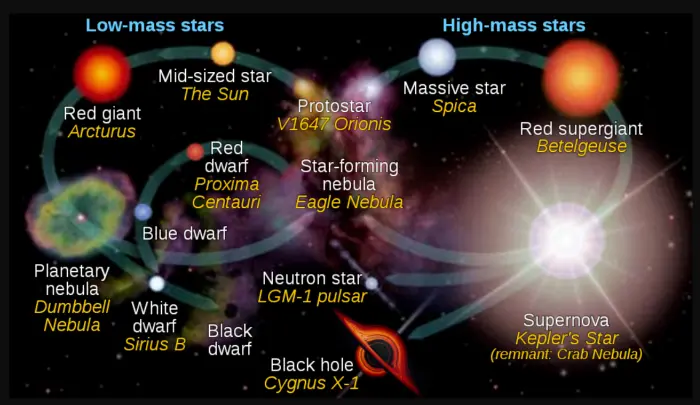
Life cycles of low-mass (left cycle) and high-mass (right cycle) stars, with examples in italics. Image: NASA Goddard Space Flight Center, cmglee at Wikimedia Commons (CC BY-SA 4.0)
Stellar evolution
Stellar evolution is a process by which a star changes in structure and composition over time. The systematic process of change that every star undergoes can take a few million years or trillions of years, depending on the star’s mass. Stellar mass determines the life stages of a star and how quickly the star goes through them.
High-mass stars like Alnilam, Alnitak and Mintaka in Orion’s Belt live very short lives, a few million years, while low-mass red dwarfs like Proxima Centauri can spend trillions of years on the main sequence. The most massive stars live the shortest lives. They burn through their supply of fuel faster due to higher core temperatures. In comparison, our Sun will spend about 10 billion years on the main sequence before it runs out of fuel and expands into a red giant.
Stars take millions of years to evolve from one stage to the next, which means that it is impossible for scientists to observe the life of a single star. The study of stellar evolution is possible because we see so many stars at different stages of their life cycles.
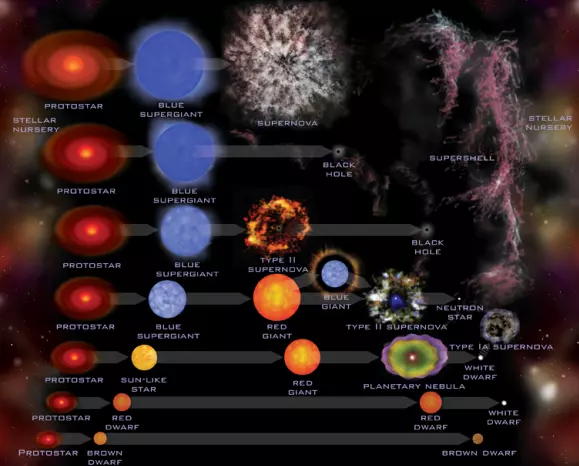
Stellar evolution, image credit: NASA/JPL-Caltech
Stellar evolution stages
The stellar life cycle is divided into several stages between the birth of a star and its end. The different evolutionary phases depend on the star’s mass and environment. Mass determines how long a star will live and the environment can determine how much additional mass it accretes. Stars in close binary systems can be affected by their companions, as can those in densely packed star clusters.
Single stars have a relatively straightforward path from the time they are formed in their stellar nurseries to when they can no longer sustain the processes in their interiors. Depending on their initial mass, stars will go through some or most of the following stages:
- Stellar birth
- Young stellar objects
• Protostars
• Pre-main-sequence stars – T Tauri stars, Herbig Ae/Be stars - Main sequence stars
- Brown dwarfs
- Subgiants
- Giants/Supergiants
- Stellar remnants
• White dwarfs
• Neutron stars
• Black dwarfs
• Black holes
• Blue dwarfs
How are stars formed
Stars are formed in nebulae, vast stellar nurseries made of clouds of dust and gas that stretch tens or hundreds of light-years across. These nebulae are known as molecular clouds because most of their hydrogen is in the molecular form (H2). If these dense clouds are disturbed, they can collapse under their own gravity.
A star’s mass, and therefore its lifespan, is determined by the amount of material that is available in its parent molecular cloud. The coldest molecular clouds are believed to give birth to low-mass stars, while the warmer giant clouds form stars of all masses.
Stars are generally not born in isolation but within star clusters or stellar associations. Large cloud cores tend to give birth to unbound OB associations – groups of massive, blue O- and B-type stars – or clusters of less massive stars that are physically bound to one another.
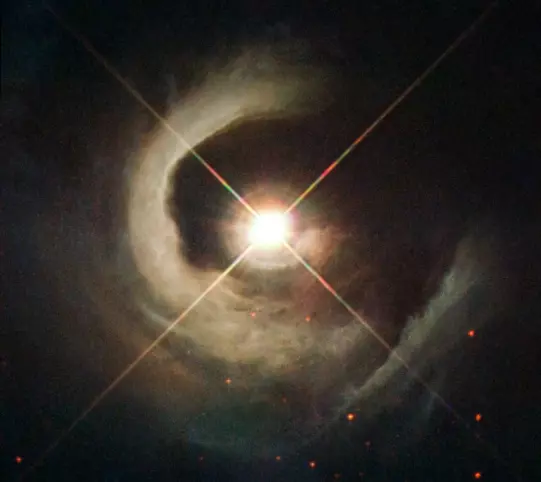
With its helical appearance resembling a snail’s shell, this reflection nebula seems to spiral out from a luminous central star in this new NASA/ESA Hubble Space Telescope image. The star in the centre, known as V1331 Cyg and located in the dark cloud LDN 981 — or, more commonly, Lynds 981 — had previously been defined as a T Tauri star. A T Tauri is a young star — or young stellar object — that is starting to contract to become a main sequence star similar to the Sun. What makes V1331 Cyg special is the fact that we look almost exactly at one of its poles. Usually, the view of a young star is obscured by the dust from the circumstellar disc and the envelope that surround it. However, with V1331 Cyg we are actually looking in the exact direction of a jet driven by the star that is clearing the dust and giving us this magnificent view. This view provides an almost undisturbed view of the star and its immediate surroundings allowing astronomers to study it in greater detail and look for features that might suggest the formation of a very low-mass object in the outer circumstellar disc. Credit: ESA/Hubble, NASA, Karl Stapelfeldt (GSFC), B. Stecklum and A. Choudhary (Thüringer Landessternwarte Tautenburg, Germany)
Low-mass stars are also formed in T associations. These are groups of young variable stars (T Tauri stars) that are still in the process of contracting. These stars form from loose fragments of small molecular cloud cores within larger regions that have a lower average density.
Bok globules, small, dark nebulae composed of dense dust and gas, make more compact sites of star formation. More than half of these objects are known to contain newborn stars. Most commonly, bok globules produce binary and multiple star systems.
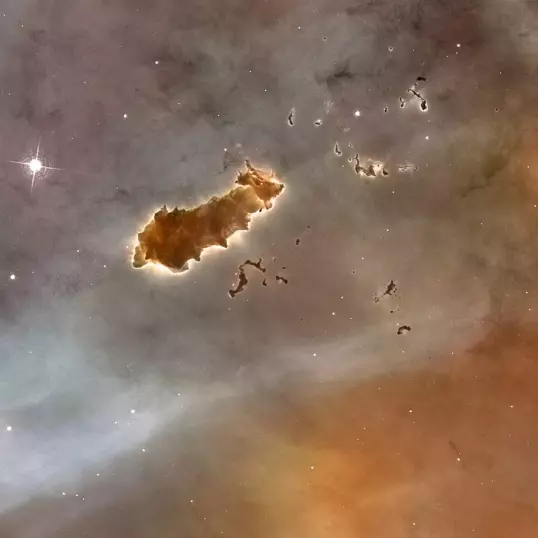
A Bok globule nicknamed the “caterpillar” appears at the right. Its glowing edge indicates that it is being photoionized by the hottest stars in the cluster. It has been hypothesized that stars may form inside such dusty cocoons. The top of the Keyhole Nebula, the most prominent feature embedded inside the Carina Nebula, is on the left. Another Bok globule is in the foreground. Image credit – Hubble: NASA, ESA, N. Smith (University of California, Berkeley), and The Hubble Heritage Team (STScI/AURA); CTIO: N. Smith (University of California, Berkeley) and NOAO/AURA/NSF
The Milky Way contains about 6,000 molecular clouds with masses of more than 100,000 solar masses. The nearest massive star-forming nebula to the Sun is the Orion Nebula, located about 1,344 light-years away. The Rho Ophiuchi cloud complex, a site of lower-mass star formation, is even closer at 460 light-years.
Other well-known star-forming regions include the Carina Nebula, the Eagle Nebula, the California Nebula, and the Tarantula Nebula, the last of which lies in the Large Magellanic Cloud.
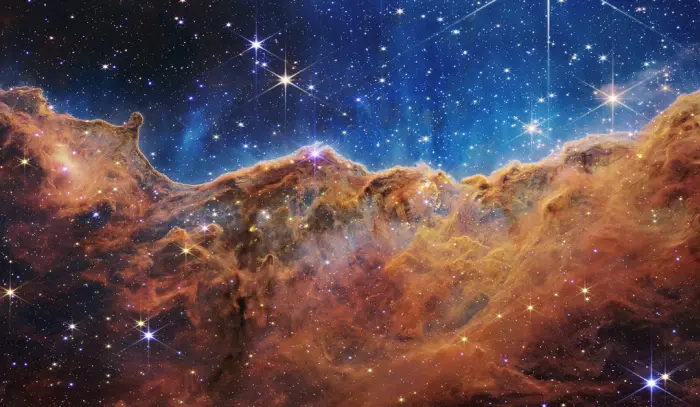
Star birth in the Carina Nebula — behind the curtain of dust and gas in these “Cosmic Cliffs” are previously hidden baby stars, now uncovered by the James Webb Space Telescope (JWST). Image: NASA, ESA, CSA, and STScI
Birth of a star
The life cycle of a star begins with the gravitational collapse of a vast molecular cloud. As the clouds contract over time, they gradually heat up, become denser, and split into smaller and smaller clumps. These small fragments are condensed into rotating disks of hot gas. New protostars with circumstellar disks of dust and gas are born within these clumps. Their envelopes of dust and gas may eventually produce planets and planetary systems. If these spinning clouds break up into smaller clumps, they produce binary and multiple star systems.
The dense cores formed within the collapsing clouds begin gathering material from their surroundings. The material may form the star itself or planets, asteroids, or comets.
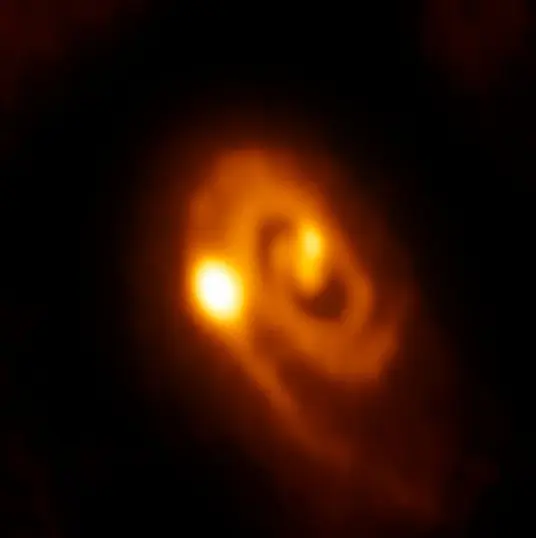
For the first time, astronomers have seen a dusty disc of material around a young star fragmenting into a multiple star system. This image comprises new observations from the Atacama Large Millimeter/submillimeter Array (ALMA), Chile, and reveals the process in action! Stars that have no companion — such as the Sun — are not as common as we once thought. In fact, almost half of the stars in our galaxy have at least one companion, and some are more sociable still! Previous studies have indicated that the stars in multiple systems tend to be either relatively close to each other, within about 500 times the Earth-Sun distance (known as an Astronomical Unit or AU), or significantly further apart, at over 1000 AU. Given these wildly different distances, scientists concluded that there were two main mechanisms producing multiple star systems — either the original cloud collapsed unstably and fragmented, each subsequent fragment crumpling to form a new star, or the rotating disc around an existing star fragmented, with the same result. This image shows the second process in action, as seen in the young triple star system L1448 IRS3B. The trio are still deeply embedded within their parent cloud in the constellation of Perseus, some 750 light-years from Earth, and are hungrily feeding from material in the surrounding disc. ALMA has revealed this disc to have a spiral structure, a feature that indicates gravitational instability. Image: ALMA (ESO/NAOJ/NRAO)/J.J. Tobin (University of Oklahoma/Leiden University)
As the surrounding clouds continue to collapse, the protostars gain more mass and become hotter. They grow by accreting the dust and gas from the parent cloud. When they reach their final mass, young stellar objects become pre-main-sequence stars. Once they are massive enough for their temperature to reach 10 million degrees Celsius, they are hot enough to start nuclear reactions in their cores and they, by definition, become stars.
Young stellar objects
Young stellar objects (YSOs) are stars in the earliest stage of evolution. They accrete mass from the infalling raw material that surrounds them and are highly active. Their powerful stellar winds blow away the surrounding clouds of gas and dust, revealing any planets that may have formed.
Young stellar objects that are gathering material from the parent cloud and are embedded in the surrounding nebulosity are known as protostars. Once their stellar winds have cleared the dust and gas and the objects are visible, they become pre-main-sequence stars. The pre-main-sequence stage is characterized by the process of contraction, which increases the internal temperature until the young stars are hot enough to start fusing hydrogen atoms into helium. At this point, they become main-sequence stars.
Protostars
Protostars are dense balls of gas that have not yet reached a temperature high enough to start burning hydrogen in their cores. They are formed at the centres of small clumps of dust and gas within larger molecular clouds. These young stars still gather mass from the surrounding molecular cloud. They are composed of about 70% hydrogen, 28% helium, and other elements in trace amounts.
The protostar stage begins when the parent cloud collapses under the force of gravity and a core is formed inside a collapsing clump. For a Sun-like star, this stage lasts about 500,000 years. It ends when the supply of infalling gas is depleted.
The dense cores – small fragments of molecular clouds – are at first in a balance between self-gravity, gas pressure, and magnetic pressure. Self-gravity compresses the object, while gas and magnetic pressure inflate it. As the fragment accretes mass from the surrounding material, self-gravity becomes stronger than pressure, triggering a collapse.
The gas falling toward the centre of the dense core first forms a protostar and then a circumstellar protoplanetary disk. As the name suggests, the protoplanetary disk is a site where planetary systems may form.
Depending on mass, protostars may evolve into pre-main-sequence stars, O-type main sequence stars, or brown dwarfs. The most massive protostars directly become luminous blue main sequence stars, while protostars that are not massive enough to start burning hydrogen become brown dwarfs, substellar objects. Low- and intermediate-mass stars go through the pre-main-sequence phase before they start fusing helium.
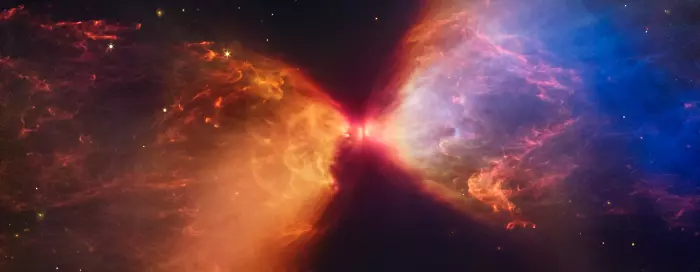
NASA’s James Webb Space Telescope has revealed the once-hidden features of the protostar within the dark cloud L1527, providing insight into the beginnings of a new star. These blazing clouds within the Taurus star-forming region are only visible in infrared light, making it an ideal target for Webb’s Near-Infrared Camera (NIRCam). The protostar itself is hidden from view within the “neck” of this hourglass shape. An edge-on protoplanetary disk is seen as a dark line across the middle of the neck. Light from the protostar leaks above and below this disk, illuminating cavities within the surrounding gas and dust. Credit: NASA, ESA, CSA, STScI; processing: Joseph DePasquale (STScI), Alyssa Pagan (STScI), Anton M. Koekemoer (STScI)
Pre-main-sequence stars
Pre-main-sequence stars are young stellar objects that have accreted almost all their mass, but their internal temperature is not high enough to start the process of nuclear fusion. Their source of energy is gravitational contraction. As these stars contract, the energy is released and the stars become hotter until they start to fuse hydrogen on the zero-age main sequence.
Depending on their mass, pre-main-sequence stars are divided into T Tauri stars and Herbig Ae/Be stars. T Tauri stars have a mass of up to 2 solar masses, while the mass of Herbig Ae/Be stars is typically between 2 and 8 solar masses. Both types of stars are less than 10 million years old.
T Tauri stars are the youngest visible stars of the spectral types F, G, K, and M, while the more massive Herbig Ae/Be stars comprise the youngest A- and B-type stars. Our Sun itself, a G-type star, likely passed through the T Tauri stage about 4.5 billion years ago.
Stars with a mass of more than 8 solar masses (class O) contract too quickly while still embedded in a gas and dust envelope and they skip the pre-main-sequence phase entirely. By the time they have blown away the surrounding clouds, they are massive and hot enough to fuse hydrogen in their cores. In other words, they are already on the main sequence.
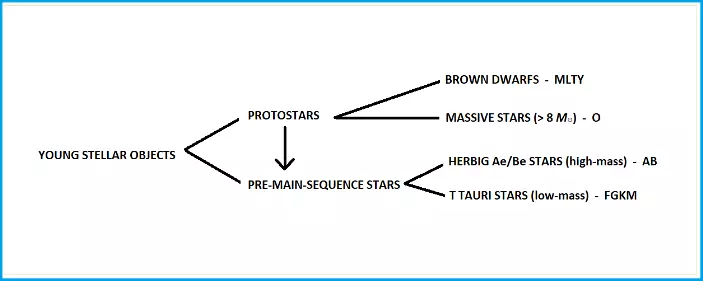
The evolution of young stellar objects
Brown dwarfs
Brown dwarfs are substellar objects that evolve from protostars with masses less than about 0.08 solar masses. These objects are not massive enough to start burning hydrogen and therefore never reach the main sequence. They can, however, fuse deuterium (heavy hydrogen) at some stage of their lives.
The first brown dwarf to be confirmed was Teide 1, a Jupiter-sized object with about 57 Jupiter masses located in the Pleiades cluster in Taurus. The discovery was verified in 1995.
The nearest pair of brown dwarfs lie in the Luhman 16 system, located only 6.503 light-years away in the constellation Vela. The discovery of the system was announced in 2013.
Brown dwarfs with masses less than 13 times that of Jupiter are called sub-brown dwarfs or planetary-mass brown dwarfs. They do not have the mass to start the thermonuclear fusion of deuterium. If they orbit around a star, they are classified as planets.
Young stellar objects that have enough mass to start fusing hydrogen in their cores evolve into main sequence stars.
Main sequence stars
Main sequence stars (or dwarfs) are stars that are converting hydrogen to helium at their cores. They make up about 90% of all known stars.
These stars burn hydrogen through nuclear fusion reactions, which produce a great deal of energy. The energy generated in the core is carried to the surface by either convection or radiation, and it is radiated away from the star’s outer shell (photosphere) in the form of heat and light. The process of producing it prevents the star from contracting further, leading to hydrostatic equilibrium. As the star evolves to a stable state, it begins the main sequence phase of its life cycle. The energy outflow from the centre both makes the star shine and keeps it from collapsing.
The main sequence is the longest stage in a star’s lifetime. Depending on the star’s initial mass, it may last for millions, billions, and even trillions of years. Our Sun, a yellow dwarf, will spend about 10 billion years on the main sequence. A star with a mass 10 times that of the Sun will spend only about 20 million years fusing hydrogen. A hot, blue B-type star like Spica (11.43 M☉) is more than halfway into its main-sequence lifetime at an age of only 12.5 million years. In contrast, a red dwarf with half the Sun’s mass can go on for 80 to 100 billion years.
Astrophysical modelling suggests that an M-type star with 10% of the Sun’s mass can stay on the main sequence for as long as 6 – 12 trillion years. It may take another several hundred billion years to gradually collapse into a white dwarf.
The different masses of main sequence stars give the stars different properties. The greater the mass, the greater the temperature of the star, which in turn affects the star’s colour. The temperature affects the properties of plasma in the star’s photosphere and, consequently, determines the star’s spectral type.
Main sequence stars are assigned seven main spectral types, which are determined based on temperature: O, B, A, F, G, K, and M.
O-type stars are the hottest and most massive, while M-class stars – red dwarfs – are the coolest, least massive, and most numerous. The table below shows the basic properties of main sequence stars across different spectral types. The life span values are illustrative and can vary significantly depending on the exact mass.
| Class | Temperature (K) | Chromaticity | Mass (M☉) | Radius (R☉) | Luminosity (L☉) | Life span (years) |
| O | ≥ 30,000 | blue | ≥ 16 | ≥ 6.6 | ≥ 30,000 | 10 million |
| B | 10,000–30,000 | blue-white | 2.1–16 | 1.8–6.6 | 25-30,000 | 100 million |
| A | 7,500–10,000 | white (blue-white) | 1.4–2.1 | 1.4–1.8 | 5–25 | 1 billion |
| F | 6,000–7,500 | white (yellow-white) | 1.04–1.4 | 1.15–1.4 | 1.5–5 | 3 billion |
| G | 5,200–6,000 | yellow | 0.8–1.04 | 0.96–1.15 | 0.6–1.5 | 10 billion |
| K | 3,700–5,200 | orange | 0.45–0.8 | 0.7–0.96 | 0.08–0.6 | 50 billion |
| M | 2,400–3,700 | orange-red | 0.08–0.45 | ≤ 0.7 | ≤ 0.08 | 200 billion |
The relationship between the stars’ absolute magnitudes (luminosities) and their spectral types (effective temperatures) is shown in the Hertzsprung-Russell diagram. The HR diagram is a colour-magnitude plot that shows stars of greater luminosity at the top and those with higher effective temperatures on the left side of the diagram. It is a useful tool in the study of stellar evolution because stars change in temperature and luminosity as they go through different stages of their evolutionary cycle.
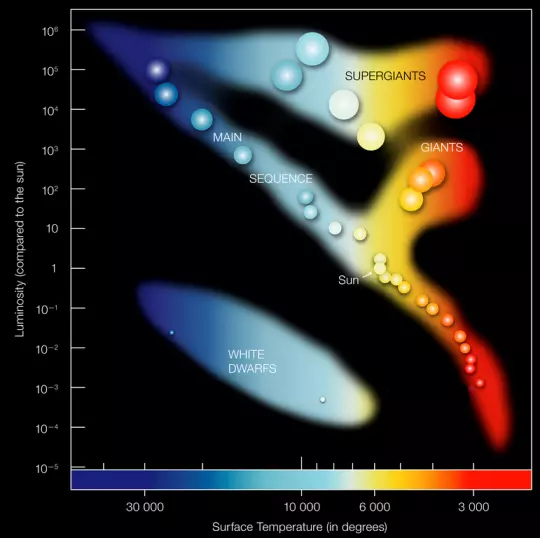
In the Hertzprung-Russell diagram the temperatures of stars are plotted against their luminosities. The position of a star in the diagram provides information about its present stage and its mass. Stars that burn hydrogen into helium lie on the diagonal branch, the so-called main sequence. Credit: ESO (CC BY 4.0)
Astronomers use the HR diagram to classify stars. The stars’ positions in the diagram reveal their evolutionary stage and internal structure. The main sequence stretches from the upper left (hot, luminous O-type stars) to the bottom right (cool, faint red dwarfs).
Once a star depletes the hydrogen in its core, its core shrinks and becomes hotter. As a result, the outer part of the star begins to expand. As the star grows in size, its surface temperature cools, making the star appear red. At this point stars with an initial mass between 0.6 and 10 solar masses evolve into red giants.
Stellar mass varies over a star’s lifetime. A star can accrete additional mass from a companion or lose it via pulsations or through a strong stellar wind. It is the initial mass that determines the life cycles of stars.
Life cycle of a low-mass star
The entire life cycle of a low-mass star has not been observed because the universe is only about 13.8 billion years old, and these stars can stay on the main sequence for trillions of years.
Stars with an initial mass of less than 0.6 solar masses do not reach the temperature required to start fusing helium. They do not produce enough gravitational pressure to trigger helium fusion.
Low-mass stars do not develop degenerate helium cores with a hydrogen-burning shell because they are fully convective. They can keep fusing hydrogen into helium until they are almost entirely made of helium. Therefore, they do not become red giants in their old age.
Modelling shows that main sequence stars with a mass about 10% that of the Sun can keep burning hydrogen for 6 to 12 trillion years. Their temperature and luminosity keep gradually increasing and they become bluer. These blue dwarfs may take another several hundred billion years to become white dwarfs.
Low mass stars are typically red dwarfs, the most common stars in the universe. Red dwarfs with a mass of more than 0.6 solar masses follow the evolutionary path of intermediate-mass stars.
Related: Life Cycles of Low-Mass Stars
Life cycle of an intermediate-mass star
Intermediate-mass stars have masses ranging from roughly 0.6 to 8 solar masses and lifespans of between 50 million and 20 billion years. They spend most of their lives on the main sequence, fusing hydrogen into helium in their cores. The Sun falls within this category.
When the core hydrogen is exhausted, these stars leave the main sequence and pass through several evolutionary stages before expelling their outer layers to form planetary nebulae and ending their lives as faint white dwarfs.
Red giant phase
Once a medium-sized star runs out of hydrogen in its core, the core contracts and the star begins fusing hydrogen in a shell around the core. The star’s outer layers expand and cool, and the star becomes a red giant. The red giant phase is divided into several stages: the subgiant branch, the red giant branch (RGB), the horizontal branch (HB), and the asymptotic giant branch (AGB).
On the subgiant branch, the star expands and cools while retaining a similar luminosity to the one it had while on the main sequence. It then ascends the red giant branch, during which the helium core grows and becomes more massive. Subsequently, the star grows in size and luminosity while its surface temperature slightly decreases.
As the inert helium core increases in size and mass, it becomes degenerate. As a result, in stars with masses of roughly 0.6 to 2 solar masses, a thermal runaway event kickstarts the fusion of helium into carbon in the core. The event is known as the helium flash.
The energy released in the helium flash lifts the degeneracy in the core, which then expands and cools. At this point, the star moves to the horizontal branch, where it fuses helium in its core and hydrogen in a surrounding shell.
More massive intermediate-mass stars ignite helium more gradually. Their cores are larger and do not become degenerate before they reach the Schönberg–Chandrasekhar mass limit (the maximum stable mass of a core that can support the pressure of an overlying envelope). Once the core reaches the mass limit, it quickly contracts and heats up, which results in an increase in the fusion rate in the hydrogen shell and in the star’s luminosity.
Once the core helium is exhausted, the star moves to the asymptotic giant branch. During this stage, it fuses hydrogen and helium in two concentric shells around an inert carbon-oxygen core. Stars can grow to sizes of 1 astronomical unit during the AGB phase, and they can lose 50 to 70 percent of their initial mass through strong stellar winds.
When the helium shell runs out of fuel, stars enter the thermally pulsing AGB phase (TB-AGB). The fusion of hydrogen in a thin shell becomes the main source of energy.
The accumulation of helium in the shell over tens of thousands of years eventually triggers a helium shell flash, which increases the star’s luminosity by thousands of times before fading. The star expands and decreases in temperature and the hydrogen burning stops for a time. When the helium fusing shell comes near the hydrogen shell, it triggers hydrogen fusion again, restarting the cycle of thermal pulsations.
Thermal pulses cause the mixing of material from the core to the surface, which changes the star’s surface composition.
Planetary nebulae and white dwarfs
An intermediate-mass star is not massive enough to begin fusing carbon. Instead, in the post-asymptotic giant branch (post-AGB) phase, the star expels its remaining outer envelope through a superwind to form a planetary nebula.
Planetary nebulae are glowing shells of gas ionized by the exposed stellar core. They are typically one light-year across. They dissipate into the interstellar medium within a few tens of thousands of years.
The expelled material is rich in carbon, nitrogen, and other elements produced by nuclear fusion in the star’s interior. Once expelled, it enriches the surrounding interstellar medium and is recycled to form future generations of stars.
The remnant core of the red giant star cools and eventually becomes a white dwarf. These dense, Earth-sized objects are composed mainly of carbon and oxygen. Without an ongoing source of nuclear energy, they slowly radiate away their heat over trillions of years.
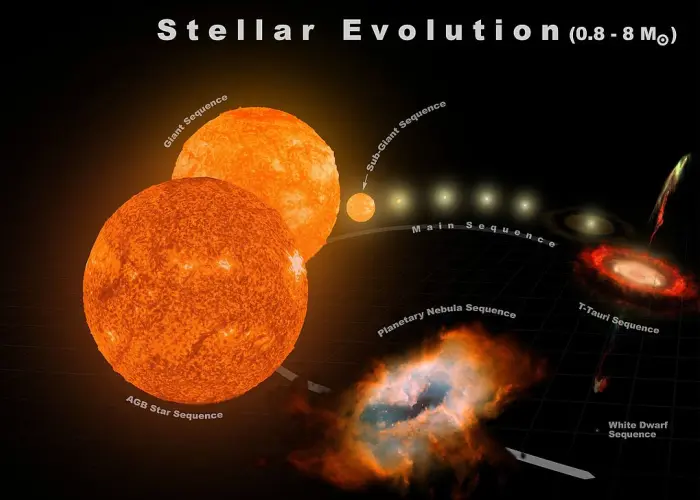
The life cycle of intermediate-mass stars. Image credit: Wikimedia Commons/Antonio Ciccolella (CC BY-SA 4.0)
Related: Life Cycles of Intermediate-Mass Stars
Life cycle of a massive star
The life cycles of massive stars are much shorter than those of intermediate-mass stars. Because of their large mass, these stars go through their supply of hydrogen fuel faster and evolve away from the main sequence within millions of years. They evolve into supergiants, stars that are larger and more luminous than giants and main sequence stars of the same spectral types.
The stars that evolve into supergiants are typically the hot blue main sequence stars of the spectral type O and the most massive B-type stars.
These stars have lifespans between a few hundred thousand years and 30 million years, depending on mass. Because they do not live very long, they do not have much time to move away from their place of birth. They are mostly found in open clusters and spiral arms of galaxies.
Supergiants may be from one thousand to more than a million times more luminous than the Sun. Their radii tend to be between 30 and 500 solar radii, but some stars exceed 1,000 solar radii. The largest supergiants can have a size of about 1,500 solar radii, but radiation pressure limits them from expanding much beyond that. If they do exceed this limit, the stars become unstable, begin to pulsate, and suffer mass loss at an exorbitant rate.
Stars with initial masses of more than 8-10 solar masses undergo carbon fusion and end their lives in core-collapse supernovae that produce stellar-mass black holes.
Supergiant stage
Evolutionary supergiants start fusing helium in their cores shortly after running out of hydrogen fuel. When they run out of hydrogen, they expand in size. However, unlike intermediate-mass stars, these stars smoothly transition away from the main sequence and keep fusing heavier elements until they develop iron cores.
Massive stars grow in size after leaving the main sequence, but they do not become as dramatically brighter as smaller stars. When they start hydrogen shell burning, their cores are already large enough to ignite helium burning. They start fusing helium without a helium flash, before their cores become degenerate. The phase during which massive stars have both hydrogen and helium-burning shells is called the asymptotic-giant branch (AGB), the same as with intermediate-mass stars.
Since these stars are massive enough to keep burning elements heavier than helium, they do not eject their atmospheres like intermediate-mass stars. The fusion does not stop at carbon. The carbon-oxygen cores of massive stars shrink and their temperatures rise to the point at which they can start fusing carbon.
During this phase, carbon and oxygen are converted to a complex fusion that contains mostly oxygen, neon and magnesium, while helium is fused in a shell around the core. The helium fusion shell is nested within a hydrogen-burning shell.
When carbon fusion stops in the core, the core shrinks and carbon fusion moves to an outward shell. The oxygen-neon-magnesium core heats up and keeps burning until it is dominated by silicon and sulfur. It then continues fusing heavier elements all the way to iron.
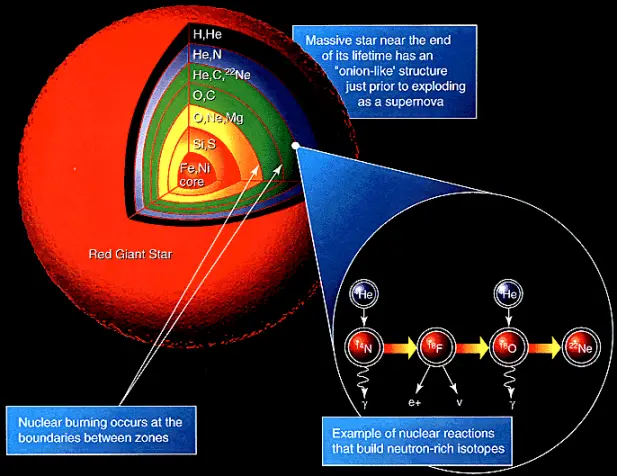
Nucleosynthesis in a red supergiant, image: NASA
Each fusion phase lasts shorter and produces less energy. The silicon fusion produces an iron core within weeks. The iron core cannot create energy and it suddenly collapses. The rebound blows away the star’s outer layers, resulting in a supernova event.
The core collapse occurs because the cores of massive stars ultimately become so massive that electron degeneracy pressure cannot prevent them from collapsing. Electron degeneracy pressure is what prevents the gravitational collapse of white dwarfs and stars with a mass under 1.44 solar masses (the Chandrasekhar limit). Stars that exceed this limit without significant thermally generated pressure collapse to form either a neutron star or a black hole. They are too massive to evolve into white dwarfs.
Supernovae
When a red supergiant’s core collapses, it produces a type II supernova. This type of supernova can reach an absolute magnitude of -18 and outshine entire galaxies. Most type II supernovae are triggered by red supergiants.
Supergiant stars fuse elements with an increasingly high atomic mass until they have a core of iron and nickel. The nickel-iron core is inert because the fusion of either of these elements does not produce any net energy output that would create outward thermal pressure. In other words, iron requires more energy than is produced by fusion. As a result, the core contracts under the force of gravity.
When the mass of the core exceeds the Chandrasekhar limit, the gravitational pressure can no longer be countered by electron degeneracy and the inner core implodes. The implosion causes the outer core to collapse inwards. The pressure increases the temperature of the inner core to up to 10 billion kelvins, but the implosion of the inner core is prevented by neutron degeneracy. Instead, the implosion bursts outward, triggering a supernova explosion. The energy of the shock wave accelerates the outer stellar material to escape velocity.
Supernova remnants – the glowing clouds formed from the star’s material – are highly enriched in iron and other heavy elements produced by fusion in the stars’ interiors. The shock wave from the supernova heats and compresses the interstellar medium, and the heavy elements become part of molecular clouds.
The core remains of the original star form a neutron star or a black hole, depending on the star’s initial mass.
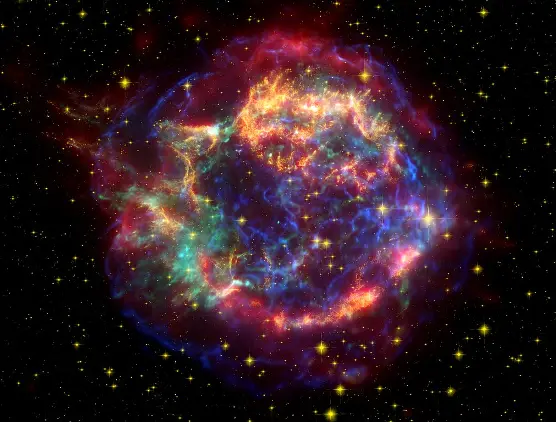
This stunning picture of the supernova remnant Cassiopeia A is a composite of infrared (red), optical (yellow) and X-ray (green and blue) images. The infrared image from the Spitzer Space Telescope reveals warm dust in the outer shell with temperatures of about 25 degrees Celsius, whereas the optical image from the Hubble Space telescope brings out the delicate filamentary structures of warmer (10,000 Celsius) gas; Chandra shows hot gases at about 10 million degrees Celsius. This hot gas was created when ejected material from the supernova smashed into surrounding gas and dust at speeds of about ten million miles per hour. A comparison of the infrared and X-ray images of Cas A should enable astronomers to determine whether most of the dust in the supernova remnant came from the massive star before it exploded, or from the rapidly expanding supernova ejecta. Image credit – X-ray: NASA/CXC/SAO; Optical: NASA/STScI; Infrared: NASA/JPL-Caltech
Related: Life Cycles of High-Mass Stars
Stellar remnants
Stellar remnants (or compact stars) are the endpoints of stellar life cycles. White dwarfs, neutron stars and black holes are high-density objects that pack an enormous amount of mass into relatively small radii. They form when the outward pressure from the nuclear fusions in the stellar core can no longer resist the forces of gravity and the star collapses.
Low and intermediate-mass stars become white dwarfs, while massive stars form neutron stars or black holes. Compact stars with a mass under 1.39 solar masses are generally white dwarfs, while those with a mass between 1.4 and 2.16 solar masses are neutron stars. Low-mass neutron stars and massive white dwarfs may overlap in mass. Remnants with a mass beyond 2.16 solar masses are believed to form black holes.
Unlike active stars, compact stars – neutron stars, white dwarfs, and black holes – do not produce energy in their interiors and maintain their structure regardless of temperature. White dwarfs and neutron stars may radiate the heat left over from the collapse for millions of years. In the process, they lose energy and become cooler. Black holes are thought to eventually evaporate from Hawking radiation, black body radiation released outside the event horizon that reduces the black holes’ mass and rotational energy. This is a very slow and gradual process that can last for trillions of years.
White dwarfs
A white dwarf is the remaining core of a red giant star that was not massive enough to reach the core temperatures required to fuse carbon. These stellar remnants are very dense. They pack a mass comparable to that of the Sun into a volume similar to the Earth’s. More than 97% of stars in our galaxy will become white dwarfs when they come to the end of their lives.
Most white dwarfs consist of carbon and oxygen. These are the remnants of stars not massive enough to fuse carbon. Larger stars with a mass between 8 and 10.5 times that of the Sun may reach a core temperature high enough to burn carbon, but not neon. These stars form oxygen-neon-magnesium white dwarfs. Very low-mass stars that are unable to fuse helium become helium white dwarfs.
Carbon-oxygen white dwarfs that accrete mass from a companion star and reach a mass of about 1.44 solar masses may reach a core temperature for carbon fusion, which triggers a runaway reaction that leads to a type Ia supernova explosion.
White dwarfs consist mostly of electron-degenerate matter. Once a star no longer burns hydrogen, its core becomes an accumulation of positively charged ions – mainly carbon and helium nuclei – surrounded by electrons that have been stripped from the nuclei. The electron degeneracy pressure supports the star against gravitational collapse.
The surface temperatures of white dwarfs range from more than 150,000 K to just under 4,000 K, corresponding to luminosities of more than 100 times that of the Sun to less than 1⁄10,000 that of the Sun. White dwarfs with effective temperatures of more than 30,000 K emit soft X-rays and can be studied by soft X-ray and extreme ultraviolet (EUV) observations.
White dwarfs take a long time to cool. Scientists estimate that it would take them a quadrillion years (1015) to cool to 5,000 K. However, the existence of weakly interacting massive particles (WIMPs) may keep them warmer for about 1025 years. WIMPS are hypothetical elementary particles that are one of the candidates for dark matter. White dwarfs may also stay warmer if protons are unstable. The energy released from proton decay (a theoretical form of particle decay) may raise the surface temperature of a white dwarf with one solar mass to 0.06 K.
When they radiate their energy away, white dwarfs stop emitting light and heat and become black dwarfs. Black dwarfs are hypothetical remnants. They have not been observed yet because the time it takes for a white dwarf to cool is longer than the age of the universe. Black dwarfs would be hard to observe because they would not emit much radiation, but their gravitational influence may make them detectable.
The nearest known white dwarf is Sirius B, the companion to Sirius, the brightest star in the sky. It is located only 8.60 light-years away. With a mass of 1.02 solar masses, Sirius B has almost twice the mass of an average white dwarf, while its volume is roughly the same as the Earth’s. It has a surface temperature of 25,200 K, which will gradually decrease for more than two billion years. The original star was believed to have been a B-type main sequence star with a mass five times that of the Sun and a luminosity of 600 to 1,200 Suns.
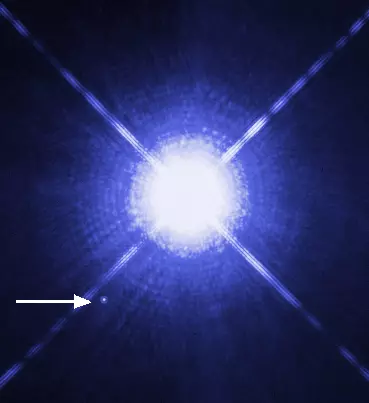
The white dwarf Sirius B, image credit: NASA, ESA, H. Bond (STScI), and M. Barstow (University of Leicester)
Neutron stars
Neutron stars are stellar remnants formed from supernova explosions of massive stars combined with gravitational collapse. They are produced by supergiants with a mass of 10 – 25 times that of the Sun. Apart from black holes, neutron stars are the smallest and densest stellar objects known. They typically have a mass of about 1.4 solar masses packed within a radius of only 10 kilometres. These remnants consist almost entirely of neutrons, subatomic particles with a neutral charge. They have surface temperatures of about 600,000 K and gravitational fields 200 billion times that of the Earth.
Neutron stars are also formed in binary systems containing a white dwarf. If the white dwarf is accreting mass from the companion, it will eventually exceed the Chandrasekhar limit. If the core of the white dwarf is composed mostly of carbon and oxygen, the fusion of these elements will trigger a Type Ia supernova.
However, if the centre consists mostly of magnesium or heavier elements, then the collapse continues. As the remnant becomes denser, the electrons react with the protons to produce more neutrons. As the density increases, the neutrons become degenerate. Once the remnant shrinks to a radius between 10-20 kilometres, it reaches a new equilibrium and becomes a neutron star. It is partly supported by neutron degeneracy pressure against collapse.
More massive neutron stars cannot be supported by neutron degeneracy pressure alone. Repulsive nuclear forces help support them against collapse.
In neutron stars, the collapse of the core results in a faster rotation due to the conservation of angular momentum. When neutron stars are formed, they retain most of their angular momentum, but since they are considerably smaller than their progenitors, their moment of inertia is markedly reduced. They spin up to several hundred times per second. If they emit beams of electromagnetic radiation, they are detectable as pulsars.
Neutron stars with a mass of more than 2.16 solar masses cannot be supported by degeneracy pressure and nuclear forces. They continue to collapse to produce black holes. The most massive neutron star known as of 2022 is PSR J0952–0607, a millisecond pulsar in a binary system. It has a mass of 2.35 ± 0.17 solar masses. It is the fastest-spinning pulsar in the Milky Way and the second-fastest-spinning pulsar discovered to date.
Pulsars are fast-spinning neutron stars that emit electromagnetic beams out of their magnetic poles. If the beams are pointing toward Earth, they can be detected as pulses of radiation. The pulses have short and regular periods, ranging from milliseconds to seconds.
Like white dwarfs, neutron stars do not generate heat once they are formed. They decrease in temperature over time, and their rotation speed slows over a very long period.
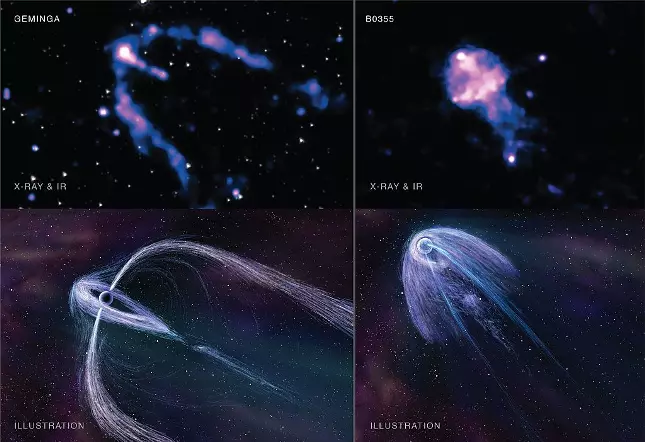
The neutron star Geminga, image: NASA/CXC/PSU/B. Posselt et al; Infrared: NASA/JPL-Caltech; B0355+54: X-ray: NASA/CXC/GWU/N. Klingler et al; Infrared: NASA/JPL-Caltech; Illustrations: Nahks TrEhnl
Black holes
Black holes are defined as regions of spacetime where gravity is so strong that nothing has the energy required to escape. This happens because enough matter or energy is compressed into a radius so small that the escape velocity exceeds the speed of light. The boundary beyond which nothing – including light and other electromagnetic waves – can escape is called the event horizon.
Black holes form from stellar remnants with a mass of about 2-3 solar masses, in which neutron degeneracy pressure cannot prevent collapse. They are produced by supernovae. It is currently uncertain whether a star can collapse directly into a black hole without first forming an unstable neutron star or producing a supernova.
Black holes do not reflect light and cannot be observed directly. Their presence can be inferred by observing their interaction with the surrounding matter and the orbits of nearby stars.
Black holes are believed to emit Hawking radiation, black body radiation that reduces their mass and rotational energy, causing them to eventually evaporate. Black holes that do not gain mass by absorbing it from their surroundings are thought to shrink and vanish over a very long period.
Black holes produced by the collapse of massive stars are often referred to as stellar mass black holes or collapsars to distinguish them from intermediate-mass black holes and supermassive black holes. Intermediate-mass black holes may form through the mergers of stellar black holes, by means of accretion, or in the collision of massive stars in tightly packed star clusters. Supermassive black holes are found in the centres of galaxies. Their formation is still a subject of ongoing research.
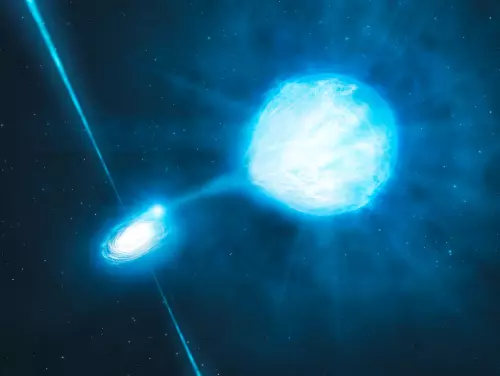
This artist’s impression depicts the newly discovered stellar-mass black hole in the spiral galaxy NGC 300. The black hole has a mass of about twenty times the mass of the Sun and is associated with a Wolf–Rayet star; a star that will become a black hole itself. Thanks to the observations performed with the FORS2 instrument mounted on ESO’s Very Large Telescope, astronomers have confirmed an earlier hunch that the black hole and the Wolf–Rayet star dance around each other in a diabolic waltz, with a period of about 32 hours. The astronomers also found that the black hole is stripping matter away from the star as they orbit each other. How such a tightly bound system has survived the tumultuous phases that preceded the formation of the black hole is still a mystery. Image: ESO/L. Calçada/M.Kornmesser (CC BY 4.0)