High-mass stars are among the most energetic and short-lived objects in the universe. With initial masses greater than roughly 8 to 10 solar masses, these stars burn through their nuclear fuel at an extraordinary rate and evolve away from the main sequence within millions of years. They end their lives in spectacular core-collapse supernovae.
The life cycles of massive stars span between a few hundred thousand and 30 million years. In comparison, intermediate-mass stars like the Sun live for about 10 billion years, and low-mass red dwarfs like Proxima Centauri can live for trillions of years.
After leaving the main sequence, high-mass stars evolve into luminous supergiants. Some of the most massive among them pass through additional stages as luminous blue variables or Wolf-Rayet stars before the final collapse.
The supernova events that end their lives release large quantities of heavy elements into the interstellar medium, enriching the environment in which future stars and planets will form. The compact remnants of massive stars, neutron stars and black holes, are the densest stellar objects known.
Definition and general properties
High-mass stars are generally defined as stars with initial masses greater than about 8 to 10 solar masses. This is the threshold above which a star can fuse carbon and ultimately go out as a core-collapse supernova.
The stars that evolve into supergiants are typically the hot blue main sequence stars of spectral type O and the most massive B-type stars. On the main sequence, these stars are the most luminous and hottest of all. Their surface temperatures commonly range from around 10,000 K to over 50,000 K, and luminosities from tens of thousands to over a million times that of the Sun.
Because of their large masses, high-mass stars exhaust their hydrogen fuel far more quickly than lower-mass stars and evolve into supergiants within millions of years. Because they do not live very long, these hot blue stars do not have much time to move far from their place of birth. They are mostly found in open clusters and in the spiral arms of galaxies.
Famous stellar nurseries that contain them include the Orion Nebula (M42), the Carina Nebula (NGC 3372), the Lagoon Nebula (M8), the Cone Nebula (NGC 2264), and the Tarantula Nebula (30 Doradus).
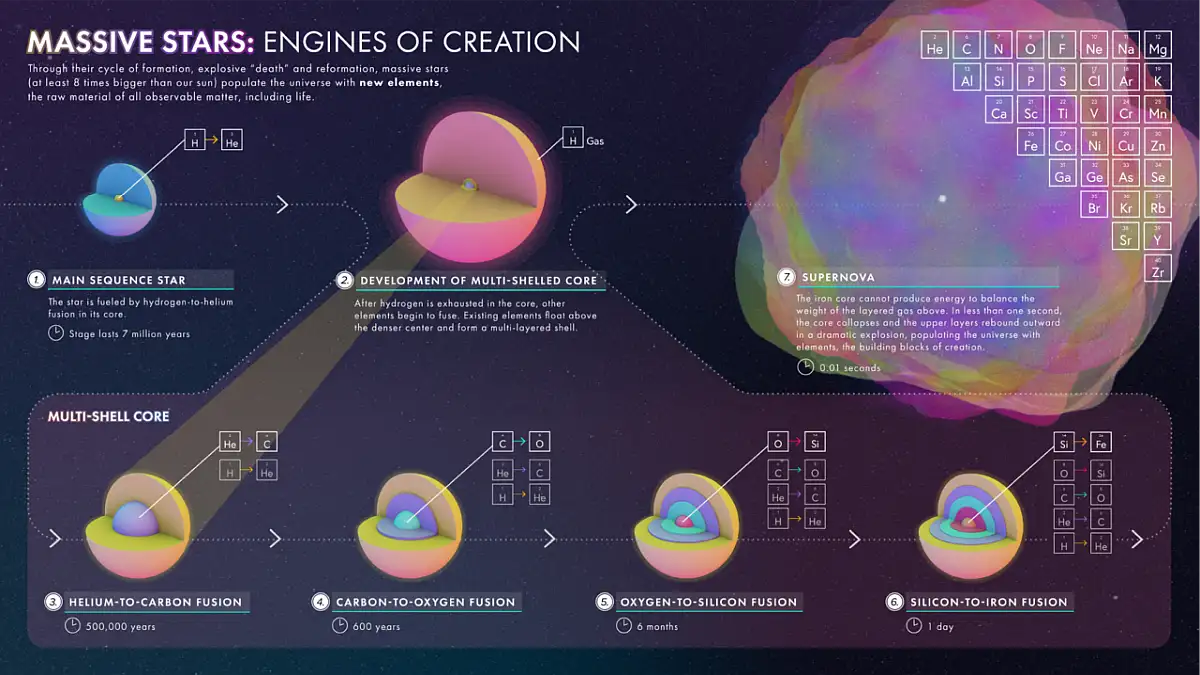
This illustration demonstrates how a massive star (at least 8 times bigger than our sun) fuses heavier and heavier elements until going out as a supernova and spreading those elements throughout space. Image credit: NASA, ESA, and L. Hustak (STScI) (CC BY 2.0)
Main sequence phase
Like all stars, high-mass stars join the main sequence when they begin fusing hydrogen into helium in their cores. For stars above roughly 1.3 solar masses, the dominant fusion process is the CNO cycle (carbon-nitrogen-oxygen cycle), in which carbon, nitrogen, and oxygen act as catalysts.
In massive stars, the high rate of energy generation drives strong convection throughout the stellar core. This convective mixing continuously circulates fresh hydrogen into the core and distributes the helium produced by fusion throughout it.
The outer envelopes of high-mass stars are, by contrast, largely radiative. Energy is transported outward by radiation rather than by movement of plasma. This structure distinguishes massive stars from the fully convective low-mass red dwarfs and from intermediate-mass stars, in which convection is confined to specific zones.
Mass loss on the main sequence
Massive stars lose significant amounts of mass in the form of powerful stellar winds even before they leave the main sequence. These stars can have surface temperatures and luminosities so high that the outward force caused by radiation pressure drives their material away at high velocities.
Stars with initial masses above approximately 40 solar masses tend to lose mass so quickly that they may lose their outer layers before they expand to become red supergiants. As a result, they stay hot and blue throughout their evolution.
Evolution away from the main sequence
When a massive star runs out of hydrogen in its core, the core contracts and becomes hotter and denser. Hydrogen fusion shifts to a shell surrounding the core. As this shell generates increasing amounts of energy, the outer layers of the star expand and cool.
Unlike intermediate-mass stars, which brighten dramatically as they expand to become red giants, high-mass stars are already so luminous on the main sequence that their expansion into supergiants does not result in such a striking change in brightness. They expand and cool, moving roughly horizontally across the Hertzsprung-Russell diagram toward the red supergiant region.
Helium ignition without a flash
Massive stars start fusing helium in their cores without experiencing a helium flash. Their cores are already large enough at the beginning of hydrogen shell burning that helium ignition happens more gradually, without a flash, as soon as the cores reach the required temperature.
In contrast, in stars with masses of 0.6 to 2 solar masses, the helium core becomes electron-degenerate before it reaches a temperature high enough to fuse helium. The helium ignition occurs very suddenly as a helium flash.
This smooth transition means that evolutionary supergiants start fusing helium in their cores shortly after running out of hydrogen fuel. When they run out of hydrogen, they expand in size like intermediate-mass stars. However, unlike these stars, they keep moving away from the main sequence and fusing progressively heavier elements until they develop iron cores.
This is another key distinction between high-mass and intermediate-mass stars. Mid-sized stars are not massive enough to start carbon fusion, so they never develop an iron core. Instead, they lose their outer envelopes, leaving behind exposed stellar cores that slowly cool and fade as white dwarfs.
Supergiant phase
Once a high-mass star has left the main sequence and begun helium fusion, it becomes a supergiant. Supergiants are among the most luminous stars known. They can be from around one thousand to more than one million times more luminous than the Sun. Their radii vary from around 30 to over 500 solar radii.
The brightest supergiant stars in the sky are Rigel and Betelgeuse in the constellation Orion, Antares in Scorpius, and Deneb in Cygnus. These massive stars are destined to end their lives as spectacular supernovae.
The largest known supergiants, including WOH G64, RSGC-F01 and VY Canis Majoris, have sizes of roughly 1,500 solar radii. Radiation pressure sets an upper limit on how large they can expand. If a star exceeds this limit, it becomes structurally unstable, begins to pulsate, and can suffer exceptionally high rates of mass loss.
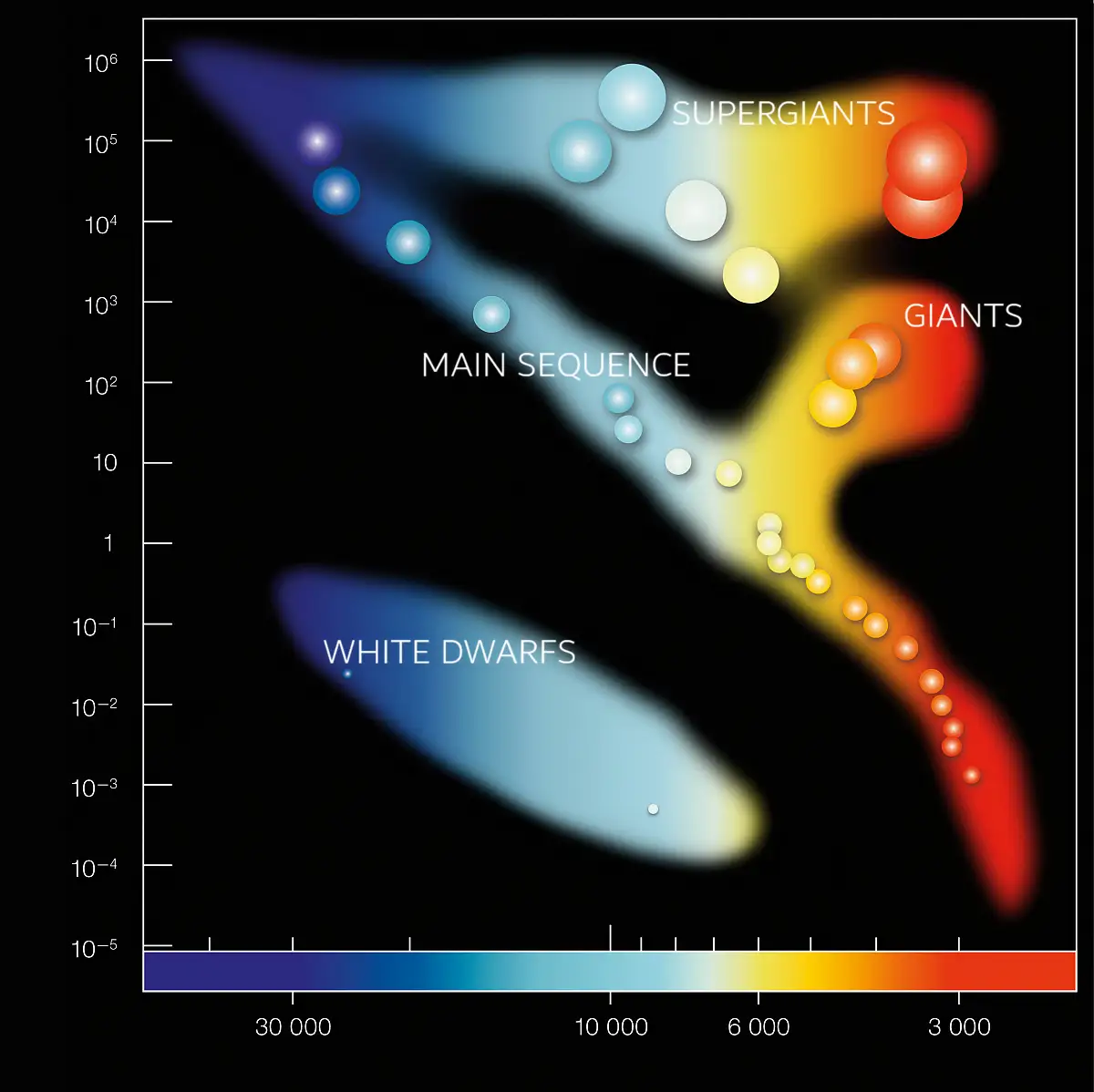
Supergiant stars in the Hertzsprung-Russell diagram. Credit: ESO (CC BY 4.0)
Red supergiants
Stars with initial masses of approximately 8 to 30-40 solar masses typically expand into red supergiants after leaving the main sequence. Red supergiants are defined as the helium-burning evolutionary phase of moderately massive stars. They are among the physically largest stars known, with surface temperatures of roughly 3,450 to 4,100 K and luminosities up to several hundred thousand times that of the Sun.
The brightest red supergiants in the sky are Betelgeuse at the shoulder of Orion and Antares at the heart of Scorpius. Betelgeuse has a mass of 14 – 19 solar masses, a radius between 640 and 764 solar radii, an effective temperature of around 3,600 K, and a luminosity around 65,000 times that of the Sun. The evolved star is believed to be less than 14 million years old.
Antares has an estimated age of only 15 million years. It has a radius about 680 times the Sun’s, a mass in the range from 13 to 16 solar masses, and a luminosity of around 75,900 Suns with a surface temperature of 3,660 K.
Red supergiants like Betelgeuse and Antares experience significant mass loss through stellar winds because of their high luminosities and low surface gravities. The rate of mass loss affects the duration of the red supergiant phase. By the time these stars reach a mass of around 10 solar masses, their cores collapse, triggering luminous supernovae.
Some massive stars go out as supernovae in the red supergiant phase while others evolve back toward higher temperatures.
Blue supergiants and luminous blue variables
Not all massive stars spend most of their post-main-sequence life as red supergiants. More massive stars, as well as red supergiants that have shed enough outer material, can be found in the blue supergiant region of the Hertzsprung-Russell diagram.
Blue supergiants are hot, luminous stars with surface temperatures between roughly 10,000 and 50,000 K. They are found toward the upper left of the Hertzsprung-Russell diagram. These stars typically represent an intermediate evolutionary stage between hydrogen-fusing main sequence stars and helium-fusing red supergiants. They can also form in stellar mergers. The evolutionary paths of blue supergiants are complex and not fully understood.
Blue supergiants are the natural result of evolution of hot, blue O- and B-type stars with initial masses of over 10 solar masses. These stars evolve away from the main sequence within a few million years after consuming the hydrogen in their cores and starting to fuse it in a hydrogen shell around the core.
Many of these hot massive stars become luminous blue variables (LBVs). These are highly unstable stars that experience episodes of dramatic mass loss. They lose mass both in periodic outbursts and occasional larger eruptions that significantly increase the stars’ brightness.
The star Eta Carinae, a well-known luminous blue variable, was a fourth magnitude star before it famously outshone Rigel during its Great Eruption in 1837. By March 1843, it brightened to become the second-brightest star in the sky before fading.
During the eruption, the star is estimated to have expelled over 20 solar masses of material. The ejected material now forms the Homunculus Nebula, a peanut-shaped emission and reflection nebula that heavily obscures the central star system.
The most massive hot blue stars may evolve directly into Wolf-Rayet stars.
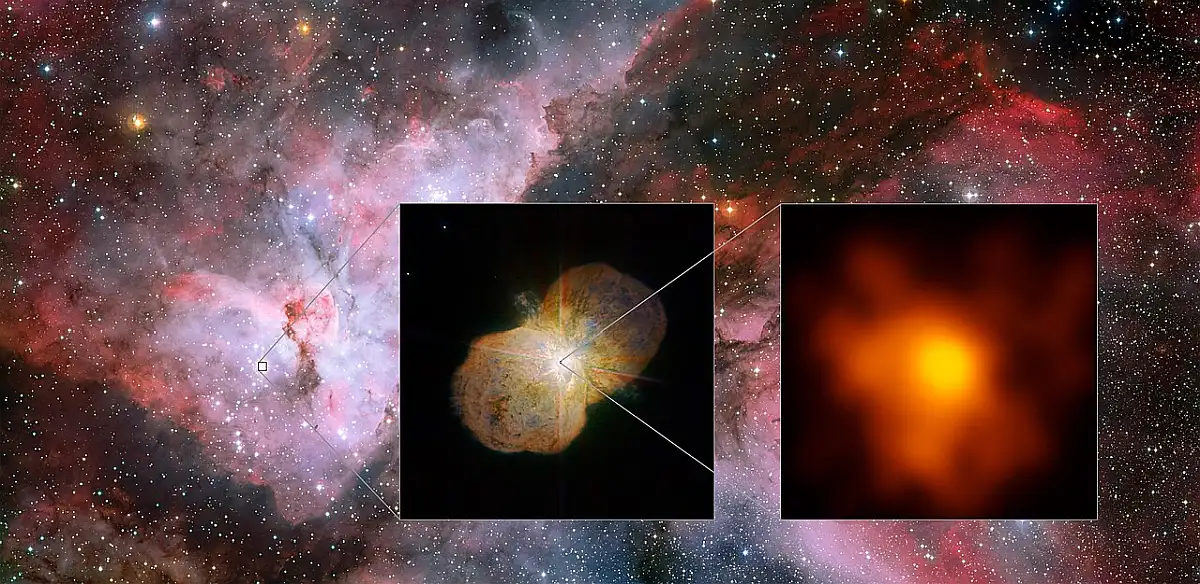
This mosaic shows the Carina Nebula (left part of the image), home of the Eta Carinae star system. This part was observed with the Wide Field Imager on the MPG/ESO 2.2-metre telescope at ESO’s La Silla Observatory. The middle part shows the direct surrounding of the star system: the Homunculus Nebula, created by the ejected material from the Eta Carinae system. This image was taken with the NACO near-infrared adaptive optics instrument on ESO’s Very Large Telescope. The right image shows the innermost part of the system as seen with the Very Large Telescope Interferometer (VLTI). It is the highest resolution image of Eta Carinae ever. Credit: ESO/G. Weigelt (CC BY 4.0)
Wolf-Rayet stars
Wolf-Rayet stars are a class of highly evolved massive stars with high surface temperatures and spectra dominated by broad emission lines of ionized helium nitrogen, carbon, or oxygen.
Wolf-Rayet stars are thought to be in a transitional phase between the supergiant stage and the supernova. Their dense stellar winds have velocities reaching up to 3,000 km per second and eject material at high rates.
With surface temperatures of 20,000 K to 210,000 K, Wolf-Rayet stars are among the hottest stellar objects known, along with neutron stars and white dwarfs. The hottest star currently known, WR 102, is a Wolf-Rayet star with an estimated temperature of 210,000 K. It is, however, not among the most massive stars known. It packs a mass of 16.1 solar masses into a radius only 52% percent that of the Sun.
Wolf-Rayet stars are small, exceptionally dense stars surrounded by extended envelopes of expelled material. Because of their powerful stellar winds, they have typically lost most or all of their outer hydrogen envelopes, leaving the products or nuclear fusion exposed at or near their surfaces.
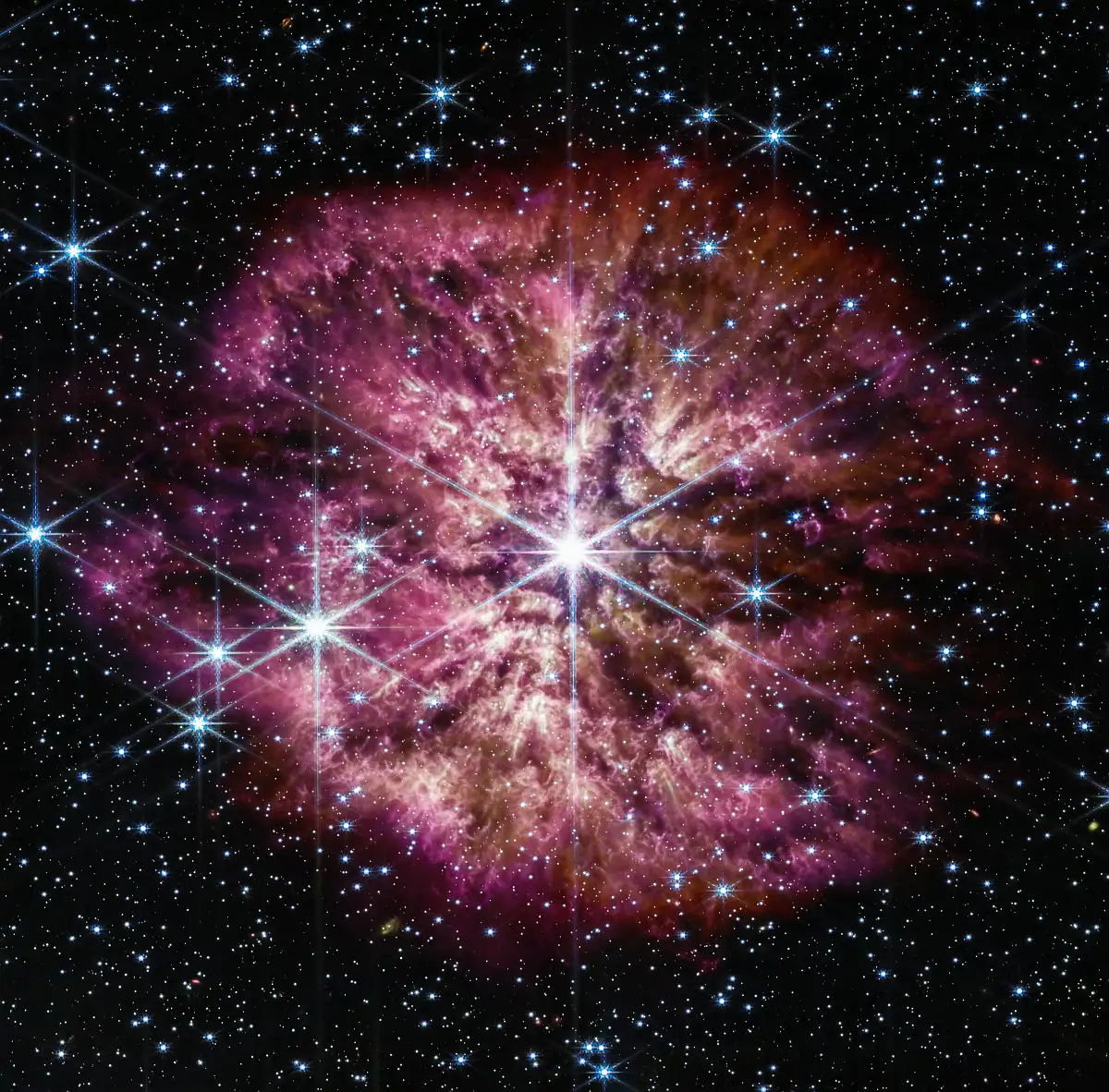
This rare sight is a super-bright, massive Wolf-Rayet star. Calling forth the ephemeral nature of cherry blossoms, the Wolf-Rayet phase is a fleeting stage that only some stars go through soon before they go out as supernovae. The star, WR 124, is 15,000 light-years away in the constellation Sagittarius. It is 30 times the mass of the Sun and has shed 10 Suns worth of material – so far. As the ejected gas moves away from the star and cools, cosmic dust forms and glows in the infrared light detectable by Webb. The origin of cosmic dust that can survive a supernova is of great interest to astronomers for multiple reasons. Dust shelters forming stars, gathers together to help form planets, and serves as a platform for molecules to form and clump together, including the building blocks of life on Earth. Stars like WR 124 also help astronomers understand the early history of the universe. Similar stars first seeded the young universe with heavy elements forged in their cores – elements that are now common in the current era, including on Earth. Image credit: NASA, ESA, CSA, STScI, Webb ERO Production Team (CC BY 2.0)
Wolf-Rayet stars are classified into WN, WC, and WO subtypes based on whether their spectra are dominated by nitrogen, carbon, or oxygen emission lines. The abundance of these elements in the stellar spectra reflects the depth to which the outer layers have been stripped away.
The Wolf-Rayet class includes some of the most luminous and massive stars known, among them R136a1 and BAT99-98 in the Tarantula Nebula in the Large Magellanic Cloud. These stars have masses over 200 times that of the Sun, and their energy output is measured in millions solar luminosities.
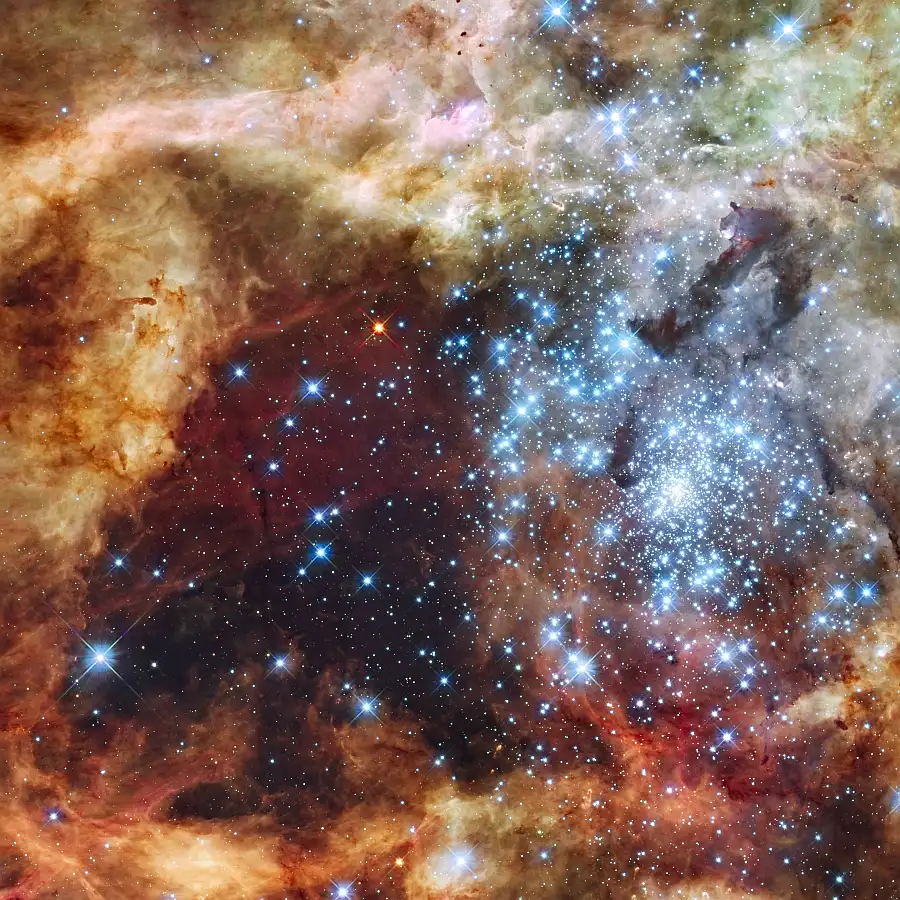
This is a view of the largest stellar nursery in our local galactic neighborhood. The massive, young stellar grouping, called R136, is only a few million years old and resides in the 30 Doradus Nebula, a turbulent star-birth region in the Large Magellanic Cloud (LMC), a satellite galaxy of our Milky Way. There is no known star-forming region in our galaxy as large or as prolific as 30 Doradus. Many of the diamond-like icy blue stars are among the most massive stars known. Several of them are over 100 times more massive than our Sun. These hefty stars are destined to pop off, like a string of firecrackers, as supernovas in a few million years. Image credit: NASA, ESA, F. Paresce (INAF-IASF, Bologna, Italy), R. O’Connell (University of Virginia, Charlottesville), and the Wide Field Camera 3 Science Oversight Committee (PD)
Advanced nuclear burning
The defining characteristic that separates high-mass stars from all lower-mass stars is their ability to fuse elements heavier than hydrogen and helium in their cores. Once the helium in the core is exhausted, the carbon-oxygen core contracts and heats until carbon fusion can begin.
Intermediate-mass stars never reach temperatures high enough to fuse carbon. Instead, they end their lives by expelling their outer layers to form planetary nebulae. High-mass stars continue burning progressively heavier elements.
Each new stage of fusion occurs in the stellar core, while the products of earlier stages burn in concentric shells around it until the star develops an iron core.
Carbon and oxygen fusion
When carbon fusion begins, carbon is converted into neon, sodium, and magnesium, while helium continues to fuse in a shell around the core. The helium-burning shell is itself nested within a hydrogen-burning shell.
When carbon fusion ceases in the core, the core contracts further and carbon fusion moves outward to a shell around the core. The core continues to heat and eventually becomes hot enough to fuse heavier elements.
Onion-shell structure
As a high-mass star approaches the end of its life, it develops a layered internal structure similar to that of an onion. The outermost layer is a hydrogen-burning shell, followed by a helium-burning shell. Deeper layers contain burning shells of progressively heavier elements: carbon, neon, oxygen, and finally silicon.
Each shell is the product of earlier fusion stages, and each active shell adds to the growing inner core as heavier elements are produced.
When the oxygen burning is complete, the core is dominated by silicon and sulphur. These elements are then fused to produce nickel, which decays to cobalt and then to iron. Silicon fusion can build up an iron core within a matter of weeks.
The timescales for each successive burning phase become dramatically shorter. A star with a mass of 25 solar masses may fuse hydrogen on the main sequence for around 10 million years, helium for roughly 1 million years, and carbon for approximately 1,000 years. The oxygen and silicon burning stages are even briefer, lasting only months to weeks.
| NUCLEAR FUSION STAGES OF A MASSIVE STAR (25 M☉) | |||
| Fuel | Products | Temperature | Duration |
| Hydrogen | Helium | 70 million K | 10 million years |
| Helium | Carbon, oxygen | 200 million K | 1 million years |
| Carbon | Neon, sodium, magnesium, aluminium | 800 million K | 1,000 years |
| Neon | Oxygen, magnesium | 1.6 billion K | 3 years |
| Oxygen | Silicon, sulphur, argon, calcium | 1.8 billion K | 0.3 years |
| Silicon | Nickel -> iron | 2.5 billion K | 5 days |
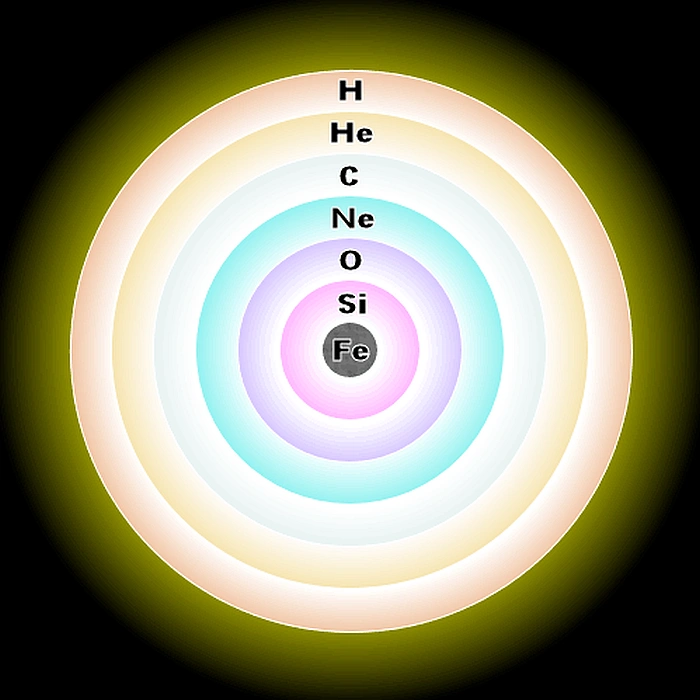
This diagram shows a simplified (and not to scale) cross-section of a massive, evolved star (with a mass greater than eight times the Sun.) Where the pressure and temperature permit, concentric shells of Hydrogen (H), Helium (He), Carbon (C), Neon/Magnesium (Ne), Oxygen (O) and Silicon (Si) plasma are burning inside the star. The resulting fusion by-products rain down upon the next lower layer, building up the shell below. As a result of Silicon fusion, an inert core of Iron (Fe) plasma is steadily building up at the center. Once this core reaches the Chandrasekhar mass, the iron can no longer sustain its own mass and it undergoes a collapse. This can result in a supernova explosion. Image credit: R. J. Hall (CC BY-SA 3.0)
Iron core
Iron is the final product of stellar fusion. The fusion of elements lighter than iron releases energy, which is what sustains a star and prevents the core from collapsing. However, by the time a star has fused silicon into iron, it runs out of fuel within days. To fuse iron, it would need an input of energy instead of releasing it.
The iron core begins to accumulate and eventually reaches the effective Chandrasekhar mass of at least 1.34 solar masses (for the least massive supergiants). At this point, the core can no longer support itself against gravity and it collapses.
Core collapse and supernovae
The collapse of the iron core happens very quickly. The inner core implodes within seconds and the outer core collapses inwards, reaching velocities of up to 23 percent of the speed of light.
The sudden compression results in a temperature increase to up to 100 billion kelvins in the inner core. At this temperature, gamma rays are produced that are energetic enough to break iron nuclei apart into helium nuclei and free neutrons through a process called photodisintegration, which accelerates the collapse.
As the core density increases further, protons and electrons merge via inverse beta decay to produce neutrons and electron neutrinos, releasing approximately 1046 joules in a 10-second burst. The neutrinos carry away enormous amounts of energy and help drive the subsequent explosion. The entire process occurs within milliseconds.
The collapse of the inner core is eventually halted by neutron degeneracy pressure and the strong nuclear force, which resist further compression at densities similar to those inside an atomic nucleus. As a result, the implosion rebounds outward as a shock wave.
The enormous energy of the shock wave accelerates the overlying material to escape velocity, triggering a supernova explosion.
Type II supernovae
When a red supergiant’s core collapses, it produces a Type II supernova. This class of supernova is characterized by the presence of hydrogen in its spectrum.
Type II supernovae can reach an absolute magnitude of approximately minus 18 and are capable of briefly outshining entire galaxies. They take a couple of weeks to a couple of months to peak. Most Type II supernovae are triggered by red supergiant progenitors.
Stars that have shed their hydrogen envelopes before exploding, such as Wolf-Rayet stars, produce Type Ib or Type Ic supernovae. These supernovae lack the hydrogen spectral lines characteristic of Type II events. In some cases, they are associated with long-duration gamma-ray bursts.
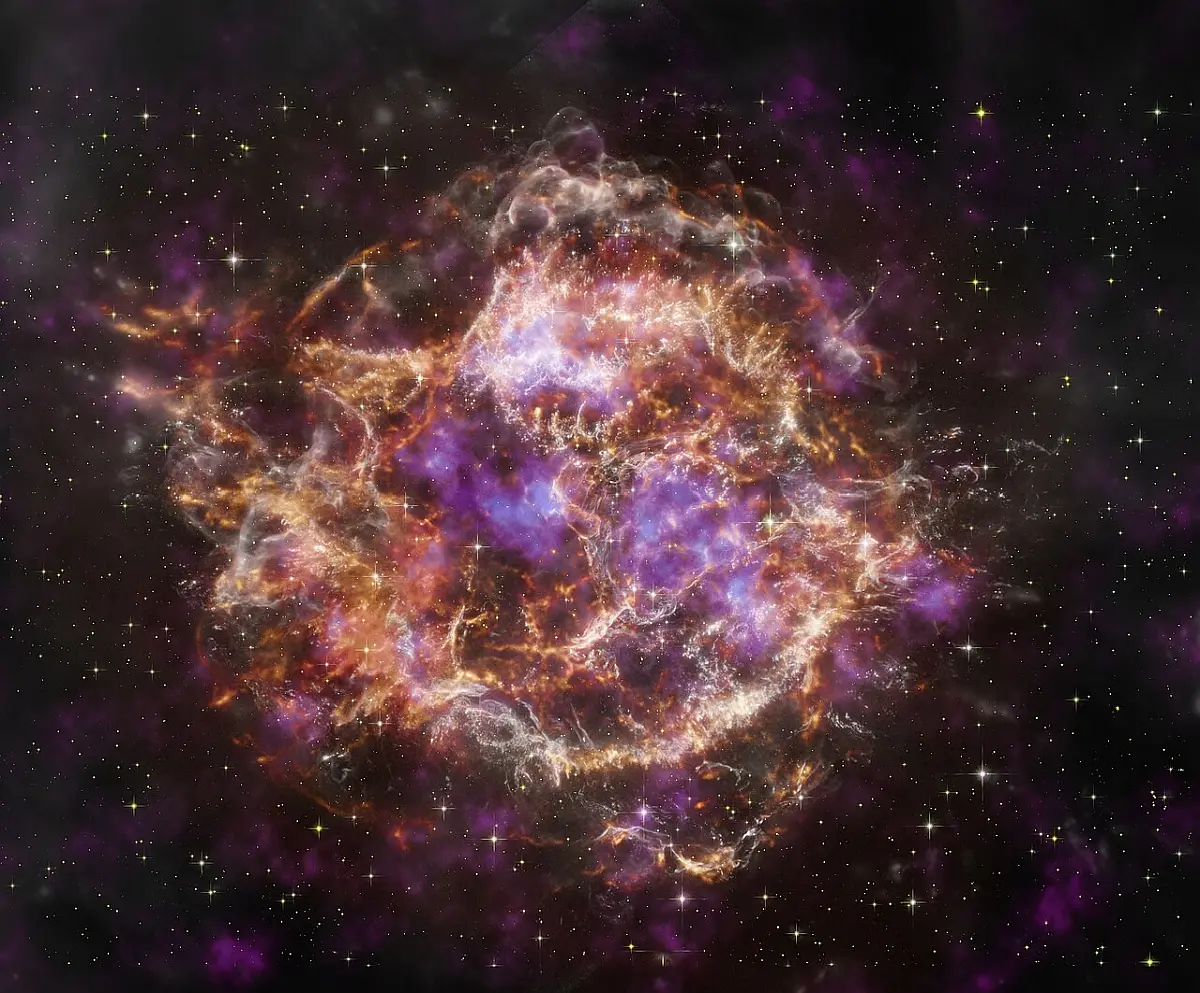
Cassiopeia A is a remnant of a Type IIb supernova that occurred 11,000 light-years away in the constellation Cassiopeia around 340 years ago (from Earth’s perspective). It spans approximately 10 light-years. Image credit: X-ray: NASA/CXC/SAO, NASA/JPL/Caltech/NuStar; Optical: NASA/STScI/HST; IR: NASA/STScI/JWST, NASA/JPL/CalTech/SST; Image Processing: NASA/CXC/SAO/J. Schmidt, N. Wolk, and K. Arcand (PD)
Supernova remnants
The material expelled by the supernova explosion forms a supernova remnant. The remnant is an expanding cloud of gas highly enriched in iron and other heavy elements produced by fusion in the star’s interior.
The shock wave from the supernova heats and compresses the surrounding interstellar medium, and the heavy elements become part of molecular clouds from which future generations of stars can form.
Elements heavier than iron, which cannot be produced by stellar fusion, are formed through neutron capture reactions during the supernova explosion itself.
This makes core-collapse supernovae the principal mechanism by which the universe is chemically enriched. The Big Bang produced only the lightest elements: hydrogen, helium, and trace amounts of lithium. All heavier elements have been produced gradually over billions of years through nuclear reactions inside stars. Each new generation of massive stars contributes to the enrichment of the interstellar medium.
The best-known supernova remnants in the sky include the Crab Nebula (Messier 1), Cassiopeia A, the Vela SNR, the Jellyfish Nebula (IC 443), the Veil Nebula, Tycho’s Supernova, Kepler’s Supernova, and SN 1987A.
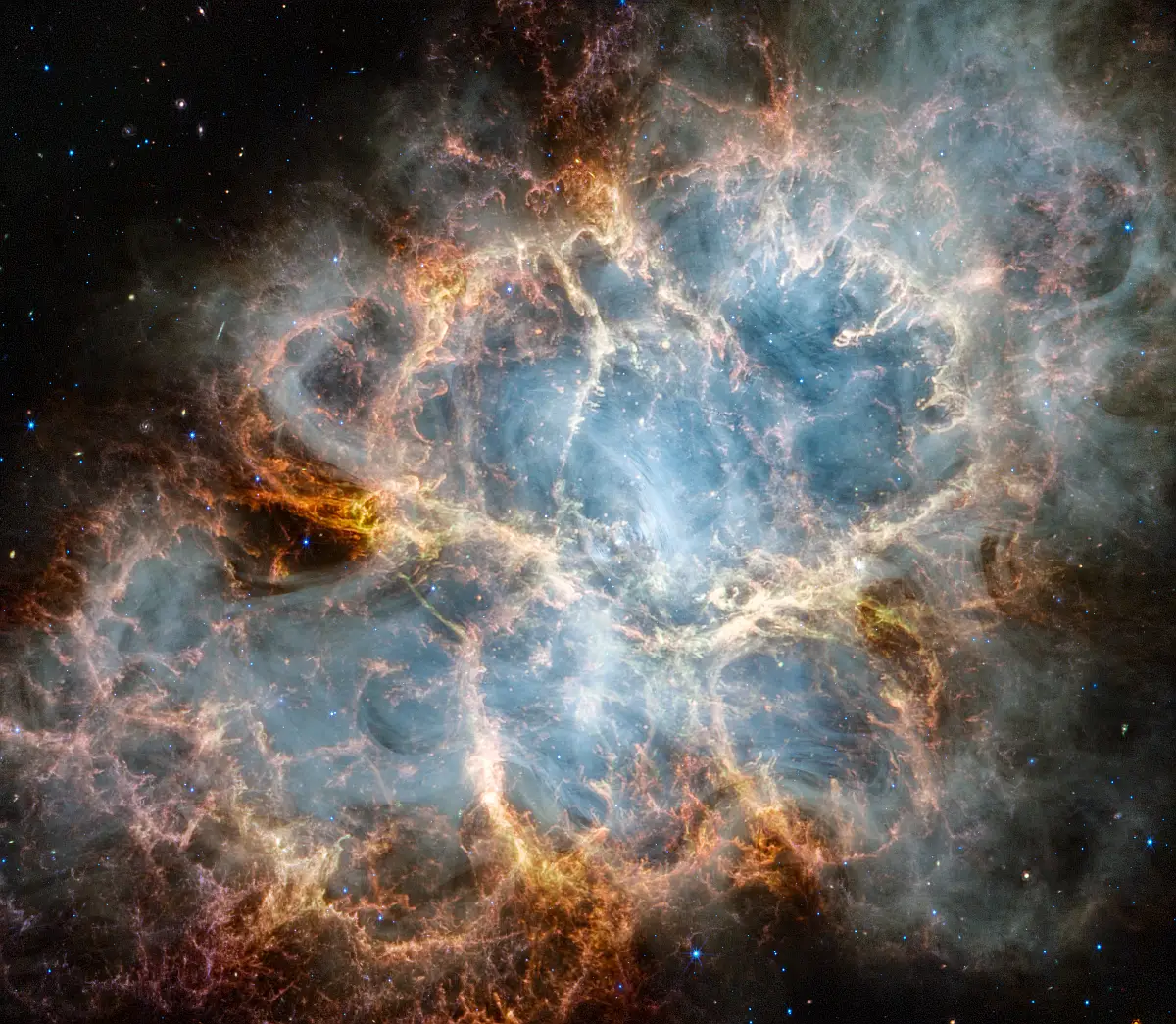
This is the Crab Nebula imaged using the James Webb Space Telescope in infrared via its NIRCam (Near-Infrared Camera) and MIRI (Mid-Infrared Instrument). The James Webb image may allow researchers to better understand the composition of the nebula, which could in turn enable better understanding of the supernova event that created it. Image credit: NASA, ESA, CSA, STScI, T. Temim (Princeton University) (CC BY 2.0)
Neutron stars
Neutron stars are the remnant cores of massive supergiants that ended their lives in supernovae. These gravitationally collapsed cores are the second densest and smallest stellar objects known, after black holes.
Neutron stars typically have masses of around 1.4 solar masses contained within a radius of only about 10 kilometres. A teaspoon of neutron star material would have a mass of around 5.5 trillion kilograms. The surface gravity of the remnant is approximately 100 billion times stronger than that of the Earth.
Neutron stars are born rotating rapidly, with rotation periods of 1.4 milliseconds to 30 seconds. The high rotation rate is a consequence of the conservation of angular momentum as the stellar core collapses from a radius of thousands of kilometres to roughly 10 kilometres.
Many neutron stars emit beams of electromagnetic radiation that sweep across space like a lighthouse. When these beams periodically pass Earth, the neutron star can be detected as a pulsar. Pulsars were first discovered in 1967, and the discovery provided the first observational evidence that neutron stars exist.
The Crab Pulsar, the best-known pulsar in the sky, is 20 kilometres across and has an estimated mass of 1.5 to 2.5 solar masses. It spins with a period of only 33.392 milliseconds. It is the remnant of the star that produced the Crab Nebula.
Black holes
Stellar black holes are remnants formed by the gravitational collapse of massive stars whose remnant cores exceed the mass that neutron degeneracy pressure can support. This limit is estimated to be 2-3 solar masses. These cores, left behind by supernovae, will continue to collapse and form a stellar-mass black hole.
Stars with initial masses of more than 8 to 10 solar masses undergo core-collapse supernovae that can produce either neutron stars or black holes. The final product depends on the initial mass of the star and on the details of the explosion.
Progenitor stars below about 20 solar masses are more likely to leave behind neutron stars, while higher-mass progenitors are more likely to produce black holes. However, the relationship between initial mass and remnant type is not straightforward and is still an object of research.
In some cases, particularly for very massive progenitors, a red supergiant may collapse directly into a black hole, without producing a bright flash. The progenitor’s core collapses completely and, becoming a black hole, it consumes the supernova in the early stages. These events are known as failed supernovae.
Properties of stellar-mass black holes
Stellar-mass black holes produced by core-collapse supernovae typically have masses ranging from roughly 5 to up to 100 solar masses. A black hole is a region of spacetime where gravity is so strong that nothing, including light, can escape once it has crossed the event horizon.
Stellar-mass black holes can be detected when they are in binary systems and are accreting material from a companion star. The accretion process heats the infalling material to temperatures high enough to produce X-ray emission detectable from Earth.
Role in chemical evolution of galaxies
Even though stars massive enough to go out as supernovae constitute only 0.12 percent of main sequence stars, they play a disproportionately large role in the chemical evolution of galaxies. Their brief, intense lives and dramatic ends have large-scale consequences for the gas and dust in the surrounding interstellar medium.
During their main sequence and supergiant phases, massive stars ionize the surrounding gas through their intense ultraviolet radiation, creating HII regions. These are clouds of ionized hydrogen where new stars form. The powerful stellar winds of massive blue stars drive shock waves into the surrounding medium, compressing gas clouds and potentially triggering new rounds of star formation.
When they explode as supernovae, massive stars enrich their environment with the products of nuclear fusion, including oxygen, silicon, and iron. This material eventually becomes part of new molecular clouds, from which future generations of stars are born. Stars formed from this enriched material have a higher abundance of metals, and some may host rocky planets built from these heavier elements.
Related articles: