Low-mass stars are the longest-lived stars in the universe. They are also the most common. Because they burn their fuel so slowly, their complete life cycles span timescales far greater than the current age of the universe (13.8 billion years). As a result, the complete life cycle of a low-mass star has never been directly observed. Astronomers can only use theoretical modelling to predict what happens to these stars in the later stages of their lives.
Low-mass stars behave differently from more massive stars. Their internal structure and lower temperatures change how nuclear fusion occurs and how the stars evolve over time.
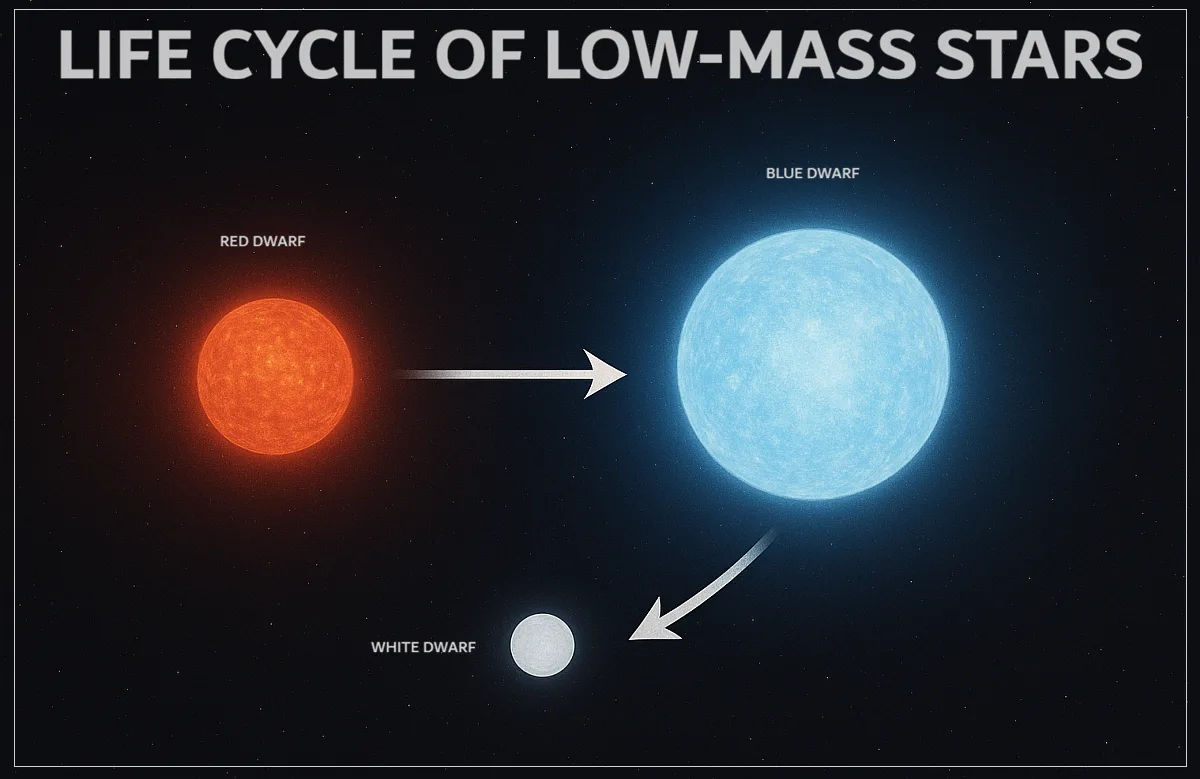
Evolution of low-mass stars
What is a low-mass star?
Low-mass stars are generally defined as stars with an initial mass of less than about 0.6 solar masses. However, different sources do not always set this boundary in the same place. These stars have relatively low pressures, a low rate of nuclear fusion, and low temperatures. They are faint red dwarfs like our neighbours Proxima Centauri, Barnard’s Star, and Wolf 359. Even the largest of these stars shine with up to 10 percent of the Sun’s luminosity.
Dwarf stars with more than 6 percent the mass of the Sun follow the evolutionary path of intermediate-mass stars and not the one described here.
Red dwarfs (M-type main sequence stars) are by far the most numerous stars in the universe. They make up over three quarters of all main sequence stars. They have masses in the range from 0.086 to 0.59 solar masses and effective temperatures between 2,380 and 3,850 kelvin.
The lifespan of a red dwarf is measured in trillions of years. The less massive the star, the longer it will stay on the main sequence. With a mass of 0.16 solar masses, Barnard’s Star is expected to stay on the main sequence for 2.5 trillion years, and the smaller Proxima Centauri (0.1221 M☉) for 4 trillion years. The even smaller Wolf 359 (0.110 M☉) will be a main sequence star for around 8 trillion years, and TRAPPIST-1 (0.0898 M☉) for 10 trillion years.
The exceptionally long lifespans make red dwarfs frequent objects of study for astronomers looking to gain new insights into stellar evolution. They are also objects of interest in the search for potentially habitable planets outside our solar system. Their long lives make them well suited to host planets where chemistry can become more complex over time.
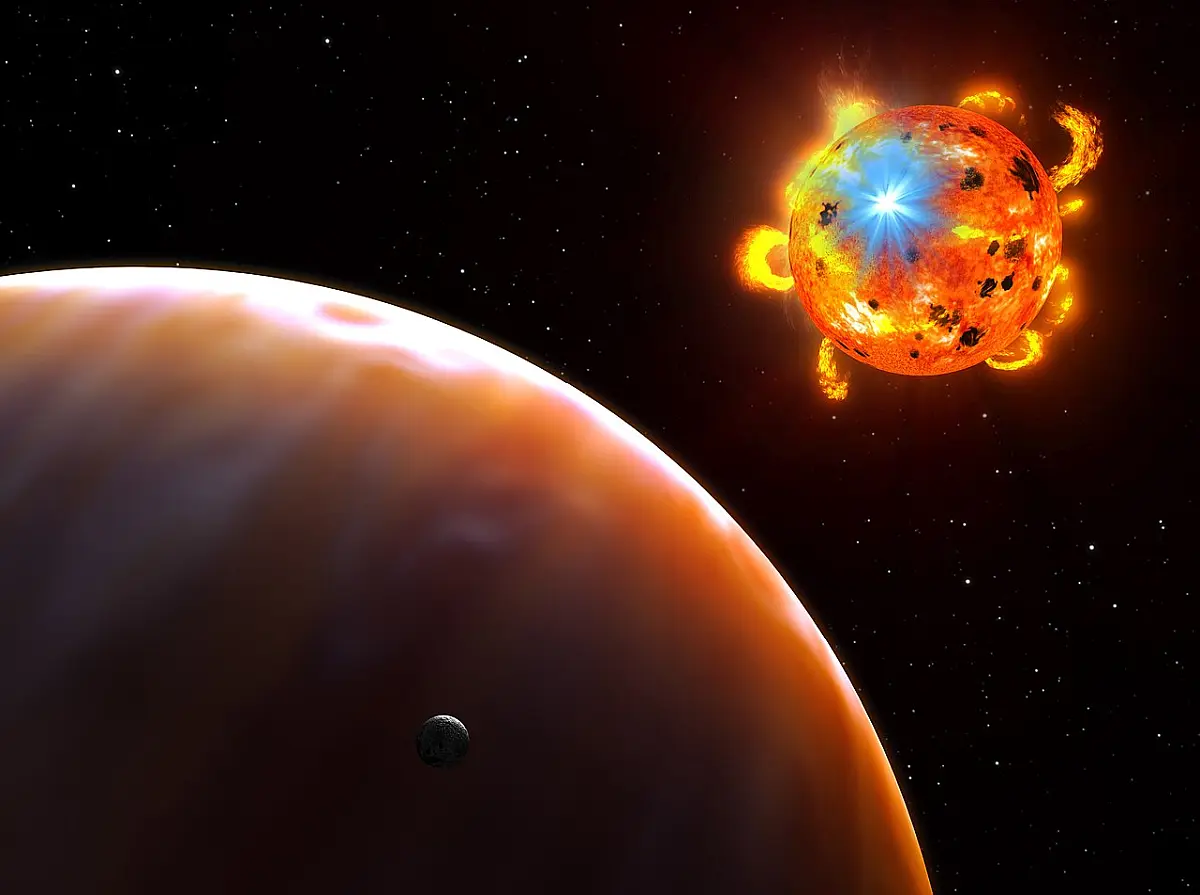
A deep survey of more than 200,000 stars in our Milky Way galaxy has unveiled the sometimes petulant behavior of tiny red dwarf stars. These stars, which are smaller than the Sun, can unleash powerful eruptions called flares. Red dwarfs are the most abundant stars in our universe and are presumably hosts to numerous planets. However, their erratic behavior could make life unpleasant, if not impossible, for many alien worlds. Flares are sudden eruptions of heated plasma that occur when powerful magnetic field lines in a star’s atmosphere “reconnect,” snapping like a rubber band and releasing vast amounts of energy. When they occur, flares would blast any planets orbiting the star with ultraviolet light, bursts of X-rays, and a gush of charged particles called a stellar wind. Image credit: NASA Goddard Space Flight Center from Greenbelt, MD, USA (CC BY 2.0)
Structure and convection
The long life cycle of low-mass stars is determined both by mass and structure. Stars with a mass less than 0.35 solar masses are fully convective. This means that energy is transported throughout the entire star by convection (mass movement of plasma) and not by radiation alone. In more massive stars, convection is limited to specific zones, while the rest of the star is radiative.
Consequences of full convection
Like all stars, red dwarfs spend most of their lives fusing hydrogen into helium in their cores. However, full convection has major consequences on how these stars age.
In stars like the Sun, hydrogen fusion results in the core of the star becoming increasingly enriched in helium, while the outer layers stay hydrogen-rich. This separation eventually leads to the development of a hydrogen-burning shell around a helium core, which causes the star to expand into a red giant.
In fully convective low-mass stars like Proxima, helium does not accumulate in the core, and material is continuously mixed throughout the whole stellar interior. Hydrogen from the star’s outer layers is transported inward to the core, and the helium produced in the core is distributed outward. As a result, these stars do not develop degenerate helium cores with a hydrogen-burning shell.
For this reason, a low-mass star does not undergo a helium flash, never reaches the red giant phase in its old age, and does not produce a planetary nebula at the end of its life.
Low-mass star evolution
Low-mass stars share a similar beginning with more massive stars but follow a different evolutionary path in the later stages of their life cycle because of their structure and lower mass.
Unlike intermediate-mass stars, they do not reach temperatures high enough to start fusing helium and they do not expand into red giants. Instead, they slowly fuse most of their hydrogen into helium while remaining small.
Formation and early development
Low-mass stars form in the same way as other stars. They begin their lives in denser regions of molecular clouds if forces of gravity are strong enough to cause the interstellar gas cloud to fragment and collapse.
Once a protostellar core forms in the collapsed fragment, it begins to accumulate material from its birth cloud until it has enough mass for the core temperature to rise enough to ignite the fusion of hydrogen. Hydrogen fusion marks the beginning of the young star’s main sequence lifetime.
However, before they become fully fledged stars, protostars pass through the pre-main sequence stage. Pre-main sequence stars are young stellar objects that have accumulated most of their mass and are in the process of contracting to the main sequence.
Pre-main sequence stars with a mass of less than 2 solar masses are known as T Tauri stars. These stars are fuelled by gravitational energy and take around 100 million years to reach the main sequence. As they contract, the temperature in their interior rises until it can trigger hydrogen fusion on the zero-age main sequence (ZAMS).
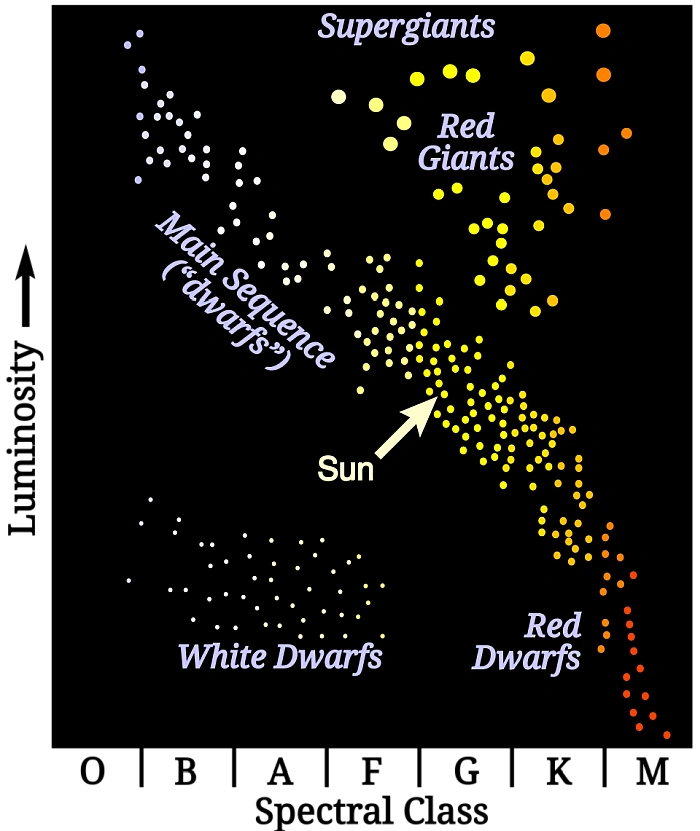
This is an example of a Hertzsprung–Russell diagram; a plot of luminosity versus spectral class for a group of stars. The diagonal band labelled “main sequence” is where dwarf stars such as the Sun spend most of their active lifespan. Red giants and supergiants are evolved stars with a mass greater than a red dwarf, that are burning elements heavier than hydrogen. However, white dwarfs are quite dense, non-luminous, but are still less in mass than supergiants. Once this supply of fuel is exhausted, these stars will migrate to the lower left on this diagram, becoming white dwarfs. Image credit: Wikimedia Commons/Rursus (CC BY-SA 3.0)
Hydrogen fusion and main sequence lifetime
Low-mass stars are powered by hydrogen fusion, much like the Sun and any other main sequence star. However, because of their lower masses and gravitational pressures, they burn fuel at a much more modest rate. The slower rate of nuclear fusion means that they consume their fuel far more efficiently over time, which is what gives them their extraordinary longevity.
Trillions of years on the main sequence
The smallest stars that are massive enough to fuse hydrogen can stay on the main sequence for trillions of years. Modelling shows that main sequence stars with a mass of about 10 percent that of the Sun can keep burning hydrogen for 6 to 12 trillion years. Because the universe is only 13.8 billion years old, no red dwarf this small has had enough time to burn through its hydrogen supply.
Even low-mass stars with masses closer to the boundary of 0.6 solar masses can spend over a hundred billion years on the main sequence. This puts their eventual fate well beyond any possibility of observation.
Absence of helium fusion and the red giant phase
Stars with an initial mass of less than 0.6 solar masses do not become hot enough to start fusing helium. They do not produce enough gravitational pressure to trigger helium fusion. This is what sets them apart from intermediate and high-mass stars, whose later stages of evolution are defined by the nuclear fusion of helium into heavier elements such as carbon and oxygen.
For low-mass stars, the red giant phase is skipped entirely. Because they are fully convective, these stars can continue fusing hydrogen into helium until they are composed almost entirely of helium. As the level of helium increases, the stars stop being fully convective. Ultimately, when they have no more hydrogen to fuse and cannot trigger helium fusion, they can no longer sustain themselves through nuclear burning.
Blue dwarfs
Low-mass stars are not believed to evolve directly from red dwarfs into white dwarfs. Modelling suggests that, once they have burned through most of their hydrogen supply, they increase in luminosity and become hotter and bluer compared to their earlier red dwarf stage.
The blue dwarf stage is a hypothetical evolutionary class that marks the final transition between the main sequence and the stellar remnant (white dwarf) stages. As red dwarfs age, they create a power excess and eventually have to get bigger and brighter like other stars.
Astronomers believe that blue dwarfs will not necessarily be blue in colour. Simulations show that they may reach a surface temperature of around 8,600 K and present as A-type stars.
This phase may last for several hundred billion years before the star eventually fades.
White Dwarfs
Like their intermediate-mass counterparts, red dwarfs eventually evolve into white dwarfs once fusion processes have ceased in their cores. A white dwarf is a dense stellar remnant that slowly radiates away its remaining heat over an immensely long period.
A white dwarf produced by a very low-mass star would be composed primarily of helium, while more massive stars typically produce carbon-oxygen white dwarfs.
After trillions of years, the stellar remnant cools sufficiently to become invisible and no longer emit any light or heat.
The late stages of low-mass star evolution, including the blue dwarf phase, the final exhaustion of hydrogen, and the transition to a white dwarf, are understood only through theoretical models. These models are based on well-established physics, but they are predictions rather than confirmed observations.
Black dwarfs
White dwarfs that have cooled enough to no longer emit any energy or light are known as black dwarfs in theoretical astrophysics. Like blue dwarfs, these remnants have never been detected because the universe is too young for them to exist. Even if they did exist, these cold, dark remnants would be very difficult to find because they would not emit enough radiation to be detectable, except possibly through their gravitational influence. Representing the final, hypothetical stage in the evolution of low and intermediate-mass stars, black dwarfs are expected to take trillions of years to form.
In this way, the evolution of low-mass stars highlights both the remarkable longevity of stellar processes and the limits imposed by the current age of the universe. From their slow-burning lifetimes to their still-theoretical remnants, these stars offer a glimpse into a future, very different universe that remains far beyond our ability to observe directly.
Related articles: